



What Is a Balanced Dog Trainer? Compare Methods and Tools
A balanced dog trainer teaches desired behavior with rewards and may also use corrections to address unwanted behavior. The approach isn’t defined by one tool. It depends on how the trainer teaches, communicates, and chooses methods for each dog. I’m Alan Carr, and in this article I compare balanced...

A balanced dog trainer teaches desired behavior with rewards and may also use corrections to address unwanted behavior. The approach isn’t defined by one tool. It depends on how the trainer teaches, communicates, and chooses methods for each dog. I’m Alan Carr, and in this article I compare balanced training with reward-based training and explain how we approach it at AK9A Alan’s K9 Academy.
Wanting clear guidance while protecting your dog’s trust and well-being is reasonable. Below, I cover how the methods compare, what published research says, how LIMA’s least-intrusive principle fits in, and why tools should be considered in context. For a look at our approach, visit AK9A Alan’s K9 Academy.
Key Takeaways
• Balanced training combines rewards with corrections; reward-based training uses rewards and redirection only.
• Two published studies looked at training method and welfare or outcomes, and both have limits worth knowing.
• LIMA favors the least intrusive, minimally aversive approach that can meet the training goal.
• Tools never replace instruction, clear communication, or a professional assessment.
• No single method is right for every dog. Your dog’s needs and response should guide the plan.
What Is Balanced Training?
Balanced training combines rewards for desired behavior with methods intended to reduce unwanted behavior. Reward-based training relies on rewards and redirection alone. The two approaches share a goal, which is a dog that understands what is being asked. They differ in how they respond when the dog gets it wrong.
Reward-Based Techniques
Rewards make a behavior more likely by adding something the dog values after the behavior. As a hypothetical example, a trainer may reward a dog for sitting calmly instead of jumping. This builds behavior through a favorable consequence, and the dog learns what to do rather than only what to avoid.
Aversive Corrections
A correction introduces an unfavorable consequence to reduce a behavior, such as pulling toward a distraction. Welfare is the main question researchers ask about this approach, and I cover two studies below. Corrections work best when the dog already understands what is being asked.
Balanced and Force-Free Approaches
The American Veterinary Society of Animal Behavior says reward-based methods offer the most advantages and least harm to welfare. Balanced trainers see a role for corrections in some cases. Outcomes and welfare both matter when you compare approaches. You can read the AVSAB position statement on humane dog training for the full wording.
| Approach | Rewards | Corrections |
|---|---|---|
| Reward-based | Teach desired behavior | Not used |
| Balanced | Teach desired behavior | May be used |
Choose by looking at your dog’s temperament, your goals, and how the trainer explains each step.
What Does the Research Say?
Two studies are often cited. Vieira de Castro et al. (2020), “Does training method matter?”, studied dogs in training schools. It associated aversive-based training with poorer welfare indicators, including more stress-related behavior, than reward-based training. It shows an association in the dogs studied, not what happens with every trainer or dog.
China, Mills and Cooper (2020), “Efficacy of Dog Training With and Without Remote Electronic Collars vs. a Focus on Positive Reinforcement,” compared groups trained for recall and related behaviors. All groups reached successful outcomes, with advantages for the reward-focused group on several measures. Both studies have limits, including specific dog populations, specific tasks, and study designs. Neither evaluated AK9A Alan’s K9 Academy, and neither shows that every trainer gets identical results. This is published research, separate from our own stated approach.
Laws, Credentials, and Questions to Ask
Tool rules can vary by state or locality, and legality is separate from effectiveness. There is also no single shared credential for balanced trainers. Before hiring, ask what behavior the plan targets, what earns a reward, when corrections are used, and how the trainer responds to signs of distress.
Trainer Qualifications and Evaluation
There isn’t one credential that establishes a trainer’s fit for every dog. Focus on practical qualifications: relevant experience, a clear explanation of training methods, and a plan tailored to your dog’s behavior. Ask how the trainer teaches a new cue, decides whether a correction is appropriate, and responds if the dog shows discomfort. Specific answers help you assess their judgment and communication.
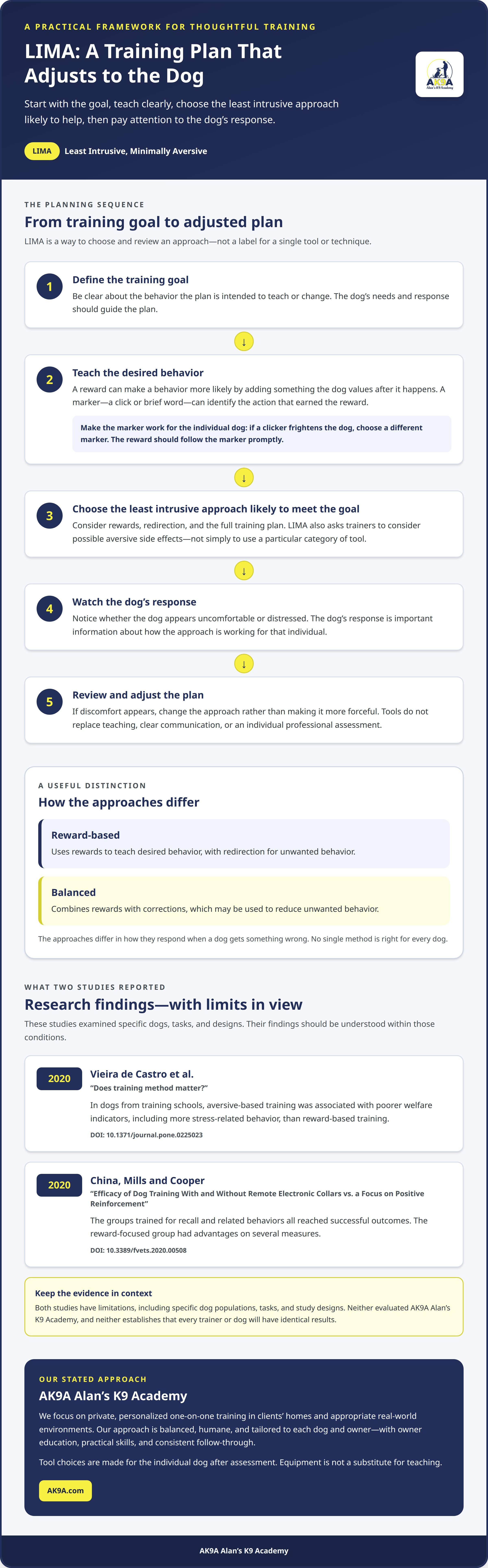
Positive reinforcement principles and LIMA
Positive reinforcement makes a behavior more likely by adding something the dog values after it happens. In a hypothetical case, a treat after a calm greeting can reinforce keeping four paws on the floor. Positive punishment has a different meaning: it reduces a behavior by introducing an unfavorable consequence. “Positive” means adding something, not that the consequence feels pleasant.
Positive-only training uses rewards to teach desired behavior, then ignores or redirects unwanted behavior. It can suit puppies learning basic commands, fearful dogs, or food-motivated pets. Complex behavior challenges may take more time and consistency when rewards or redirection alone don’t change the pattern.
LIMA stands for least intrusive, minimally aversive. It means choosing the least intrusive technique likely to meet the training goal while minimizing risks from aversive side effects. LIMA isn’t simply another label for using rewards; it also guides trainers away from tools or techniques that scare or hurt a dog. The trainer monitors the dog’s response and changes the plan if discomfort appears.
Timing helps make rewards meaningful. A marker, such as a click or a brief word, tells the dog which action earned the reward, and the reward should follow promptly. A clicker may frighten an individual dog. If that happens, choose a different marker.
For a plan shaped around your dog’s responses and home routines, see our private in-home training. LIMA offers a framework for responding thoughtfully when progress stalls.
Training tools such as prong collars and e-collars
Balanced trainers may combine rewards with equipment that applies pressure or interrupts behavior. A tool’s role depends on the training goal, the dog’s response, and how it is introduced.
Tools Used by Balanced Trainers
General industry sources list prong collars, e-collars, and slip leads among the tools some balanced trainers use. Unlike a treat pouch or clicker, these can deliver or signal an aversive consequence. This is industry information, not a description of what every trainer does. At AK9A Alan’s K9 Academy, tool choices are made for each individual dog after assessment, and tools never stand in for teaching.
A tool is not a training plan. Timing, teaching, and the dog’s understanding matter more than equipment.
Risks of Aversive Tools
Aversive methods and pain-based tools may cause distress for some dogs, as the welfare research above suggests. If a dog shows distress, the approach needs to change, not become more forceful.
Tool choice should match the dog and the training objective. Tools such as e-collars and prong collars are not something to try on your own. Fit, timing, and your dog’s temperament call for a professional assessment and individualized guidance, so I don’t offer step-by-step instructions here.
AK9A Alan’s K9 Academy
Every dog and household is different. This article provides general education and does not replace an individualized training assessment. For aggression, bite risks, or serious behavioral concerns, seek professional guidance before attempting training exercises.
AK9A Alan’s K9 Academy was founded in 2021, and I bring 35+ years of professional dog-training experience to our work. We use a balanced, customized approach that combines positive reinforcement, clear communication, structure, and appropriate tools based on each dog’s temperament and needs. We focus on teaching desired behaviors and educating owners, so you understand what your dog is learning and how to continue it.
Our private, personalized in-home training begins with an assessment, then moves into real-world environments such as parks, neighborhoods, and pet-friendly stores as your dog progresses. For serious concerns like aggression, anxiety, or reactivity, see our behavior modification program. Our services include puppy training, obedience, off-leash training, behavior modification, therapy dog training, and service dog training.
We also offer free monthly alumni group classes or pack walks for graduates of our training programs. This is an exclusive benefit for graduates of our training programs, not a group class service open to the general public.
Choose a Training Path That Fits Your Dog
I’d like to hear about your dog. Tell us what you’re seeing and what you hope to change, and we’ll schedule an individualized assessment to recommend a plan that fits your dog and your household.
Get Help With Your Dog’s Training
Frequently Asked Questions
Which Dogs Benefit From Each Method?
Reward-based training can suit puppies learning basic cues, fearful dogs, and food-motivated pets. Balanced methods may be considered for challenges such as reactivity, with attention to the welfare considerations above. We serve North Metro Atlanta and Northwest Georgia. A dog’s behavior and response are the key considerations.
What does “balanced dog trainer” mean?
It means a trainer who teaches with rewards and may also use corrections to address unwanted behavior, based on the individual dog.
What Training Methods and Tools Do Balanced Dog Trainers Use?
Balanced trainers may combine praise, treats, and verbal cues with tools such as a leash, slip lead, prong collar, or e-collar. The choice should relate to the behavior being taught and the dog’s response, not simply the trainer’s preferred equipment. As a hypothetical example, a recall lesson needs clear cue teaching and practice, while a leash-walking lesson focuses on the dog’s movement beside the handler. Tools don’t replace that teaching.
Article by
Alan Carr
Alan Carr is the founder of AK9A Alan’s K9 Academy, a military veteran, and a former police K9 handler and trainer with more than 35 years of professional dog-training experience. He specializes in personalized in-home training, puppy development, obedience, off-leash reliability, and behavior modification. His approach emphasizes clear communication, humane balanced training, and helping owners build lasting relationships with their dogs. AK9A serves North Metro Atlanta and Northwest Georgia. Learn more at AK9A.com.