%20(620%20x%20150%20px)%20(14).webp)
%20(620%20x%20150%20px)%20(15).webp)
.webp)
_page-0001.webp)
.webp)
Training Difficult Dogs: A Guide to Lasting Progress
What if your dog isn’t being stubborn, but is reacting to fear, stress, or a situation they haven’t learned to handle? Barking, lunging, snapping, or ignoring familiar cues can make everyday life feel unpredictable. If generic tips haven’t helped, it makes sense to ask whether dog training for diffi...
%20(5).gif)
What if your dog isn’t being stubborn, but is reacting to fear, stress, or a situation they haven’t learned to handle? Barking, lunging, snapping, or ignoring familiar cues can make everyday life feel unpredictable. If generic tips haven’t helped, it makes sense to ask whether dog training for difficult dogs can make a real difference.
Challenging behavior can be exhausting, but it doesn’t mean your dog is beyond help or that you’ve failed. Progress starts with understanding what may be driving the behavior, recognizing safety needs, and choosing an approach that fits your dog and household. A one-size-fits-all solution may miss what’s happening beneath the surface.
This guide explains how to notice potential triggers, manage everyday situations more safely while you seek help, and decide when individualized professional support may be useful. You’ll also find practical ways to prepare for a training conversation and build clearer communication with your dog.
Key Takeaways
• Track what happens before, during, and after challenging episodes to spot patterns and possible triggers.
• Consider how environment, past learning, daily needs, and health may shape your dog’s behavior.
• Compare training options by fit, safety planning, relevant experience, and how they involve you in the process.
• Dog training for difficult dogs should match your dog’s specific needs. Distance, barriers, and predictable routines can help reduce avoidable risks while you seek support.
• Personalized in-home training, behavior modification, and group classes from Alan’s K9 Academy may suit different goals in Cartersville, Bartow County, and North Atlanta.
Dog Training for Difficult Dogs Starts with Understanding the Challenge
When walks become a tug-of-war, visitors feel like a risk, or you’re constantly watching for the next outburst, caring for your dog can feel exhausting and isolating. You may love your dog deeply and still feel unsure what to do. Dog training for difficult dogs starts with treating behavior as information, not proof that your dog is bad, stubborn, or beyond help.
“Difficult” describes the challenge a household is facing, not a permanent identity. A dog who pulls toward other dogs, barks at the window, has poor recall, or struggles to settle may need help with different skills and situations. The same behavior can have different causes. Barking, for example, might reflect excitement, fear, frustration, or a learned response. The visible action alone doesn’t explain what your dog needs.
What does “difficult dog” mean in everyday life?
Separate the behavior you observe from the explanation you might be tempted to assign. An obedience gap may mean your dog hasn’t learned a cue reliably in a distracting setting. A fear-related response may appear when your dog feels unsafe. Reactivity describes a strong response to a particular trigger, not its cause. A noticeable behavior change deserves attention rather than a quick label. A general overview of dog training explains how different teaching approaches shape behavior, but your dog’s individual context still matters.
Look for the pattern: where the behavior happens, what’s nearby, and whether it’s new or longstanding. For example, note whether your dog barks at every passerby or only when someone approaches the home. These details help you describe the concern clearly without assuming a diagnosis.
When behavior needs more than a basic obedience class
A group class can be useful for practicing skills, but repeated, intense, or highly context-specific behavior may make ordinary routines difficult or unsafe. If your dog can’t settle around other dogs, reacts strongly to people approaching, or struggles in the very setting where a class takes place, individualized guidance may be a better starting point. A private setting can give a trainer room to learn about your household, observe relevant triggers, and include you in a practical plan.
Progress isn’t one-size-fits-all. Health, learning history, environment, consistency, and your dog’s needs can influence what’s realistic and which steps are appropriate. A trainer can provide guidance on training and behavior, but can’t replace a veterinarian’s assessment or diagnose a medical or behavioral condition. If behavior is new, worsening, or raises health concerns, consult a veterinarian. Clear observations and the right kind of support give you a more useful place to begin.
Why Difficult Dog Behavior Happens and What to Observe First
A barking or lunging episode is one moment in a larger pattern. The setting, what happened just before, and how your dog recovered afterward can all affect what that moment means. Environment, learning history, daily needs, and health may influence behavior, so an accurate picture is more useful than settling on a label too quickly.
Context matters more than a single behavior label because it helps reveal what your dog is responding to and what support may fit. For dog training for difficult dogs, that context can guide safer, more individualized decisions. Start keeping brief, factual notes rather than trying to interpret every incident as it happens.
Which behavior patterns should owners track?
After an episode, write down what you observed. Include the trigger, distance, location, people or animals present, and how long it took your dog to settle. Note whether the behavior happens during walks, when visitors arrive, around meals, or at another point in the home routine. Patterns across situations may be more informative than one dramatic event.
Before
What was happening? For example, another dog came into view across the street.
During
What did your dog do, and for how long? Record observable actions, such as barking, pulling, hiding, or pacing.
After
What changed, and how quickly did your dog recover? Note whether more distance, a quiet space, or a change in routine helped.
Use plain descriptions. “Growled when a visitor reached toward the bed” gives a trainer something specific to consider. “Was manipulative” or “acted out of spite” assumes a motive that can’t be confirmed from the behavior alone. You might also note changes in routine, sleep, appetite, activity, or surroundings if they seem relevant.
When should a veterinarian be part of the plan?
If behavior changes suddenly, seems unusual for your dog, or coincides with signs of possible discomfort, contact your veterinarian before assuming the cause is a training issue. Health concerns require veterinary assessment. A trainer can offer guidance on learning and behavior, but can’t diagnose a medical condition or replace veterinary care.
Your notes can help both professionals understand the same pattern. Share them with your veterinarian and, when appropriate, your trainer. If you’re in Cartersville, Bartow County, or North Atlanta, you can also explore personalized dog training guidance and ask whether service is available in your city. A clear record gives those conversations a practical starting point.
How to Compare Training Options for a Difficult Dog
The right format depends on what your dog needs to learn, where the difficulty occurs, and how safely you can practice. Self-guided work may suit familiar skills you can practice consistently. A group class offers structured practice around distractions. For behavior tied to household routines or a more complex pattern, individualized professional support may be a better starting point. No single approach fits every dog.
| Option | Setting and attention | May fit when |
|---|---|---|
| Self-guided practice | At home; owner-led | You’re working on familiar skills and can practice safely and consistently. |
| Group class | Shared setting; trainer guides the group | Your dog can participate comfortably while learning around other people and dogs. |
| Individual support | Tailored to your dog and household | The challenge is specific, disruptive, or difficult to address in a group. |
When are private lessons or behavior modification a better fit?
If the challenge happens around your front door, during family routines, or in another specific part of daily life, in-home coaching can address the setting where it occurs. Behavior modification focuses on the behavior pattern and practical goals, while ordinary command practice may center on cues such as sit or come. For more background, explore this behavioral training guide.
Ask how the trainer adapts their approach to the dog rather than assuming one method works for every case. Humane, balanced guidance should take the dog’s needs and safety into account. Cornell’s veterinary behavior service provides context on the medical side of complex behavior. Cornell University's Behavior Medicine Service describes veterinary care for behavioral concerns. Training support and veterinary assessment have distinct roles.
What should owners ask a prospective dog trainer?
A useful conversation should make the plan understandable, not leave you guessing. Ask how the trainer evaluates your dog, household routines, goals, and safety considerations. Find out how you’ll participate, what you’ll practice between sessions, and how progress will be reviewed. Also ask what methods are used, how the plan may change if your dog struggles, and when veterinary input may be appropriate.
Notice whether the trainer listens carefully and explains recommendations in language you can use at home. For dog training for difficult dogs, owner involvement matters. The goal is not simply to practice during a session, but to build skills and communication that make sense in everyday life.
Safe First Steps Owners Can Take While Seeking Training Help
You don’t need to wait for a formal training plan to make daily life more predictable. Focus on management, not testing your dog. The goal is to reduce situations that could lead to another difficult episode while keeping people and animals safe. These steps can support dog training for difficult dogs, but they aren’t a substitute for professional guidance when behavior feels hard to manage.
How can owners make daily situations safer?
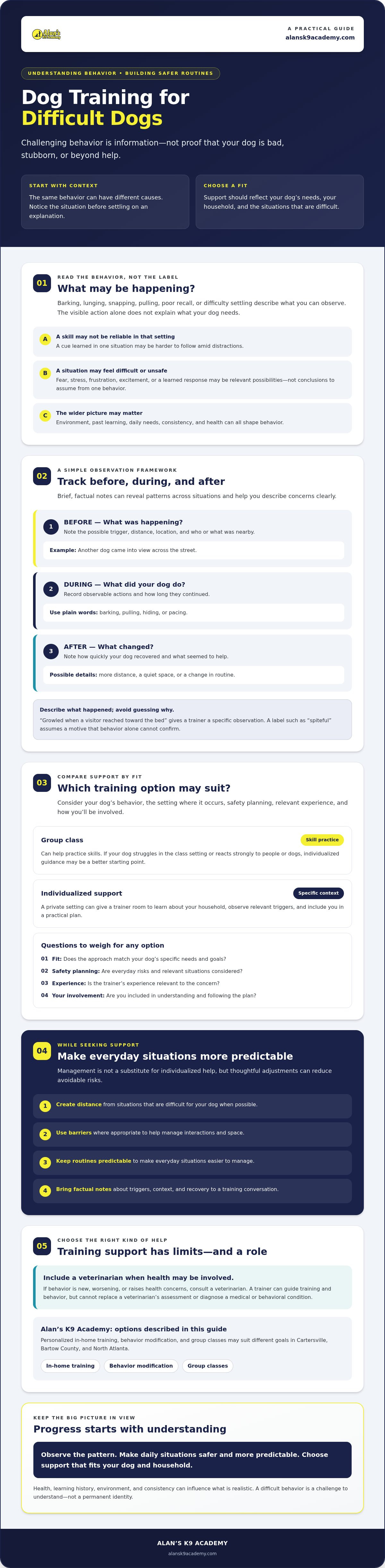
Use this practical sequence as a starting point, adjusting it to what you can safely control:
Create distance from known triggers.
On walks, cross the street or choose a quieter route if you see a situation your dog struggles with. Don’t move closer to see how your dog reacts.
Use barriers at home.
A closed door, secure gate, or separate room can help prevent unwanted contact with visitors, children, or other animals. Make sure everyone in the household understands the plan.
Make routines more predictable.
Decide where your dog waits when the door opens, how you’ll manage busy areas, and which route gives you room to respond calmly. Reduce pressure rather than forcing your dog to stay in a situation they can’t handle.
Avoid punishment and forced exposure.
Scolding, deliberately provoking a reaction, or increasing the challenge to “get your dog used to it” can add risk. Don’t place children or other animals in situations you can’t reliably control.
If you can’t confidently prevent contact or keep people and animals safe, stop trying to manage the situation alone and seek qualified professional input. For sudden behavior changes or suspected discomfort, contact your veterinarian as well. A trainer can help with training and management, but doesn’t replace veterinary assessment.
How can owners prepare for a useful training assessment?
Bring concise notes about what happens, where it occurs, who or what is present, and how your dog responds afterward. Add relevant history, household routines, and the goals that matter most to your family. Be open about what you’ve already tried and what happened next, including approaches that seemed to increase stress or didn’t help. That information lets a professional consider your dog’s real-life needs rather than relying on assumptions.
For a closer look at how guidance can be tailored to your home, read this professional in-home training guide. If you’re ready to discuss in-home training or behavior modification, contact Alan’s K9 Academy about training support.
Finding Personalized Dog Training for Difficult Dogs in North Atlanta
Once you’ve identified the situations your dog struggles with, look for support that connects those challenges to realistic goals at home. A useful plan considers more than a single behavior. It should account for your dog, your household routines, and what you want daily life to look like, while recognizing that progress may take different forms for different dogs.
What does personalized support from Alan’s K9 Academy involve?
Alan’s K9 Academy offers in-home dog training, behavior modification, and structured group classes. In-home support can focus on practical concerns in your home environment, while group classes provide a different setting for structured learning. The appropriate option depends on your dog’s needs and whether the setting is comfortable and suitable for the work.
Training involves the owner as well as the dog. A hands-on approach can help you understand what to practice, how to respond consistently, and how to make training relevant to your household’s goals. Founded by Master K9 Trainer Alan Carr, the academy draws on his more than 35 years of professional dog instruction experience. Its approach is balanced and humane, with an emphasis on lasting communication between dogs and owners. It does not promise that every behavior will change in the same way or on the same schedule.
If you want to learn more about support for challenging behavior, read the dog behavior modification guide. It can help you consider how behavior-focused guidance may relate to your dog’s specific needs.
How can local owners take the next step?
Alan’s K9 Academy serves Cartersville, Bartow County, and North Atlanta. Coverage may depend on your specific location, so confirm directly whether service is available in your city and which training option may suit your situation.
You don’t need to have every answer before asking for guidance. Be ready to explain your main concern, where you live, what you’ve observed, and what change would make everyday life easier. That gives the conversation a practical starting point and helps clarify whether in-home training, behavior modification, or a group class may be appropriate.
If you’re looking into dog training for difficult dogs, reach out to discuss your dog’s training needs. A straightforward conversation can help you understand possible next steps without assuming one plan fits every dog.
Take the Next Step Toward Better Communication
Lasting progress begins with understanding what may be behind your dog’s behavior, noticing patterns, and choosing support that fits your household. Safe management can reduce pressure while you decide what to do next. An individualized plan can turn broad concerns into practical goals.
Dog training for difficult dogs isn’t about labeling your companion or expecting one approach to work for every challenge. It’s about building clearer communication, one realistic step at a time, with support that includes you as well as your dog.
Alan’s K9 Academy offers personalized in-home training and behavior modification in Cartersville, Bartow County, and North Atlanta. Master K9 Trainer Alan Carr brings over 35 years of professional dog instruction experience. Confirm directly whether service is available in your city and which option may fit your dog’s needs.
Talk with Alan’s K9 Academy about your dog’s training needs. Start with a conversation about what you’re seeing and what you’d like to change.
Frequently Asked Questions
Can difficult dogs really be trained?
Many dogs can learn useful skills and make progress when their needs, environment, and learning history guide the plan. Dog training for difficult dogs isn’t usually a quick fix, and outcomes vary from one dog to another. Start by observing behavior patterns and managing situations safely. If challenges persist, seek help from a trainer who explains their approach and involves you. Discuss sudden behavior changes or possible discomfort with a veterinarian.
What is the best training method for a difficult dog?
There’s no single training method that suits every dog or situation. Look for a professional who evaluates your dog as an individual, explains the plan clearly, considers safety, and gives you an active role. Ask how progress will be assessed and how the approach can be adjusted if your dog struggles. Be cautious of promises of instant results or advice to force your dog into situations that seem overwhelming.
When should I hire a professional dog trainer for difficult behavior?
Consider professional guidance when behavior repeatedly disrupts daily routines, creates safety concerns, or doesn’t improve with basic practice. A trainer can consider your dog’s behavior in context and help you build practical skills. Ask how you’ll participate and what to practice at home. If behavior changes suddenly or your dog may be in pain, contact a veterinarian too. Training support doesn’t replace veterinary assessment or diagnosis.
Can an in-home trainer help with a dog that behaves differently at home?
In-home training may help when challenges are connected to household routines, visitors, doorways, or other parts of your dog’s everyday environment. A trainer can observe relevant situations and coach you where the skills will be used. The right setting depends on your dog’s needs and safety considerations. When discussing an assessment, describe the behavior, where it happens, and what you’d like to change so you can explore whether in-home support is a suitable fit.
Should I use group classes for a reactive or anxious dog?
It depends on your dog, the class setup, and whether the environment can be managed comfortably. Structured group classes may suit some dogs practicing obedience or social skills, while a busy shared setting may be difficult for others. Ask about spacing, supervision, and how the trainer handles dogs with different needs. If you’re unsure, an individual assessment can help you decide whether private support should come first or whether a class is appropriate.
What should I do if my dog’s behavior suddenly gets worse?
Don’t assume a sudden change is simply disobedience. Note when it began, which situations are involved, and any other changes you’ve observed. Reduce exposure to circumstances that may create risk, and contact your veterinarian to discuss possible health factors, especially if your dog may be uncomfortable. Once immediate safety and health concerns have been considered, a trainer can help you explore a behavior plan suited to your dog’s needs.
Does Alan’s K9 Academy offer dog training for difficult dogs near Cartersville?
Alan’s K9 Academy serves Cartersville, Canton, Woodstock, Marietta, Rome, Acworth, Kennesaw, Sandy Springs, Roswell, Alpharetta, Powder Springs, Dallas, Hiram, Jasper, Cumming, Holly Springs, Ball Ground, and Milton. Services include personalized in-home training and behavior modification, with group classes also available. Contact the academy to describe your dog’s needs and confirm current availability in your city. The academy doesn’t offer board-and-train or veterinary care.