%20(620%20x%20150%20px)%20(14).webp)
%20(620%20x%20150%20px)%20(15).webp)
.webp)
_page-0001.webp)
.webp)
.png)
Training a Stubborn Dog at Home: Professional Guide
What if your dog isn't actually stubborn, but is simply waiting for a language they can finally understand? You call their name for the third time, yet they don't even tilt an ear, choosing instead to keep sniffing the grass while you feel the heat of frustration rise. It’s exhausting to feel ignore...
%20(5).gif)
What if your dog isn't actually stubborn, but is simply waiting for a language they can finally understand? You call their name for the third time, yet they don't even tilt an ear, choosing instead to keep sniffing the grass while you feel the heat of frustration rise. It’s exhausting to feel ignored or disrespected by your own pet, especially when training a stubborn dog at home has felt like an uphill battle. You deserve a companion who listens because they trust your leadership, not just because you’re holding a piece of chicken.
We understand that sense of overwhelm. You want a calm household and the confidence of a reliable off-leash recall, but right now, public outings feel like a gamble. In this professional guide, you'll learn how to transform your headstrong pet into a responsive partner using balanced, humane techniques. We will show you how to build a deeper bond through clear communication and real-world application. From establishing boundaries in your living room to achieving total focus outdoors, we are going to provide the roadmap you need for a meaningful, lasting transformation.
Key Takeaways
• Reframe "stubbornness" as a communication breakdown to move from a state of frustration to a proactive, confident training mindset.
• Master the science of motivation by adjusting reward ratios, making training a stubborn dog at home a seamless and effective part of your daily routine.
• Explore why balanced, humane techniques provide the specific clarity that high-drive or independent breeds need to remain responsive in real-world situations.
• Implement a practical five-step plan that starts with auditing unearned affection and focuses on short, impactful sessions to maximize your dog's focus.
• Learn to recognize the critical signs that indicate your DIY efforts require the hands-on expertise of a professional mentor to ensure a safe, calm household.
Is Your Dog Stubborn or Just Confused? Redefining Canine Resistance
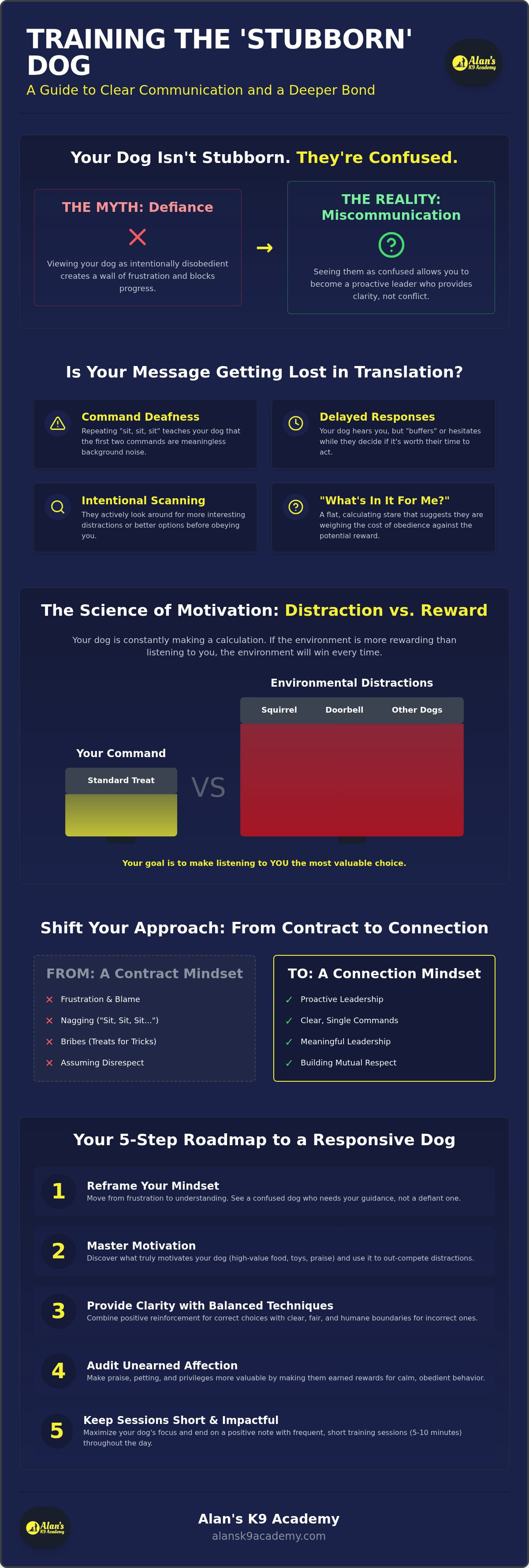
Labeling your dog as "stubborn" is often the first roadblock in your progress. It's a human term we apply when our expectations don't match our pet's actions. When you're training a stubborn dog at home, this mindset creates a wall of frustration. Instead of seeing a defiant animal, try seeing a confused one. Most resistance stems from a simple disconnect: your dog either doesn't understand the request or doesn't see the value in performing it at that exact moment. We often mistake a lack of clarity for a lack of respect, but your dog is simply responding to the information they've been given.
There is a fundamental difference between a dog that "won't" do it and a dog that "doesn't understand" it. If your dog performs a sit perfectly in the kitchen but ignores you at the front door, they likely haven't generalized the behavior. They aren't being difficult; they are simply struggling with environmental distractions. Different breeds process information through unique genetic filters. A Beagle's world is dominated by scent, while a Shiba Inu values personal space and independence. Recognizing these inherent traits allows us to move away from a "contract" mindset, where we merely trade treats for tricks. Instead, we strive for a "connection" mindset based on mutual respect and refined dog training methods that bridge the gap between human intent and canine action.
The Communication Gap: Why Your Dog Filters You Out
Are you nagging your dog? Repeating "sit, sit, sit" teaches your pet that the first two times don't count. This creates "command deafness." Your dog learns to filter out your voice like background static. Inconsistent body language also plays a role. If your hands say one thing while your voice says another, your dog will choose the path of least resistance. This is why many owners find their dog only listens when the treat bag is visible. Without the "bribe," the communication line goes dead. We need to replace these bribes with meaningful leadership that works even when your pockets are empty.
Common Signs of a Communication Breakdown
Recognizing the signs of a breakdown is the first step toward fixing it. Watch for these behaviors during your sessions:
Delayed responses
Your dog hears you but "buffers" before deciding to act.
Intentional scanning
They look around for distractions or better options before acknowledging your command.
The "What's in it for me?" stare
A flat, calculating look that suggests they are weighing the cost of obedience against the potential reward.
Understanding these signals helps you realize that training a stubborn dog at home isn't about breaking their will. It's about refining your own delivery to ensure your message is received loud and clear, fostering a partnership built on reliability rather than convenience.
The Science of Motivation: Why Your Dog Ignores Commands at Home
Why does your dog obey perfectly when the house is quiet, only to become "selectively deaf" the moment a guest arrives? The answer lies in the Distraction vs. Reward ratio. When you're training a stubborn dog at home, you are constantly competing with the environment. If the reward for ignoring you, such as chasing a squirrel or jumping on a visitor, is more satisfying than the reward for listening, your dog will choose the distraction every time. This isn't a character flaw; it's a calculation based on biological drives.
High-drive instincts play a massive role in what we perceive as resistance. Dogs bred for hunting, guarding, or herding have internal "programs" that prioritize specific stimuli. A "stubborn" dog is often just a pet whose drive hasn't been channeled into a productive task. Professional dog training advice from the AKC emphasizes that understanding these genetic predispositions is essential for unlocking focus. By using balanced training, we combine high-value rewards with fair boundaries to ensure the dog understands that listening is always the most beneficial choice.
Environmental Triggers in North Atlanta Homes
In many North Atlanta neighborhoods, our homes are sensory minefields. The "doorbell frenzy" is a common hurdle where the adrenaline of a guest's arrival completely overrides a standard food reward. Backyards are even more challenging. Between the scent of local wildlife and the noise of nearby traffic, the yard offers a level of stimulation that a kitchen sit-stay simply can't match. Your home is also a "Safe Haven." This is where your dog feels most comfortable pushing boundaries to see which rules are firm and which are merely suggestions.
Identifying Your Dog's Unique Currency
Motivation goes far beyond the treat bag. While food is a fantastic starting point, many strong-willed dogs value physical play, verbal praise, or "life rewards" like getting to sniff a favorite bush. We often utilize the Premack Principle, which uses a high-probability behavior, like going through a door, to reinforce a low-probability behavior, like waiting patiently. Balanced training is a humane mix of positive reinforcement and clear corrections. This approach provides the clarity your dog needs to navigate complex environments. If you find your pet's "stubbornness" is winning the battle against your treats, our personalized in-home training can help you identify the specific currency that makes your dog want to work for you.
Balanced Training Techniques for Strong-Willed Breeds
The AK9A philosophy is built on a single, powerful pillar: communication through clarity. When you are training a stubborn dog at home, you often discover that "purely positive" methods hit a ceiling, especially with high-drive or truly independent breeds. While rewards are essential for teaching new behaviors, they don't always provide the "stop" button needed for dangerous or disruptive actions. Truly independent dogs often weigh your treat against the thrill of a squirrel and decide the squirrel wins. This is where balanced training provides the missing piece of the puzzle, offering a complete language that your dog can actually respect.
To see real progress, you must transition from being a treat dispenser to becoming a trusted mentor. Your dog needs to know that your guidance is reliable, regardless of whether you have a cookie in your hand. Professional behavioral training for dogs creates this reliability by establishing a clear "Yes" and "No" in their vocabulary. By providing a full spectrum of communication, you remove the guesswork that leads to canine anxiety and human frustration. You aren't just teaching tricks; you are building a partnership based on mutual understanding.
Setting Clear Boundaries Without Fear
Effective boundaries aren't about intimidation; they are about information. A dog's world is black and white, yet we often speak to them in shades of gray. Using fair, humane corrections alongside high-value rewards provides the contrast they need to learn quickly. When training a stubborn dog at home, your energy is your most potent tool. Maintaining a calm, assertive presence tells your dog that you are in control of the situation. This stability allows them to relax, knowing that the rules are consistent and that you will lead them through any distraction with confidence.
The Myth of the 'Alpha' and the Reality of Leadership
The old "dominance theory" and the "alpha" myth have been largely debunked, but the need for leadership remains essential. Being a leader doesn't mean being a bully. It means being the source of structure, safety, and predictable routines. Dogs crave the security that comes from knowing exactly what is expected of them in any given environment. Utilizing in home dog training allows you to establish this leadership exactly where it matters most: in your own living room and backyard. By creating a structured environment at home, you build a foundation of trust that carries over into every public interaction you have together.
5 Steps to Training Your Stubborn Dog at Home Today
Transforming your pet's behavior doesn't require a complete lifestyle overhaul. It starts with small, intentional shifts in how you interact every day. When training a stubborn dog at home, consistency is your greatest asset. Follow these five professional steps to reclaim control and build a more responsive relationship.
Step 1: Audit 'Free' Rewards.
Stop giving away unearned affection. If your dog gets endless belly rubs and treats for simply existing, they have no incentive to work. Make affection a reward for a job well done.
Step 2: Shorten Your Sessions.
Keep training to 5 or 10 minutes max. Stubborn dogs often check out when they get bored. Ending while they are still engaged leaves them wanting more.
Step 3: Proof in Low-Distraction Areas.
Don't start in the park. Practice in a quiet hallway or bedroom where your dog has fewer places to look and fewer smells to follow.
Step 4: Introduce Distractions Gradually.
Once they are 90% reliable in the hallway, move to the living room with the TV on, then eventually to the backyard.
Step 5: Implement NILIF Protocols.
"Nothing in Life is Free" means your dog sits for their dinner, waits at the door, and earns their playtime. This creates a structured environment where you are the clear leader.
Mastering the 'Stay' and 'Recall' at Home
Reliable recall is a literal lifesaver. For stubborn breeds like retrievers or hounds, use a "Long Line" in the backyard. This 15 to 20 foot leash allows them freedom while ensuring you can always follow through if they ignore a command. Additionally, the "Place" command is essential for managing home chaos. Teaching your dog to stay on a specific mat or bed provides them with a boundary and a sense of purpose. This keeps dog obedience training from becoming a chore; instead, it becomes a functional part of your daily life together.
Common Mistakes to Avoid
One of the biggest pitfalls is the "sit, sit, sit" trap. Repeating a command only teaches your dog that they can ignore the first few requests. Say it once, then use a fair correction or guidance to ensure they follow through. Never train when you are frustrated. Your dog will sense your anger and shut down, which only reinforces their "stubborn" reputation. Finally, always end on a win. If a session is going poorly, ask for a simple behavior they know well, reward it, and stop there. This ensures your dog views training a stubborn dog at home as a positive experience.
Ready to see these steps in action with professional guidance? Schedule your in-home consultation today and let's turn your "impossible" dog into a responsive companion.
When to Call a Pro In-Home Trainer in North Atlanta
While the steps outlined earlier provide a strong foundation, there comes a point where training a stubborn dog at home requires a professional eye. Recognizing the limit of DIY is crucial, especially when "stubborn" behavior shifts into something more concerning. If your dog's resistance includes growling, snapping, or extreme anxiety that prevents them from functioning in the high-traffic suburbs of North Atlanta, it's time to bring in an expert. Safety should always be your priority, and a professional can help you navigate these challenges without escalating the stress for you or your pet.
One-on-one coaching offers a significant advantage by addressing issues exactly where they happen. We don't just train your dog; we train you to lead your dog within your specific household layout. Unlike many competitors, Alan’s K9 Academy (AK9A) avoids "Board and Train" services. We believe that for training to be successful long-term, you must be the one the dog listens to, not a stranger in a remote facility. Serving Cartersville, Marietta, and the wider North Atlanta Metro, we bring over 35 years of award-winning expertise directly to your front door to solve problems in the real world.
Personalized Solutions for Complex Behaviors
Every dog is an individual with a unique temperament. A strategy that works for a high-drive Malinois might overwhelm a sensitive rescue. Master K9 Trainer Alan Carr specializes in these nuances, particularly when handling aggression rehabilitation and severe anxiety. A professional eye can identify "hidden" triggers, perhaps a specific sound from the neighbors or a visual cue in your backyard, that you might have missed. This level of customization ensures that the behavior modification plan is as unique as your companion, moving beyond generic advice to achieve meaningful results.
Join the AK9A Community
Your journey begins with a comprehensive in-home evaluation. This allows us to see the "stubborn" behavior in its natural environment and provide immediate, hands-on feedback. Once you've established a solid foundation through private lessons, you can transition into our group classes. These sessions provide the perfect "real-world" test, allowing your dog to practice focus and obedience around other people and pets in local parks and public spaces. By choosing professional support, you aren't just fixing a problem; you are building a lifetime of communication and trust based on excellence and compassionate service.
Reclaim Your Partnership and Peace of Mind
Transforming your relationship with your pet starts by recognizing that "stubbornness" is simply a call for clearer communication. By shifting from a contract of bribes to a connection of mutual respect, you can overcome the hurdles of training a stubborn dog at home. You've learned that balanced, humane methods provide the clarity your dog craves, especially when navigating the real-world distractions of a North Atlanta household. Whether you are auditing unearned rewards or mastering the "place" command, every small victory builds a foundation of lasting trust.
You don't have to navigate this journey alone. With 35+ years of Master K9 Training experience, we specialize in providing award-winning behavioral support tailored to your unique environment. Our approach ensures personalized in-home results that empower you to be the leader your dog needs. Don't let another day of frustration pass you by. Book Your In-Home Evaluation with Alan’s K9 Academy Today and take the first step toward a calmer, more responsive companion. Your "impossible" dog is ready to listen; it's time to give them the language they finally understand.
Frequently Asked Questions
Is my dog too old to learn new commands?
No, dogs of any age can learn new behaviors and commands. While puppies are often faster to absorb information, senior dogs in North Atlanta homes frequently benefit from the mental stimulation of new routines. We have worked with dogs well into their double digits to improve house manners and communication. The key is adjusting the pace to match their physical capabilities while remaining consistent with your expectations for their behavior.
What are the best treats for a dog that isn't food-motivated?
High-value "life rewards" often work better than biscuits for dogs that aren't food-motivated. This includes access to the backyard, a favorite squeaky toy, or enthusiastic verbal praise. When training a stubborn dog at home, you must identify what your pet values most in that specific moment. Some dogs will work harder for a game of tug than a piece of chicken. Identifying this unique currency is a major part of our in-home evaluations.
How long does it take to see results with a stubborn dog?
Initial behavioral shifts often appear within the first few sessions, but long-term reliability takes consistent practice. Every dog is an individual with a unique learning curve. While some owners in Marietta see immediate improvement in focus, deep-seated habits like leash reactivity or aggression rehabilitation require a steady commitment. Our balanced approach focuses on building a foundation that lasts a lifetime rather than offering a temporary quick fix that fails under pressure.
Should I use a crate for a dog that refuses to listen?
Crates should be used as a management tool for safety and structure, never as a form of punishment. A crate provides a secure den where your dog can relax when you cannot supervise them. This prevents them from practicing bad habits, like chewing furniture or counter surfing, while you are busy. Using a crate correctly helps establish the boundaries necessary for a calm household and supports the overall training process effectively.
Can I train my dog if they have already bitten someone?
Yes, dogs with a bite history can still be trained, but this requires specialized behavior modification rather than standard obedience. Alan Carr has over 35 years of experience in aggression rehabilitation, helping families in Cartersville manage and resolve complex safety issues. We take a balanced, humane approach to identify the root cause of the aggression and implement strict safety protocols to protect both your household and the North Atlanta community.
How often should I practice training sessions at home?
Short, frequent sessions are much more effective than one long practice. Aim for two or three sessions a day, lasting only 5 to 10 minutes each. This frequency keeps the information fresh in your dog's mind without causing mental fatigue or boredom. Training a stubborn dog at home is about quality over quantity. Brief wins help your pet stay engaged and eager to participate in the next learning opportunity you provide.
Why does my dog listen to my partner but not to me?
This disconnect usually stems from subtle differences in consistency, tone, or follow-through. Dogs are incredibly observant and will often push boundaries with the person they perceive as being more flexible with the rules. If your partner is firm and you are lenient, your dog will naturally prioritize the clearer communicator. Our in-home coaching helps everyone in the family align their signals to ensure your pet remains responsive to every household member.
Is it possible to train a dog without using any corrections?
While you can teach tricks with rewards alone, achieving real-world reliability often requires a balanced approach that includes fair corrections. Corrections provide the "No" in your dog's vocabulary, giving them a complete picture of what is expected. Without this clarity, many independent breeds will ignore commands when a distraction becomes more interesting than a treat. We use humane, professional methods to ensure your dog understands both what to do and what to avoid.