%20(620%20x%20150%20px)%20(14).webp)
%20(620%20x%20150%20px)%20(15).webp)
.webp)
_page-0001.webp)
.webp)
.png)
Therapy Dog Training: A Comprehensive Guide to Preparing Your Canine Companion
Does your dog's occasional over-excited bark or habit of jumping up to say hello mean they aren't "therapy material"? Many North Atlanta owners feel that same hesitation, worrying that a single behavioral hiccup disqualifies their companion from making a meaningful difference. You likely see the pot...
%20(5).gif)
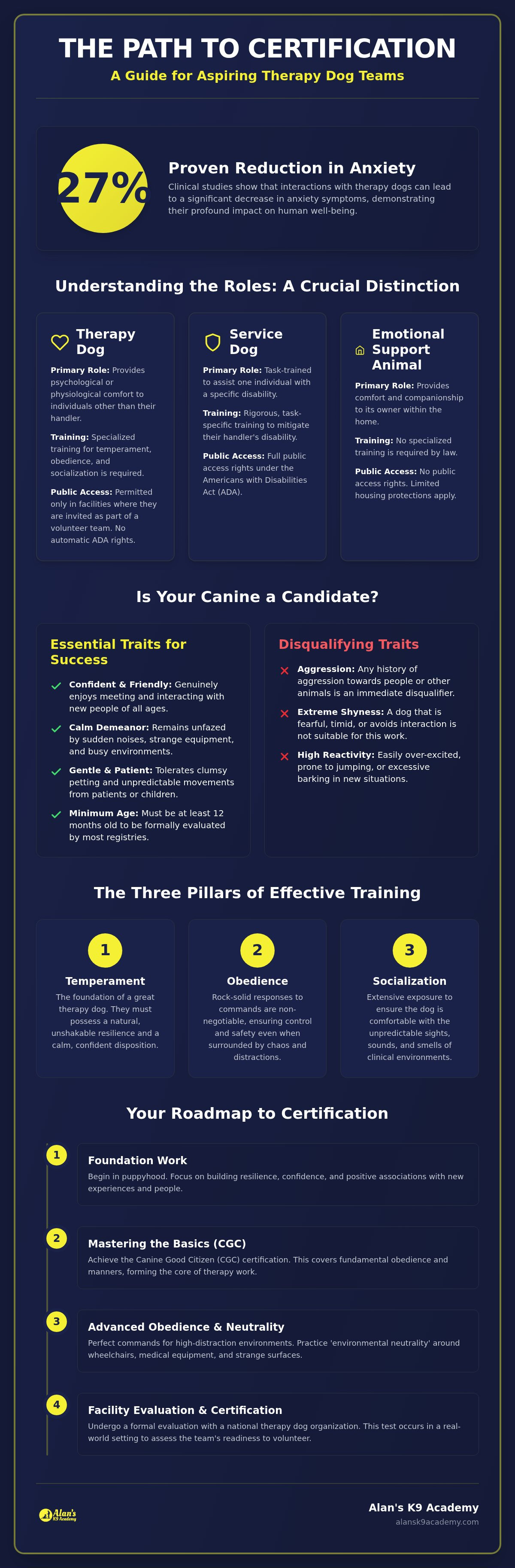
Does your dog's occasional over-excited bark or habit of jumping up to say hello mean they aren't "therapy material"? Many North Atlanta owners feel that same hesitation, worrying that a single behavioral hiccup disqualifies their companion from making a meaningful difference. You likely see the potential for your pet to provide comfort, especially knowing that clinical studies show interactions with therapy dogs can lead to a 27 percent reduction in anxiety symptoms. Yet, the confusion between therapy dogs, service dogs, and emotional support animals often makes the path to volunteering feel like an impossible maze.
We believe that every friendly dog deserves a chance to serve; we're here to turn that overwhelm into a clear plan of action. Through professional therapy dog training, you can transform your pet's natural affection into a disciplined, reliable gift for the community. In this guide, we'll provide a comprehensive roadmap to certification. You will discover the essential temperament requirements, the training milestones needed for stressful public environments, and the specific local organizations in Georgia where you and your companion can start making an impact together.
Key Takeaways
• Understand the crucial distinctions between therapy dogs, service animals, and ESAs to ensure your pet is on the right path.
• Learn how to assess your dog’s natural temperament to determine if they possess the social neutrality required for high-stress public environments.
• Explore the core curriculum of therapy dog training, from mastering Canine Good Citizen basics to advanced obedience commands.
• Get a clear roadmap of the certification process and learn what to expect during real-world facility evaluations.
• Discover how a professional foundation-first approach can help you avoid common pitfalls and prepare your dog for local volunteer opportunities.
What is Therapy Dog Training? Defining the Roles and Goals
What makes a dog more than just a companion? For many owners in North Atlanta, the answer lies in the specialized path of therapy dog training. While your pet might be the star of your living room, transitioning into a therapy role requires a specific shift in focus. A Therapy dog is a personal pet specifically trained to provide psychological or physiological comfort to individuals other than their handler. This work usually happens in public settings like hospitals, schools, or nursing homes. Unlike service dogs, these animals are there for the benefit of the community, serving as a bridge to emotional healing for strangers in need.
Success in this field rests on three non-negotiable pillars that we prioritize in every session. First is temperament; the dog must possess a natural, unshakable resilience. Second is obedience; they need rock-solid responses to commands, even when surrounded by chaos. Finally, socialization ensures they are comfortable with the unpredictable sights, sounds, and smells of clinical environments. The ultimate goal is to develop a dog that remains a "neutral" and calming presence. In a busy hospital hallway with rattling carts and medical equipment, your dog should be a steady anchor of peace, never reactive or overwhelmed.
Therapy Dogs vs. Service Dogs vs. ESAs
Confusion regarding legal rights is one of the biggest hurdles for new handlers. Service dogs are task-trained to assist individuals with specific disabilities and have full protection under the Americans with Disabilities Act (ADA). They go everywhere their handler goes. Therapy dogs don't have these automatic public access rights. They only enter facilities where they are invited as part of a volunteer team. Lastly, Emotional Support Animals (ESAs) provide comfort within the home and don't require specialized training or public access. Understanding these legal boundaries helps you set realistic goals for your dog's future career.
The Social Mission of a Therapy Team
The mission of a therapy team is about more than just a wagging tail. It involves a structured approach known as Animal Assisted Intervention. This methodology is proven to lower blood pressure and reduce stress in people facing trauma, illness, or educational challenges. You might find yourself working in funeral homes, disaster areas, or university libraries during finals week. However, the dog's well-being is just as vital as the human's. A great therapy candidate doesn't just "tolerate" being petted by strangers; they actively enjoy the work. If your dog feels drained or anxious by the interaction, the role isn't the right fit. We focus on ensuring the dog finds the work as meaningful and rewarding as the handler does.
Is Your Canine a Candidate? Assessing Temperament and Foundation
Does your dog have the "it" factor for therapy work? While we all love our pets, the professional standard for a therapy companion is exceptionally high. The ideal temperament isn't just about being "nice." It's about being confident, friendly, and completely unfazed by sudden environmental shifts. If your dog is naturally aggressive or shows extreme shyness around strangers, they are unfortunately disqualified from this specific career path. These traits can create safety risks in high-pressure settings where predictability is the most valuable asset you have.
Most national registries require a dog to be at least 12 months old before they can sit for a formal evaluation. However, waiting until the first birthday to begin therapy dog training is a mistake. Foundation work should start in puppyhood to build the resilience needed for a long career. You also have to remember that you are 50% of this team. Your ability to read your dog’s stress signals and advocate for their needs is just as important as their ability to sit and stay. For those looking for a deep dive into breed-specific traits and initial steps, the American Kennel Club offers a great resource on How To Train a Therapy Dog.
The 'Environmental Neutrality' Test
A hospital isn't a quiet living room. Can your dog handle the high-pitched beep of an IV pole or the sight of a motorized wheelchair? We look for "environmental neutrality," which means the dog notices these things but chooses to remain calm. You should test their reactions to strange floor textures, like slippery linoleum or metal grates, and prepare them for "clumsy" petting. Patients with limited mobility or children may not always pet gently. Your dog needs to remain relaxed even when a hand comes at them from an awkward angle or with unexpected pressure.
Foundation Skills to Master Early
Before you ever step foot in a facility, certain behaviors must be second nature. Perfecting loose leash walking is a priority, especially in crowded North Atlanta parks where distractions are everywhere. We also enforce a strict "Four on the Floor" rule. Jumping is never acceptable in therapy work; it could easily knock over a frail patient or scratch sensitive skin. Additionally, a reliable "Leave It" command is a literal life-saver. In a medical environment, dropped pills or hazardous waste are common. Your dog must ignore these items instantly on command. If you're unsure where your dog stands, our in-home behavioral assessments can help identify the right starting point for your journey.
The Core Curriculum of Therapy Dog Training
Think of basic obedience as the elementary school of your dog’s education. For therapy dog training, we need to move into the graduate level. While the Canine Good Citizen (CGC) certificate is a vital baseline, it is essentially a controlled test. Real-world therapy work happens in the unpredictable chaos of a busy lobby or a crowded classroom. We focus on bridging that gap by moving beyond simple commands and building deep, reliable habits that hold up when the environment gets loud or messy.
A reliable "Stay" takes on a new meaning when a nurse drops a tray of food nearby or a visitor walks past with a loud cart. We train for a rock-solid down-stay that holds up under these real-world pressures. Your dog must also display complete neutrality toward other animals. In a facility, you will likely encounter other therapy teams. If your dog pulls or barks to say hello, it disrupts the calming environment you’re there to create. We also prioritize "Look at Me" as a primary refocusing tool. This command allows you to instantly pull your dog’s attention back to you when a distraction threatens to break their concentration.
Because your dog will be touched by dozens of strangers, they must be comfortable with intensive handling. This includes having their ears, tail, and paws inspected by people who might not have a gentle touch. We practice these scenarios repeatedly, ensuring the dog remains relaxed and happy throughout the interaction. If your dog tenses up when their paws are touched, that’s a hurdle we address early in the curriculum.
Advanced Public Access Manners
Navigating an elevator is a specific skill that requires patience and precision. Your dog shouldn't sniff the other passengers or crowd the door. We practice tight-space navigation where the dog stays glued to your side, regardless of who enters the space. We also train for "duration." Therapy work is mentally taxing for a canine. A dog might be great for five minutes, but can they maintain that same level of polite focus for a full forty-five minute visit? Building that mental stamina is a core part of our professional preparation.
Troubleshooting Common Behavioral Hurdles
Even the best dogs have quirks that need smoothing over. Some whine when they get excited, which can be stressful for a recovering patient. Others might "paw" for attention. While cute at home, a heavy paw on a patient’s bruised arm or medical site is a serious liability. This is where customized dog training plans become essential. We address these individual habits with precision, ensuring your dog is a safe, welcome guest in any professional environment.
Navigating Certification and Local Volunteer Opportunities
Once you've built a solid foundation through therapy dog training, the next step is formalizing your partnership with a national registry. In Georgia, the most common paths are through Therapy Dogs International (TDI) and the Alliance of Therapy Dogs (ATD). These organizations don't just provide a patch for your dog’s vest; they provide the essential liability insurance that protects you during a visit. Attempting to volunteer without this registration is a significant risk that most professional facilities in the North Atlanta area simply won't allow.
The evaluation process is often the most nerve-wracking part for owners, but it's designed to be a supportive observation of your teamwork. Unlike a standard obedience trial, a therapy evaluation often takes place in a real-world environment. An evaluator will watch how your dog handles the specific stressors we’ve trained for, such as medical equipment or crowded hallways. They are looking for a dog that is engaged and happy, not just compliant. If you feel ready to take this step, we can help you schedule a final preparation session to ensure you meet every local requirement.
Finding a Place to Serve in North Atlanta
Opportunities for service are abundant across the metro area once you're certified. Many handlers enjoy partnering with local libraries for 'Read to a Dog' programs in Bartow County, where children practice literacy skills by reading to a non-judgmental canine listener. You might also visit senior living communities in Alpharetta or Roswell, providing much-needed companionship to residents. For those who prefer a high-energy environment, working with local colleges like Kennesaw State during finals week stress-relief events is a rewarding way to give back to the student community.
The Certification Checklist
Before you head to your evaluation, ensure your "paperwork" is as ready as your dog. Most registries require up-to-date vaccinations and health screenings, including Rabies, DHPP, and a recent negative fecal test. Your equipment choice is also strictly regulated. You'll need a plain buckle collar or a well-fitted harness; retractable leashes are universally banned in therapy work due to safety concerns. Finally, prepare yourself for the 'Volunteer Handler' portion of the test. You'll need to demonstrate a clear understanding of facility rules and patient privacy as you finalize your therapy dog training journey.
Professional Therapy Dog Foundation Training at Alan's K9 Academy
National registries provide the final stamp of approval, but they don't provide the hands-on instruction needed to get there. That is where we step in. At Alan's K9 Academy, we believe that successful therapy dog training starts long before you walk into a hospital or school. It begins with a rock-solid foundation built on trust and clear communication. Master Trainer Alan Carr brings over 35 years of professional instruction to every session, helping North Atlanta families avoid the common pitfalls that lead to failed evaluations or stressed-out dogs.
Our approach is unique because we apply the same rigorous standards found in our service dog foundation training North Atlanta programs to our therapy candidates. While the roles differ, the need for environmental neutrality and impulse control is identical. We don't train in a vacuum. Our in-home sessions are designed to simulate real-world distractions within your own environment, ensuring your dog can handle the doorbell, the vacuum, or a dropped tray before they ever face the chaos of a public facility. We also provide specialized preparation for the Canine Good Citizen (CGC) test, ensuring you and your dog approach the evaluator with total confidence.
Why Choose AK9A for Therapy Prep?
We treat every dog as an individual, not a line item. Our methods are balanced and humane, designed to ensure your dog is happy and eager to work, rather than just compliant. When you choose to partner with us, you receive:
Personalized Coaching
We focus on the bond between you and your dog, teaching you how to advocate for your pet in stressful settings.
Balanced Methods
We prioritize reliability while maintaining your dog's natural personality and enthusiasm.
Expert Guidance
We help you select the right national certification body that aligns with your specific volunteer goals.
Getting Started with Your Therapy Journey
Is your dog truly ready to begin foundation training? Every journey starts with an initial evaluation. We look at your dog's current temperament and obedience level to determine the most effective path forward. Whether you have a young puppy in Cartersville or an adult dog in Marietta, our customized lesson plans are tailored to your specific needs and lifestyle. Don't leave your dog's certification to chance. Book your in-home therapy dog evaluation today!
Ready to Share Your Dog’s Heart with the Community?
The transition from a friendly family pet to a reliable therapy partner is a rewarding transformation for both ends of the leash. You now have a clear roadmap of the temperament requirements, the core curriculum, and the legal distinctions that define this vital work. True success in therapy dog training isn't found in a textbook; it's built through consistent, real-world preparation that ensures your companion remains a calm anchor in high-stress environments.
We understand that the path to certification can feel overwhelming. That’s why we provide customized in-home training designed for real-world reliability. Led by Master K9 Trainer Alan Carr, who brings over 35 years of experience to every session, we proudly serve families in Cartersville, Marietta, and throughout North Atlanta. We don't just teach commands. We build the foundation your dog needs to pass national evaluations with ease. Your dog has the natural gift to provide comfort, and we have the professional expertise to help them share it safely and effectively.
Start Your Dog's Journey to Becoming a Certified Therapy Companion
Frequently Asked Questions
How long does it take to train a therapy dog?
Most dogs require six to twelve months of consistent preparation to reach certification standards. This timeline depends heavily on your dog's current obedience level and social maturity. While basic commands might take weeks, building the environmental neutrality needed for hospital visits is a gradual process. Starting with a professional foundation helps streamline this journey, ensuring you don't waste time on ineffective methods or confusing instructions.
Can any breed of dog become a therapy dog?
Any breed or mixed breed can potentially succeed as a therapy companion. Certification bodies focus on individual temperament rather than a specific pedigree. Whether you have a Golden Retriever or a rescue mutt, the dog must be naturally friendly, confident, and resilient. We've seen success across various breeds as long as the dog genuinely enjoys meeting new people and stays calm in unpredictable, high-pressure settings.
What is the difference between a therapy dog and an emotional support animal?
Therapy dogs are trained to provide comfort to strangers in facilities, while Emotional Support Animals (ESAs) provide therapeutic support only to their owners. Therapy dogs require specialized training and must pass an evaluation to work in public settings like schools. ESAs don't require any specific training and are primarily recognized for housing purposes. Understanding this distinction is vital for setting the right goals for your pet's future career.
Do therapy dogs need to pass the Canine Good Citizen (CGC) test?
Most national registries require or strongly recommend passing the Canine Good Citizen (CGC) test as a prerequisite for certification. The CGC serves as a baseline for public manners, covering skills like sitting politely for petting and walking on a loose lead. While the CGC is a great start, therapy dog training involves additional layers of preparation to handle medical equipment and clinical environments that the standard test doesn't cover.
Can I take my therapy dog into grocery stores or restaurants?
No, therapy dogs do not have the same legal public access rights as service dogs. You cannot take them into grocery stores, restaurants, or other non-pet-friendly businesses unless you are there for a scheduled, invited visit. They are only allowed in facilities like hospitals or nursing homes after you have received permission from the administration. Always respect these boundaries to maintain the integrity and professional reputation of the therapy dog community.
How old does my dog have to be to start therapy dog training?
You can begin foundation training as early as eight to twelve weeks old, but most organizations require a dog to be at least one year old to certify. Starting therapy dog training during puppyhood allows you to focus on vital socialization and neutrality before the challenging teenage phase hits. Early exposure to different sights and sounds builds a more resilient adult dog that will be much more likely to pass the final evaluation.
Do I need a special vest or ID card for my therapy dog?
Official identification and vests are typically issued by your chosen registry only after you pass the certification process. While you might see therapy dog patches sold online, these carry no legal weight and won't grant you access to professional facilities. Most hospitals and schools require you to wear the official ID badge provided by organizations like TDI or ATD during your visits to verify your insurance and training status.
What happens if my dog fails the therapy dog certification test?
Failing a certification test is not the end of the road; it's simply a sign that more preparation is needed. Most evaluators provide specific feedback on which areas your dog struggled with, such as jumping or reacting to loud noises. You are usually allowed to re-test after a designated waiting period. We often work with owners to address these specific hurdles through targeted behavior modification so they can return and pass with total confidence.