%20(620%20x%20150%20px)%20(14).webp)
%20(620%20x%20150%20px)%20(15).webp)
.webp)
_page-0001.webp)
.webp)
.png)
The Ultimate Family Dog Training Checklist: A 2026 Guide for a Peaceful Home
It starts with a simple game of tag in the living room, but within seconds, your dog is jumping on the kids and the afternoon turns from playful to chaotic. You love your companion, but those sharp nips during play and the constant worry about resource guarding make your home feel more like a battle...
%20(5).gif)
It starts with a simple game of tag in the living room, but within seconds, your dog is jumping on the kids and the afternoon turns from playful to chaotic. You love your companion, but those sharp nips during play and the constant worry about resource guarding make your home feel more like a battlefield than a sanctuary. Effective dog training for families shouldn't feel like a second job, yet it's exhausting to feel like you're always on edge in your own house.
We know you want a dog that respects boundaries, but finding time for traditional group classes feels impossible between school runs and work. You aren't alone in this frustration; many parents struggle to balance pet ownership with a busy family life. This guide is designed to bridge that gap. We promise to provide you with the essential tools to master safety and obedience through a hands-on, real-world approach that fits your lifestyle.
In this 2026 guide, we provide a structured checklist covering everything from stopping mouthy behavior to ensuring your dog listens even when the kids are loud. You'll discover how to create a meaningful, customized environment where every member of the household feels secure and in control. Let's move from overwhelm to a state of calm confidence with your four-legged family member.
Key Takeaways
• Understand why training in your own environment is the key to solving the "facility vs. home" behavioral gap.
• Master the "Place" and "Recall" commands as non-negotiable safety tools for effective dog training for families.
• Learn to identify subtle body language cues like stiffening and "whale eye" to prevent resource guarding and aggression.
• Implement the "No Hugging" rule and other essential boundaries to teach your children how to respect canine personal space.
• Discover how professional in-home coaching provides the hands-on, real-world context needed for a truly peaceful and structured household.
Why Standard Training Often Fails Busy Families
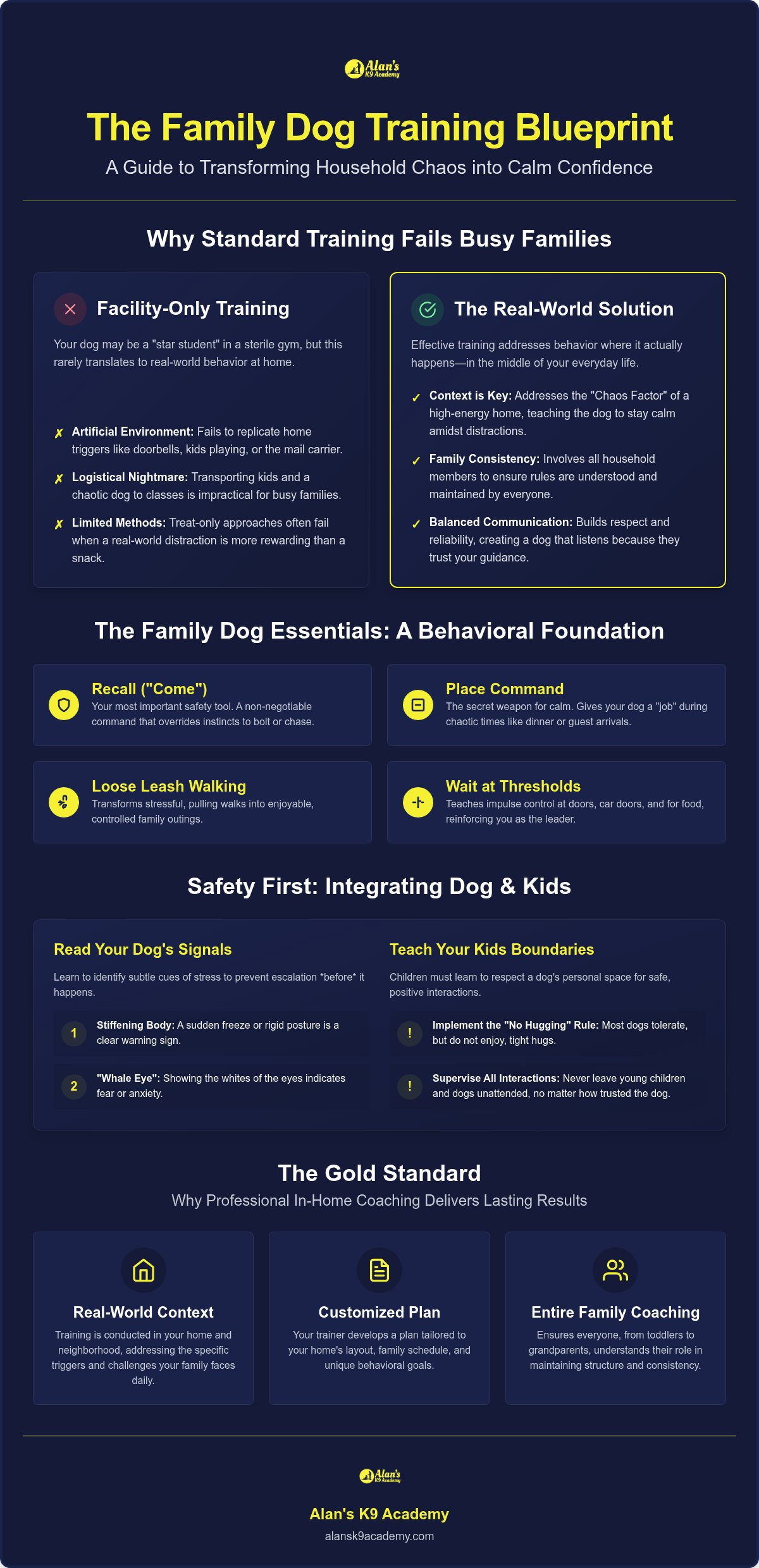
Have you ever wondered why your dog is a "star student" at the training center but a total disaster at your front door? It's a common frustration that leaves many parents feeling defeated. You spend money and time on group classes, yet the jumping and nipping continue the moment you walk back into your kitchen. Real dog training for families isn't about teaching a dog to perform tricks in a quiet gym. Instead, it's the professional process of establishing clear communication and boundaries that every household member, from toddlers to grandparents, can maintain in the middle of everyday life.
High-energy households naturally trigger canine over-arousal. When the kids are running, the TV is loud, and the doorbell rings, a dog's "thinking brain" often shuts off. Standard training fails because it doesn't account for this "Chaos Factor." Without a structured home environment where the dog knows its place, they default to impulsive behaviors like mouthiness or bolting. If only one person is doing the work, the dog learns that rules are optional when "Mom" isn't looking. This inconsistency creates a vacuum where the dog feels overwhelmed and under-guided.
While training your dog to remain calm when the doorbell rings is essential, maintaining the physical security of your entryways is equally important; for expert home security solutions, check out A Aable Locksmith.
The Limitations of Facility-Only Training
Transporting a chaotic dog and three kids to a 6 PM class across town is a logistical nightmare. Even if you make it there, the environment is sterile and artificial. A training facility can't replicate the specific triggers of your residence, such as the sound of the mail carrier's truck or the excitement of a backyard soccer game. In-home training addresses these real-world scenarios where the problems actually occur. It allows us to customize the plan to your home's layout, ensuring the dog respects the "no-go" zones like the dining room or the baby's nursery.
A well-prepared home environment also extends to your outdoor space, where many training triggers occur. For families who want to ensure their backyard is as functional as it is beautiful, Ray Lawns offers professional sod installation that creates a durable surface for kids and dogs to enjoy together.
The Role of Balanced Communication
Relying solely on "treat-only" methods often fails when the distraction is more exciting than the snack. If your dog values chasing a squirrel or jumping on a guest more than a piece of kibble, your communication breaks down. We focus on balanced, humane methods that establish the owner as a mentor rather than just a food dispenser. This shift is essential for high-stakes safety, especially regarding resource guarding or aggression. You need a dog that listens because they understand the structure of the family. This approach builds off-leash reliability and real-world respect that keeps everyone safe.
The Family Dog Essentials: A Behavioral Foundation Checklist
Building a peaceful home requires more than just teaching your dog to "sit" for a treat in a quiet room. It's about creating a shared language that works when the kids are playing tag and the delivery driver is at the door. Effective dog training for families starts with a checklist of behaviors that prioritize safety, impulse control, and real-world reliability. Without these essentials, your dog isn't a partner in your household; they're a source of constant management and stress.
A reliable recall is your most important insurance policy. "Come" must be a non-negotiable response that overrides a dog's instinct to chase a squirrel or bolt through an open garage door. Similarly, loose leash walking transforms family outings from a physical struggle into an enjoyable experience. If you're tired of being dragged toward every distraction in the neighborhood, professional in-home dog training can help you establish the leadership needed for a calm, controlled walk. Teaching your dog to wait at doors and for their food bowl further reinforces that you are the mentor they can trust for guidance.
Foundational Commands for Daily Life
Mastering "Sit" and "Down" is only the beginning. For a busy family, these commands must include duration and the ability to handle distractions. Can your dog stay in a "Down" while your toddler drops a cracker or a guest enters the foyer? We also prioritize the "Leave It" command to prevent your dog from ingesting dropped toys, harmful foods, or household items. 'Place' is a stationary boundary that reduces household anxiety by giving your dog a specific job to do while the family is busy. This command is your secret weapon for peaceful family dinners and managing the "chaos factor" of guest arrivals.
Socialization vs. Exposure
There is a critical difference between a dog being "exposed" to children and being "comfortable" with them. Exposure is simply being in the same room; socialization is the process of teaching the dog to remain neutral and relaxed around strollers, bicycles, and loud, screeching toys. We want your dog to see these high-energy triggers as background noise rather than a reason to bark or jump. Use this checklist for neutral behavior when visiting North Atlanta parks or walking through your neighborhood:
Neutrality near wheels
Ignoring bicycles, scooters, and strollers without lunging.
Calmness with noise
Remaining settled during loud play or sudden shouts from kids.
People-focus
Choosing to look at the handler when strangers or other dogs pass by.
Body awareness
Moving out of the way of foot traffic instead of blocking hallways.
Safety First: Checklist for Managing High-Stakes Behaviors
Do you know the exact moment your dog’s mood shifts from playful to protective? It’s often a split-second change that goes unnoticed by the untrained eye until a growl or snap occurs. It's a heavy burden for any parent to carry. While many providers of dog training for families explicitly avoid cases involving aggression or bite history, we lean into these challenges. Your family’s safety depends on professional, hands-on intervention that addresses the root cause of the behavior rather than just the symptoms.
Before a physical confrontation happens, dogs almost always provide a series of "early warning" signals. Learning to identify these is the first step in your safety checklist. Watch for these high-stakes indicators:
Stiffening
The dog’s body becomes rigid and frozen. This is a clear signal of high tension.
Lip Curling
A visible lift of the flews that often precedes a growl.
Whale Eye
The dog turns its head slightly away but keeps its eyes on the "threat," showing the whites of the eyes.
Resource guarding, which involves aggression over toys, food, or furniture, is a common trigger in households with children. Puppies also present a unique challenge with "mouthy" behavior. While nipping is natural for a pup, it must be corrected before it scales into adult aggression. Similarly, over-excited jumping can easily knock over a small child. We use balanced, humane methods to ensure your dog understands that these behaviors are unacceptable in a family environment.
Addressing Aggression and Anxiety
The AK9A approach to behavior modification focuses on fear-based aggression through customized, real-world scenarios. We don't just tell you what's wrong; we provide a roadmap for change. While training is in progress, management is key. Use crates, baby gates, and tethers to create a structured environment where mistakes can't happen. If you’re seeing these red flags in Bartow County, it’s time to call a Master K9 Trainer for professional intervention. We specialize in aggression rehabilitation that others find impossible.
The Myth of the 'Bad Breed'
Any breed can thrive in a family home when provided with the right structure and leadership. We focus on the individual temperament of the dog rather than breed stereotypes. Whether you have a Golden Retriever or a Doberman, the quality of communication determines the outcome. This is especially vital for rescue dogs with unknown histories. A professional assessment ensures you understand your new companion’s specific needs and potential triggers before they become an issue in your household.
Integration Checklist: Training Your Dog AND Your Kids
A peaceful home isn't just about a well-behaved pet; it's about educated children. Many parents focus solely on the animal, but dog training for families is actually a two-way street. If your kids are constantly wrestling with the dog or ignoring its personal space, even the most trained canine will eventually reach a breaking point. We need to teach our children that leadership isn't about being bossy. It's about being predictable and respectful of a living creature's boundaries.
The "No Hugging" rule is often the hardest for kids to follow. While humans show affection through physical closeness, most dogs perceive a hug as a restrictive, threatening gesture. Instead of physical restraint, we encourage structured play like Fetch. This game provides mental stimulation and exercise without the over-arousal caused by wrestling or high-stakes tug-of-war. For school-aged children between 5 and 12, involving them in age-appropriate chores builds a sense of responsibility. Have them help with filling water bowls or brushing the dog under your supervision to foster a healthy, calm bond.
Teaching Children Respect and Leadership
Children must understand that some moments are off-limits for interaction. They should never approach a dog that is sleeping or eating. 'Let sleeping dogs lie' is a critical safety rule for households with toddlers because a startled dog is more likely to react defensively. Once kids are old enough to follow multi-step directions, you can involve them in "Sit" and "Stay" practice. This teaches the dog that even the smaller members of the household are mentors worth listening to. If you need hands-on help coordinating these family interactions, our in-home dog training programs are designed to involve every member of your household.
Creating a 'Safe Zone' for the Dog
Every dog needs a sanctuary where they can escape the noise of a busy household. Establish the crate or a specific bed as a child-free sanctuary. If the dog goes to this spot, the children must leave them alone. Teaching kids body language literacy is vital for preventing accidents before they happen. If you see your dog yawning, tucking their tail, or looking away, they are telling you they've had enough and need a break. In multi-level homes in Marietta or Roswell, using baby gates or tethers helps manage movement and ensures everyone has the space they need to stay calm and safe.
Why Professional In-Home Coaching is the Gold Standard
Many training facilities have recently shifted away from house calls, choosing instead to focus exclusively on center-based classes. This forces you to pack up the kids and a stressed dog after a long workday just to practice commands in a sterile gym. We believe this approach ignores the most critical element of success: your home environment. Professional dog training for families is most effective when it happens where the problems actually occur. Whether it's the doorbell in your foyer or the squirrel in your backyard, real-world context is the key to lasting behavior change.
Family participation is the heartbeat of our program. One-on-one coaching allows every member of your household to learn without leaving the comfort of your home. We don't just train the dog; we mentor you. This ensures that the communication remains consistent long after we leave. Alan’s K9 Academy brings over 35 years of Master K9 expertise directly to your doorstep. We provide customized solutions tailored to your specific home layout and neighborhood triggers. It's a high-end, hands-on experience designed to move you from a state of overwhelm to a feeling of total control.
This level of specialized expertise is just as valuable when managing professional milestones; for instance, business owners can turn to Bravo Kilo Advisors for expert M&A advisory and brokerage services that provide similar clarity and control during complex transitions.
Personalized Training Plans for North Atlanta Families
We take pride in building meaningful communication between owners and their dogs throughout Cartersville, Marietta, and Alpharetta. The reality is that group classes often gloss over the nuances of complex behavior modification. One-on-one sessions allow us to address your dog's specific temperament and your family's unique lifestyle. We focus on transformation rather than just temporary fixes. To understand how we bridge the gap between facility training and home reliability, you can read more in our Professional In-Home Dog Training: A Comprehensive Guide for Owners.
Achieving Off-Leash Reliability and Beyond
Imagine the peace of mind that comes with taking your dog to Kennesaw Mountain or a local park with total confidence. Off-leash reliability isn't a pipe dream; it's the result of a solid foundation built on trust and clear expectations. We prepare your dog for the distractions of the real world so you can enjoy family trips without the constant pull of a leash. For those who want to reach the highest levels of partnership, we also offer Service Dog Foundation Training. Your journey toward a peaceful home starts with a single step. Ready to transform your household? Contact Alan’s K9 Academy today for a consultation.
Transforming Chaos into Household Harmony
You don't have to settle for a home filled with jumping, nipping, or constant worry. By implementing the foundations of dog training for families, you are choosing a path of safety and mutual respect. Success comes from training in the environment where life actually happens, ensuring your dog listens even when the kids are loud or the doorbell rings. You now have the checklist to identify early warning signs and the tools to integrate your children into the training process safely.
We are ready to help you move from a state of overwhelm to total confidence. Master K9 Trainer Alan Carr offers over 35 years of experience as an award-winning in-home behavior modification specialist. Serving Cartersville, Marietta, and the North Atlanta Metro area, we provide the hands-on expertise needed to handle even the most difficult behavioral challenges. It's time to reclaim your peace of mind and enjoy the companion you've always wanted.
A well-trained dog is a joy at home and a reliable partner on the road, especially for those in careers like professional trucking where pets are often welcome; if you are interested in starting a career in transportation, eastusatrucking.com offers the CDL training and testing you need.
Creating a stress-free environment often involves clearing out physical clutter as well; if an old vehicle is taking up space in your Atlanta-area driveway, you can explore Cash for Junk Cars through Windward Auto Removal Service to simplify its removal and focus on your home's harmony.
Take the next step toward a structured and happy home. Schedule Your In-Home Family Dog Training Consultation with Alan’s K9 Academy today. We look forward to partnering with you and your companion for a lifetime of success.
Frequently Asked Questions
Is my dog too old to start family training?
No dog is ever too old to start family training as long as they are healthy and cognitively present. Senior dogs often enjoy the mental stimulation and the renewed sense of structure in the household. While we might adjust the physical demands for an older pet, the core principles of communication and respect remain the same. It's about building a better partnership at any stage of life.
How do I stop my dog from jumping on the kids when I get home?
Stopping jumping begins by removing the reward of attention. When you walk through the door, ignore the dog completely until all four paws are on the floor. Teach your children to turn their backs and remain quiet when the dog is over-excited. Once the dog settles, reward them with calm praise or a "Sit" command to reinforce the behavior you want to see.
What should I do if my dog growls at my child?
You should never punish a dog for growling; this is their way of communicating discomfort before a bite happens. Immediately separate the dog and child without making a scene to lower the tension. A growl is a clear signal that the dog feels overwhelmed or threatened. This is a critical time to seek professional dog training for families to address the underlying anxiety or resource guarding.
Can kids be involved in the professional training sessions?
Yes, we highly encourage children to participate in training sessions under adult supervision. It's vital for the dog to see the kids as leaders and mentors rather than just playmates. We teach age-appropriate ways for children to give commands and reward good behavior. This involvement ensures that the whole household is on the same page and maintains consistent boundaries.
How long does it typically take to see results with in-home training?
You will often see a noticeable shift in behavior within the first one or two sessions of in-home dog training for families. While long-term reliability takes consistent practice over several weeks, the initial changes happen quickly because we address the problems in their real-world context. Your commitment to following the customized plan between sessions is the biggest factor in how fast your dog transforms.
Do you use treats or corrections in your family dog training?
We utilize balanced methods that incorporate both positive reinforcement and clear corrections to build lasting communication. Treats are excellent for teaching new behaviors, but real-world reliability requires a dog to listen even when a snack isn't present. Our goal is to establish you as a mentor. This humane approach ensures your dog understands both what to do and what behaviors are unacceptable in your home.
What is the best way to introduce a new dog to a household with children?
The best way to introduce a new dog is on neutral ground, such as a park, rather than inside your home. Keep the initial meeting brief and parallel walk the dogs before allowing direct interaction. Once inside, use baby gates to manage space and ensure the resident dog and the new arrival have separate areas for eating and sleeping to prevent resource guarding.
How do I manage a high-energy dog in a small home or apartment?
Managing a high-energy dog in a small space requires a focus on mental stimulation rather than just physical exercise. Scent work, puzzle feeders, and indoor "Place" command practice can tire a dog out more effectively than a short walk. Focus on "decompression walks" in local North Atlanta parks where they can sniff and explore. This helps lower their overall arousal levels within the home.