



Task-Specific Service Dog Training After Foundation Obedience
The task matters, but the foundation makes it usable. Under the ADA, a service dog must be trained to take a specific action to assist a person with a disability, and the work or task must be directly related to that disability, according to the U.S. Department of Justice. Professional task specific...

The task matters, but the foundation makes it usable. Under the ADA, a service dog must be trained to take a specific action to assist a person with a disability, and the work or task must be directly related to that disability, according to the U.S. Department of Justice. Professional task specific service dog training builds on reliable obedience so a dog can respond with a meaningful behavior when support is needed.
It makes sense to focus on a task that could help during emotional overload. But the dog also needs to stay engaged, understand cues, and respond reliably in the situations where you need support. Those skills develop step by step through training tailored to the handler’s needs.
Here, you’ll learn why foundation obedience comes first, how attention cues help a dog stay connected to you, and how a trainer can develop tasks such as deep pressure or an alert to support you during emotional overload. You’ll also see what professional training involves and how foundational skills support practical, consistent task work.
Key Takeaways
• Match trained tasks to the specific ways a disability affects daily life, so the dog’s work has a clear purpose.
• Explore how a trained response, such as deep pressure, may offer practical support during emotional overload.
• Learn how attention cues help a dog reconnect with the handler and respond more consistently.
• Understand why reliable foundation obedience comes before disability-specific task training.
Wondering how a professional can train your own service dog?
A professional starts by identifying useful assistance, then assesses the dog’s foundation and tailors practice to each task. The goal is a specific, disability-related response that works in the situations where the handler needs it.
Disability-Based Task Selection
Disability-based task selection matches trained behaviors to a handler’s specific disability-related needs.
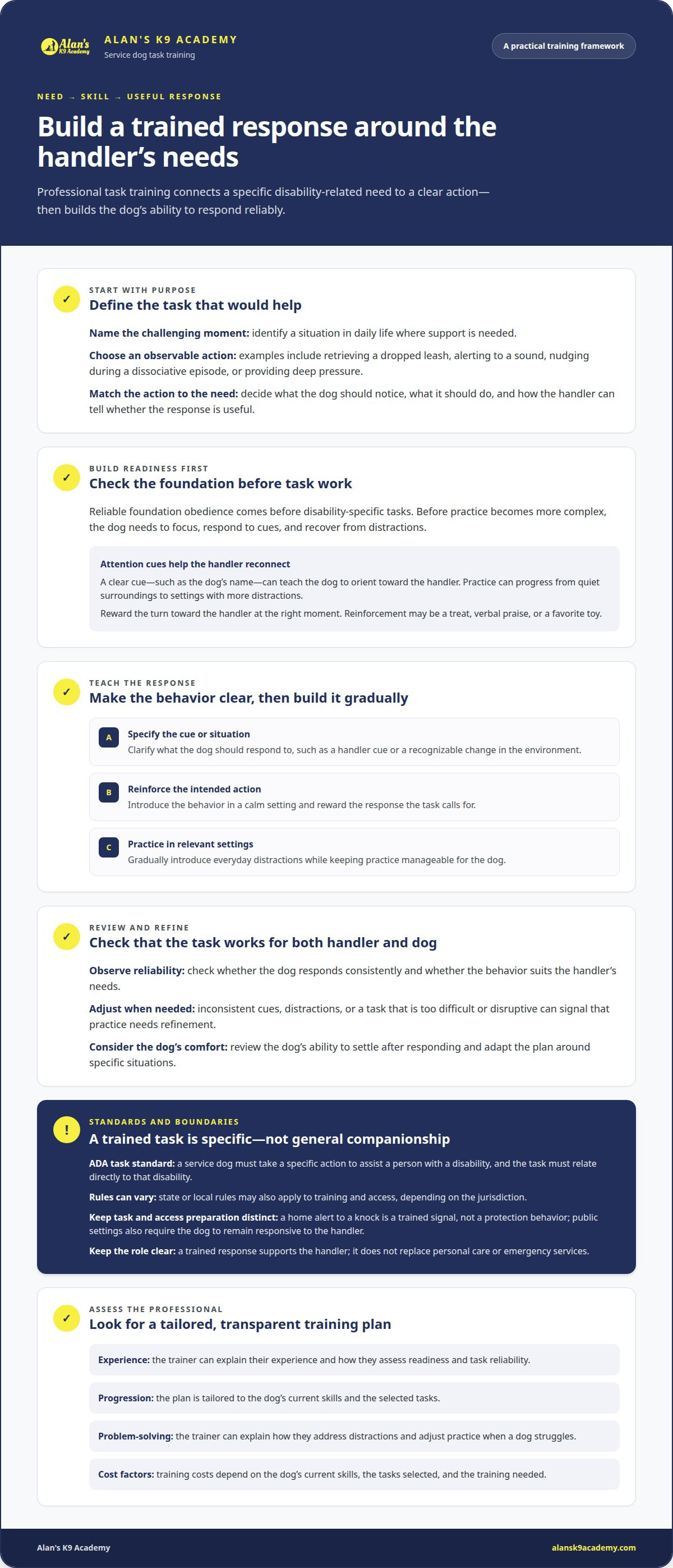
A trainer can connect challenging moments in daily life with practical actions. For example, a dog might retrieve a dropped leash, alert to a sound, or nudge the handler during a dissociative episode. The handler’s priorities guide which tasks matter most and when each response would help. A professional also assesses readiness: before task practice becomes more complex, the dog needs to focus, respond to cues, and recover from distractions.
Task-Focused Training Approaches
Task-focused training teaches a dog a distinct action for a defined situation.
A trainer breaks the behavior into clear steps, reinforces the desired response, and practices it in relevant settings. For psychiatric assistance, this might include alerting to an impending panic attack or providing deep pressure. The trainer can also shape a home alert, such as responding to a knock at the door. That is a trained signal, not a protection behavior. Common challenges include inconsistent cues, distractions, or a task that does not match the handler’s needs. Practice helps reveal where the response needs refinement.
Training Rules and Public Access
Training standards describe the task and the laws that apply to public access.
Under the ADA, a service dog must take a specific action when needed to assist a person with a disability, and the task must relate directly to that disability, according to the U.S. Department of Justice. State or local rules may also apply to training and access, depending on the jurisdiction. A professional distinguishes teaching a task from preparing for public settings, where the dog must remain responsive to the handler.
Professional Training Costs and Qualifications
Professional training costs reflect the work needed to develop and practice a dog’s tasks.
Costs depend on the dog’s current skills, the tasks selected, and the training needed; pricing is provided after a quote request. Look for a trainer who can explain their experience, outline a tailored progression, and show how they assess readiness and task reliability. Ask how they address distractions and adjust practice when a dog struggles. These checks matter because rushed training or a poor task match can leave the handler without dependable assistance when it’s needed.
Assistance during emotional overload
A service dog performs trained work that supports a person with a disability. During emotional overload, that work can be planned around the handler’s needs, the dog’s responses, and the situations where support matters. Start by defining the goal: for example, decide whether the dog should respond to a handler’s cue or to a recognizable change in the handler’s environment.
A task plan turns that goal into an observable behavior. The trainer and handler identify what the dog should notice, what action should follow, and how the handler can tell whether the response is useful. For instance, the plan might specify that the dog moves close after a particular cue. This makes practice consistent and helps distinguish a trained task from general companionship.
Training builds the response in manageable stages. A professional can introduce the cue or situation in a calm setting, reinforce the intended behavior, and gradually practice amid everyday distractions. The trainer observes whether the dog responds reliably and whether the behavior suits the handler’s needs. If the response is too difficult or disruptive, the task can be adjusted before practice moves to a busier setting.
Clear boundaries matter, too. A dog’s trained response supports the handler; it doesn’t replace personal care or emergency services. The plan should also account for the dog’s comfort and ability to settle after responding. During review, the trainer can assess cues, timing, and the dog’s recovery, then refine practice around specific situations such as waiting in a quiet public space. For individualized guidance, explore support for service dog training.
How professional training builds attention cues and handler focus
An attention cue is a signal that tells a dog to orient toward its handler. A trainer chooses a clear cue and teaches the dog to respond before adding a service task. For example, the dog may turn toward the handler when it hears its name. The trainer observes the response and helps the handler deliver the cue consistently.
That response gives the handler a practical way to reconnect with the dog. During a noisy outing, for example, a trainer might work on having the dog turn toward the handler instead of continuing to watch a passing cart. Training progresses from quieter surroundings to settings with more distractions. The trainer adjusts the environment so the dog can practice successfully without losing focus.
Reward timing helps make the cue meaningful. Positive reinforcement may include a treat, verbal praise, or a favorite toy. The trainer rewards the dog when it turns toward the handler, not several moments later after it has looked away. This clear feedback helps the dog understand which behavior earns reinforcement and gives the handler a consistent way to recognize success.
Handler focus is part of the training, too. The trainer can help the handler notice whether the dog is attentive, distracted, or ready to respond, then choose an appropriate moment to give a cue. For example, if a dog is fixated on a sudden sound, the handler may need to wait for a pause before using the attention cue. This keeps the signal distinct from the next task instruction.
Once the dog responds reliably in a familiar setting, the trainer can vary the location and distractions. A quiet room, a doorway, and a busier public environment each present different demands. The trainer tracks whether the dog responds to the same cue in each situation and adjusts practice when attention slips. Strong attention skills support clear communication, helping the handler and dog work as a team during task training.
Foundation obedience before disability-specific task training
Foundation obedience is the ability to respond to everyday cues so a dog can work safely and predictably. Before adding a disability-specific task, a trainer assesses whether the dog can respond to cues amid distractions, settle, and maintain positions. A dog that cannot hold a sit reliably may struggle to perform a task in a busy setting.
A practical progression starts in a low-distraction room. One suggested benchmark is ten consecutive sit repetitions, each held for three seconds. In a moderately distracting setting, the target becomes ten sits with a thirty-second hold. For down duration, trainers can build in five-minute increments before introducing stores or restaurants. These steps help show whether a dog understands the cue or responds only in a familiar place.
Foundation skills also include settling for longer periods. Assistance Dogs International describes a thirty-minute down under a restaurant table without breaks, whining, or position changes as a service dog benchmark. For most handlers training a healthy puppy, foundation obedience may take six to twelve months. Progress depends on how consistently the dog performs cues across settings, not simply on knowing a command at home.
Obedience training teaches general behaviors such as sitting or settling; task training teaches a specific action related to a person’s disability. An emotional support animal provides comfort, while a service dog performs a trained action, such as retrieving an item. That distinction matters: even a calm, well-mannered dog needs to learn the relevant task.
The takeaway is simple: reliable foundation behaviors make specialized work easier to assess and practice. A trainer can identify gaps before adding task demands, then build a progression suited to the dog and handler. Explore professional service dog training to discuss structured foundation and task work.
Alan's K9 Academy: Therapy & Service Dog Training
Alan's K9 Academy offers Therapy & Service Dog Training for handlers seeking professional guidance with foundation skills and disability-related tasks. Training can focus on the behaviors that support your daily needs, while In-Home Dog Training provides a setting to work on skills in your home. If behavior challenges affect learning, Behavior Modification may also help address them as part of the training picture.
Consider professional support when you need help deciding which tasks fit your needs, assessing your dog’s readiness, or building a consistent training plan. The right starting point depends on your dog’s current behavior and the assistance you’re seeking. Discuss those goals with Alan's K9 Academy to explore a suitable next step.
Contact Alan's K9 Academy to talk about your task specific service dog training needs.
Turn your training goals into a practical next step
The next step is a focused conversation about the situations where you need support and the role you hope your dog can play. Discussing task-specific service dog training gives a trainer a starting point for shaping a plan around your priorities, your dog’s current skills, and daily life. A thoughtful approach to task-specific service dog training centers on your partnership, not a one-size-fits-all checklist.
Alan's K9 Academy offers Therapy & Service Dog Training, alongside In-Home Dog Training and Behavior Modification. These options can support different parts of your training journey, from task goals to behavior needs that affect learning. Share what you’re working toward and what feels challenging; the conversation can help clarify a suitable direction.
Contact Alan's K9 Academy to discuss your training goals. A clear first step can make the path ahead feel more manageable.
Frequently Asked Questions
How long does the foundation phase take?
For most handlers training a healthy puppy, foundation obedience takes six to twelve months. Progress depends on the dog’s consistency with cues, settling, and focus across different settings. A dog that responds at home may need more practice around new sounds or people before moving to specialized tasks. Owner-trainers should also expect six to twelve months of public access work after establishing the obedience foundation.
What is the minimum basic obedience a service dog needs?
There is no single obedience test that determines every dog’s readiness, and the ADA does not require a Canine Good Citizen test. A practical baseline is responding to cues, settling calmly, and staying under the handler’s control. For example, the dog should be able to lie quietly while the handler speaks with someone, rather than pulling toward the person or disrupting the interaction.
What's the difference between basic obedience and public access skills?
Basic obedience is a dog’s response to everyday cues; public access skills apply those behaviors in shared spaces. A dog may sit reliably at home but struggle to settle beside a chair in a busy café. The handler needs to maintain control, and the dog must be housebroken. Under the ADA, a business may remove a service dog that is out of control or not housebroken.
What tasks can a service dog be trained to perform for a specific disability?
Tasks depend on the assistance a handler needs for their disability. Examples include a hearing dog alerting to a smoke detector, a mobility dog delivering a dropped object to the handler’s hand, or a guide dog navigating around an unfamiliar obstacle. A dog may also detect allergens or alert to changes related to blood sugar. The useful task is the one that addresses a specific need.
How does a professional train a dog to perform a specific service task?
A professional turns the handler’s goal into a clear, observable behavior. For example, retrieving a dropped item involves learning to locate it, pick it up, and deliver it to the handler. The trainer develops each part, reinforces correct responses, then practices with different objects and in varied settings. Tracking progress helps identify which step needs more work before combining the full sequence.
Can you train your own service dog, or must you use a professional trainer?
Owner-trainers can train their own service dogs, and professional support can help structure the work. A trainer can assess the dog’s current skills, plan task practice, and identify challenges that may be hard to spot alone. After foundation obedience is established, owner-trainers should expect six to twelve months of public access work, according to the training timeline provided for this topic.