%20(620%20x%20150%20px)%20(14).webp)
%20(620%20x%20150%20px)%20(15).webp)
.webp)
_page-0001.webp)
.webp)
.jpg)
Structured In-Home Dog Training Program: The 2026 Guide to Lasting Results
You've just invited guests over for dinner, but instead of a warm welcome, they're met with a whirlwind of barking and jumping that leaves you apologizing before the coats are even off. It's a stressful scene that many dedicated owners know all too well. You've likely spent hours scrolling through c...
%20(5).gif)
You've just invited guests over for dinner, but instead of a warm welcome, they're met with a whirlwind of barking and jumping that leaves you apologizing before the coats are even off. It's a stressful scene that many dedicated owners know all too well. You've likely spent hours scrolling through conflicting online videos while your busy schedule makes commuting to a distant facility feel impossible. We understand that frustration. You want a companion who listens, not just in a classroom, but in the real-world environment where life actually happens.
This guide reveals how a structured in-home dog training program transforms chaotic canine behavior into reliable obedience through personalized, expert coaching tailored to your specific home. We'll examine the shift toward owner-involved communication, the pitfalls of information overload, and the exact steps to achieve a peaceful household. Real transformation requires a system that integrates into your daily life rather than isolated sessions in a vacuum. By the time you finish reading, you'll understand why hands-on training in your own hallway is the most effective path to a meaningful, lasting bond with your dog in 2026.
Key Takeaways
• Learn how a structured in-home dog training program ensures your dog’s obedience translates seamlessly from a practice lesson to your real-world daily life.
• Discover why training in your own environment is more effective than "Board and Train" facilities by solving the "transfer problem" and strengthening your direct bond.
• Understand the value of a comprehensive behavioral assessment that targets the root causes of unwanted habits rather than just masking superficial symptoms.
• Identify the essential criteria for selecting an expert coach, such as Master K9 Trainer credentials and a commitment to balanced, humane training methods.
• Explore how customized coaching tailored to your specific household dynamics can transform stressful interactions into a peaceful, reliable partnership.
What Defines a Structured In-Home Dog Training Program?
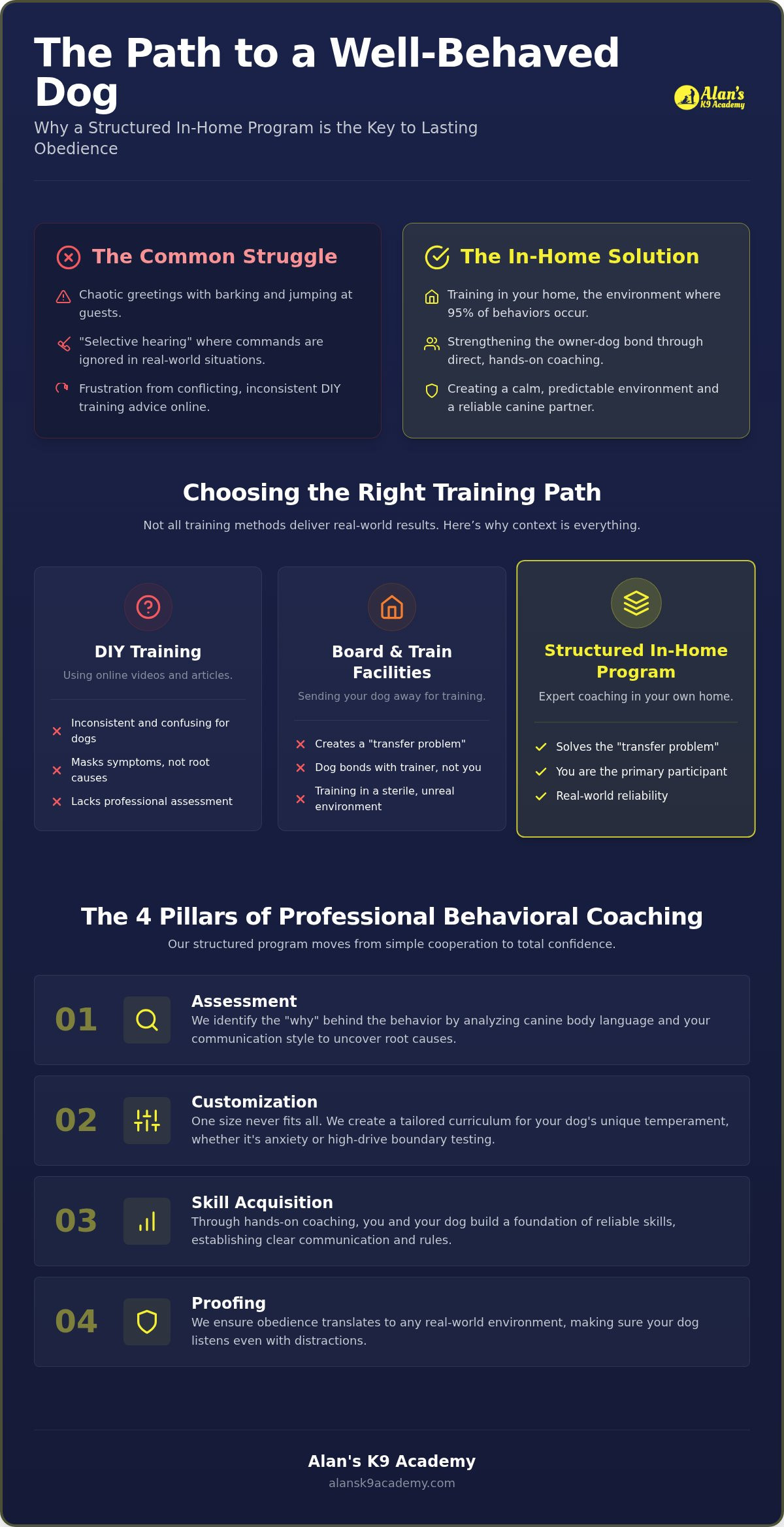
A structured in-home dog training program is far more than a simple set of commands like "sit" or "stay." It is a systematic curriculum taught in the very environment where your dog spends 95 percent of their time. This approach ensures that every lesson translates directly to your daily routine, rather than being a performance reserved for a classroom. Unlike the "tips and tricks" often found in viral videos, a cohesive framework focuses on the underlying behavioral health of your pet. Dogs thrive when they understand the rules, boundaries, and limitations of their pack; this structure provides the mental stability they need to feel secure. Instead of guessing what you want, your dog learns exactly how to succeed within your home.
In this model, we view the owner as the primary participant rather than a passive observer. While you might research various dog training methods online, a professional program translates those theories into hands-on practice tailored to your life. It's about building a partnership where you lead and your dog follows with confidence. This isn't just about "fixing" a dog. It's about establishing a lasting line of communication that works even when life gets chaotic.
The Limitations of Haphazard DIY Training
Many owners turn to YouTube when a specific problem arises, but these videos rarely account for your dog's unique temperament. DIY training often leads to inconsistent cues that confuse your pet or a reliance on "bribing" with treats without a long-term plan. Without a structured in-home dog training program, dogs frequently develop selective hearing. They might listen in the quiet of the living room but completely ignore you when a guest arrives at the door. A lack of structure means you're only treating symptoms while the root cause of the behavior remains unaddressed.
Why the Home Environment is the Ultimate Classroom
Training in a sterile facility is one thing, but addressing triggers where they actually happen is the key to real-world reliability. Whether it's the front door, the backyard fence, or the kitchen counter, the home is where the most frustrating behaviors occur. By working in these spaces, we ensure the dog associates obedience with you and your property, not a specific training building. This eliminates the stress of transport, which can often skew a dog's behavior and make it harder for a trainer to see the "real" issues. When the training happens in your hallway, the results stay in your hallway.
The Core Pillars of Professional Behavioral Coaching
A truly structured in-home dog training program follows a logical, multi-phase progression. It doesn't simply start with a leash in hand; it begins with an expert observation. We move through four distinct phases: assessment, customization, skill acquisition, and proofing. This methodical approach ensures your dog isn't just performing a trick for a treat but is developing a lifestyle of reliability that sticks even when you aren't holding a piece of cheese. By building on a solid foundation, we move from simple cooperation to total confidence in any environment.
Assessment: Beyond 'Good' or 'Bad' Behavior
We must analyze the "why" behind the "what" to see real change. Is your dog barking at the window because they're territorial, or is it a frantic search for clarity driven by underlying anxiety? A Master Trainer identifies subtle canine body language cues such as a slight weight shift or a specific ear position that reveals the dog's true emotional state before they even react. We also take a close look at your current communication style to find points of friction. Sometimes, the most well-meaning owners accidentally reinforce the very behaviors they want to stop. Identifying these root causes is the only way to move past temporary fixes toward lasting results.
Tailored Solutions for Complex Issues
One size never fits all in canine education. The approach for behavioral training for dogs differs significantly depending on the individual. A rescue dog struggling with severe anxiety requires a completely different strategy than a headstrong, high-drive puppy testing boundaries for the first time. We integrate specialized tools and balanced methods specifically for aggression rehabilitation, ensuring your family's safety while making meaningful progress through every session.
Once we establish the foundation of basic dog commands training, we move into the critical proofing stage. This is where we test skills under the real-world distractions of North Atlanta life. Whether it's a squirrel running across a trail or a neighbor's dog barking nearby, we ensure your dog stays focused on you. We create a clear roadmap for off-leash reliability so you can enjoy the freedom of local parks with total confidence. If you're ready to stop managing the chaos and start enjoying your companion, our customized coaching programs provide the professional support you need to succeed.
In-Home Training vs. Board and Train: Why Context Matters
Have you ever wondered why some dogs act like angels at a training facility but turn back into troublemakers the moment they cross their own threshold? This is known as the "Transfer Problem." Dogs are highly situational learners. They associate specific behaviors with the environment and the person holding the leash. When a dog is sent away for a residential program, they learn to respect a specific trainer in a specific building. Once they return to your living room, the old environment often triggers the old behaviors because the context has shifted back to the status quo.
At Alan's K9 Academy, we believe training is about building a bridge of communication, not just repairing a machine. This is why we prioritize a structured in-home dog training program over board-and-train models. With over 35 years of experience, Master Trainer Alan Carr has seen that the most successful, permanent outcomes happen when the owner is the primary leader. The long-term ROI of investing in your own coaching far outweighs the temporary convenience of sending your dog away. You aren't just getting a trained dog; you're becoming a confident owner who knows how to maintain those results for a lifetime.
The Myth of the 'Fixed' Dog
Many owners fall into the trap of believing a dog can be sent away and returned "fixed" forever. Behavior requires ongoing reinforcement and a clear understanding of the safe space where the dog actually lives. Choosing in home dog training prevents the dreaded relapse that often follows a board-and-train "honeymoon phase." When a dog learns in their primary environment, the lessons stick because they are tied to their daily reality. This psychological stability allows for more meaningful transformation without the stress of being uprooted to an unfamiliar kennel where you aren't there to support them.
Building Real-World Reliability
Real-world reliability means having a dog that listens while you're walking through the streets of Marietta or Alpharetta, not just in a quiet training hall. We focus on the challenges you face in your own neighborhood. This includes practical, hands-on techniques to stop dog pulling on leash during your morning walks. We also tackle essential social manners, specifically how to stop dog jumping on people when your actual neighbors or friends come to visit. A structured in-home dog training program ensures that the dog respects the rules of your home and the people within it, creating a peaceful life for everyone involved.
How to Evaluate a Structured Program for Your Dog
Selecting the right structured in-home dog training program is one of the most important decisions you'll make for your family. You aren't just hiring a service; you're choosing a mentor for you and your companion. While we tailor our rates to the specific needs of our North Atlanta clients, comparing Professional Dog Training Service Fees from other top-tier providers like K9Elite can help you gauge the standard investment for high-level behavioral modification. Start by looking at credentials. While many certifications exist, "Master K9 Trainer" status indicates a lifetime of dedicated study and field experience. With over 35 years of work, we've seen that certifications on paper don't always equal real-world capability. You need a trainer who has handled every possible scenario, from puppy basics to severe aggression rehabilitation, with a proven track record of success.
Questions to Ask a Potential Trainer
Don't be afraid to ask direct questions before committing. Ask how they handle high-arousal reactivity or aggression. A vague answer is a warning sign. You should also ask if the trainer will be training the dog for you or if you'll be coached to handle the dog yourself. As we discussed in the previous sections, real success depends on you being the primary leader in your own home. Ask what happens if the initial methods don't produce the desired results; a true expert has a deep toolbox of strategies to pivot when needed.
Identifying Red Flags in Training Programs
Be wary of "guaranteed" timelines. Every dog is an individual; they learn at different paces. If a trainer promises a "fixed" dog in exactly three days, they're likely prioritizing speed over lasting behavioral health. Be cautious of trainers who refuse to work with specific breeds or "difficult" behaviors. This often signals a lack of the depth of experience required for complex behavior modification. Finally, avoid purely clinical or cold approaches. Training is about the emotional bond and partnership between you and your dog. If you're ready to work with a partner who values integrity as much as results, contact Alan's K9 Academy today to schedule your assessment.
Starting Your Journey with Alan’s K9 Academy
Choosing to begin a structured in-home dog training program is the first step toward reclaiming the peace and joy in your household. At Alan’s K9 Academy, we don't just provide a service; we offer a partnership built on over 35 years of Master Trainer expertise. Alan Carr brings a lifetime of behavioral knowledge directly into your living room, applying the same principles used for high-stakes rehabilitation to your family pet. This isn't a generic, one-size-fits-all approach. It's a deep dive into the unique relationship between you and your dog, ensuring that the results we achieve are both meaningful and permanent.
In your first personalized session, you can expect a comprehensive diagnostic assessment. Alan looks past the surface-level barking or jumping to find the root cause of the behavior. We'll discuss your specific goals, evaluate your dog's temperament, and begin implementing the foundation of dog obedience training immediately. You'll walk away from this first meeting with a clear roadmap and the confidence that your dog's "impossible" problems actually have a solution.
Service Area and Logistics
We believe that expert coaching should be accessible to families throughout the region. Our team has a strong presence in Bartow, Cherokee, and Cobb counties, ensuring that high-end behavioral support is never out of reach. We provide flexible scheduling to accommodate the busy professionals of Sandy Springs and Alpharetta, who often struggle to find time for traditional facility-based classes. Whether you're located in the heart of Cartersville, the growing neighborhoods of Canton, or the busy streets of Woodstock, we bring the classroom to you. We are deeply committed to serving the entire North Atlanta Metro area with integrity and excellence.
Your Path to a Confident, Obedient Companion
The transition from daily frustration to genuine hope happens quickly when you have a structured plan in place. Imagine the freedom of a dog that can go anywhere and do anything with you, from a crowded outdoor cafe to a quiet hiking trail. By investing in your own skills as a leader, you're ensuring that your dog remains a reliable, happy member of the family for years to come. The stress of "selective hearing" or embarrassing guest greetings will become a thing of the past. It's time to stop managing the chaos and start enjoying the companion you've always wanted. Contact Alan’s K9 Academy today to begin your transformation!
Take the Lead in Your Dog's Transformation
You don't have to settle for a home filled with tension and unpredictable behavior. Throughout this guide, we've explored how a structured in-home dog training program bridges the gap between chaotic reactions and reliable obedience by training exactly where life happens. By focusing on root causes rather than symptoms and choosing owner-involved coaching over distant facilities, you're building a bond that stands the test of time. Real success isn't about a quick fix in a distant kennel; it's about the daily communication you establish right in your own hallway.
As North Atlanta's aggression specialists, we bring award-winning expertise to every doorstep in Bartow, Cherokee, and Cobb counties. With Master K9 Trainer Alan Carr's 35+ years of experience, you're gaining more than just a few new commands. You're gaining a lifetime of professional insight tailored to your specific family dynamics. It's time to move from frustration to total confidence. Ready to see the difference for yourself? Schedule Your In-Home Behavioral Assessment Today and take the first step toward a peaceful, obedient companion. You have the power to change your dog's future, and we're here to lead the way.
Frequently Asked Questions
What is the difference between a dog trainer and a Master K9 Trainer?
A Master K9 Trainer possesses a level of field experience and behavioral expertise that far exceeds standard certifications. Alan Carr’s 35 year career has seen every imaginable challenge, from simple obedience to extreme aggression. This title represents a lifetime commitment to the craft, ensuring you receive guidance from a veteran who understands the nuance of canine psychology rather than just basic commands.
How many sessions are typically in a structured in-home program?
Most families see significant results within a structured in-home dog training program consisting of three to six sessions. The exact number depends on your dog's current behavior and your specific goals for reliability. We focus on quality over quantity, ensuring each meeting provides actionable steps that integrate into your daily life without overwhelming your schedule.
Can you help with a dog that has already bitten someone?
Yes, we specialize in aggression rehabilitation even for dogs with a bite history. We don't shy away from "impossible" cases because we understand that biting is often a symptom of underlying fear or lack of clarity. By identifying these triggers during an assessment, we create a safe, balanced plan to modify behavior and restore safety to your home.
Is my dog too old to start a structured training program?
Dogs can absolutely learn new behaviors at any age. While puppies are blank slates, older dogs often possess a maturity that helps them focus once they understand what is expected of them. A structured in-home dog training program provides the mental enrichment senior dogs need to stay sharp while correcting bad habits they may have practiced for years.
What areas of North Atlanta do you serve for in-home training?
We provide expert coaching across a wide North Atlanta footprint, including Bartow, Cherokee, and Cobb counties. Our trainers regularly visit clients in Cartersville, Canton, Woodstock, Marietta, Alpharetta, and Sandy Springs. If you live in the North Atlanta Metro area, we bring our professional behavioral services directly to your living room to address issues where they happen.
Do I need to buy special equipment before the trainer arrives?
You don't need to purchase any new gear before your first session. We prefer to evaluate your current collars, leashes, and toys during the initial assessment to see what is actually working. If specialized tools are needed for behavior modification, we'll provide professional recommendations based on your dog's breed, size, and specific training requirements.
How much time will I need to practice between professional sessions?
Consistency is more important than long hours of work. Most owners find success by practicing for just 15 to 20 minutes a day, which can be broken into five minute increments. This fits the busy schedules of most professionals while ensuring your dog receives the frequent reinforcement they need to turn new skills into permanent habits between our visits.
What makes Alan's K9 Academy different from a board-and-train facility?
Unlike a board and train facility, Alan’s K9 Academy prioritizes owner involved communication to prevent the "transfer problem." We believe you must be the one your dog respects and listens to in your own home. By training in your safe space, we ensure the dog associates obedience with you rather than a distant kennel or a temporary trainer.