%20(620%20x%20150%20px)%20(14).webp)
%20(620%20x%20150%20px)%20(15).webp)
.webp)
_page-0001.webp)
.webp)
.png)
Service Dog Training Requirements in Georgia: 2026 Legal & Practical Guide
What if that "official" service dog certificate you bought online is actually a $2,000 ticket to a Georgia courtroom? With the 2026 implementation of the Mara Jade Act, the stakes for handlers in the Peach State have never been higher. You've likely felt the sting of confusion when trying to disting...
%20(5).gif)
What if that "official" service dog certificate you bought online is actually a $2,000 ticket to a Georgia courtroom? With the 2026 implementation of the Mara Jade Act, the stakes for handlers in the Peach State have never been higher. You've likely felt the sting of confusion when trying to distinguish between an emotional support animal and a true service dog. It's frustrating to deal with conflicting advice while you're simply trying to gain independence. Understanding the specific service dog training requirements Georgia now enforces is the only way to ensure your dog is legally protected and reliably capable of performing life-saving tasks.
We know you want more than just a vest. You want a partner that remains unfazed in a crowded Alpharetta cafe or a busy Marietta park. This guide clarifies exactly what the law requires for public access, including new standards for dogs in training. You'll learn how to navigate the legal landscape and identify the essential foundation skills your dog needs to be a reliable companion. We're moving past the "certification" myths to focus on real-world reliability and the peace of mind that comes from knowing your dog is truly ready for the job.
Key Takeaways
• Understand how the 2026 Mara Jade Act updates Georgia law to protect your right to owner-train while introducing strict penalties for misrepresentation.
• Learn the specific service dog training requirements Georgia mandates to ensure your dog performs reliable, life-saving tasks that directly mitigate your disability.
• Master the "Under Control" public access standards required to keep your dog welcome in businesses from Marietta to Alpharetta.
• Debunk the myths surrounding online registries and "official" certificates that offer no legal standing under the ADA or state law.
• Discover how professional foundation training in your home environment builds the necessary focus and reliability for a successful service dog career.
The Legal Framework: ADA vs. Georgia State Service Animal Laws
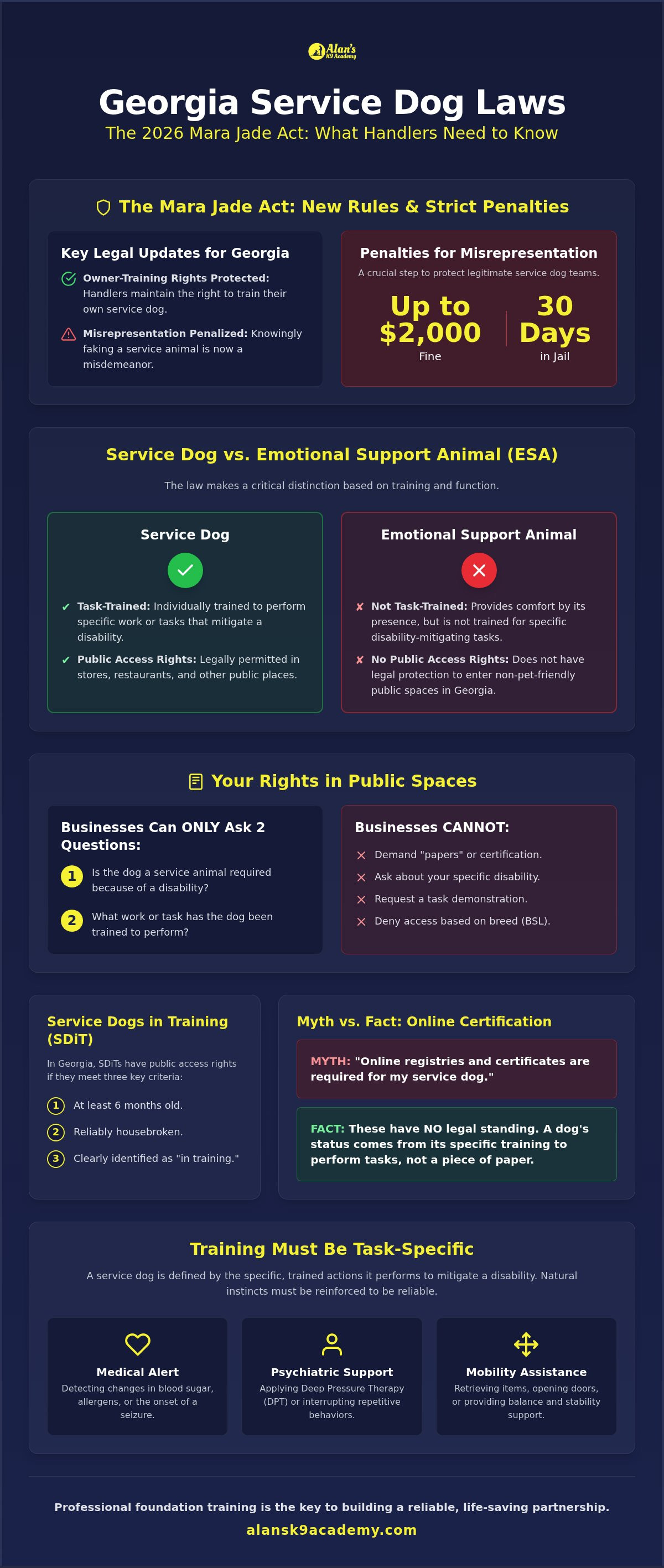
The Americans with Disabilities Act (ADA) provides the baseline for your rights, but the specific service dog training requirements Georgia enforces often cause the most confusion. Think of the ADA as the foundation and Georgia Code Title 30 as the structure built upon it. Since the Mara Jade Act (HB 668) took effect on July 1, 2026, state law has moved into closer alignment with federal standards, specifically recognizing your right to owner-train. This is a massive win for handlers who prefer a customized, hands-on approach to their companion's education.
When you're out in public, business owners are strictly limited in what they can ask. They can't demand "papers," medical records, or a physical demonstration of the dog's task. They are legally restricted to two specific questions:
• Is the dog a service animal required because of a disability?
• What work or task has the dog been trained to perform?
Because service dogs are considered necessary medical equipment rather than pets, breed-specific legislation (BSL) cannot be used to bar your entry. Whether your partner is a German Shepherd or a Pit Bull mix, their right to access depends on their behavior and training, not their DNA. For a broader look at how these roles are categorized globally, you can review this Assistance Dog Overview. Your dog's legality is defined by their utility, not their appearance.
Rights for Service Dogs in Training (SDiT) in Georgia
Georgia stands out by granting SDiTs public access rights, provided certain conditions are met. Under the 2026 updates, your SDiT must be at least six months old and reliably housebroken. They must also wear a collar, leash, or identifier that clearly marks them as a service dog in training. Meeting the service dog training requirements Georgia mandates for dogs in training is the first step toward a successful public access career. This legal protection allows for early socialization in real-world environments like the shops in Marietta or Alpharetta, provided you are actively engaged in the training process.
Service Dogs vs. Emotional Support Animals (ESAs)
The distinction between a service dog and an ESA is often misunderstood, but the legal consequences are now very real. A service dog is trained to take specific actions to mitigate a disability. An ESA provides comfort through its presence alone. In Georgia, ESAs do not have public access rights to restaurants, stores, or theaters. The 2026 law introduced strict penalties to protect the integrity of legitimate service teams. Knowingly misrepresenting a pet or an ESA as a service animal is a misdemeanor, punishable by a fine of up to $2,000 and 30 days in jail. Starting with professional in home dog training ensures your dog meets the high standards of task-based work, keeping you on the right side of the law while building a reliable partnership.
Mandatory Training Requirement #1: Task Specificity
What distinguishes a pet from a medical necessity isn't the vest; it's the specific, trained action the dog takes to help you. The service dog training requirements Georgia handlers must follow center on "task specificity." According to the Federal ADA Requirements, a service animal must be individually trained to do work or perform tasks for the benefit of an individual with a disability. If the dog's mere presence provides comfort, it's an emotional support animal. If the dog pushes a button to call for help, alerts you to a spike in blood sugar, or detects an allergen before you touch it, it's a service dog.
Tasks can be physical, medical, or psychiatric. For example, a dog might be trained in Deep Pressure Therapy (DPT) to ground a handler during a panic attack or to interrupt repetitive behaviors associated with autism. While some dogs have a "natural" alert for seizures or low blood sugar, these instincts must be reinforced through professional training to be considered reliable. A natural alert that only happens half the time isn't a medical tool; it's a lucky guess. We work to turn those natural instincts into a consistent, life-saving response.
Identifying the Right Tasks for Your Disability
Not every dog is cut out for every task. Matching your dog's natural drive and aptitude with your specific medical needs is the first step in a successful journey. In legal terms, "work" usually refers to broader assistance like guiding a person who is blind, while "tasks" are specific actions like picking up dropped items or providing stability. We recommend keeping a detailed log of your dog's task training. While you don't need to show this to enter a store, having a record of your dog's progress and reliability provides a layer of personal protection and confidence.
Foundation Training: Why the Basics Matter Most
Success starts with a rock-solid foundation, which is why dog obedience training is non-negotiable for any aspiring service team. A dog cannot focus on alerting you to a medical crisis if they are distracted by a dropped French fry or another dog across the street. A service dog must be "neutral" to the world around them. This means they remain calm and focused on you, regardless of the environment. At Alan's K9 Academy, we focus on building this intense level of focus through customized sessions. If you're ready to see if your dog has the foundation for this meaningful work, you can consult with a trusted mentor to evaluate your dog's potential.
Mandatory Training Requirement #2: Public Access Standards
Task training makes your dog a service animal, but public access training keeps them in the room. Even if your dog performs life-saving alerts, a business owner can legally ask you to leave if the animal is out of control. This is where the practical service dog training requirements Georgia handlers face truly come into play. Being "under control" means your dog acts as a silent, invisible partner. They shouldn't be barking, lunging at other shoppers, or sniffing the produce at a North Atlanta grocery store.
Housebreaking is another absolute requirement. A single indoor accident can be grounds for removal, regardless of the dog's skill level. Beyond hygiene, your dog must maintain a high standard of neutrality. This means ignoring the squirrel darting across the sidewalk or the friendly stranger trying to pet them without permission. Under both the ADA and Georgia law, your dog must be harnessed, leashed, or tethered. The only exception is if these devices interfere with the dog's ability to perform its task, in which case you must maintain control through voice or signal commands.
The Public Access Test (PAT) Benchmarks
While not a legal requirement for entry, the Public Access Test (PAT) provides the benchmarks we use to ensure real-world reliability. Can your dog navigate the heavy foot traffic of Marietta Square on a Saturday morning? Can they hold a "down-stay" under a table while you eat at a busy restaurant in Woodstock? We focus on the "four on the floor" rule: your dog's paws stay on the ground unless they are specifically performing a task that requires them to be up. This level of discipline is what separates a true service team from a pet in a vest.
Managing Public Interactions and "Gatekeepers"
Even with a perfectly behaved dog, you'll encounter "gatekeepers" who don't understand the law. Confidence is your best tool here. When you know your dog meets the service dog training requirements Georgia sets, you can calmly explain your rights. Handling an illegal access denial is stressful, but it's easier when you're certain of your dog's behavior. Remember that public access training for dogs isn't a one-and-done event. It's a lifelong process of maintenance and reinforcement. Every outing is a training opportunity to ensure your partner remains reliable, focused, and welcome in every space you visit.
The Truth About Registration, Vests, and Certificates
How many times have you seen an advertisement for an "official" national service dog registry? These websites often promise legal protection and "instant certification" for a fee. Here is the reality: the ADA does not recognize any official registry, and the Department of Justice does not require service animals to be registered in any database. Buying a vest on Amazon or a laminated ID card from a website does not satisfy the service dog training requirements Georgia law and federal mandates actually care about. A vest is simply a piece of fabric; it's the hundreds of hours of training that make the dog a service animal.
Scam websites selling "doctor's letters" or "certificates" are more than just a waste of money. They often provide a false sense of security that can lead to legal trouble when your dog's behavior doesn't match their "certified" status. Legitimate documentation isn't a shiny badge. It looks like a detailed training log showing when and where your dog mastered specific tasks, up-to-date veterinary records, and a record of consistent public access work. These documents prove your dog is a reliable medical tool rather than a pet in a costume.
Why Vests and IDs Can Be Useful (But Not Required)
While gear isn't a legal requirement, it can be a practical tool for managing your daily life in North Atlanta. A vest serves as a clear visual signal to the public. It tells people "do not pet" and "I am working," which helps maintain your dog's focus in busy environments. Using gear can also reduce friction with uneducated business owners who may not yet know that the law forbids them from demanding "papers." Just remember that a vest is a tool for communication, not a substitute for the rigorous training required for public access.
Georgia's Penalties for Fraudulent Service Animals
The stakes for using fake credentials changed significantly on July 1, 2026. Under the Mara Jade Act (HB 668), knowingly misrepresenting a pet as a service animal is now a misdemeanor in Georgia. This can result in a fine of up to $2,000 and 30 days in jail. These laws exist to protect the rights of legitimate handlers whose safety depends on their dogs. Ensuring your partner has professional behavioral training for dogs is your best defense against scrutiny. When your dog remains neutral and performs their tasks flawlessly, their behavior speaks louder than any certificate ever could. If you want to ensure your dog meets these high standards of integrity and skill, connect with us at Alan's K9 Academy to start your journey the right way.
Starting Your Service Dog Journey with Alan's K9 Academy
Building a service dog isn't about buying gear; it's about a long-term commitment to excellence. Master K9 Trainer Alan Carr brings over 35 years of experience to help you meet the service dog training requirements Georgia handlers must navigate. We focus on foundation training because it's the most critical step for any service role. Whether you're working with a high-energy breed or a dog for psychiatric support, we create a customized plan that fits your specific needs. Our approach is designed to move you from a state of overwhelm to a feeling of hope and control.
We primarily offer in home dog training because it allows us to address task work in the dog's natural environment. This is where your dog needs to be most reliable. We serve the entire North Atlanta Metro area, providing hands-on support from Cartersville to Alpharetta. We don't just view this as a business transaction; it's a mission to improve the quality of life for both you and your companion through meaningful, real-world results.
Foundation Training: The AK9A Difference
A service career can be derailed by small behavioral cracks like anxiety or reactivity. We address these issues head-on before they become permanent barriers to public access. Our balanced, humane methods build real-world reliability. We don't just train in a quiet room; we help you implement socialization strategies in busy local spots. This ensures your dog remains neutral to distractions, whether you're in a crowded cafe in Marietta or a park in Alpharetta. We've seen every possible challenge over three decades and remain unfazed by difficult behaviors.
How to Get Started in Cartersville or North Atlanta
The journey begins with a thorough in-home evaluation to assess your dog's temperament and ensure they can meet the service dog training requirements Georgia law expects from a working animal. If you're starting with a young dog, we often begin with in-home puppy training to build the necessary focus before transitioning to advanced task work.
Our approach is a true partnership. We train the handler as much as the dog, giving you the skills to manage public interactions and advocate for your rights. This seasoned professional support is what transforms a pet into a reliable service partner. We're ready to help you build a life-changing partnership that provides the legal protection and peace of mind you deserve during your outings in North Atlanta.
Take the Next Step Toward Independence
Meeting the service dog training requirements Georgia enforces doesn't have to be a source of stress. You now know that true legal protection is built on the foundation of specific task training and impeccable public behavior, not on a purchased certificate or a vest. Whether you're training a medical alert partner or a psychiatric support dog, the goal is a reliable companion that remains neutral in every environment. This level of discipline is what ensures your dog is a life-changing asset rather than a liability in public spaces.
With 35+ years of professional K9 instruction, Master Trainer Alan Carr specializes in building these essential foundations. Our award-winning in-home training brings the classroom directly to you in Cartersville, Marietta, or Alpharetta. We're here to ensure your dog is not just legal, but truly capable of the meaningful work you need for your daily independence. You don't have to navigate this complex journey alone. Schedule Your Service Dog Foundation Evaluation with AK9A Today and start working with a trusted mentor who is deeply invested in your success. Your future as a confident service dog team starts now.
Frequently Asked Questions
Do I need to register my service dog in Georgia?
You don't need to register your service dog in any official database or state registry. Under the ADA and the 2026 Mara Jade Act, there's no legal requirement for papers or certification. While many websites claim to offer official status for a fee, these are not recognized by the Department of Justice. Your dog's legality comes from its ability to meet the service dog training requirements Georgia mandates through specific, individually trained task performance.
Can a landlord in Georgia charge a pet deposit for a service dog?
Landlords in Georgia cannot charge a pet deposit or monthly pet fee for a service dog. Under the Fair Housing Act, service animals are considered assistive devices rather than pets. This applies to rentals in Alpharetta, Cartersville, and across the state. However, the handler is still responsible for any physical damage the dog causes to the property. You must ensure your dog is well-behaved and housebroken to maintain these essential housing protections.
Are pit bulls or other 'bully breeds' allowed to be service dogs in Georgia?
Yes, any breed can be a service dog in Georgia, including pit bulls and other bully breeds. Local breed bans or breed-specific legislation cannot be used to exclude a legitimate service dog from public spaces or housing. The law focuses on the dog's individual training and behavior. As long as your dog is under control and performs specific tasks for your disability, their breed is irrelevant to their legal status in Marietta or Woodstock.
Does my service dog have to wear a vest in public?
No, a service dog isn't legally required to wear a vest, harness, or special tag under the ADA. However, Georgia's 2026 update requires a service dog in training to wear an identifier like a collar or leash that marks its status. For fully trained dogs, many handlers in the North Atlanta Metro area use vests as a visual signal to the public that the dog is working and should not be approached or petted.
What are the two questions a business can ask about my service dog?
Business owners are legally permitted to ask only two questions. First, they can ask if the dog is a service animal required because of a disability. Second, they can ask what work or task the dog has been trained to perform. They cannot ask about your specific disability, require a demonstration, or demand documentation. Knowing these rules helps you navigate public spaces in Roswell or Kennesaw with confidence and professional authority.
Can I train my own service dog in Georgia without a professional?
Yes, you can train your own service dog in Georgia. The 2026 Mara Jade Act explicitly recognizes the right of individuals with disabilities to owner-train their companions. While professional assistance isn't mandatory, many handlers in Bartow County choose to work with a mentor for foundation work. This ensures the dog meets the service dog training requirements Georgia expects for public access and reliable, life-saving task performance in high-distraction environments like Marietta Square.
What happens if my service dog barks or misbehaves in a store?
If your service dog barks, lunges, or misbehaves, a business owner can legally ask you to remove the animal from the premises. Service dogs must be under control at all times. A single incident of aggression or a housebreaking accident in a Marietta store can lead to an access denial. This is why foundation training is so critical; it ensures your dog remains focused and neutral regardless of the distractions around them.
Does Georgia law recognize psychiatric service dogs the same as mobility dogs?
Yes, Georgia law recognizes psychiatric service dogs (PSDs) with the same legal protections as mobility or medical alert dogs. As long as the PSD is trained to perform a specific task, such as interrupting a panic attack or grounding the handler, they have full public access rights. It's important to distinguish them from emotional support animals, which don't have these rights in Georgia restaurants or shops in Alpharetta and Cartersville.