%20(620%20x%20150%20px)%20(14).webp)
%20(620%20x%20150%20px)%20(15).webp)
.webp)
_page-0001.webp)
.webp)

Service Dog Training Foundations in Sandy Springs: Skills, Readiness, and Next Steps
What if the best first step toward service work isn’t teaching a task, but building everyday skills your dog can rely on in different situations? It’s natural to wonder whether your dog is a good candidate and what to practice first. Service dog training foundations Sandy Springs handlers build thro...
%20(5).gif)
What if the best first step toward service work isn’t teaching a task, but building everyday skills your dog can rely on in different situations? It’s natural to wonder whether your dog is a good candidate and what to practice first. Service dog training foundations Sandy Springs handlers build through steady, individualized practice can help answer those questions without requiring you to decide everything at once.
Foundation training develops communication, focus, and practical skills such as responding to cues, walking on a loose leash, and settling around distractions. It differs from teaching disability-related tasks or preparing for public access, both of which require further, individualized training. Foundation work can show you how your dog learns and responds, but it can’t guarantee suitability or completion.
In this guide, you’ll learn which early skills to practice, how obedience, task work, and public-access training differ, and how to choose a thoughtful next step in Sandy Springs. Alan’s K9 Academy offers personalized therapy and service dog foundation training, along with in-home coaching that connects practice to daily life. Founded by Master K9 Trainer Alan Carr, the academy brings over 35 years of professional dog-instruction experience to its balanced, humane approach.
Key Takeaways
• Let your goals as a handler guide early practice instead of relying on a one-size-fits-all command list.
• Build communication, settling, attention, and everyday manners through consistent practice and reinforcement.
• Understand how service dog training foundations Sandy Springs handlers practice differ from individualized tasks and later public-access preparation.
• Use an adaptable progression: clarify goals, strengthen core skills, practice in everyday settings, and review what your dog is ready to learn next.
• Personalized foundation coaching can support the handler-dog partnership without promising a particular service-dog outcome.
What Service Dog Training Foundations Mean for Sandy Springs Handlers
Could your dog learn to support you as a service dog, and what should you work on first? It’s understandable to feel uncertain at the start. Early behavior can offer useful information, but it can’t predict every step of a demanding training journey. The purpose of service dog training foundations Sandy Springs handlers practice is to develop skills and communication that support future learning while keeping expectations realistic.
Concise definition: Service dog foundation training is the early development of transferable communication, attention, calm behavior, and everyday responses that help prepare a dog and handler for individualized training. These foundations are not disability-related tasks, a certification, or proof that a dog will become a working service dog.
What counts as a service dog foundation?
Foundations are repeatable behaviors in everyday situations: responding to a handler’s cue, staying engaged when distractions appear, settling during a quiet moment, and moving through familiar routines without constant prompting. The goal isn’t perfect performance everywhere. It’s a shared language that the handler and dog can build on as learning continues.
That groundwork can support later task instruction, but it doesn’t replace it. Under the U.S. Department of Justice’s ADA guidance, a service animal is a dog individually trained to do work or perform tasks for a person with a disability; those tasks must be directly related to the person’s disability. The DOJ also distinguishes trained task work from comfort provided by an animal’s presence alone. For a broader overview of service dogs, including common roles and training, see the linked reference alongside the DOJ’s service animal requirements.
A dog that knows basic cues isn’t automatically a service dog, and a label or certificate doesn’t establish task ability. Foundation work is a learning stage, not a promise of suitability, certification, public-access readiness, or future working ability. A thoughtful plan makes room to review progress and the dog’s comfort as training develops.
Why start with the handler-dog partnership?
Dogs learn more clearly when cues and routines are consistent. If “come” always means returning to the handler, for example, the dog gets a clearer picture of what response is expected and can be reinforced for it. Handlers learn, too: they can notice what captures their dog’s attention, which rewards the dog responds to, and when a break may help.
Practice should also reflect the person’s needs and daily environments. A plan might account for routines at home, quiet waiting, or walking near everyday distractions, then adjust as the team gains confidence. Personalized in-home coaching makes it possible to connect practice with familiar surroundings. For broader context on how a structured program approaches this work, explore the service dog foundation training guide. Alan’s K9 Academy provides therapy and service dog foundation training for Sandy Springs handlers, shaped around the handler-dog team.
Which Foundation Skills Help a Service Dog Candidate Learn?
Service dog foundations build communication, attention, calm behavior, and everyday manners so a dog and handler can learn together and approach later individualized training with a shared set of reliable skills.
Think in terms of useful behaviors, not a checklist to complete as quickly as possible. A dog may respond well to a cue at home but need more practice when the surroundings change. The aim is to help the dog understand what the handler is asking and make the desired response worthwhile, while adapting practice to the team.
Communication, attention, and basic responses
Start with clear, consistent cues and simple opportunities to respond. Saying your dog’s name can invite them to check in; recall gives them practice returning to you; and brief engagement exercises reward choosing to pay attention. Rehearse these skills during familiar routines, such as before a meal or in a quiet moment at home. Short, repeatable practice helps a cue become meaningful without overwhelming the dog.
Communication
Use the same cue for the same response, and reinforce your dog when they get it right.
Attention
Notice and reward voluntary check-ins, not only responses after repeated prompting.
Everyday manners
Practice waiting briefly, moving with you, and responding to familiar cues during ordinary routines.
When your dog is comfortable, make learning a little more challenging. Practice in another familiar room or add a mild distraction while keeping the cue clear. If your dog struggles, return to an easier version and reinforce a successful response. Reliable learning comes from suitable repetition and reinforcement, not drilling a long list of commands. No single cue, including recall, proves that a dog is ready for service work.
Calm behavior and recovery in everyday settings
Calm behavior doesn’t mean a dog must stay motionless or ignore everything. Foundation practice can include settling near the handler, waiting briefly, and returning attention after noticing an ordinary distraction. For example, reward your dog for relaxing on a mat at home, then practice the same familiar skill in another comfortable setting when they’re ready.
Build gradually. Keep enough distance from distractions for your dog to stay engaged, and make the exercise easier if they become unsettled or stop responding. Progress looks different for every dog because comfort, motivation, and prior learning all matter. A steady response in one situation is useful information, not a guarantee of how the dog will respond everywhere.
To make service dog training foundations Sandy Springs handlers practice relevant, choose skills that fit your team’s real routines and reinforce small steps toward the desired response. Alan’s K9 Academy provides personalized therapy and service dog foundation training using balanced, humane methods. For tailored support building these early skills, explore personalized dog training in Sandy Springs.
Is Basic Obedience Enough? How Foundations Differ from Tasks
Basic obedience matters, but it isn’t the same as training a service dog to perform disability-related work. A dog may respond to cues such as “sit” or “come” and still need individualized training for a specific task. The U.S. Department of Justice defines a service animal under the ADA as a dog individually trained to do work or perform tasks for a person with a disability, with the work or tasks directly related to that person’s disability. See the DOJ’s service animal guidance for its current explanation.
Foundation skills versus individualized task training
Foundations give the dog and handler tools for learning together: responding to cues, staying engaged, and settling when appropriate. Task training has a different purpose. It teaches a dog an action tailored to a particular handler’s disability-related needs. For example, a handler might need a dog to perform a specific trained action in response to an individual situation. The action depends on the person, not a universal service-dog checklist.
Think of foundations as the learning framework, not the finished job. Strong basic obedience can make further instruction easier, but obedience alone doesn’t establish that a dog can perform a needed task or is ready for service work.
Foundation skills: Everyday responses and routines that help the dog understand and work with the handler.
Individualized tasks: Trained actions connected to the needs of a particular person with a disability.
Public-access preparation: A distinct training focus for preparing a team to navigate public settings; it is not the same as task instruction or basic obedience.
This distinction helps keep expectations grounded. Success with one foundation skill is useful information about how a dog learns, not a prediction of future suitability. Task training should be shaped around the handler’s needs rather than chosen because a task sounds common or impressive.
Where public-access preparation fits
Public-access preparation is a separate part of a broader training pathway. It builds on the team’s developing skills, but this section focuses on foundations and how they differ from tasks, not on teaching public-access work or interpreting access rules. Keeping these goals distinct makes it easier to identify what you’re practicing now and what belongs to later training.
For handlers exploring service dog training foundations Sandy Springs, the practical question isn’t simply whether a dog knows commands. It’s whether the handler and dog are developing a reliable way to communicate, and how that groundwork can support learning tailored to the handler. Alan’s K9 Academy offers personalized therapy and service dog foundation training, with guidance shaped around the individual team. Training can build skills and provide direction, but it doesn’t guarantee service-dog suitability, certification, or a particular outcome.
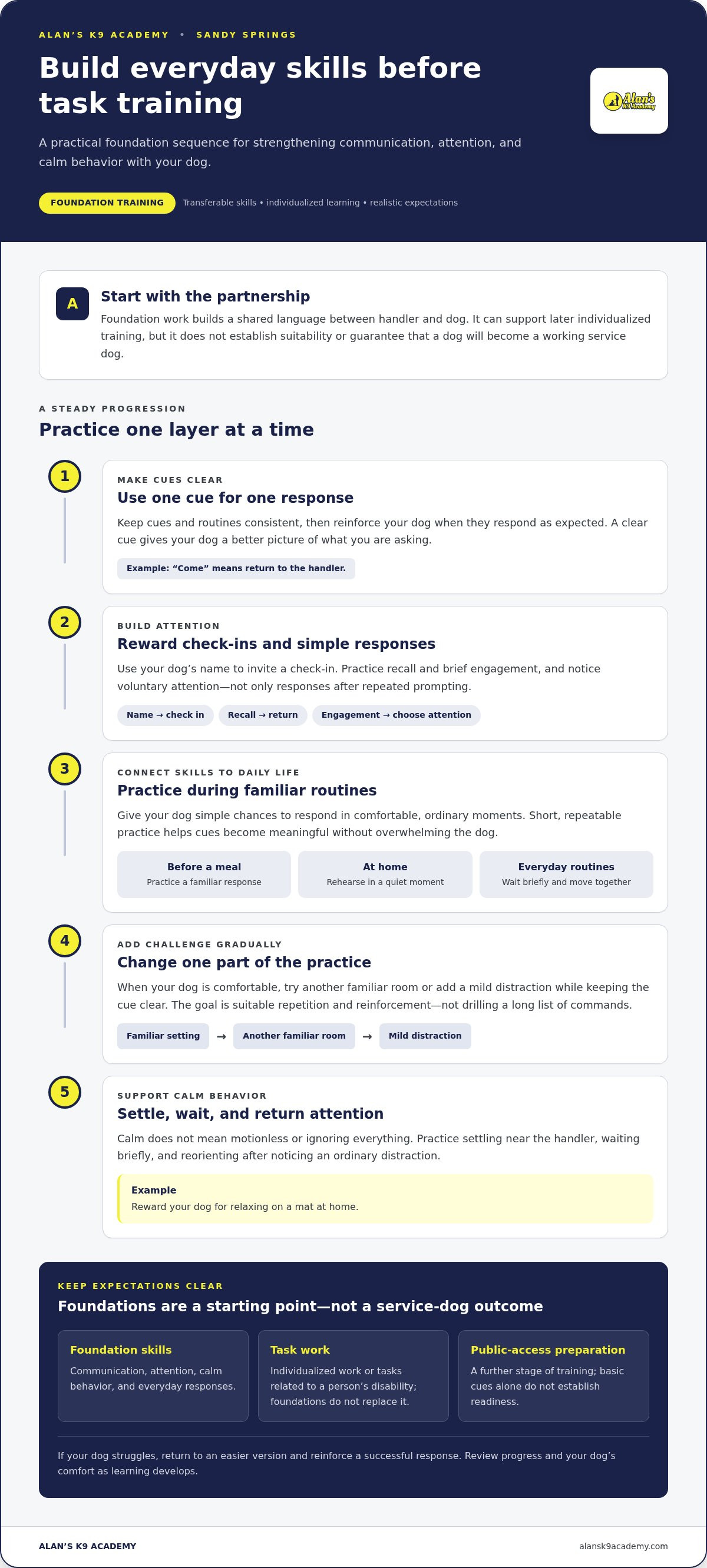
A Practical Foundation Training Roadmap for Sandy Springs
A useful training roadmap gives you direction without imposing a fixed timeline. Start with the handler’s priorities, build the skills that support those goals, and adjust practice as you learn how your dog responds. In Sandy Springs, home and neighborhood routines can provide familiar settings for gradual practice. You don’t need to turn every outing into a training test.
Clarify the handler’s priorities.
Think about the routines where you hope your dog can be a steady partner. Note what would be most useful to work on first, what your daily environment is like, and which cues your dog already understands. A clear starting point keeps sessions focused on your team’s needs.
Choose observable foundation goals.
Turn broad aims such as “be calmer” into a behavior you can notice and reinforce, such as settling near you briefly or checking in when you say your dog’s name. Choose one or two skills to focus on rather than changing several expectations at once.
Practice in an easy setting.
Begin in a familiar, low-distraction place at home. Keep the cue clear, give your dog time to respond, and reinforce the behavior you want to see. Short, focused sessions make it easier to identify what your dog understands and where they need support.
Add everyday complexity gradually.
Once a response is becoming consistent in one setting, try it in another familiar room or during a calm part of a regular walk. Change one element at a time, such as the location or level of distraction, and make the exercise easier if your dog has trouble staying engaged.
Review and adjust.
After practice, note what worked, what was difficult, and any questions that came up. Look for consistency and your dog’s ability to return attention after a distraction, not how quickly a skill is completed. Share those observations with a trainer so the next steps can reflect your dog’s responses and your routines.
Make practice fit the team
A trainer can adapt an exercise if a cue is unclear, a setting feels too challenging, or a dog needs more time before distractions are added. If a behavior concern is interfering with foundation practice, the plan may need a separate behavior-modification focus. That isn’t a failure. It’s a way to address what’s getting in the team’s way before adding more complexity.
For service dog training foundations Sandy Springs handlers can build into daily life, reliability grows through thoughtful repetition and review, not an arbitrary deadline. A related North Atlanta dog obedience guide explores real-world reliability concepts that can inform foundation practice. Alan’s K9 Academy offers personalized in-home dog training and therapy and service dog foundation training, with guidance shaped around the handler-dog team. Explore personalized training support to take a considered next step.
Starting Service Dog Foundation Training with Alan's K9 Academy
Once you understand what foundations can and can’t establish, choose a starting point that fits your dog and daily life. Alan’s K9 Academy serves Sandy Springs and the North Atlanta Metro area with therapy and service dog foundation training. Instruction is personalized and uses balanced, humane methods to build useful skills and clearer communication between handler and dog.
Founded by Master K9 Trainer Alan Carr, the academy brings over 35 years of professional dog-instruction experience to its work. That experience supports handlers as they navigate early training, while expectations remain realistic: no trainer can promise that a particular dog will become a service dog or complete every stage of training. The work begins with the team in front of you, its goals, existing skills, routines, and learning needs.
What personalized foundation support can address
In-home coaching connects practice to the places and routines that shape everyday life. A trainer can observe how your dog responds to familiar cues at home, help clarify expectations, and tailor foundation exercises to your partnership. For example, you can practice a routine involving waiting calmly or checking in with the handler in a familiar context before working toward greater consistency elsewhere.
This foundation instruction focuses on communication and foundational obedience that support future learning. It isn’t a substitute for individualized, disability-related task training, and it doesn’t establish that a dog is suited to service work. Keeping those expectations clear helps handlers focus on achievable learning goals rather than a label or predicted outcome.
Behavior modification is a related but distinct focus. If a behavior concern is interfering with learning or daily routines, behavior-modification training can address it as part of a tailored plan. It isn’t the same as general foundation instruction, and it doesn’t guarantee a particular result. The appropriate focus depends on the dog’s behavior and the handler’s needs.
Take the next step in Sandy Springs
You don’t need to have every future task mapped out before beginning foundation work. Start by identifying your goals, the routines you’d like to improve, and what your dog currently finds easy or challenging. Those details can help shape a practical starting point and keep early training relevant to your life in Sandy Springs.
Professional guidance provides structure and feedback as you build skills at a pace suited to your team. Alan’s K9 Academy serves handlers across the area, including Cartersville, Canton, Woodstock, Marietta, Rome, Acworth, Kennesaw, Sandy Springs, Roswell, Alpharetta, Powder Springs, Dallas, Hiram, Jasper, Cumming, Holly Springs, Ball Ground, and Milton. If you’re ready to discuss a starting point for service dog training foundations Sandy Springs handlers can work toward, explore service dog foundation training with Alan's K9 Academy.
Take One Thoughtful Step Forward
You don’t have to map out your dog’s entire future before beginning. Choose one practical priority, such as clearer communication during a familiar routine, and notice what helps your dog succeed. That gives you a useful starting point for your next training conversation while leaving room to adapt as you learn more about your partnership.
For handlers exploring service dog training foundations Sandy Springs, steady progress comes from building skills with care and keeping expectations realistic. Choose a next step that respects both your needs and your dog’s pace. Bring your questions, goals, and observations together to shape a thoughtful path forward.
Plan your dog’s foundation training next step. With patient practice and supportive guidance, you can move forward with greater clarity, one skill at a time.
Frequently Asked Questions
What are the foundations of service dog training?
Service dog training foundations are early, transferable skills that help a dog and handler communicate and learn together. They can include attention to the handler, calm behavior, responding to cues, and basic everyday responses. For example, practicing a consistent check-in routine helps the handler notice how the dog responds to guidance. Foundations prepare a team for further individualized training, but they can’t guarantee the dog will become a service dog.
Can any dog become a service dog?
No one can guarantee a dog’s suitability based on breed, obedience, or a brief evaluation. Temperament, health, ability to learn, and the handler’s needs may all affect whether service work is a suitable path. Foundation training can help you build skills and understand how your dog responds to learning. Treat progress as useful information about your team, not a promise of future working status.
When should service dog foundation training begin?
There isn’t one starting age that fits every dog. A useful beginning depends on your dog’s age, experience, behavior, and learning needs, as well as your goals. Start with achievable exercises your dog can practice comfortably, then build gradually as understanding develops. Professional guidance can help you choose a humane sequence if you’re unsure which skills to address first or how to structure practice.
What commands should a service dog learn first?
Begin with cues and responses that support clear communication, attention, recall, settling, and everyday routines. For example, practice a name response in a quiet room before trying it during a familiar household activity. Choose priorities based on what your dog understands now and what matters to you as the handler. There’s no universal checklist, and command performance alone doesn’t establish readiness. Individualized task work is a separate stage.
How long does service dog foundation training take?
Foundation training has no fixed timeline because progress depends on the dog, handler, starting skills, practice opportunities, and goals. Rather than measuring success by a deadline, observe whether a response is becoming more consistent and whether your dog can learn as practice settings gradually vary. If a skill becomes difficult, adjust the plan to make the next step manageable. This keeps training responsive to the team’s development.
Is basic obedience the same as service dog training?
No. Obedience foundations help a dog and handler communicate and develop dependable everyday responses, while task training teaches work tailored to a handler’s disability-related needs. These areas are related, but they aren’t interchangeable. Public-access preparation is another distinct part of a broader training pathway. For legal definitions or public-access information, consult current U.S. Department of Justice guidance rather than relying on obedience skills as a legal measure.
Does Alan's K9 Academy offer service dog foundation training near Sandy Springs?
Yes. Alan’s K9 Academy serves Sandy Springs and offers therapy and service dog foundation training. Its personalized instruction uses balanced, humane methods to shape practice around the handler-dog team. Training can support skill development, but it can’t guarantee suitability or a particular outcome. To get started, explore the academy’s approach and identify your goals and current challenges.