%20(620%20x%20150%20px)%20(14).webp)
%20(620%20x%20150%20px)%20(15).webp)
.webp)
_page-0001.webp)
.webp)

Reactive Dog Training: A Professional Guide to Stopping Leash Reactivity in 2026
In 2026, industry data reveals that over 70% of owners seeking professional reactive dog training reported that traditional treat-based methods failed them in high-distraction environments. You've likely felt that same hollow frustration. You're trying to enjoy a sunny afternoon in a Cartersville or...
%20(5).gif)
In 2026, industry data reveals that over 70% of owners seeking professional reactive dog training reported that traditional treat-based methods failed them in high-distraction environments. You've likely felt that same hollow frustration. You're trying to enjoy a sunny afternoon in a Cartersville or Marietta park, but your dog is a lunging, barking blur of motion the moment another pet appears. It's embarrassing, physically exhausting, and leaves you feeling anxious about potential injuries. You love your dog, but those neighborhood walks have become a stressful chore you'd rather avoid.
We believe your relationship with your companion should be built on trust, not tension. You can master the professional techniques to transform those explosive outbursts into calm, reliable focus with the help of a Master K9 Trainer. This guide provides a clear roadmap to help you understand the "why" behind the behavior while equipping you with real-world solutions. We'll explore how to build a dog that listens even when the world gets loud, ensuring your future walks are defined by peaceful connection rather than a tight leash.
Key Takeaways
• Understand that reactivity is a physiological response rather than a character flaw, helping you identify if your dog is acting as a "frustrated greeter" or a "fearful protector."
• Learn why professional reactive dog training is most effective when initiated in your dog’s natural home environment to build a foundation of safety and focus.
• Master real-world management strategies like the "Look at That" game and "U-Turn" cues to navigate tight spots and high-distraction areas with confidence.
• Discover how a balanced, humane approach to behavior modification creates clear communication and fair boundaries for a long-term transformation.
• Leverage 35+ years of expert insights to move from the embarrassment of explosive walks to the freedom of a calm, listening companion.
What is Reactive Dog Training and Why Does Your Dog Overreact?
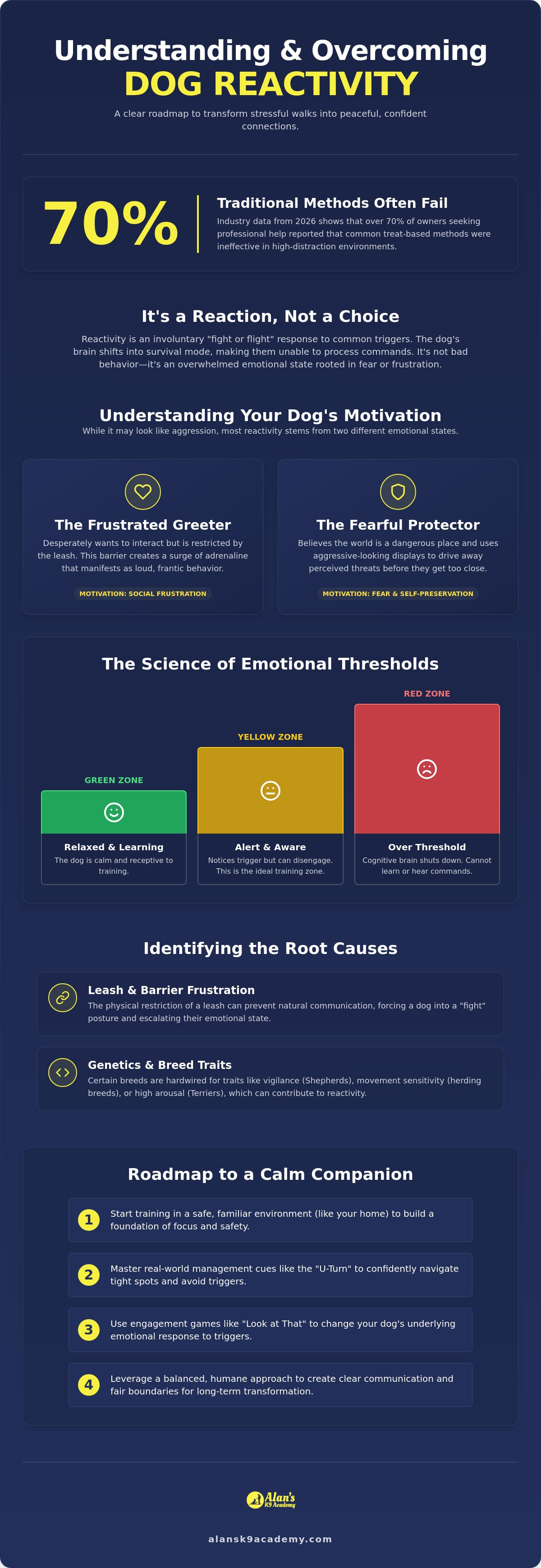
Reactivity isn't a choice your dog makes to spite you or ruin your walk. It is an abnormal physiological response to common environmental triggers. When a reactive dog spots a trigger, their sympathetic nervous system takes over, triggering a "fight or flight" response. This leads to the "explosion" many owners dread: frantic barking, lunging, and a complete inability to disengage from the target. At this moment, your dog isn't being "bad"; they are simply overwhelmed by a brain that has shifted into survival mode.
Common triggers often include other dogs, fast-moving joggers, bicycles, or even specific types of people. This behavior rarely happens in a vacuum. It's usually the result of a complex mix of genetics, a lack of proper socialization during puppyhood, or previous traumatic experiences that have left a lasting mark. By studying canine behavior fundamentals, we can see that reactivity is a communication breakdown. Your dog is using the only tools they have to manage their space and safety. Professional reactive dog training isn't about suppression; it's about teaching your dog that these triggers aren't threats that require a massive physical response.
Reactivity vs. Aggression: Knowing the Difference
Is your dog truly intent on causing harm, or are they just "loud but scared"? To a neighbor at the park, a lunging dog looks aggressive. However, there's a vital distinction. Most reactivity is rooted in fear or social frustration. A "frustrated greeter" might bark because they desperately want to say hello but are restricted by the leash. A fearful dog barks to create distance, hoping the "scary thing" will go away. While reactivity looks like aggression to the untrained eye, the motivations are different. If left unaddressed, however, the constant stress of reactivity can eventually escalate into true aggressive behavior. This is why early intervention with reactive dog training is so critical for long-term safety.
The Science of Thresholds
We visualize a dog's emotional state using three zones: Green, Yellow, and Red. In the Green Zone, your dog is relaxed and capable of learning. The Yellow Zone is the "alert" phase where they notice a trigger but can still look away or take a treat. The Red Zone is where they've crossed the line. Once your dog is over threshold, their cognitive brain shuts down. They can't hear your commands or feel the pull of the leash because they are flooded with adrenaline. Success depends on identifying your dog's specific distance threshold. We work in the Yellow Zone, gradually decreasing the distance while keeping the dog calm and focused on you.
Identifying the Root Cause: Fear, Frustration, or Genetics?
Identifying the specific motive behind your dog’s behavior is the first step in successful reactive dog training. Not every lunging dog is trying to start a fight. Some are "Frustrated Greeters" who desperately want to play but feel trapped by the leash. This restriction creates a surge of adrenaline that manifests as a loud, frantic tantrum. On the other hand, the "Fearful Protector" believes the world is a dangerous place. They use aggressive-looking displays to drive away perceived threats before they get too close. These two motivations require very different approaches to rehabilitation.
We also have to consider the physical feedback loop created by leash tension. When a leash is pulled tight, it restricts a dog's ability to use natural body language to communicate. This physical restriction often forces a dog into a "fight" posture, escalating their emotional state from mild concern to a full-blown explosion. Learning to manage this tension is a vital skill for any owner of a reactive dog.
Environmental Triggers in North Atlanta
Managing these behaviors becomes even more challenging in high-distraction areas like the Marietta Square or local hiking trails. The sheer density of people and other pets can push a dog over their threshold instantly. In suburban neighborhoods like Cartersville, "neighborhood pressure" from barking dogs behind fences can keep your dog’s stress levels elevated even before you leave the driveway. We also see a high incidence of "barrier frustration," where dogs become reactive only when looking through a window or a fence, which eventually bleeds into their behavior on a leash.
The Owner's Emotional Mirror
Your dog is a master at reading your body language. When you see another dog and instinctively tighten the leash, you're sending a clear signal down the line: "Something is wrong." This tension tells your dog that a threat is near, validating their need to react. Breaking the cycle of "walking on eggshells" is a major component of our behavior modification programs. We'll show you how to maintain a loose leash and a steady heart rate, even in stressful moments. Calm handling is the foundation of behavioral rehabilitation. When you change your response, you give your dog the permission they need to change theirs.
In-Home Training vs. Group Classes: Which is Best for Your Dog?
Choosing the right setting for reactive dog training is the most critical decision you'll make for your dog's progress. Many owners feel pressured to jump straight into group classes, hoping for quick socialization. However, for a dog already lunging or barking at every trigger, a crowded class can be a recipe for disaster. We consider private, in-home training the gold standard for severe reactivity because it prioritizes emotional safety. By starting in a controlled environment, we ensure your dog stays below their threshold, preventing the stressful setbacks that often occur in public settings. You don't want your dog's first lesson to be a traumatic experience; you want it to be a win.
Working in your dog's "natural habitat" provides insights that a generic training center cannot. Your dog's behavior is often tied to specific local triggers. Whether it's the high-traffic chaos of Kennesaw Mountain trails or the bustling foot traffic near Marietta Square, your home and neighborhood are where the real challenges happen. We need to see how your dog reacts to the mail carrier or the neighbor's barking dog to build a plan that actually works in your daily life. This real-world context is what makes behavior modification stick long after the trainer leaves.
The Benefits of Personalized In-Home Sessions
Private sessions offer one-on-one attention from a Master Trainer without the overwhelming distraction of other dogs. We tailor every exercise to your household layout and your specific neighborhood walk routes. This focused approach builds a foundation of trust and clear communication where your dog feels safest. It's about giving you the hands-on skills to handle real-world scenarios before we even think about heading into more crowded environments. We focus on your specific needs, ensuring you have the confidence to lead your dog through any situation.
When Group Classes Make Sense
Socialization should be a secondary step, never a first-line treatment for reactivity. We only recommend transitioning to structured group classes once your dog has mastered basic focus and disengagement in private settings. In these supervised environments, your dog learns to work around "neutral" dogs, which are pets that aren't going to bark back or challenge them. This is where we "proof" your dog's obedience under real-world distractions, ensuring the lessons learned at home stick even when you're out in public. It's a methodical progression that turns a reactive dog into a reliable companion.
Proven Strategies to Manage and Fix Leash Reactivity
Avoidance is a temporary fix, but it isn't a long-term cure. While some advice suggests simply staying away from triggers, true reactive dog training focuses on changing your dog's underlying emotional state. We use counter-conditioning to shift their response from "That dog is scary!" to "That dog means I get a treat!" This process requires patience and precision. By pairing the sight of a trigger with high-value rewards, you teach your dog that the presence of other animals or people predicts something wonderful. Over time, the sight of a bicycle or another pet becomes a cue for them to check in with you rather than exploding.
We also utilize the "Look at That" (LAT) game to build active engagement. In this exercise, you reward your dog for calmly noticing a trigger and then immediately looking back at you for guidance. It gives your dog a job to do. If you find yourself in a tight spot on a narrow trail, emergency management cues like the "U-Turn" or "Find It" can save the day. A quick U-turn allows you to exit a high-pressure situation before your dog reaches their threshold. Scattering treats on the ground with a "Find It" command uses their sense of smell to lower their heart rate and redirect their focus downward.
Mastering the Walk: Gear and Handling
The equipment you choose directly impacts your success. We strongly advise against retractable leashes for reactive dogs. These leashes offer zero control, and the constant tension they apply can actually increase a dog's anxiety. Instead, use a sturdy six-foot leather or nylon leash. Proper handling is equally vital. Avoid wrapping the leash tightly around your hand, as this signals your own panic to the dog. Focus on keeping your shoulders relaxed and the leash loose whenever possible. If you need professional help choosing the right tools for your specific situation, our behavior modification experts can provide a personalized assessment.
Building Focus and Engagement
A reliable "Focus" or "Watch Me" command is your best defense under pressure. Start practicing this in your living room where it's quiet, then gradually move to your backyard before trying it on a walk. When your dog makes a breakthrough, such as choosing to look at you instead of barking at a passing car, use the "Jackpot" method. This means delivering several high-value treats in rapid succession to mark the importance of that choice. Finally, remember the "Three-Second Rule" for public life. If your dog is allowed to sniff or greet, keep the interaction to three seconds or less. This prevents the arousal levels from climbing too high and ending in a reactive outburst.
Between training sessions, don't forget the power of decompression walks. These are not training walks. Take your dog to a quiet, low-traffic field in Cartersville or a secluded trail where they can explore on a long line. Allowing them to sniff and move freely helps lower their overall cortisol levels, making your structured training sessions much more effective.
The Alan's K9 Academy Approach to Behavior Modification
Alan's K9 Academy provides the professional authority needed to handle even the most complex behavioral challenges. With 35+ years of experience, Master Trainer Alan Carr has seen every possible reaction and remains unfazed by explosive behavior. We know the daily stress you're under, and our mission is to move you from a state of overwhelm to a feeling of hope and control. Professional reactive dog training is more than just a series of commands; it's a total transformation of your dog's mindset and your own confidence as a handler.
Our balanced and humane philosophy fills a critical gap for owners of high-drive dogs who have found that other methods don't hold up under extreme pressure. We use clear communication and fair boundaries to create a language your dog actually understands. This structure is a form of relief for a reactive pet. It removes the burden of them needing to "protect" or "react" because they know you're handling the situation. We focus on reliability, ensuring your dog's new skills work in the face of real-world triggers, not just in a quiet living room.
Every family in Georgia has a unique dynamic, so we reject "cookie-cutter" solutions. Your reactive dog training program is built from the ground up to fit your household lifestyle and your dog's specific temperament. Whether you're managing a busy home with children or a quiet life in the suburbs, we ensure the training is meaningful and sustainable. We're committed to building lasting communication between you and your companion that stands the test of time.
Real-World Rehabilitation in North Atlanta
We believe that training isn't finished until it works where life actually happens. Our rehabilitation process moves into real-world settings like local parks, stores, and neighborhood streets to proof every command. We serve clients across Cartersville, Woodstock, Alpharetta, and the surrounding Metro area, taking the work to the very places where you've previously struggled. Seeing a dog go from "untrainable" to "unshakeable" in a high-distraction environment is the ultimate proof of our commitment to your success.
Getting Started with Professional Help
The path to a peaceful walk begins with a comprehensive in-home behavioral assessment. We'll sit down with you to analyze your dog's history, identify specific triggers, and map out a clear roadmap for rehabilitation. You can move from the stress of reactive chaos to the freedom of a reliable, focused companion. Learn more about our In-Home Dog Training and discover how we can help you reclaim your relationship with your dog today.
Reclaim the Joy of Walking Your Dog
Living with a reactive pet doesn't mean you're destined for a lifetime of stressful walks and park-side embarrassment. You now understand that reactivity is a physiological response, not a character flaw. By identifying your dog's specific triggers and starting your reactive dog training in the safety of your own home, you can bridge the gap between chaos and calm. Whether your dog is a "frustrated greeter" or a "fearful protector," the right professional guidance makes the impossible feel manageable again.
Master K9 Trainer Alan Carr has spent over 35 years refining award-winning behavior modification programs for families across the North Atlanta Metro. We focus on building a partnership based on clear communication and humane boundaries. You deserve to enjoy your neighborhood strolls in Cartersville or Marietta without the constant fear of an outburst. It's time to move from a state of overwhelm to a feeling of total control.
Ready to transform your walks? Schedule your In-Home Behavioral Assessment today!
Your dog's transformation is waiting. We're here to help you every step of the way.
Frequently Asked Questions
Is it ever too late to start reactive dog training?
It is never too late to start reactive dog training. Dogs are incredibly resilient and capable of learning new behaviors at any age, from energetic puppies to seniors. While older dogs may have more ingrained habits, our balanced methods focus on shifting their emotional response to triggers. With patience and a customized plan, you can significantly improve the quality of life for your older companion.
Can I train a reactive dog myself, or do I need a professional?
While you can practice basic focus at home, professional guidance is essential for managing reactivity safely. A Master Trainer identifies the subtle body language cues you might miss and ensures you aren't accidentally rewarding the wrong behavior. Professional help provides a structured roadmap that prevents setbacks and protects both you and your dog during the rehabilitation process.
How long does it take to see results with a reactive dog?
You should expect to see manageable improvements in your dog's focus within the first few sessions of reactive dog training. However, full behavioral transformation is a marathon, not a sprint. While we can often achieve a calmer state relatively quickly, long term reliability in high-distraction areas like Marietta Square requires months of consistent practice and reinforcement.
Should I use a muzzle during reactive dog training sessions?
Using a muzzle is a responsible safety choice, not a sign of failure. If your dog has a history of nipping or if you feel anxious during walks, a properly fitted basket muzzle provides a vital safety net. This allows you to stay calm and focused on the training exercises without worrying about a potential physical altercation or injury.
Will my dog ever be able to play with other dogs again?
Every dog is different, but the ultimate goal is a dog that can exist calmly in public spaces. Some dogs will eventually return to structured play with known companions, while others may simply become "dog neutral." We focus on ensuring your dog can walk past another pet without an explosion, giving you the freedom to enjoy public parks again.
What is the difference between a reactive dog and an aggressive dog?
Reactivity is an overreaction to a stimulus, while aggression is the actual intent to cause harm. A reactive dog might bark and lunge out of fear or frustration, essentially throwing a distance-increasing tantrum. If these signals are ignored or punished harshly, the behavior can escalate into true aggression, which is why early professional intervention is so important.
To ensure a safe and effective approach to this intervention, I Wuff You Dog Training offers expert canine behavior consulting to help owners distinguish between these behaviors and create a tailored plan for their pet.
Does 'balanced training' involve harsh punishment?
Balanced training at Alan's K9 Academy focuses on clear communication and fair boundaries, not harsh punishment. We use high-value rewards to encourage desired behaviors while providing the structure your dog needs to feel secure. This approach ensures your dog understands exactly what is expected of them, which naturally lowers their stress and arousal levels during walks.
Why is my dog only reactive when on a leash?
Many dogs are only reactive on a leash because they feel trapped and unable to use their natural flight instinct. When a dog cannot move away from a perceived threat, they often resort to a loud fight display to drive the trigger away. This leash frustration is a common issue we address by teaching your dog that you are in control of their safety.