%20(620%20x%20150%20px)%20(14).webp)
%20(620%20x%20150%20px)%20(15).webp)
.webp)
_page-0001.webp)
.webp)
Puppy Training Programs: The 2026 Guide to Foundation Training
What if the secret to a calm, well-behaved dog isn't teaching commands, but transforming how your household communicates? If you're running on broken sleep from midnight potty alarms, nursing scratches from needle-sharp teeth, and worrying about how to socialize your companion safely before their fi...
%20(5).gif)
What if the secret to a calm, well-behaved dog isn't teaching commands, but transforming how your household communicates? If you're running on broken sleep from midnight potty alarms, nursing scratches from needle-sharp teeth, and worrying about how to socialize your companion safely before their final vaccines, you aren't alone. It's completely normal to feel exhausted. The most effective puppy training programs don't just drill basic obedience; they focus on your daily home environment and coach you to build a lasting, two-way connection.
You deserve a clear path toward a polite puppy that respects crate routines, ignores household temptations, and handles new environments with ease. In this 2026 guide, you'll discover how to evaluate puppy training programs to build real-world obedience, reliable house manners, and rock-solid confidence. We'll break down essential curriculum milestones, compare the distinct advantages of personalized in-home coaching versus structured group classes, and give you the exact criteria needed to choose the right professional training partner for your family.
Key Takeaways
• Understand why comprehensive puppy training programs focus on proactive developmental milestones and emotional regulation rather than just quick obedience tricks.
• Compare the distinct advantages of private in-home coaching and structured group classes to match your puppy's immediate social and behavioral needs.
• Identify essential curriculum pillars every reliable foundation course must cover, including proper crate conditioning, potty rhythms, and impulse control.
• Use a proven checklist to assess a trainer's hands-on experience, methodology, and ability to coach every member of your household.
• Discover how tailored in-home foundation work establishes permanent two-way communication and seamless daily routines for your family.
What Are Professional Puppy Training Programs and Why Do They Matter?
Bringing home an eight-week-old puppy often feels like stepping into a whirlwind of shredded paper, needle-sharp teeth, and interrupted sleep. While casual online forums often suggest that raising a dog simply requires patience and a bag of treats, structured developmental guidance tells a different story. Professional puppy training programs provide an intentional framework that shapes a dog's lifelong temperament, impulse control, and household manners. Rather than chasing isolated symptoms through disjointed internet tips, expert-led training targets biological milestones before minor bad habits become deeply ingrained adult problems.
Modern dog training recognizes that your puppy's brain is undergoing rapid neurological changes. Early guidance balances crucial real-world exposure with household structure, preventing the severe adolescent behavioral regressions that frequently emerge around eight to twelve months of age.
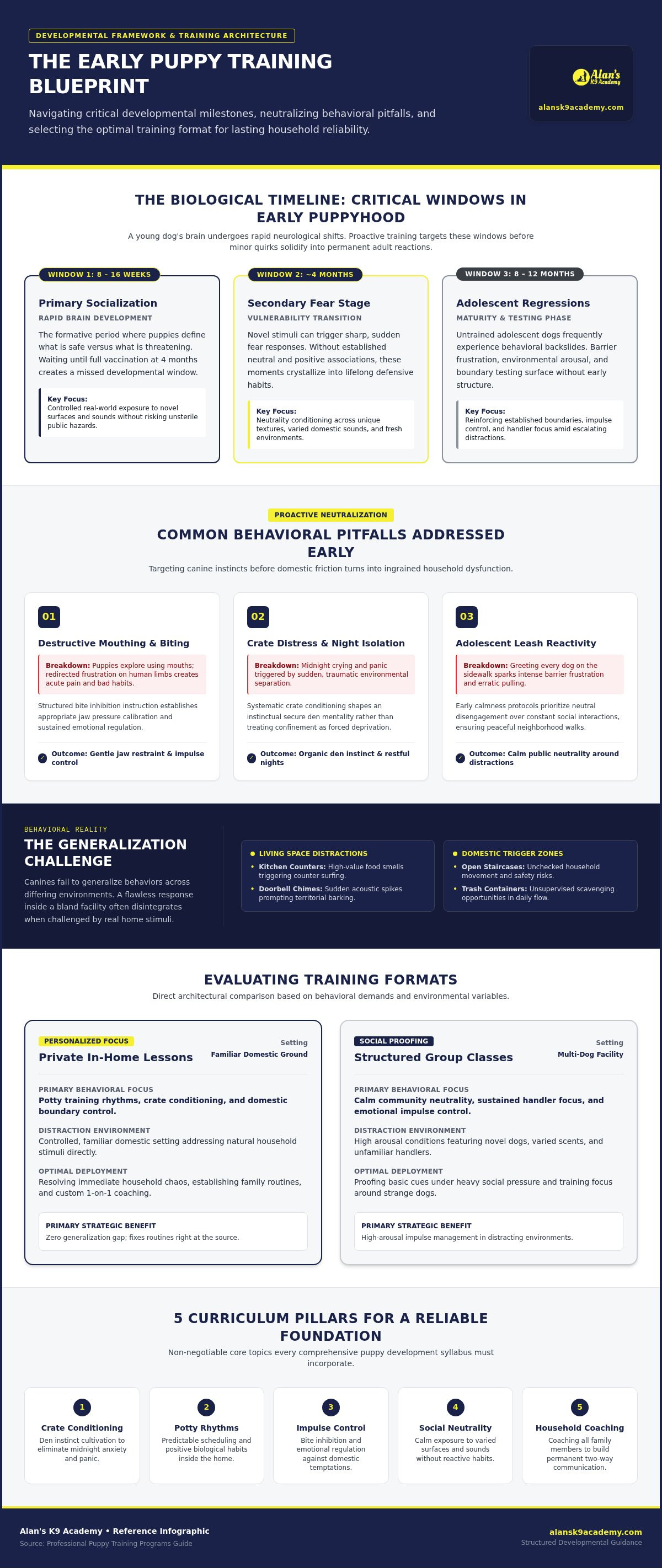
The Critical Developmental Windows in Early Puppyhood
Between 8 and 16 weeks of age, your puppy experiences their primary socialization window. During this brief phase, their brain forms foundational impressions about what is safe and what is threatening. Many owners face a difficult dilemma during this period: how do you properly socialize a young puppy before their full vaccination series is finished? Waiting until four months old to step outside often means missing this formative period entirely.
Around four months of age, secondary fear stages emerge. If a pup has not formed positive, neutral associations with unique surfaces, household sounds, and varied environments, sudden fear responses can crystallize into permanent defensiveness. Professional coaching teaches you how to safely introduce novel stimuli without risking disease exposure on contaminated public grounds.
Common Behavioral Pitfalls Prevented by Early Training
Without structured guidance, natural canine instincts clash directly with domestic living. Early training proactively neutralizes the most frustrating household breakdowns before they escalate:
Destructive Mouthing and Play-Biting
Puppies explore with their mouths, but redirected frustration on human hands quickly turns painful. Structured bite inhibition teaches appropriate jaw pressure and emotional regulation.
Crate Distress and Separation Anxiety
Chronic crying at night usually stems from sudden isolation panic. Systematic crate conditioning creates an organic den instinct rather than feelings of confinement.
Adolescent Leash Reactivity
Allowing your puppy to greet every dog on the sidewalk builds intense barrier frustration. Teaching calm neutrality early ensures walks remain peaceful as your dog grows.
Investing in comprehensive puppy training programs during early development builds a dependable companion who feels secure, predictable, and confident inside your home and out in the community.
Types of Puppy Training Programs: In-Home Lessons vs. Group Classes
Every dog learns within the context of their immediate environment. A common heartbreak for pet owners is watching their pup execute a flawless sit inside a commercial training center, only to ignore basic cues the second they step foot back in the living room. Dogs struggle to generalize behaviors across different settings. Selecting between different puppy training programs comes down to identifying where your dog's most urgent behavioral gaps exist.
| Training Format | Primary Behavioral Focus | Distraction Environment | Best For |
|---|---|---|---|
| Private In-Home Lessons | Potty training, crate conditioning, boundary control | Controlled, familiar domestic setting | Resolving specific household chaos and family routines |
| Structured Group Classes | Calm neutrality, handler focus, impulse control | High arousal with novel dogs and owners | Proofing focus amidst real-world canine distractions |
In-Home Puppy Training: Tailored Environmental Control
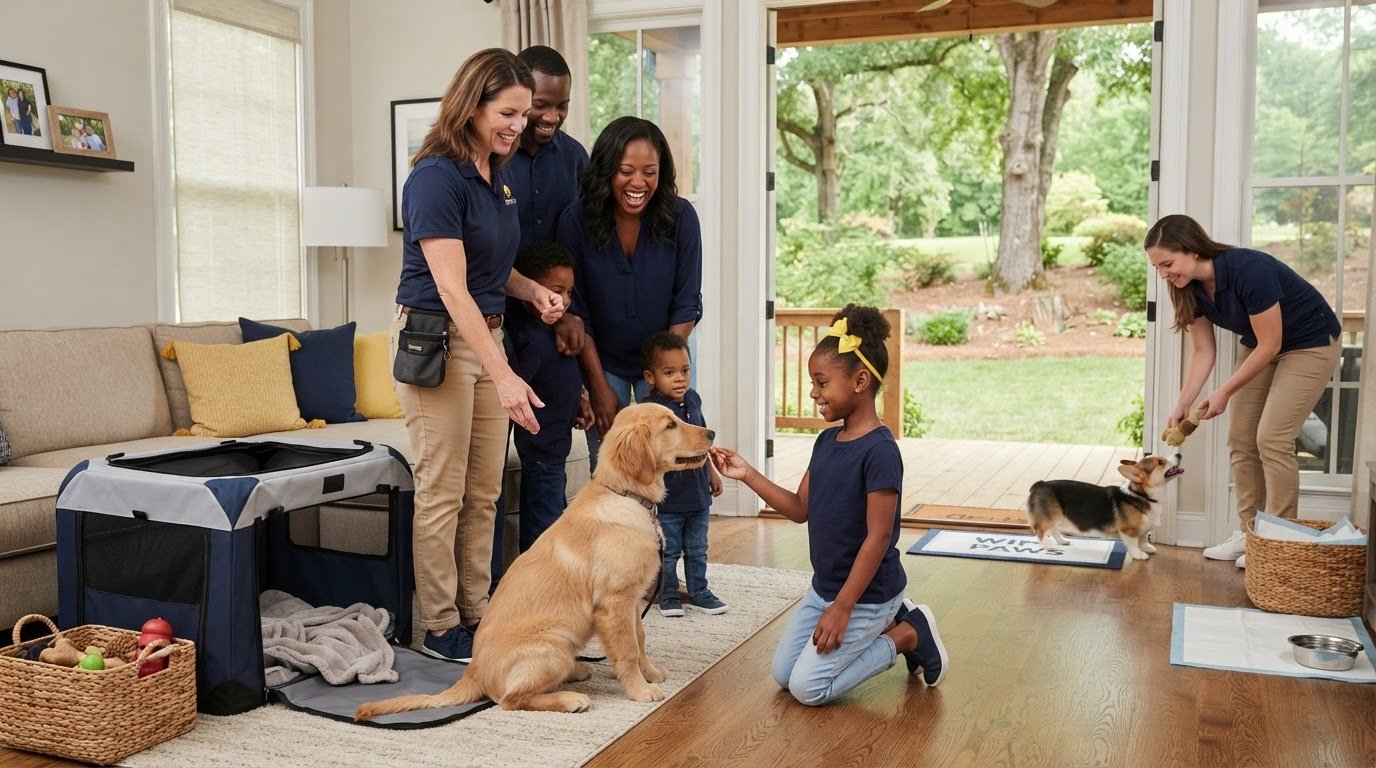
Living spaces present unique temptations that commercial facilities simply cannot replicate. High-value trash cans, open staircases, tempting kitchen counters, and the sudden doorbell chime all trigger immediate arousal. Investing in private in home dog training allows a professional to address jumping on furniture, doorway darting, and mouthing right where they happen.
Equally important, in-home training structures an airtight housebreaking rhythm. By evaluating your home's layout and your family's schedule, a trainer builds potty and rest routines that stop accidents before they start.
Group Puppy Classes: Socialization and Distraction Proofing
Group classes serve a completely different developmental goal: teaching emotional regulation around peers. True canine socialization does not mean allowing your puppy to engage in uncontrolled, chaotic wrestling matches. Instead, it teaches your dog to look to you for direction while other dogs are moving nearby.
A properly sanitized group setting provides controlled exposure while reducing the risk of disease before final vaccinations are completed. Working around unfamiliar sights and smells prevents your puppy from becoming hyper-reactive on future neighborhood walks.
Many families achieve the greatest success by pairing foundational domestic lessons with structured group settings. If you want a tailored approach that fits your household's exact rhythm, partnering with Alan's K9 Academy gives you the hands-on owner coaching needed to build true obedience at both ends of the leash.
Core Curriculum: What Every Great Puppy Program Must Cover
Teaching a dog to sit on cue takes five minutes. Teaching that same puppy to pause, control their impulses, and settle calmly when guests arrive takes intentional behavioral conditioning. High-caliber puppy training programs move far beyond static obedience tricks. They prioritize emotional regulation, frustration tolerance, and clear two-way communication.
Housebreaking and Crate Conditioning Foundations
Reliable housebreaking depends on biology, not luck. A comprehensive curriculum establishes bathroom timing based on your dog's natural sleep, wake, and digestion cycles. Puppies must eliminate immediately after waking, playing, or eating. By using proactive schedules and supervisory tethering, keeping the pup gently leashed to you indoors, you eliminate indoor accidents before they turn into habits. Paired with gradual crate acclimation, this routine transforms the crate into a restful sanctuary that prevents nighttime distress and separation anxiety.
Bite Inhibition and Impulse Control Exercises
Razor-sharp puppy teeth can leave hands bruised and owners overwhelmed. Quality programs don't just scold mouthing; they teach bite inhibition. Handlers learn to immediately redirect teething onto texture-specific rubber or rope toys, teaching soft mouth pressure. Trainers introduce impulse control through structured wait games around high-value food bowls and doorway thresholds. Rather than forcibly prying stolen socks from a puppy's jaw, trainers teach positive trade games, preventing defensive resource guarding before it starts.
Safe Environmental Exposure and Neutral Socialization
Socialization is often misunderstood. It is not about letting your companion greet every stranger or wrestle with every dog on the sidewalk. True socialization produces calm neutrality. Modern puppy training programs build environmental resilience through structured, low-stress exposure:
Acoustic Desensitization
Neutral conditioning to sudden household sounds like vacuum cleaners, doorbells, and dropped pans.
Tactile Exploration
Confident navigation across novel, uneven surfaces such as open metal grates, wobbly ramps, and slick hardwoods.
Leash Engagement
Foundational loose-leash mechanics that reward handler focus instead of frantic forward pulling.
Mastering these core pillars transforms a chaotic bundle of energy into an attentive, adaptable family companion.
How to Choose the Right Puppy Training Program for Your Dog
Anyone can buy a domain name, put on a treat pouch, and market puppy lessons online. Because the pet industry lacks mandatory state or federal licensing, the responsibility falls squarely on you to verify who guides your young companion. Selecting among local puppy training programs requires looking past glossy marketing to assess hands-on methodology, real field experience, and how actively the curriculum involves your household.
A dependable vetting process protects both your puppy's emotional well-being and your peace of mind. Use these five steps to evaluate any prospective program:
Identify Your Core Challenge
Determine whether you need in-home intervention for potty accidents and doorway chaos or a group environment for distraction proofing.
Verify Real-World Experience
Look for an instructor with documented success handling varied breed drives, ranging from tenacious working breeds to sensitive companion pups.
Evaluate the Training Philosophy
Insist on balanced, humane methods that focus on clarity, fair boundaries, and relationship-building rather than intimidation or pure bribery.
Confirm Direct Owner Coaching
Ensure the trainer coaches you and your family hands-on, teaching you to read body language and handle mechanics smoothly.
Keep Puppies with Their Families
Keep young pups in their home environment during formative fear periods rather than handing them off to offsite board-and-train facilities.
Key Questions to Ask a Prospective Puppy Trainer
Before enrolling, ask specific questions about how the instructor handles daily challenges. How do they address intense play-biting and boundary testing when high-value treats lose their appeal? Will lessons take place directly in your living room where issues happen, or are they confined to a sterile offsite facility? Finally, ask how many decades of practical field experience the master instructor brings to the table.
Red Flags to Avoid When Researching Local Programs
Watch out for quick-fix promises. Any business guaranteeing 100% off-leash obedience in a ten-week-old puppy is selling unrealistic illusions. A baby dog's neurological development cannot be rushed. Steer clear of programs that push one-size-fits-all curricula, ignoring your dog's distinct temperament. Above all, reject operations offering board-and-train for young puppies. Sending an eight-to-twelve-week-old pup away separates them from their primary bond during critical developmental periods, creating unnecessary detachment stress.
Ready to build a reliable, well-mannered companion with support tailored directly to your home? Discover how Alan's K9 Academy combines over 35 years of master-level expertise with personalized, in-home guidance.
Building Lifelong Reliability with In-Home Puppy Coaching
Real-world reliability isn't forged in a sterile classroom. It takes root right where your daily life unfolds: between the kitchen island, the front entryway, and the backyard fence. While many puppy training programs offer broad guidelines, personalized in-home foundation coaching stands as the premier standard for lasting success. Working inside your living environment allows a trainer to observe and adjust subtle family habits that unintentionally reward pushy behavior. Early, balanced guidance establishes clear boundaries from day one, preventing minor quirks from spiraling into costly behavioral issues when your dog reaches maturity.
Customizing Training to Your Home and Family Dynamics
Every household operates on a distinct rhythm. Children run through living rooms, work calls demand quiet hours, and guests arrive unannounced. In-home coaching brings the entire household together to establish unified verbal cues and handling mechanics. When one person says "off" while another says "down," puppies get confused. Direct coaching resolves location-specific triggers, such as front-door jumping or counter cruising, exactly where they happen. If you live in Northwest Georgia, exploring specialized in-home puppy training in Cartersville provides your family with a customized roadmap tailored directly to your floor plan and lifestyle.
Preparing for the Transition to Adult Obedience
Puppyhood passes in the blink of an eye. Around six to eight months of age, natural hormone surges and emerging independence test every routine you've established. Solid puppy training programs lay the groundwork for this shift, smoothly transitioning early engagement games into dependable adult obedience:
Extended Duration and Distance
Turning short sits into calm, extended place commands while your family eats dinner.
Emergency Recalls
Conditioning an enthusiastic, non-negotiable recall cue that cuts through unexpected outdoor distractions.
Adolescent Stability
Reinforcing emotional neutrality before secondary fear periods turn into frustrating leash reactivity.
As your puppy grows, continuing with structured dog obedience training ensures those early good manners mature into real-world control across any setting. You don't have to navigate these developmental leaps through trial and error. Contact Alan's K9 Academy to schedule your custom in-home puppy consultation and give your companion the foundation they deserve.
Set Your Puppy Up for a Lifetime of Success
Navigating puppyhood shouldn't feel like an endless cycle of sleepless nights, chewed baseboards, and second-guessing your every move. The best puppy training programs aren't designed around performing rigid routines in a vacuum. Instead, they transform your day-to-day household dynamic, giving your puppy the emotional stability, clear boundaries, and polite domestic manners needed to thrive alongside your family.
Led by Master K9 Trainer Alan Carr, who brings over 35 years of professional experience, our team specializes in personalized in-home foundation coaching across North Atlanta and Bartow County. We utilize proven, balanced, and humane methods that build genuine two-way communication and lasting household confidence. When everyone in your home shares a unified approach, real progress happens quickly.
Take the guesswork out of early development. Schedule your in-home puppy evaluation with Alan's K9 Academy today, and take the first step toward enjoying the calm, reliable companion you've always envisioned.
Frequently Asked Questions
At what age should my puppy start a professional training program?
Puppies can start foundation training as early as eight weeks old, the moment they arrive in your home. Early developmental guidance focuses on house manners, crate comfort, and gentle bite inhibition rather than formal adult commands. Starting early capitalizes on your pup's critical neurological development window, establishing solid routines before unwanted habits form. Professional puppy training programs ensure you build clear communication right from day one.
Can my puppy attend training classes before receiving all vaccinations?
Yes, puppies can participate in properly managed environments before receiving their final booster shots. Veterinary behavior guidelines emphasize that the developmental risks of zero early socialization often outweigh infection risks when precautions are taken. In-home lessons eliminate public exposure risks entirely. For group settings, choose reputable facilities that require age-appropriate vaccines, enforce strict sanitation protocols, and prohibit sick dogs from entering the training floor.
What is the main difference between in-home puppy training and group puppy classes?
In-home training targets domestic habits inside your living space, such as crate anxiety, potty routines, and doorway manners. It tailors instruction directly to your family's daily lifestyle. Group classes, by contrast, focus on teaching your puppy to stay calm and responsive around novel dogs and handlers. Many families across North Atlanta start with in-home foundation work before using group environments to proof obedience under real-world distractions.
Why shouldn't I send my young puppy to a board-and-train program?
Young puppies need to bond with their human family during their early developmental stages. Sending an eight-to-sixteen-week-old puppy away introduces intense separation stress during critical fear periods. More importantly, board-and-train facilities don't teach you the handling skills needed to maintain rules at home. Puppies must learn to respect your living room, your kids, and your schedule alongside you, not an unfamiliar kennel staff.
How long does it take to housebreak a puppy with a structured routine?
With a consistent schedule, most puppies develop dependable daytime housebreaking within two to four weeks. Full physiological bladder control generally solidifies around five to six months of age. Success depends entirely on your management: taking the pup out on leash after every meal, nap, and play session, while eliminating unsupervised indoor freedom. Tracking bathroom cycles prevents accidents and establishes an organic habit of eliminating outdoors.
What should I do if my puppy nips and bites constantly during playtime?
Immediately redirect your puppy's teeth onto a durable chew toy the second mouth contact occurs. Avoid pulling your hands away rapidly or yelling, as puppies interpret dramatic movement as playful prey drive. If your puppy persists or gets overstimulated, calmly stand up, cross your arms, and disengage completely for thirty seconds. Providing structured naps also helps, since constant biting often signals an overtired puppy needing quiet crate rest.
How do I socialize my puppy without overwhelming them or causing fear?
Focus on calm, neutral exposure from a safe distance rather than forcing direct physical interactions. Socialization is about teaching your puppy that novel stimuli are safe and non-threatening. Let them observe passing strollers, strange surfaces, and unfamiliar noises while rewarding them for relaxed eye contact with you. High-quality puppy training programs emphasize gentle, voluntary exploration, ensuring your companion builds genuine confidence without tipping into defensive fear.