%20(620%20x%20150%20px)%20(14).webp)
%20(620%20x%20150%20px)%20(15).webp)
.webp)
_page-0001.webp)
.webp)
.jpg)
Public Access Dog Training: Professional Guide (2026)
Imagine walking into a busy storefront and having your dog immediately settle at your feet, ignoring the clatter of carts and the smell of fresh popcorn. For many, this feels like an impossible dream. Most owners know the stress of a dog that listens perfectly in the kitchen but forgets every comman...
%20(5).gif)
Imagine walking into a busy storefront and having your dog immediately settle at your feet, ignoring the clatter of carts and the smell of fresh popcorn. For many, this feels like an impossible dream. Most owners know the stress of a dog that listens perfectly in the kitchen but forgets every command the moment they hit a sidewalk in North Atlanta. It's embarrassing to deal with leash pulling or barking when you just want to enjoy a quiet outing. Public access training for dogs is the bridge that turns a well-behaved pet into a reliable, neutral partner in any environment.
At Alan's K9 Academy, we specialize in moving beyond simple obedience to achieve real-world reliability. This guide provides the expert roadmap you need to transition your dog from the living room to the lobby with confidence. You'll learn the essential foundation skills to master at home, a graduated plan for visiting local businesses, and how to navigate the legal complexities of the ADA. We're here to help you move from a state of overwhelm to a feeling of total control during every public outing.
Key Takeaways
• Understand the critical legal distinctions between pet-friendly spaces and the elite standards required for public access training for dogs.
• Learn why the "Living Room First" philosophy is the essential starting point for building real-world reliability in North Atlanta.
• Master a graduated, two-level approach to transition your dog from quiet local parks to high-distraction retail environments with confidence.
• Identify and solve common public challenges like leash reactivity and floor scavenging using professional, hands-on techniques.
• Discover the specific criteria of the Public Access Test (PAT) and how to avoid "no-go" behaviors that lead to automatic failure.
What is Public Access Training for Dogs?
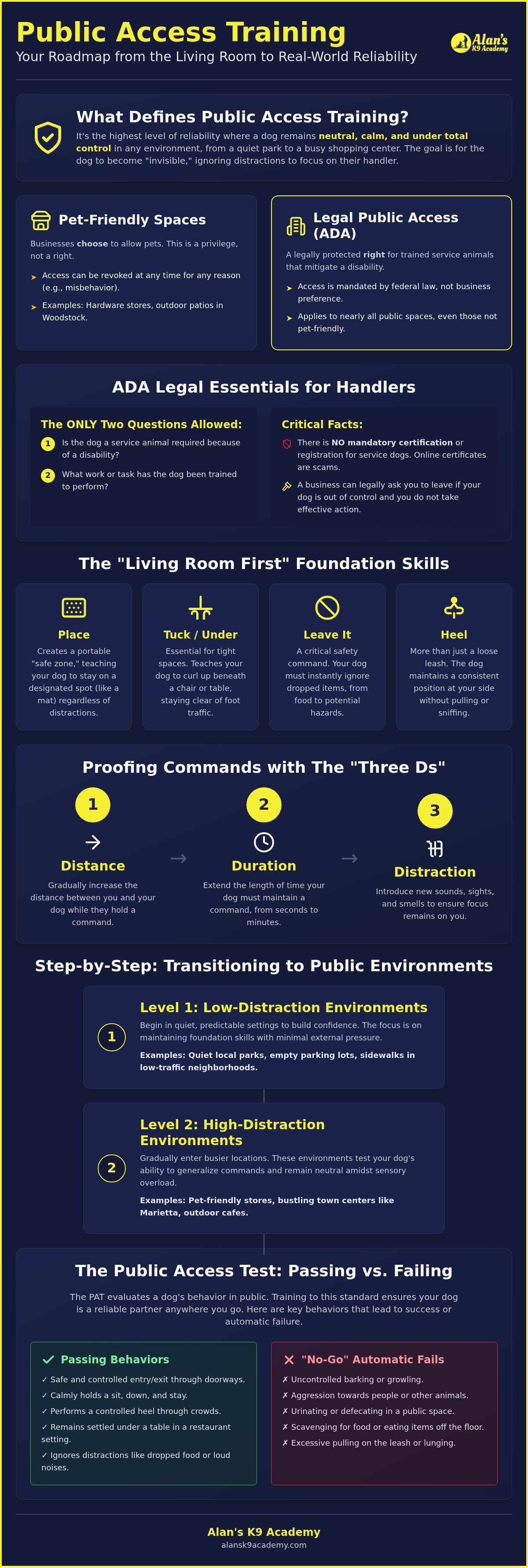
Public access is the ability of a dog to remain neutral, calm, and under total control regardless of the environment. It's the highest level of behavioral reliability a team can achieve. While many dogs are well-behaved in their own backyards, public access training for dogs ensures they can handle the sensory overload of a busy North Atlanta shopping center or a crowded office building. It moves beyond simple commands to achieve a state where the dog essentially becomes "invisible" in public spaces, ignoring the chaos around them to focus entirely on their handler.
We often see confusion regarding where dogs are legally allowed to go. Pet-friendly businesses, like certain hardware stores or outdoor patios in Woodstock, choose to allow animals, but they can revoke that permission at any time if a dog misbehaves. In contrast, legal public access is a right protected by the Americans with Disabilities Act (ADA) for trained service animals. Even if you don't require a service dog, pursuing this level of training is the gold standard. It transforms a standard pet into a reliable companion that can navigate the real world without stress or disruption.
The Difference Between Obedience and Public Access
Standard obedience focuses on commands like "sit," "stay," or "heel." Public access is about environmental neutrality. Think about the difference between a "sit" in your quiet living room and a "sit" at a bustling Marietta cafe. In the cafe, there are rolling suitcases, clattering silverware, and the distracting smell of food. A dog that is merely obedient might follow the command but remain vibrating with tension or scanning for threats. A dog with public access training remains emotionally calm. They aren't just complying; they're relaxed because the environment has become background noise. This emotional stability is what Alan Carr emphasizes through 35 years of experience; we want a partner, not just a robot.
Legal Standards and ADA Basics in 2026
Understanding the law is vital for any handler. As of 2026, the Department of Justice has reinforced that there is no mandatory certification or registration for service dogs under the ADA. If you see a website selling "official" badges or certificates, it's a scam. Real access is earned through rigorous, hands-on training. Business owners are legally limited to asking only two specific questions to determine if a dog is a service animal:
• Is the dog a service animal required because of a disability?
• What work or task has the dog been trained to perform?
The dog must be "individually trained" to do work that mitigates a disability. While the law provides protections, it also holds handlers to a high standard. If a dog is out of control and the handler doesn't take effective action, a business can legally ask them to leave. With civil penalties for ADA violations reaching up to $55,000 for a first offense in 2026, knowing these rules protects both the handler and the local business community.The Foundation: Skills to Master Before Going Public
Success in public access training for dogs starts long before you step into a store. We follow a "Living Room First" philosophy. Why? Because your dog cannot learn complex focus while overwhelmed by the sights and sounds of a busy street. Our in-home training sessions in Cartersville provide a controlled environment where your dog feels safe enough to fail and try again. It's about building a rock-solid foundation before adding the pressure of the outside world. If you can't get a focused heel in your hallway, you won't get it in a crowded lobby. At Alan's K9 Academy, we focus on four essential skills during this phase:
Place
This is more than just a bed. It's a portable safe zone. It teaches your dog to stay in a designated spot regardless of what's happening around them.
Tuck or Under
Vital for navigating tight spaces like local restaurants. This command teaches your dog to curl up beneath a chair or table, keeping them out of the way of foot traffic and clattering carts.
Leave It
In a public setting, this is a safety command. Whether it's a dropped pill or a discarded chicken bone, your dog must ignore it instantly.
Heel
A loose-leash walk is the bare minimum. For public access, we look for a dog that maintains a consistent position near your leg without pulling or sniffing.
Proofing Commands Against Distractions
Proofing is the process of ensuring a dog responds to commands regardless of the environment. We use the "Three Ds" to achieve this: Distance, Duration, and Distraction. Start by asking for a stay while you stand two feet away, then ten. Increase the time they must hold the position from five seconds to a full minute. Finally, introduce distractions. We often simulate public noises within the home, such as clattering plates or recorded sirens, to prepare them for the sensory reality of a Marietta cafe. This controlled exposure prevents the "scare factor" when you eventually head outdoors.
The Handler’s Role in Foundation Training
You are half of the team. Your role is to master leash communication that guides rather than forces. A tight leash often transmits your own anxiety to the dog, creating a cycle of stress. Learning to read subtle body language, like a flicking ear or a stiffened tail, allows you to intervene before a meltdown occurs. This partnership is the core of service dog foundation training North Atlanta residents trust. If you're feeling overwhelmed by your dog's reactions, starting with personalized in-home training can help you regain control and build the confidence needed for the next step.
Step-by-Step: Transitioning to Public Environments
Transitioning from the home to the world is where most owners struggle. You've built the foundation in your living room, but now it's time to proof those skills in real-world settings. We use a four-level hierarchy to ensure neither you nor your dog feels overwhelmed. Public access training for dogs isn't a race. It's a methodical process of expanding your dog's circle of comfort until they remain neutral in any North Atlanta environment. By moving through these levels slowly, you prevent the "setbacks" that occur when a dog is pushed too far, too fast.
Level 1
Low-traffic outdoor areas like local parks in Canton or Woodstock.
Level 2
Pet-friendly retail environments, such as hardware stores, with moderate noise and concrete floors.
Level 3
High-distraction outdoor malls like Avalon or Marietta Square.
Level 4
Non-pet-friendly environments, which are strictly for service dog candidates.
Level 1 & 2: Building Confidence in "Safe" Zones
We start with short, 10-minute sessions. The goal is to ensure your dog ends on a "win" every single time. During these outings, your primary focus should be "Checking In." This is the moment your dog chooses to look at you for guidance instead of fixating on a passing bird or a clattering shopping cart. When they check in, they're telling you they trust your lead. You'll also need to manage "Drive-By Petting." Well-meaning strangers often reach out to touch a dog without asking. You must advocate for your partner. Politely but firmly explain that your dog is working and needs to stay focused. It's not being rude; it's protecting your dog's training.
Advanced Transitions: Restaurants and Crowds
Level 3 is the ultimate testing ground for public access training for dogs. At busy spots like Marietta Square, you'll practice the "Under" command while you eat or work. Your dog should settle quietly beneath the table, ignoring the enticing smells of food and the vibration of heavy foot traffic. Navigating tight aisles and automatic doors also requires intense focus. Many dogs find the sudden "whoosh" of an automatic door startling. Practice approaching them calmly, rewarding your dog for remaining neutral as the glass slides open. Finally, master elevator and stair etiquette. Your dog should enter elevators last, tuck into a corner to save space for others, and remain in a "settle" until the doors open. This level of professional reliability is what defines a successful public access team.
Maintaining this level of professional behavior allows you to seamlessly integrate your dog into your travel plans, including when utilizing premium car services like abstransportations.com for your local transportation needs.
Common Challenges and How to Solve Them
Even the most prepared teams face hurdles. Public access training for dogs is a dynamic process, not a static achievement. You might find that a dog who was perfect yesterday struggles with the high-pitched beep of a checkout scanner today. One of the most common issues is leash reactivity. When your dog spots another animal at a Woodstock park, their focus should remain entirely on you. If they pull or bark, you've hit a threshold issue. Unlike some programs that simply label this a failure, we see it as a vital data point. It tells us we need to step back to Level 2 and reinforce neutrality at a greater distance before trying again.
The scavenger problem is another frequent frustration. North Atlanta restaurants often have dropped crumbs or spilled liquids. A dog sniffing the floor isn't just a distraction; it's a breach of professional standards. We solve this by making "eyes on me" more rewarding than anything on the tile. Similarly, you must learn to read vocalizations. A sharp alert bark might be a trained task, but a persistent whine usually signals that your dog is over-stimulated. Knowing when to "Call It" is the sign of a master handler. Pushing a stressed dog beyond their mental limit only creates negative associations with public spaces. If your dog stops taking treats or starts panting heavily without heat, it's time to head home.
Managing Environmental Stress
If your dog becomes over-stimulated, don't panic. Use a "Reset" walk. This involves calmly moving away from the trigger, perhaps back to the parking lot, to regain focus. Once the dog's heart rate drops and they are checking in again, you can decide whether to re-enter or end the session. In 2026, 28 states have laws making it illegal to falsely represent a pet as a service animal. This makes behavioral reliability more important than ever. For dogs showing more intense reactions, specialized dog aggression training North Atlanta can provide the deeper behavioral modification needed to return to public work safely.
Dealing with the Public and Business Owners
You'll inevitably face questions from the public. While the ADA protects your rights, staying professional is your best defense. If a business owner asks the permitted "Two Questions," answer clearly: "Yes, this is a service dog for a disability, and he is trained to perform [task]." If a stranger tries to pet your dog, a simple script works best: "I'm sorry, he's working right now and needs to stay focused." Maintaining this "Compassionate Expert" persona prevents conflict and sets a high standard for the community. If you're struggling with these real-world interactions, schedule a personalized session to practice handling public pressure with confidence.
The Public Access Test (PAT) and Professional Support
The Public Access Test (PAT) represents the final milestone in public access training for dogs. It is a comprehensive evaluation that proves a team can operate with professional neutrality in high-pressure environments. While previous sections focused on building and proofing skills, the PAT is where those behaviors are scrutinized under official standards. A typical evaluation includes navigating narrow doorways with a focused heel, performing a recall past significant distractions, and maintaining a quiet settle in a restaurant for at least 30 minutes. It's the ultimate proof that your dog is a reliable partner rather than a liability.
Understanding the "No-Go" list is critical for any handler approaching test day. Certain behaviors result in an automatic failure because they compromise public safety or hygiene. Any display of aggression toward humans or other animals, as well as elimination inside a building, leads to an immediate disqualification. These strict criteria protect the integrity of service dog work across the country. By working with Alan's K9 Academy, you ensure your dog has been proofed against these failure points long before the formal evaluation begins.
Alan Carr brings over 35 years of experience to every training plan, offering a level of mentorship that goes beyond simple command drills. We understand the nuances of animal behavior that can make or break a public access team. Our approach focuses on the psychological state of the dog, ensuring they are truly relaxed in their role. Having a Master K9 Trainer in your corner gives you the technical edge and emotional confidence needed to handle the pressure of the PAT.
Preparing for the Test Day
Mock tests are the most effective way to identify lingering weaknesses. We simulate the exact conditions of the PAT in various North Atlanta settings to ensure there are no surprises during the actual evaluation. This includes checking that your gear, such as vests and leashes, is professional, well-fitted, and functional. If you are still in the early stages of your journey, knowing how to pick a service dog puppy with the right temperament is the first step toward a successful test day in the future.
Why In-Home Training is the Best Start
While the goal is public success, the most effective work happens in private. In-home sessions allow us to create customized plans that target your dog's specific personality quirks without the distraction of a group class. This one-on-one attention is vital for high-stakes public access training for dogs, as it allows us to correct minor issues before they become ingrained habits. We provide the focused environment necessary to polish the elite behaviors required for professional work. Ready to take the next step toward total reliability? Schedule your in-home consultation today and let's begin the transition to excellence.
Transform Your Public Outings into Professional Partnerships
Achieving flawless behavior in public isn't an overnight event. It's a journey that begins with a solid foundation in your own living room before moving to the busy streets of North Atlanta. By mastering environmental neutrality and proofing commands against real-world distractions, you ensure your dog remains calm and focused. Public access training for dogs requires patience, consistency, and a deep understanding of your partner's needs. Whether you're navigating a crowded cafe in Marietta or preparing for the rigor of the Public Access Test, success is built on trust and professional guidance.
You don't have to walk this path alone. With 35+ years of experience, Master K9 Trainer Alan Carr provides the award-winning behavioral modification programs you need to succeed. We serve the entire North Atlanta Metro area with personalized in-home sessions designed for real-world reliability. It's time to move from the frustration of public scenes to the pride of a perfectly behaved companion. Master Public Access with Alan’s K9 Academy and start your transformation today. Your dog is capable of greatness; let's unlock it together.
Frequently Asked Questions
Is public access training only for service dogs?
No, public access training for dogs is the gold standard for any owner who wants a reliable companion. While it's a legal necessity for service teams, it's also perfect for pet owners who want their dogs to remain neutral in busy North Atlanta spaces. This training transforms a reactive pet into a focused partner that can handle the sensory overload of a crowded shop or a bustling sidewalk with ease.
How long does it take to train a dog for public access?
It typically takes 12 to 18 months of consistent work to achieve full reliability. This timeline varies based on your dog's temperament and how often you practice. You can't rush the process of building environmental neutrality. We focus on short, successful sessions to ensure your dog stays confident. Rushing into high-distraction zones before the foundation is ready often leads to behavioral setbacks that take months to correct.
What is the ADA Public Access Test (PAT)?
The Public Access Test is a comprehensive evaluation of a dog's behavior in real-world settings. It measures their ability to heel through crowds, ignore dropped food, and remain calm in restaurants. While the ADA doesn't mandate a specific certificate, passing a PAT provides peace of mind. It proves that your dog meets the high standards of professional reliability required to represent the service dog community with integrity.
Can I do public access training myself or do I need a pro?
You can train your dog yourself, but partnering with a professional is often the safer route. A Master K9 Trainer sees subtle stress signals that most owners miss. We help you bridge the gap between home obedience and public reliability. Professional support ensures your public access training for dogs follows a structured hierarchy, preventing you from pushing your dog beyond its mental threshold too early in the process.
What should I do if my dog has an accident in a store?
If an accident happens, you should clean it up immediately and politely exit the building. An indoor accident is a clear sign that your dog is either unwell or overwhelmed by the environment. It's not a reason to give up, but it is a signal to reset. You'll need to step back to lower-distraction training until your dog's house-training and stress management are 100 percent reliable again.
Are therapy dogs allowed public access in Georgia?
No, therapy dogs do not have legal public access rights under the ADA. Their access is limited to specific facilities where they are invited to work, such as schools or nursing homes. Unlike service dogs, therapy dogs are pets that provide comfort to others, not task-trained animals for a specific disability. Always check with individual North Atlanta business owners before bringing a therapy dog into their establishment.
What are the "Two Questions" business owners can ask me?
Business owners are legally allowed to ask two specific questions. First, is the dog a service animal required because of a disability? Second, what work or task has the dog been trained to perform? They cannot ask about the nature of your disability or require your dog to demonstrate the task. Knowing these rules helps you navigate interactions with North Atlanta businesses calmly and professionally without feeling intimidated.
How do I know if my dog is ready for a busy environment like Marietta Square?
Your dog is ready when they consistently "check in" with you in Level 2 environments like hardware stores. If they can ignore a clattering cart or a nearby stranger without tension, they're prepared for the next step. Start with a quiet corner of Marietta Square during off-peak hours. Watch for loose body language and a willingness to take treats. If they remain relaxed, you can slowly increase the challenge.
While you are in the area focusing on your dog's development, it's also a great time to look into local fitness opportunities for yourself, such as the empowering pole dance classes Marietta GA designed for women.