%20(620%20x%20150%20px)%20(14).webp)
%20(620%20x%20150%20px)%20(15).webp)
.webp)
_page-0001.webp)
.webp)
.png)
Public Access Dog Training: 2026 Reliability Guide
You're sitting at a quiet outdoor cafe when a toddler runs by, and suddenly, your dog's at the end of the leash, barking with an intensity that turns every head in the area. That stinging heat of embarrassment is something many handlers know too well. It's the anxiety of wondering if your companion...
%20(5).gif)
You're sitting at a quiet outdoor cafe when a toddler runs by, and suddenly, your dog's at the end of the leash, barking with an intensity that turns every head in the area. That stinging heat of embarrassment is something many handlers know too well. It's the anxiety of wondering if your companion will hold it together or if a single distraction's going to cause a scene. We understand you want more than just basic obedience; you want a partner you can trust in the middle of a crowded terminal or a busy restaurant. Proper public access training for dogs isn't about a vest or a certificate you bought online. It's about building a foundation of neutrality so deep that the environment becomes background noise.
We agree that the legal landscape and training requirements can feel overwhelming, especially with the May 2026 updates to housing and service animal standards. This guide will provide the master standards and techniques required to transform your dog into a focused, reliable companion. You'll gain a clear roadmap to passing a Public Access Test while mastering the IAADP and ADA protocols. We're going to break down the specific milestones your dog needs to hit to handle complex public environments with absolute ease.
Key Takeaways
• Learn the rigorous IAADP standards that separate basic pet manners from the reliability required for true public access.
• Master the three pillars of reliability to ensure your dog remains neutral to "white noise" distractions like strollers and busy crowds.
• Follow a proven five-step roadmap for public access training for dogs that begins with perfecting foundations at home before transitioning to real-world settings.
• Understand the distraction scale and why environmental context, not just the command, determines your dog’s success in high-stakes locations.
• Discover how professional guidance prevents "flooding" by helping you identify your dog’s emotional thresholds before they lead to a public failure.
What is Public Access Training for Dogs?
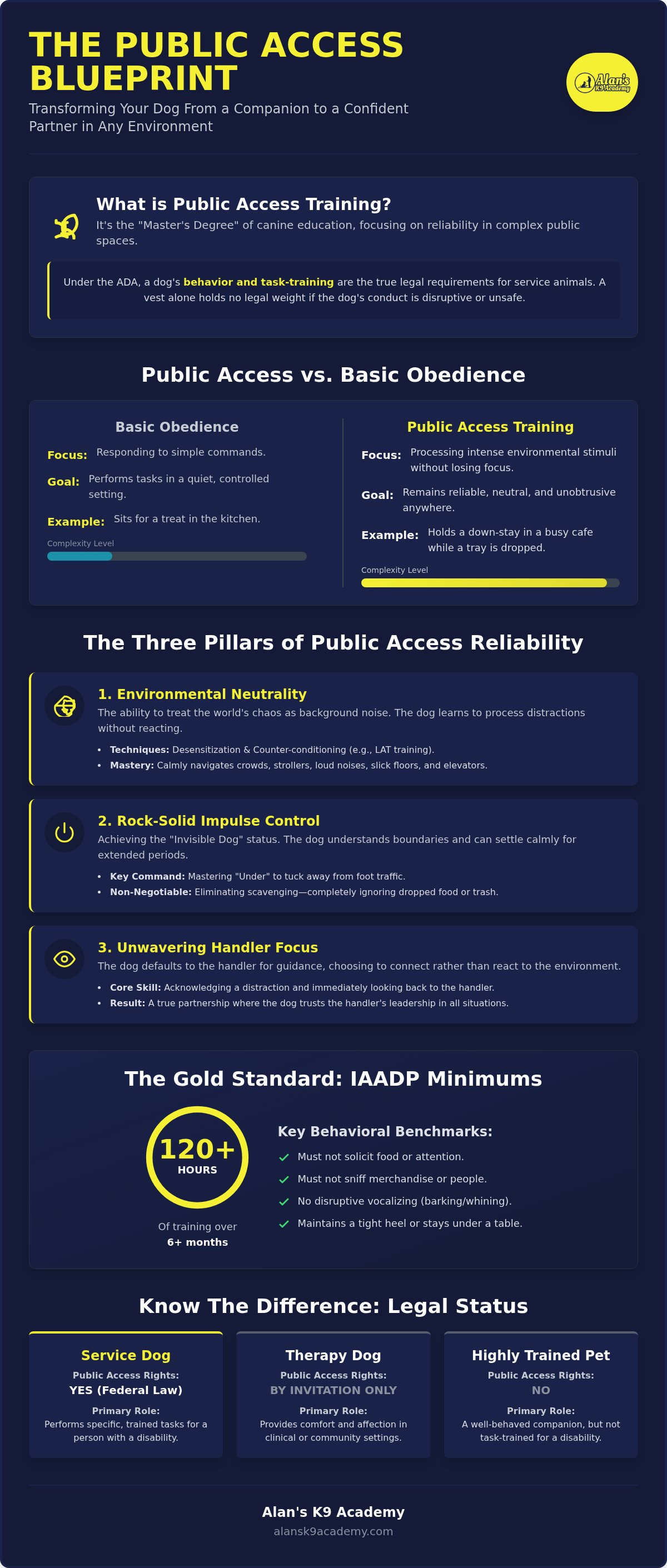
Public access training for dogs is the specialized education required for a canine to behave reliably and unobtrusively in complex public spaces. Think of it as the "Master's Degree" of canine education. While most dogs learn to sit for a treat in a quiet kitchen, a dog with public access skills can maintain a "down-stay" under a table in a bustling cafe while a server drops a tray nearby. This level of training moves beyond simple obedience, focusing on the dog's ability to process intense environmental stimuli without losing focus on the handler. Under the ADA, behavior and task-training are the true legal requirements for service animals. A vest alone holds no legal weight if the dog's conduct is disruptive or unsafe.
The IAADP Minimum Standards Explained
The International Association of Assistance Dog Partners (IAADP) provides the gold standard for these behaviors. One of the most critical components is the 120-hour rule, which requires at least 120 hours of training over six months or more. This requirement emphasizes that "time under tension" in various environments is necessary to build true reliability. Behavioral benchmarks are strict; a dog must not sniff merchandise, vocalize, or wander from a tight heel position. IAADP standards represent the benchmark for service dog behavior in 2026. This level of discipline ensures the dog is practically invisible to the public, allowing the handler to focus entirely on their day without managing a reactive pet.
Service Dogs vs. Therapy Dogs vs. Highly Trained Pets
Understanding service animal legal definitions is vital for anyone training for public spaces. Service dogs have federal access rights because they perform specific tasks for a person with a disability. Therapy dogs and highly trained pets do not have these same rights under the ADA. Even for a legitimate service animal, a business can legally request a "removal" if the dog is out of control, lunging, or not housebroken. Many owners seeking Service Dog Foundation Training North Atlanta start with these public access foundations. This training serves as the essential bridge between a well-behaved pet and a professional working companion. It ensures that whether you are in Cartersville or downtown Atlanta, your dog remains a calm, neutral presence regardless of the chaos nearby.
The Three Pillars of Public Access Reliability
Why do some dogs look like they're on a casual Sunday stroll while others vibrate with tension in a hotel lobby? True reliability in public access training for dogs rests on three specific pillars: Environmental Neutrality, Impulse Control, and Handler Focus. While many programs rush into teaching complex tasks, we believe that a dog who can't ignore a dropped french fry or a rattling stroller isn't ready for a vest. We utilize balanced methods to ensure your dog understands that "No" is a firm boundary, especially in high-stakes environments where safety is non-negotiable. This clarity creates a confident dog that knows exactly what's expected, even when the world gets loud.
Mastering Environmental Neutrality
Environmental neutrality is the ability to treat the world's chaos as background noise. We often distinguish between desensitization, which is the gradual exposure to a stimulus to reduce a reaction, and counter-conditioning, which changes the dog's emotional response entirely. For public access, you need both. Using "Look at That" (LAT) training helps your dog acknowledge a distraction, like another dog in a Marietta pet store, and immediately choose to look back at you for direction. This neutrality must extend to physical sensations too. Your companion should be equally comfortable walking over metal sidewalk grates, navigating slick marble floors, or entering a moving elevator without hesitation. Building this foundation requires professional guidance to ensure the dog is learning, not just surviving the experience.
The "Invisible Dog" Concept
The ultimate compliment for a service dog or a highly trained companion is that no one noticed they were there. This "Invisible Dog" status is achieved through mastered impulse control and the "Under" command. Whether you're dining in Alpharetta or waiting at a doctor's office, your dog should tuck tightly under your chair or legs, staying out of the path of foot traffic. This goes beyond a simple "Stay" command; it is a state of relaxed settling where the dog isn't constantly scanning for threats or food. Eliminating scavenging behavior is a critical part of this process. A dog focused on public access ignores grocery store spills and low-hanging displays, adhering to the strict service animal training requirements that mandate unobtrusive behavior at all times. When your dog maintains a "check-in" habit while you're busy paying a cashier, you've achieved the handler focus necessary for real-world success.
Public Access vs. Basic Obedience: A Comparison
Does your dog have a perfect "Sit" in the living room but suddenly "forget" their name when you step onto a busy sidewalk? This is the fundamental difference between standard obedience and public access training for dogs. Basic obedience is about the command itself. It's the technical ability to perform a physical action, like a sit or a down, in a controlled setting where the dog feels safe. Public access, however, is entirely about the context. It's the ability to maintain that behavior while the world is moving at full speed around you. If your dog hasn't mastered the basics yet, we recommend starting with our Dog Obedience Training in North Atlanta to build the necessary foundation.
We categorize distraction levels on a scale from 1 to 10 to help handlers understand this progression. A level 1 environment is your quiet home with no distractions. A level 10 is the Canton Farmers Market on a Saturday morning, packed with food smells, other dogs, and wandering toddlers. Real public access reliability means your dog can function at a level 10 with the same calm they show at a level 1. Duration is another critical factor. While a 30-second "Stay" might pass a basic class, a 30-minute "Down-Stay" is a public access prerequisite. This stamina is what allows you to navigate a long checkout line or a full meal without your dog breaking focus.
Standard Obedience Benchmarks
At the standard level, your dog should demonstrate a reliable recall with moderate distractions, such as coming when called in a fenced park. They should maintain a loose leash while walking through a quiet neighborhood and understand a basic "Leave It" when a treat is dropped nearby. These skills show that the dog understands the mechanics of your requests. These are the building blocks, but they don't yet account for the high-intensity variables found in true public spaces.
Public Access Level Benchmarks
Public access benchmarks require a much higher degree of environmental neutrality. Your dog must heel through a dense crowd without breaking focus or sniffing passersby. They need to ignore a barking dog or a running child, even if that distraction is within three feet of their space. These benchmarks align with federal expectations, as ADA service animal regulations mandate that the animal must be under the handler's control at all times. This includes maintaining a stay even when you are momentarily out of sight or engaged in a conversation with a stranger.
The Public Access Training Roadmap: 5 Steps to Success
Mastering public access training for dogs isn't a race; it's a methodical progression that ensures your dog never feels overwhelmed or "flooded." We follow a structured roadmap designed to build confidence in layers. If you skip a step, you risk creating cracks in your dog's reliability that will inevitably show up when the environment gets difficult. By moving through these five stages, you ensure that your companion is truly ready for the demands of the real world.
Step 1: Solidify In-Home Foundations.
You cannot fix in public what isn't perfect at home. This is where we establish the rules of engagement and the focus habits that will save you later.
Step 2: Low-Distraction Outdoor Exposure.
We move to quiet areas in Cartersville or local parks. The goal here is to maintain focus while the dog feels the wind, hears distant traffic, and smells the grass.
Step 3: Semi-Public "Pet Friendly" Locations.
Training at local hardware stores or garden centers that permit leashed animals introduces indoor distractions like sliding doors and high shelves.
Step 4: High-Distraction Non-Pet Locations.
Reserved for service dogs only, this step involves navigating malls and busy restaurants where the dog must remain entirely unobtrusive.
Step 5: The Mock Public Access Test (PAT).
We evaluate your dog's reliability under pressure, simulating the rigors of the official IAADP standards to ensure you're both ready.
Building the In-Home Foundation
Starting your journey with private dog lessons is the fastest way to achieve results because it allows us to address your dog's specific personality without outside interference. We focus heavily on the "Place" command during this phase. This skill is the vital precursor to public settling; if your dog can't relax on a mat while you cook dinner, they won't be able to settle under a table at a cafe. Any underlying behavior modification for anxiety must be fully resolved before public access begins to prevent the dog from becoming reactive in high-stress settings.
Scaling Distractions in North Atlanta
Once the home is mastered, we utilize local environments to test your progress. Locations like Marietta Square or downtown Woodstock serve as excellent "Level 8" training grounds due to the heavy foot traffic and outdoor dining. You'll learn to handle "Drive-By" petting attempts from well-meaning strangers by advocating for your dog's space. We also implement the "Three Second Rule" for sniffing. This technique involves correcting the dog's intent to sniff an object or person before they actually engage. This proactive approach keeps your dog in a working mindset rather than a scavenging one. Ready to see how these steps apply to your companion? Contact us to schedule your first in-home assessment and start your roadmap to reliability.
Why Professional Guidance is Vital for Public Access
Many owners attempt to navigate public access training for dogs using only online tutorials or social media advice. While these resources offer basic tips, they often lack the nuance required to read a dog's subtle stress signals. One of the greatest risks in DIY training is "flooding." This occurs when a dog is pushed into a high-distraction environment before they are emotionally ready, effectively shutting down their ability to learn. A Master K9 Trainer identifies the "threshold" long before a dog reacts; they see the slight stiffening of the tail or the flickering of an eye that signals rising anxiety. By catching these moments early, a professional ensures the training remains a positive, confidence-building experience rather than a traumatic one.
We believe in a balanced approach that provides your dog with clear, understandable boundaries. In high-stakes public environments, "treat-only" methods often fail because the environment becomes more rewarding than the food. Our balanced methodology ensures your dog understands that focus is mandatory, not optional. This clarity builds a deeper sense of security in the dog, as they know exactly what is expected of them regardless of the chaos. For North Atlanta residents, we customize these plans to fit your specific lifestyle, whether you're navigating a busy office in Alpharetta or a weekend festival in Marietta.
The AK9A Difference: 35 Years of Expertise
Alan Carr brings over 35 years of experience to every session. His extensive background in aggressive dog rehabilitation informs how we approach safe public access. We understand how to transition a dog from a state of reactivity to one of total environmental neutrality. One-on-one coaching offers a significant advantage over generic group classes for public work. It allows us to focus entirely on your dog's unique temperament and your specific goals. Our humane, balanced methods create more reliable results in high-distraction zones because they address the dog's internal state, not just their outward behavior.
Getting Started with Alan's K9 Academy
We proudly serve Cartersville, Marietta, Alpharetta, and the entire North Atlanta Metro area. Because we prioritize the owner's role in the process, we do not offer board-and-train services. We want you to be the leader your dog looks to in public. Every successful partnership begins with a thorough in-home assessment. This allows us to evaluate your dog's current foundation and identify any behavioral hurdles that need to be cleared before stepping into the public eye. Taking this first step ensures that your journey toward a reliable, focused companion is built on a solid, professional foundation. Schedule your public access evaluation with Alan's K9 Academy today!
Achieving Unshakeable Real-World Reliability
Public access training for dogs represents the peak of canine education, turning the stress of unpredictable outbursts into the quiet confidence of a neutral partner. We have explored how environmental neutrality and a methodical roadmap provide the bridge from the living room to the busiest streets of North Atlanta. This journey is about more than just passing a test; it is about reclaiming your freedom to navigate the world without the weight of anxiety or the fear of a public scene. By prioritizing context and duration over simple commands, you ensure your dog is prepared for the reality of high-distraction environments.
At Alan's K9 Academy, we bring a mission-driven approach to every client, operating as a Christian-owned local business with deep roots in our community. Master K9 Trainer Alan Carr utilizes his 35+ years of experience to mentor handlers through the complexities of behavior modification and service dog foundations. We are committed to providing the excellence and integrity your family deserves as you work toward your goals. Ready for real-world reliability? Book your Private Training Session with Alan's K9 Academy! Let's work together to transform your dog into the focused, reliable companion you need.
Frequently Asked Questions
Is public access training only for service dogs?
No, while it's a legal requirement for service animals, any pet owner can benefit from these high standards. Many clients in North Atlanta seek this training to ensure their dogs behave perfectly at outdoor cafes or retail stores. It provides a level of manners that goes far beyond basic obedience. We treat it as a lifestyle choice for owners who want a truly neutral, reliable companion in any environment. To explore high-quality professional pet care and training as a benchmark for your own goals, read more about the services provided by H&H Dog.
How many hours of training does a dog need for public access?
The IAADP standard requires a minimum of 120 hours of training over at least six months. This time must include at least 30 hours of training in public places to ensure the dog can handle real-world distractions. Public access training for dogs isn't something you can rush; it requires consistent "time under tension" to build the muscle memory and emotional maturity needed for high-stakes environments.
Can any dog pass a Public Access Test (PAT)?
Not every dog possesses the temperament required for public access work. While we can improve behavior through modification, a dog must have a baseline of confidence and environmental stability. Statistics show that 50% to 70% of dogs in professional programs "wash out" due to behavioral issues. We use our initial in-home assessment to determine if your dog has the natural aptitude to handle the stress of public spaces.
What happens if my dog barks or has an accident in a store?
Under the ADA, a business can legally ask you to remove the dog if it's out of control or not housebroken. A single bark in response to a sudden fright might be overlooked, but persistent barking or a bathroom accident is a sign the dog isn't ready. This is why we emphasize perfecting foundations at home before attempting to enter non-pet-friendly locations in Marietta or Alpharetta.
Do I need a vest or certification for public access training?
No, there's no federal registry or mandatory certification for service dogs in the United States as of 2026. Vests and ID cards are optional and don't grant legal rights. Your dog's right to access is based on their training and the specific tasks they perform for a disability. We focus on the dog's behavior because a well-trained dog is its own best credential in any public setting.
How do I stop my dog from being distracted by other dogs in public?
We use a combination of "Look at That" (LAT) training and clear boundaries to build environmental neutrality. The goal is for your dog to acknowledge the other animal and immediately check back in with you for direction. By using balanced methods, we teach the dog that ignoring distractions is more rewarding than engaging. This creates a habit of focus that remains steady even in crowded parks.
What are the most common reasons a dog fails public access training?
High prey drive, fear-based reactivity, and an inability to recover from sudden noises are the most frequent causes of failure. Many dogs also struggle with the stamina required for a long "down-stay" in a busy environment. If a dog can't remain neutral when a child runs past or a cart rattles nearby, they may not be suitable for public work. Identifying these thresholds early prevents behavioral setbacks.
Is public access training different for therapy dogs?
Yes, because therapy dogs don't have the same legal access rights as service dogs. While they need a high level of manners to visit hospitals or schools, they only enter locations where they're specifically invited. However, we still recommend public access training for dogs in therapy roles. It ensures they remain calm and focused during their visits, providing the best possible experience for the people they're meant to comfort.