%20(620%20x%20150%20px)%20(14).webp)
%20(620%20x%20150%20px)%20(15).webp)
.webp)
_page-0001.webp)
.webp)
Professional Puppy Training: Build Skills That Last Beyond the Lesson
What if the key to better puppy behavior isn’t more commands, but clearer communication you can keep building at home? It’s natural to wonder which habits to tackle first, especially when your puppy is still learning and everyone in the household needs to be consistent.Professional puppy training gi...
%20(5).gif)
What if the key to better puppy behavior isn’t more commands, but clearer communication you can keep building at home? It’s natural to wonder which habits to tackle first, especially when your puppy is still learning and everyone in the household needs to be consistent.
Professional puppy training gives you hands-on coaching to turn everyday moments into useful lessons. With clear priorities and regular practice, you can help your puppy learn skills such as settling, coming when called, and greeting people calmly. Just as important, you can avoid mixed signals that make it harder for a puppy to understand what you expect.
This article explains what a trainer can teach, when personalized guidance can help, and how to reinforce learning between sessions. Alan's K9 Academy offers personalized in-home training and structured group classes, with formats suited to different learning needs. Founded by Master K9 Trainer Alan Carr, the academy draws on more than 35 years of professional dog instruction to help owners and dogs build lasting communication.
Key Takeaways
• Start with a few everyday skills that matter most to your household instead of trying to change everything at once.
• Professional puppy training works best when coaching and consistent owner practice reinforce each other between sessions.
• Choose between personalized in-home coaching and structured group learning based on your puppy’s needs and the situations you want to practise.
• Keep practice calm and brief, and use clear feedback to help your puppy understand what you’re asking.
• Build a realistic routine around your family’s daily life so new skills can carry beyond the lesson.
What professional puppy training teaches, and why early guidance helps
A new puppy brings plenty of questions. Should you focus first on attention, household routines, or basic cues? You don’t need a perfect plan from day one. Professional puppy training helps you choose practical priorities, communicate clearly, and practise skills in ways that fit your everyday life.
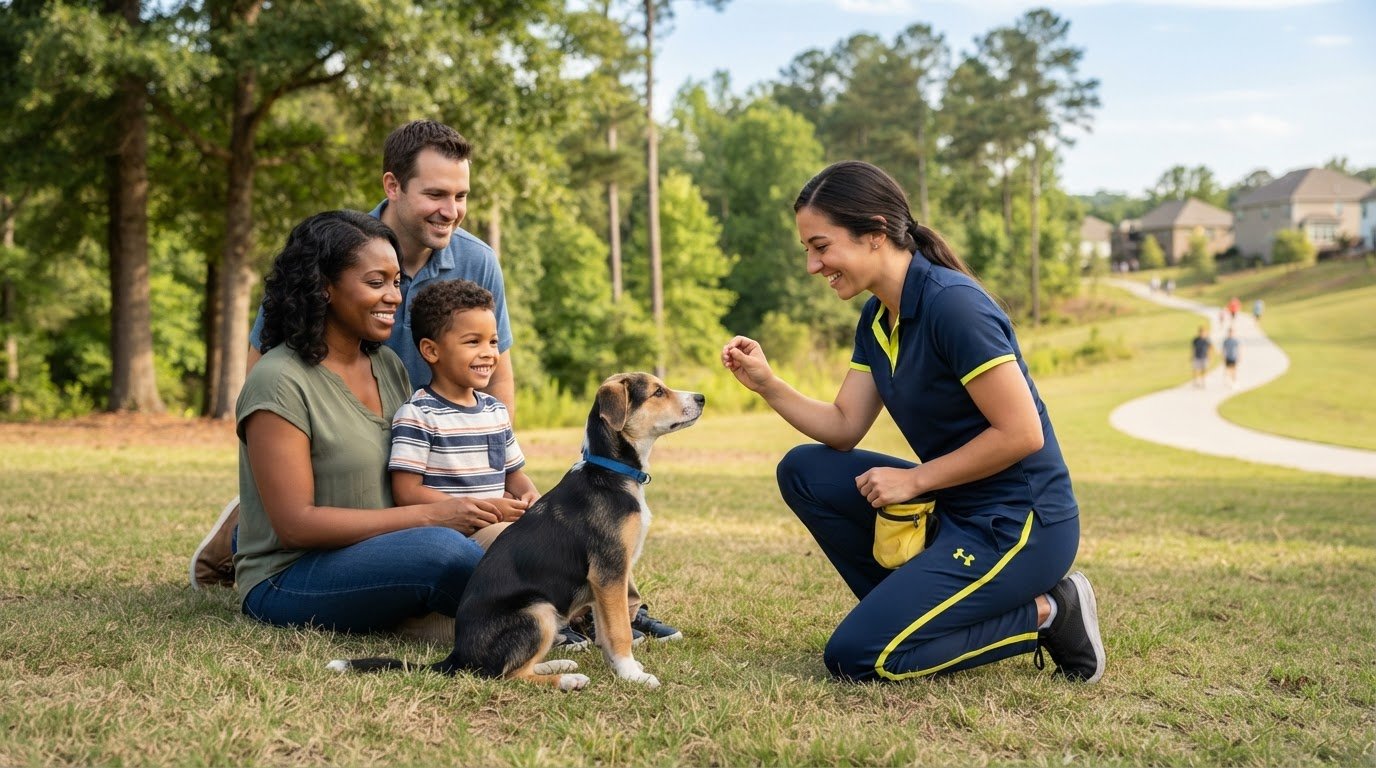
Professional puppy training is guided learning for both a puppy and the people helping that puppy succeed. A trainer can demonstrate how to teach a skill, observe how you and your puppy respond, and help you adjust your approach. You then practise in ordinary situations at home. The aim isn’t to expect every puppy to progress in the same way, but to build understanding through clear cues and consistent practice.
That shared approach matters in a busy household. When family members use the same cue and respond consistently, a puppy gets a clearer picture of what’s expected. For a broad introduction to training approaches and basic commands, see Dog training.
Which everyday puppy skills are useful foundations?
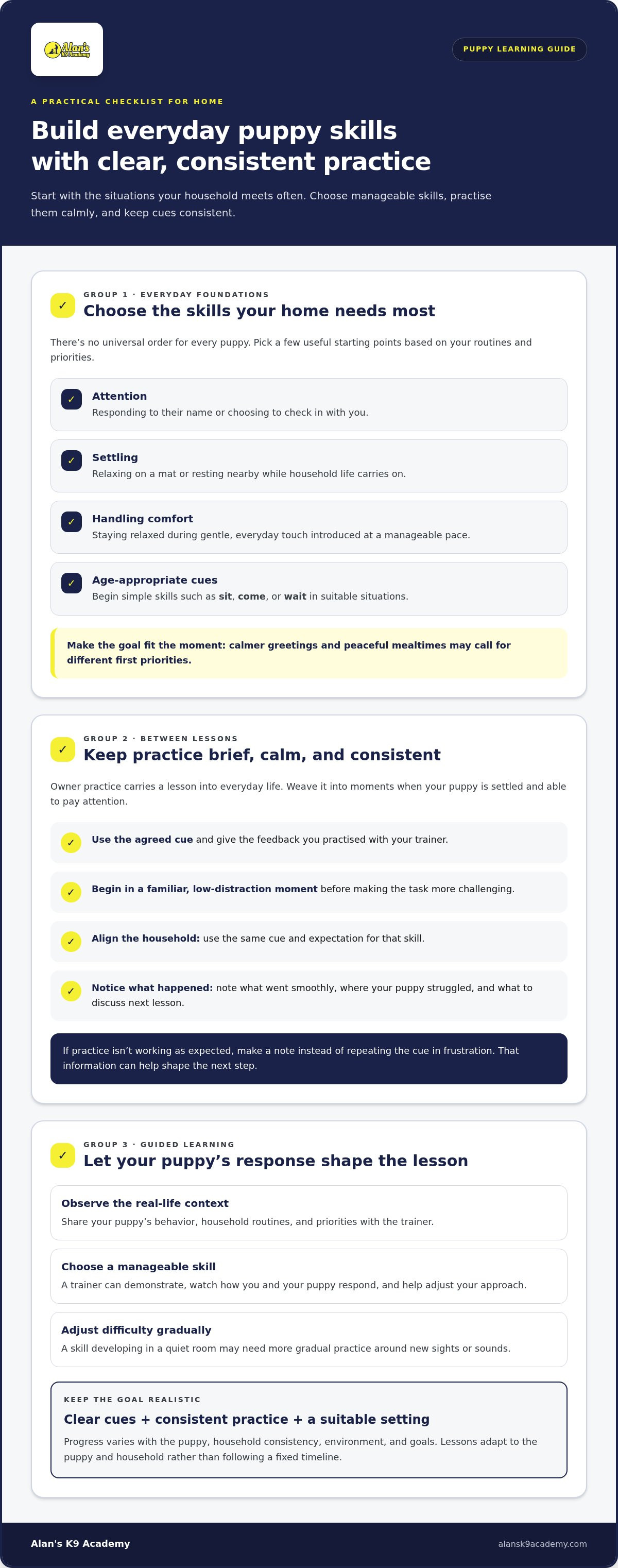
Useful starting skills can make daily routines smoother and help your puppy learn how to engage with you. Choose priorities based on what your household needs most. Early goals might include:
Attention
responding to their name or choosing to check in with you.
Settling
relaxing on a mat or resting nearby while household life carries on.
Handling comfort
staying relaxed during gentle, everyday touch introduced at a pace your puppy can manage.
Age-appropriate cues
beginning simple skills such as sit, come, or wait in suitable situations.
There’s no universal sequence that suits every puppy. A family hoping for calmer greetings may choose different first goals from a household working on peaceful mealtimes. A trainer can help you select manageable skills based on your puppy’s age, temperament, and environment. Start with the situations that happen often, then build from there rather than practising a long list of cues without a clear purpose.
When can professional puppy training help?
Hands-on coaching can help when you’re unsure how to respond consistently to everyday challenges, or when people in the household are using different cues. A trainer can help you identify what happens before a behavior, practise a clear response, and adjust the lesson to your puppy. Normal puppy behavior isn’t automatically a crisis. Early guidance gives you a chance to build understanding before an unhelpful routine becomes established.
For a closer look at personalized support at home, read the in-home puppy training guide for Cartersville. A realistic starting point, combined with owner practice between lessons, can support clearer communication as your puppy grows.
How professional puppy training connects coaching, practice, and progress
A useful lesson doesn’t end when the trainer leaves. Professional puppy training works as a cycle: understand what’s happening, choose a manageable skill, practise it in a suitable setting, then adjust based on your puppy’s response. You learn not only what to do, but also how to recognize when a cue is too difficult, the environment is distracting, or your puppy needs a simpler step.
Owner practice carries a training lesson into a puppy’s everyday life. A trainer can coach your timing and technique, while familiar routines give your puppy chances to connect the lesson with real situations. Progress varies with the puppy, household consistency, environment, and goals. A skill that’s developing in a quiet room may need more gradual practice around new sights or sounds.
How does a trainer tailor puppy lessons?
Good coaching starts with listening and observation. The trainer learns about your puppy’s behavior, household routines, and priorities. If greetings feel hectic, for example, a lesson might focus on a simple alternative behavior and how family members can respond consistently. As your puppy gains experience, the focus can shift to refining the skill or practising it in another everyday context. Lessons adapt to the puppy and household rather than following a fixed timeline.
Your puppy’s experiences beyond the lesson can also shape training priorities. If you’re considering how to build positive familiarity with people, places, and other experiences, the AVMA’s scientific literature on socialization offers helpful background. Your trainer can help you set practical learning goals and approach them at a pace suited to your puppy.
What should owners practise between lessons?
Keep practice calm, brief, and connected to skills introduced in coaching. You don’t need to turn the whole day into a training session. Instead, weave practice into moments when your puppy is settled and able to pay attention:
• Use the agreed cue and give the feedback your trainer has helped you practise.
• Choose a familiar, low-distraction moment before making the task more challenging.
• Ask household members to use the same cue and expectation for that skill.
• Note what went smoothly, where your puppy struggled, and what you want to discuss at the next lesson.
If practice isn’t working as expected, make a note rather than repeating the cue in frustration. That information helps the trainer choose an appropriate next step. For owner-focused coaching in Cartersville and nearby communities, explore personalized puppy training options from Alan's K9 Academy.
Private puppy coaching or group classes: which learning setting fits?
Choosing a learning setting is less about finding one format that suits every puppy and more about deciding what you want to practise. Personalized coaching gives you time to focus on your puppy and household routines. A structured group class offers guided practice alongside other owners and dogs. Both can support professional puppy training. Your goals, your puppy’s needs, and the situations you want to work on can help you decide where to begin.
| Learning focus | Useful context | Owner participation |
|---|---|---|
| Personalized coaching | Household routines and skills practised at home | Work directly with the trainer on goals for your puppy and family |
| Structured group learning | Guided obedience practice with other owners and dogs | Practise cues while learning alongside the group |
What can personalized puppy coaching address?
One-on-one attention lets you focus on the details of home life: where your puppy settles, how routines unfold, and which skills would make daily interactions easier. You can practise in the setting where those habits happen while the trainer coaches your timing and response. This format can be useful when you want guidance tailored to specific household goals. Learn more in the professional in-home dog training guide.
What can structured group classes add?
Group classes provide a guided setting to practise obedience while other owners and dogs are present. You can focus on your puppy and apply cues in a different learning context, with instruction to support your practice. A group environment isn’t the right starting point for every puppy or goal, and joining a class doesn’t make personalized coaching unnecessary.
Consider the skill you want to work on. If your main priority is a household routine, personalized in-home coaching may be a natural fit. If you want structured practice alongside other dog-owner teams, a group class may suit that goal. Different settings can support different parts of your puppy’s learning. Choose based on what you want to practise, while keeping your puppy’s comfort and ability to engage in mind.
How to support professional puppy training in your daily routine
A lesson gives you direction, and daily life gives your puppy chances to practise. You don’t need to add a demanding training block to an already busy day. Follow the trainer’s guidance and weave brief, calm repetitions of familiar skills into routines you already have. Consistent responses help your puppy understand how a lesson applies beyond the coaching session.
Try this simple routine:
Choose one familiar skill.
Focus on a cue or routine already introduced with your trainer instead of adding several new expectations at once.
Pick a suitable moment.
Practise when your puppy is comfortable and able to pay attention, such as before a meal or during a quiet pause at home.
Give the cue clearly.
Use the agreed word and allow your puppy time to respond. Follow with the feedback your trainer recommends.
Adjust to your puppy.
If your puppy seems distracted or unsure, make the situation easier or pause. Comfort and attention matter more than completing a set number of repetitions.
Make a quick note.
Record what went well and any recurring question to discuss during your next lesson.
How can a household keep puppy cues consistent?
Agree on shared cue words and a simple expectation for each skill. If one person says “down” while another says “lie down,” your puppy may not understand that you mean the same response. Choose predictable practice moments, too. A brief repetition before a familiar routine can be easier to maintain than an extra session that’s hard to fit into the day. Keep household notes simple and share them with the trainer.
How can owners build skills beyond the home?
Once a skill is becoming familiar in a quiet setting, ask your trainer how to practise it in an appropriate everyday environment. Add change gradually. A new location, nearby activity, or unfamiliar sound can make a known cue harder, so avoid adding distractions before your puppy is ready. If your puppy struggles, return to an easier context and build from there. For ideas on extending obedience skills into real-world situations, read the North Atlanta dog obedience training guide.
Professional puppy training is a partnership: coaching helps you understand the next step, and your everyday responses give your puppy a chance to practise it. Alan's K9 Academy provides personalized in-home training and structured group classes for these different learning needs.
Start professional puppy training with a local plan built around your family
Training is most useful when it connects what your puppy is learning with the routines your family actually lives. Alan’s K9 Academy serves families in Cartersville, Bartow County, and the North Atlanta Metro area with personalized in-home puppy training and structured group classes. These options give owners different ways to practise while keeping the focus on clearer communication between people and their dogs.
How does local coaching make puppy skills more practical?
With personalized in-home coaching, you can work on goals where many of your everyday routines happen. That might mean practising a calm response in a familiar part of the home or helping family members use the same cue. The trainer can observe the context, coach you as you practise, and shape the lesson around your household’s priorities.
For families in Cartersville and Bartow County, a home-based approach connects instruction with familiar routines. Alan’s K9 Academy also serves the broader North Atlanta Metro area. Founded by Master K9 Trainer Alan Carr, the academy brings more than 35 years of professional dog instruction experience to its work with puppies and their owners.
Structured group classes offer another learning setting, with guided opportunities for owners and puppies to practise together alongside other teams. Depending on your puppy’s needs and your goals, group learning can complement personalized coaching rather than replace attention to the routines and skills your family wants to develop at home.
What is a helpful next step for a puppy owner?
Begin with a short list of priorities. Which everyday moments would you most like to make easier? What skill would help your household communicate more clearly? Bringing those goals to the academy can help set a direction for training that fits your family and puppy, without assuming every household needs the same plan.
You don’t have to solve every puppy challenge before getting guidance. Start with what matters most to your family, then build from there with hands-on coaching and practice at home. Explore professional puppy training with Alan’s K9 Academy and take a practical first step toward lasting communication with your puppy.
Build a Strong Start With Your Puppy
Reliable puppy skills grow through clear coaching and steady practice in the moments that make up family life. Choose priorities that fit your household, reinforce the cues your puppy is learning, and adjust practice to your puppy’s comfort and attention. Professional puppy training can help you build that foundation with hands-on guidance and a plan suited to your goals.
Alan’s K9 Academy serves Cartersville, Bartow County, and the North Atlanta Metro area with personalized in-home training and structured group classes. Founded by Master K9 Trainer Alan Carr, the academy brings more than 35 years of professional dog instruction experience to helping owners and dogs develop lasting communication.
Start with what matters most to your family, then take the next step at a manageable pace. Explore professional puppy training with Alan’s K9 Academy and give your puppy’s learning a supportive start. Small, consistent efforts can build skills you’ll value for years to come.
Frequently Asked Questions
What does professional puppy training include?
Professional puppy training can include guided practice with attention, settling, handling comfort, and age-appropriate obedience cues. The trainer helps you choose priorities based on your puppy, household routines, and goals, then shows you how to practise and reinforce skills at home. At Alan’s K9 Academy, puppy support is available through personalized in-home training and structured group classes, giving families different settings for learning and owner participation.
When should I start professional puppy training?
You can seek guidance as soon as you want help establishing routines or choosing useful first skills. There isn’t one perfect starting point for every puppy, and normal puppy behavior doesn’t mean you’ve waited too long or that something is wrong. Early coaching can help you respond consistently, understand what to practise, and build communication as your puppy grows. Keep goals manageable and suited to your puppy’s comfort and experience.
Are puppy training classes or private lessons better?
Neither format is best for every puppy or goal. Personalized in-home lessons let you work on skills within familiar household routines with direct coaching. Structured group classes offer guided practice alongside other owners and dogs. Consider what you want to work on and where your puppy can engage comfortably. One setting may suit your current priorities, while the other may support different practice goals as your puppy learns.
Can professional puppy training help with biting and potty training?
Training guidance can help you develop consistent responses to common puppy challenges, including mouthing and potty routines. A trainer can help you decide what to practise, respond calmly, and help household members follow the same approach. Your puppy’s age, routine, and individual needs matter, so advice should fit your situation. If a behavior raises health concerns, consult a veterinarian for medical guidance.
How long does professional puppy training take?
There’s no single timeline that applies to every puppy. Progress depends on the skills you’re working on, your puppy’s experience and comfort, the training environment, and how consistently the household practises between lessons. Some skills may become familiar before they’re reliable in new situations. Focus on steady progress rather than a deadline, and share what’s working or proving difficult with your trainer so practice can be adjusted appropriately.
Can a puppy learn around distractions during group classes?
Group classes can provide a guided setting to practise while other owners and dogs are present, but puppies vary in how readily they can focus in that environment. A puppy who finds the setting difficult may need simpler practice or a quieter starting point before distractions are added. Follow the trainer’s guidance, watch your puppy’s comfort and attention, and build challenge gradually rather than expecting every puppy to learn equally well in a group.
Does professional puppy training teach owners what to do at home?
Yes. Owner participation is an important part of carrying lessons into everyday routines. Alan’s K9 Academy provides personalized in-home training and structured group classes for families in Cartersville, Canton, Woodstock, Marietta, Rome, Acworth, Kennesaw, Sandy Springs, Roswell, Alpharetta, Powder Springs, Dallas, Hiram, Jasper, Cumming, Holly Springs, Ball Ground, and Milton. Founded by Master K9 Trainer Alan Carr, the academy draws on over 35 years of professional dog instruction experience.