



Positive Reinforcement Not Working? Learn How Reward Choice Matters
A treat isn’t automatically a reward. Positive reinforcement means adding something after a behavior to make that behavior more likely to happen again. If positive reinforcement isn’t working for your dog, the reward may not feel valuable in that moment, or it may arrive too late for your dog to con...

A treat isn’t automatically a reward. Positive reinforcement means adding something after a behavior to make that behavior more likely to happen again. If positive reinforcement isn’t working for your dog, the reward may not feel valuable in that moment, or it may arrive too late for your dog to connect it with the behavior.
It’s frustrating to offer praise or food while your dog seems more interested in everything else. That doesn’t mean your dog can’t learn or that rewards are useless. The reward needs to matter to your dog in that moment, and the setup should give them a fair chance to focus.
You’ll learn how to tell whether a reward is reinforcing a behavior, why timing and distractions affect training, and how dogs can value different rewards. We’ll also look at how stress and an overwhelming environment can interfere, so you can understand what may be happening and when positive reinforcement is useful.
Key Takeaways
• A treat counts as a reinforcer only if it makes the behavior more likely to happen again.
• Match the reward to what your dog values in that moment, especially when distractions compete for attention.
• A marker word or clicker can help pinpoint the behavior you want to reinforce, but timing matters.
• When fear, reactivity, or persistent training challenges are involved, tailored professional guidance can help make the approach more effective.
What is positive reinforcement?
Positive reinforcement adds something after a behavior to make that behavior more likely to happen again. In dog training, the reward must matter to your dog, and the timing and setting affect whether learning can take place.
Applying Rewards in Dog Training
To use positive reinforcement, offer something your dog values immediately after they perform the desired behavior. For example, reward your dog for greeting someone with all four paws on the floor instead of jumping. This helps connect the reward with the action. There’s no fixed timeline for training to work; progress depends on the behavior, practice, reward, and distractions.
Marking Desired Behavior
A marker word such as “yes” or a clicker identifies the precise behavior that earns a reward. Mark the moment your dog gets it right, then deliver the reward so the sequence stays clear. If the marker comes after your dog has already moved on, it may reinforce a different action. For a recall, begin in a quiet room by calling your dog from 10 feet away before adding distractions.
Making Training Rewards Effective
Rewards may not work if they don’t motivate your dog, arrive too late, or compete with something more compelling. A handful of treats may not outweigh nearby dogs, squirrels, or people. Another common mistake is trying a method only once or twice and deciding it has failed. For jumping, reward four paws on the floor. Withholding attention can also affect behavior, since attention itself may be rewarding.
Fear, anxiety, or aggression can make learning difficult when your dog feels overwhelmed. Work at a distance where your dog remains comfortable, introduce triggers gradually, and avoid flooding. Reward calm behavior around another dog; tossing treats to a dog already barking and lunging doesn’t change the underlying response. Reward-based training may fall short when the environment is too intense for your dog to focus.
Consult a qualified dog trainer or veterinary behaviorist if fear, aggression, or anxiety persists, or you can’t keep training comfortable and controlled. A professional can assess triggers and help shape a plan around your dog’s behavior. If positive reinforcement isn’t working for your dog, review the reward, timing, and environment before assuming your dog can’t learn.
Choosing rewards dogs find motivating
A reward works only if your dog values it in that moment. Food is one option, but your dog may prefer chasing a ball, tugging a toy, snuggling, or access to a new place. Notice what your dog chooses during everyday routines. One dog may eagerly work for a toy, while another responds better to a chance to explore.
Your dog’s preferences can change with the setting and task. A familiar biscuit might hold their attention in the kitchen but lose value near an exciting activity. Consider whether the environment itself offers something your dog wants. For example, after your dog performs a desired behavior, access to sniffing or moving toward a new area can serve as the reward.
Think of everyday opportunities as part of a reward menu. A dog who loves a ball may earn a brief game after settling on a mat. A dog eager to greet someone may earn permission to approach after walking calmly. A dog focused on a squirrel may earn the chance to chase it after completing a desired behavior. The reward should follow the behavior you want to see again.
Watch what happens next. If the behavior becomes more frequent in similar situations, the consequence is likely reinforcing it. If it doesn’t, try a different reward or adjust how often you offer it. Changing a consequence’s value or frequency can change behavior, so one reward schedule won’t suit every task. A handful of cookies may matter less to a fearful dog than getting farther from a trigger.
That distinction matters when changing behavior. A dog who moves away from something frightening may value distance more than food, so simply offering treats may not address what’s motivating them. Choose rewards to suit the individual dog and situation, then observe whether the target behavior increases. This makes reward choice a practical way to understand why training seems ineffective, rather than assuming every dog should respond to the same treat.
Definition of positive reinforcement
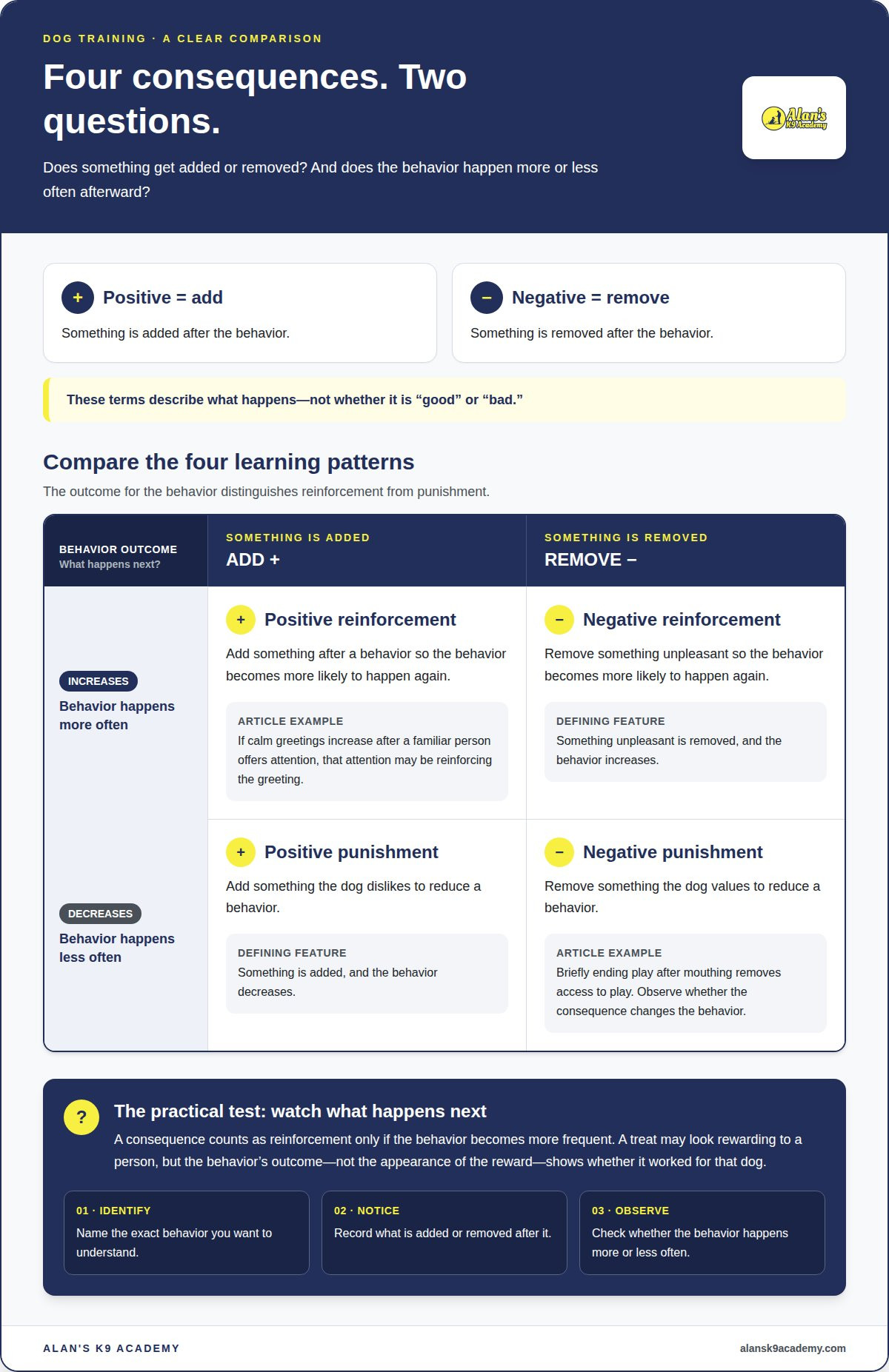
Positive reinforcement means adding something after a behavior so that behavior happens more often. The key test is what happens next, not whether the consequence seems rewarding to a person. For example, if calm greetings increase after a familiar person offers attention, that attention may reinforce the greeting. If the behavior doesn’t increase, the consequence isn’t functioning as a reinforcer for it.
In operant conditioning, “positive” means adding something; it doesn’t mean good or bad. A dog might find a particular sound unpleasant, even though it has been added to the situation. Similarly, a treat may look like an obvious reward to you but have little value to your dog. Whether the behavior happens more often tells you if the consequence worked as reinforcement.
This definition distinguishes reinforcement from punishment. Positive punishment adds something disliked to reduce a behavior, while negative reinforcement removes something unpleasant to increase a behavior. Negative punishment removes something the dog values to reduce a behavior. For example, briefly ending play after mouthing removes access to play; observe the outcome to determine whether that consequence changes the behavior.
These learning patterns apply across animal species, not only dogs. The underlying principle also doesn’t change because a dog weighs more than 60 pounds. Size may affect how you manage a training situation, but it doesn’t alter the definition: something follows a behavior, and that behavior becomes more frequent. The same test applies to a small dog learning to settle on a bed or a larger dog learning to wait at a doorway.
This practical definition can clarify why a reward seems ineffective. Identify the exact behavior, note what follows it, then observe whether it occurs more often in similar situations. If a dog receives praise for lying down but lies down no more often, praise isn’t reinforcing that response in that context. The next useful question is what consequence the dog actually values.
How to use a marker word or clicker in positive reinforcement training
A marker word or clicker identifies the exact behavior you want to reinforce. Say “yes” or click as your dog performs the behavior, then deliver the reward. This brief signal helps distinguish the desired action from what happens immediately afterward, such as your dog standing up or turning away.
Choose one marker and use it consistently. For example, say “yes” when your dog’s bottom touches the floor during a sit, then give the reward. A clicker provides a distinct sound, while a spoken word is always available. Neither works as a reward on its own; follow the marker with something your dog values.
Timing matters. If you mark after your dog has already left the sit, you may accidentally signal the wrong moment. Keep the marker brief, and don’t repeat it for the same behavior. During leash practice, for example, mark the moment your dog looks toward you, then reward that attention.
Keep the sequence clear:
• Wait for the specific action, such as a calm pause at the doorway.
• Mark the instant it happens with your chosen word or click.
• Deliver the reward promptly, before moving to another cue.
If your dog responds to the sound but doesn’t repeat the behavior, review your timing and the reward’s value. A marker can’t make an unappealing reward motivating or overcome a setting where your dog is too distracted to focus. Practice a simple behavior in a quiet room before adding activity, then see whether your dog responds more consistently.
For help refining marker timing during real-life training, get personalized dog training support.
Alan's K9 Academy
Alan's K9 Academy helps you make sense of training challenges when rewards aren’t leading to the behavior you want. In personalized training, the focus can include which rewards motivate your dog, how timing affects learning, and whether distractions or stress are making practice difficult. Behavior modification can address more complex patterns, including fear or reactivity, with a plan shaped around your dog and your real-life goals.
If you’re developing a foundation for therapy or service work, tailored guidance can also help clarify the behaviors and reinforcement approach involved. The right next step depends on what your dog is doing and where training gets stuck. Contact Alan's K9 Academy to discuss your dog’s training needs.
Make your next training step more focused
If positive reinforcement isn’t working for your dog, treat the stalled behavior as useful information, not a verdict on your dog’s ability to learn. Look at the whole picture: what happens before the behavior, what follows it, and how your dog responds in that setting. This context can help shape training around your dog’s needs and your everyday goals.
Alan’s K9 Academy offers In-Home Dog Training and Behavior Modification for training challenges and behavior concerns. Therapy & Service Dog Training is also available for those developing a working foundation. Discussing where your current approach gets stuck can help identify the kind of support that fits.
Contact Alan’s K9 Academy to talk about your dog’s training needs. A clearer plan can help you move forward with care and confidence.
Frequently Asked Questions
How does learning take place?
Dogs learn by connecting cues, actions, and what follows in their surroundings. A cue that works in the living room may not yet make sense in the yard, where smells and movement compete for attention. Practice familiar behaviors in different everyday settings, changing one feature at a time. This helps your dog recognize the same cue beyond the place where they first learned it.
Should I reward my pet every time?
For a new or inconsistent behavior, reward each correct response so your dog can identify the pattern. For example, as your dog learns to wait at a gate, reward each successful pause before opening it. Once the behavior is dependable, you can vary rewards while keeping the cue and expectation clear. If the response starts slipping, offer rewards more often as you rebuild consistency.
What type of reinforcement schedule works best for training?
A consistent schedule is useful while your dog learns a new skill; later, varied reinforcement can help maintain it. Keep the behavior criteria clear as you change the schedule. For example, if your dog reliably waits before meals, sometimes reward them with food and sometimes by starting the meal. If the wait becomes shorter or less reliable, make reinforcement more consistent again.
Why might positive reinforcement training not work for my dog?
Training can stall if the cue is unclear or the behavior becomes more difficult faster than your dog can manage. For example, asking for a longer stay before your dog can hold a brief one may lead to repeated breaks. Make the task easier, reward an achievable version, and build gradually. Also, watch for food held in view before the cue; your dog may follow the lure without learning the spoken signal.
How often and when should I reward my dog during training?
Deliver the reward promptly after the behavior you want, and reward each correct attempt while teaching a new skill. For example, when practicing a door greeting, reward the moment your dog pauses instead of rushing forward. Keep practice focused, then take a break if your dog’s attention fades. As the behavior becomes more reliable, vary rewards without delaying them so long that the connection becomes unclear.