%20(620%20x%20150%20px)%20(14).webp)
%20(620%20x%20150%20px)%20(15).webp)
.webp)
_page-0001.webp)
.webp)
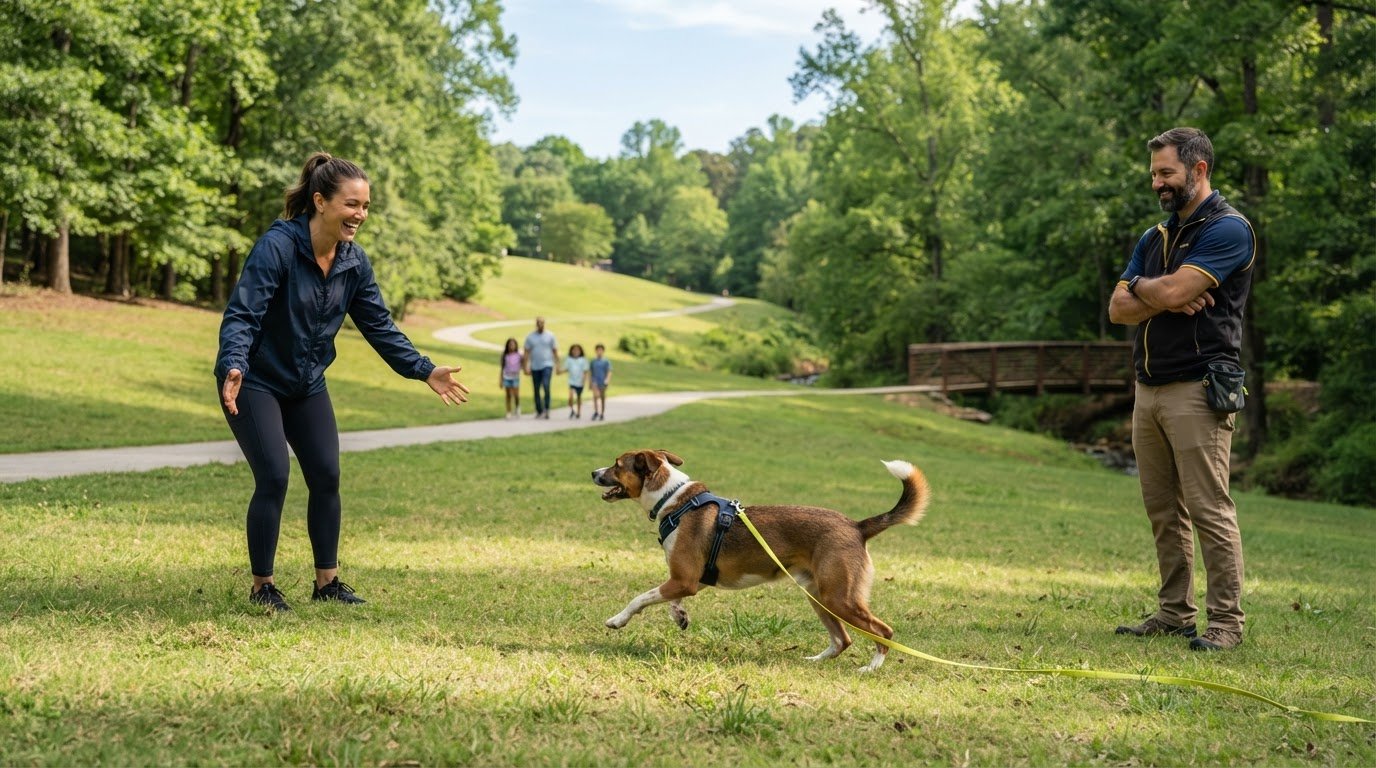
Off-Leash Dog Training in North Atlanta: The 2026 Guide to Real-World Reliability
What if the path to a dog who listens in a busy North Atlanta park starts in your own backyard? If you’re worried your dog might bolt toward traffic, rush up to another dog, or ignore you in public, you’re not alone. And if treats or quick-fix classes haven’t brought dependable results, it’s underst...
%20(5).gif)
What if the path to a dog who listens in a busy North Atlanta park starts in your own backyard? If you’re worried your dog might bolt toward traffic, rush up to another dog, or ignore you in public, you’re not alone. And if treats or quick-fix classes haven’t brought dependable results, it’s understandable to wonder whether off-leash reliability is possible. The right off-leash dog training North Atlanta plan builds communication step by step, starting in familiar places.
Reliable recall isn’t about removing the leash and hoping for the best. It’s about teaching your dog to respond around real distractions while giving you the skills to guide them clearly. Master K9 Trainer Alan Carr brings more than 35 years of experience to personalized training that helps owners and dogs work together using balanced, humane methods.
This guide explains how to build recall and calm walking skills, why practicing at home can support learning, and how to prepare for busier environments. Off-leash reliability never replaces local leash rules: practice off-leash only where it’s permitted. The goal is confidence, connection, and dependable communication, not unnecessary risk.
Key Takeaways
• A recall that works at home may fail in a busy park. Build your dog’s focus gradually around distractions.
• Unclear or inconsistent cues can undermine off-leash responses. Use consistent communication with your dog.
• Your dog needs to understand and respond to you, not only to a trainer. Owner involvement matters.
• Off-leash dog training North Atlanta can progress from familiar home settings to carefully introduced distractions.
• Personalized, balanced, and humane coaching can help you work toward greater reliability while strengthening your partnership.
What is True Off-Leash Reliability for North Atlanta Dogs?
True off-leash reliability isn’t simply a dog responding to “come” when nothing more interesting is happening. It means your dog has learned to stay connected to you when wildlife, other dogs, people, or unfamiliar sounds compete for attention. That takes clear communication and practice across different settings. A dog who recalls in a quiet kitchen may not yet understand that the same cue applies at a busy Marietta park.
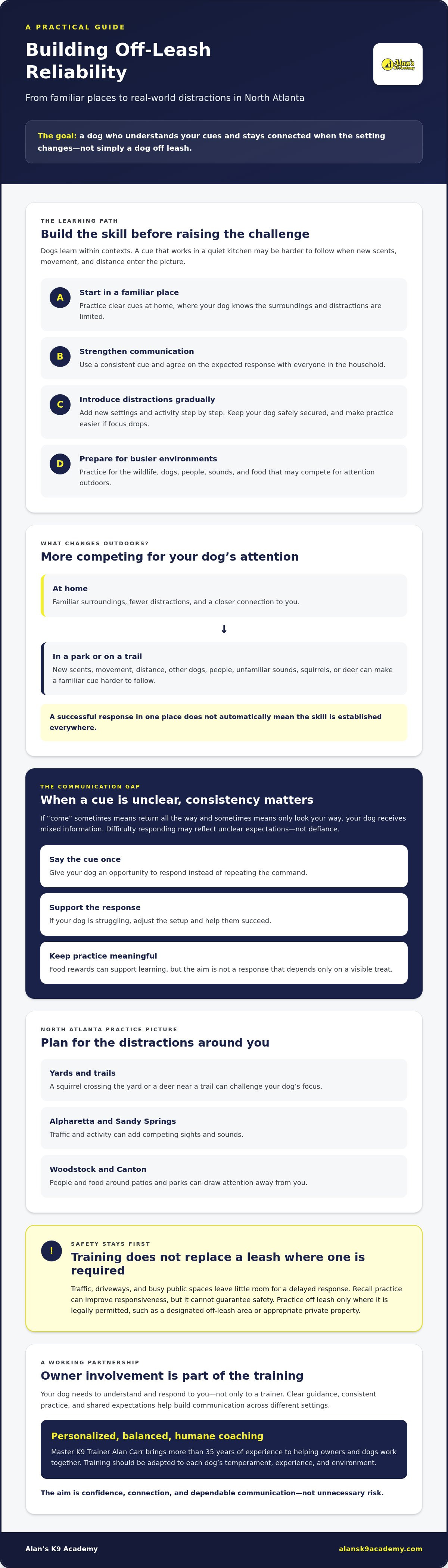
Dogs learn within contexts. The kitchen is familiar, distractions are limited, and you’re close by. A park adds new scents, movement, and distance, which can make a familiar cue harder to follow. Build skills gradually instead of testing them for the first time in a high-distraction place. For an overview of foundational cues such as recall and different approaches to training, see Dog training.
There’s also a difference between outward compliance and communication-based reliability. A dog may appear obedient in one situation without understanding what to do when the setting changes. A communication-based approach aims to help the dog recognize cues, understand boundaries, and respond consistently. Food rewards can be useful, but the goal is not a dog who listens only when a treat is visible. It’s a working partnership built through clear guidance and practice.
Safety matters. Traffic, driveways, and busy public spaces leave little room for a delayed response. Recall training can improve responsiveness, but it can’t guarantee safety or replace a leash where one is required. Practice off-leash only in places where it’s legally permitted, such as a designated off-leash area or appropriate private property.
The Psychology of the Off-Leash Bond
Think of the “invisible leash” as a metaphor for attention built through trust and clear cues, not a substitute for physical restraint. Master K9 Trainer Alan Carr brings more than 35 years of experience to helping owners develop that communication. With balanced, humane training, the focus is on meaningful responsiveness, not dependence on a treat or pressure in the moment.
Distractions Unique to the North Atlanta Metro
A squirrel darting across a yard or a deer at the edge of a trail can challenge a dog’s focus. So can traffic and activity around Alpharetta and Sandy Springs, or people and food around patios and parks in Woodstock and Canton. Effective off-leash dog training North Atlanta should prepare dogs for changing environments step by step, with owners practicing where it’s safe and permitted.
The Communication Gap: Why Your Dog Doesn't Listen Off-Leash
When a dog ignores a cue, the cause may be unclear expectations rather than defiance. If “come” sometimes means return all the way to you and at other times means simply glance your way, your dog receives mixed information. That ambiguity becomes more apparent when the surroundings change. Clear cues and consistent follow-through make it easier for your dog to understand what you’re asking.
Agree on the cue and expected response with everyone in the household. Say it once, give your dog an opportunity to respond, then adjust the setup if they’re struggling. Rather than repeating the command, make the next practice easier and help your dog succeed. When the response is consistent, gradually introduce new settings and distractions.
Common Mistakes North Atlanta Owners Make
Repeating the cue
Calling “come” several times can teach your dog that the first request is optional. Use one clear cue, then support the response instead of repeating it.
Relying on food alone
Treats can motivate learning, but food may be less compelling during a stressful or highly stimulating moment. Practice rewarding responses without making a visible treat the only reason to listen.
Expecting skills to transfer automatically
A behavior practiced at home may not be established in a different environment. Introduce new locations gradually, keep your dog safely secured, and make practice easier if focus drops.
Behavioral Foundations for Off-Leash Success
Address behaviors that interfere with safe handling before increasing freedom. For example, a dog who lunges at other dogs may need help learning calmer responses before recall practice around them is appropriate. Behavior modification can help owners understand what’s happening and build more useful communication with their dog.
Balanced training uses motivation to encourage desired behavior alongside clear, appropriate boundaries that help a dog understand expectations.
Off-leash work isn’t limited to dogs considered “easy” breeds. Each dog has individual needs shaped by temperament, experience, and environment, so training should be adapted rather than based on breed labels alone. The American Kennel Club’s guidance on readiness for off-leash offers further considerations, including recall and responses around distractions. Personalized in-home coaching can help you identify where your dog needs support and practice together in familiar surroundings. Learn more about in-home dog training support from Alan's K9 Academy.
In-Home Coaching vs. Board-and-Train: Which Delivers Real Results?
When choosing a training format, consider where your dog needs to use the skills and who will guide them day to day. A facility-based program may teach behaviors in its own setting, so ask how the training prepares you to continue that work at home. For off-leash goals, consider whether you’ll be able to handle your dog confidently around the distractions you actually encounter.
Alan's K9 Academy doesn’t offer board-and-train. Its focus is personalized in-home training, with owners involved in building skills within their routines and surroundings. You practice handling and cues with guidance instead of relying on a trainer to do the work while you’re away.
The Advantage of In-Home Private Lessons
Training at home lets you address specific situations in context. In an Alpharetta or Milton backyard, for example, you can work through how to handle a gate, visitors, or other everyday interruptions. With in-home dog training, you take part in practice and learn how to continue reinforcing skills between sessions. The focus is on useful tools for your dog’s real routine.
Consider the full commitment involved in each format, not just the time a trainer spends with your dog. Ask what owner instruction is included, how skills are practiced in different environments, and what work you’ll need to do between sessions. A facility stay and private lessons are different formats. The right fit depends on your goals, your dog’s needs, and how you want to be involved.
Why “Quick Fix” Boot Camps Often Fail
A dog’s success in a facility doesn’t automatically mean the same skills will appear at home. Different people, routines, and surroundings can change how a dog responds. Without a clear plan for owners to practice and maintain those behaviors, progress may be harder to carry into daily life. Personalized coaching can help you identify where practice is needed and build your handling confidence alongside your dog.
Before pursuing off-leash activity, consider whether your dog responds reliably to you amid distractions and whether the location permits dogs to be off-leash. The American Kennel Club offers guidance for assessing if your dog is ready to be off-leash. For off-leash dog training North Atlanta, ask how a customized in-home plan can address your goals. Learn more about personalized in-home dog training from Alan's K9 Academy.
Off-Leash Dog Training North Atlanta: The AK9A Roadmap
A useful training roadmap makes progress observable: your dog responds to a cue, repeats that response in a slightly harder situation, and you know when to reduce the challenge. Move forward based on what your dog can do consistently, not on a fixed calendar. Keep a leash on unless you’re in a place where off-leash activity is permitted and appropriate.
Step 1: Establish the foundation at home.
In Cartersville, Canton, or another North Atlanta home, practice attention, settling, and recall in familiar rooms and the yard. Decide what a completed response looks like, such as coming close enough for you to calmly take hold of the collar.
Step 2: Add manageable distractions.
Change one factor at a time. Try practicing while a family member moves across the room, then in a quieter outdoor area. If your dog can’t respond, increase the distance from the distraction or return to an easier setup.
Step 3: Practice around real-world activity.
Work on focus near, not in the middle of, busier environments. Keep your dog secured at places such as Roswell Square or the Woodstock Outlet Shoppes, and follow property rules. Reward calm attention and successful responses before increasing the difficulty.
Step 4: Assess the next step with care.
A longer line can help you practice recall while maintaining physical control, where permitted. Before any off-leash practice, confirm the location allows it and consider whether your dog responds reliably despite competing distractions.
Foundational Skills Every Dog Needs
A “Place” cue can give a high-energy dog a clear task, such as settling on a mat while activity happens nearby. For recall, define the response you expect and practice until your dog follows through consistently. Dog obedience training can help develop the focus needed to build on these foundational behaviors.
Proofing in North Atlanta Settings
Choose practice locations according to your dog’s current skill, not simply their proximity to a landmark. At a shopping area or patio, begin at a distance where your dog can still pay attention. On trails near Kennesaw Mountain, check posted rules before using a long line. Keep sessions manageable so your dog can succeed, then adjust the challenge as responses become more consistent.
With off-leash dog training North Atlanta, each step should build on demonstrated skills while respecting local rules. To discuss a training plan for your dog and home environment, explore personalized in-home dog training with Alan's K9 Academy.
Start Your Journey to Freedom with Alan’s K9 Academy
Progress toward off-leash reliability takes more than teaching a command. You need to know how to guide your dog, recognize when the environment is too distracting, and build skills at a pace that supports safe choices. Master K9 Trainer Alan Carr brings more than 35 years of experience to personalized in-home training, helping families strengthen communication in the settings where daily routines and behaviors happen.
Alan’s K9 Academy uses balanced, humane methods and works with both dog and owner. Training can reflect your dog’s temperament, your family’s goals, and the challenges you encounter in everyday life. The aim is meaningful progress and a stronger partnership, not a promise of instant or perfect control. Practice off-leash only where it’s permitted and appropriate for your dog’s readiness.
Personalized Training for Your Lifestyle
Individual coaching gives you the chance to work through handling questions and practice consistent cues with your dog. One family might prioritize recall around neighborhood distractions; another may need help with a behavior concern before moving to busier settings. Personalized support can help you carry skills from home into new environments.
Training goals can also differ by purpose. Families exploring service dog foundation training North Atlanta may have different priorities from those working toward dependable everyday recall. In either case, clear communication between dog and handler is a foundation worth building. Skills practiced together can support your relationship beyond a single training goal.
Booking Your North Atlanta Training
Alan’s K9 Academy serves the North Atlanta Metro area, including Cartersville, Canton, Alpharetta, Marietta, Roswell, Cumming, and nearby communities. When you get in touch, explain your dog’s history, the behaviors you’re seeing, what you’ve already tried, and what you hope to achieve. You can also ask how training will involve you and progress from familiar surroundings toward appropriate real-world distractions.
Choosing off-leash dog training North Atlanta is a step toward more confident walks and clearer communication, but the work is a partnership. Ready to discuss your goals and your dog’s needs? Contact Alan’s K9 Academy about personalized in-home training.
Build a Stronger Partnership, One Step at a Time
Real-world reliability grows from clear communication, consistent practice, and skills that transfer from home to appropriate public settings. The key isn’t simply asking your dog to come. It’s building a response you can trust while respecting your dog’s readiness and local leash rules.
Master K9 Trainer Alan Carr brings more than 35 years of experience to personalized, humane in-home training that keeps you involved in your dog’s learning. Alan’s K9 Academy focuses on owner-dog communication rather than board-and-train, helping you develop handling skills to support progress in everyday life. For families considering off-leash dog training North Atlanta, that hands-on partnership is a meaningful place to begin.
Take the next step by discussing your dog’s behavior, your goals, and the challenges you’d like to address. Contact Alan’s K9 Academy to discuss in-home training and start building a more confident connection with your canine companion. Progress takes patience, but you and your dog can move forward together.
Frequently Asked Questions
Is my dog too old for off-leash training?
Age alone doesn’t determine whether a dog can learn new skills. Training goals should account for your dog’s health, temperament, behavior history, and current abilities. Start with foundational communication and build gradually instead of expecting an older dog to match another dog’s pace. A trainer can help identify a realistic starting point and whether behavior modification or other foundations should come before recall practice around distractions.
How long does it take to achieve off-leash reliability?
There’s no single timeline for reliable off-leash responses. Progress depends on factors such as your dog’s age, temperament, previous training, behavioral concerns, and consistency of practice at home. Strengthen recall gradually around distractions rather than judging it by one successful response. Keep your dog leashed where required, and use off-leash areas only when your dog’s skills and the location’s rules make practice appropriate.
Do you use e-collars for off-leash training in North Atlanta?
Ask Alan’s K9 Academy directly whether e-collars are used, how they might apply to your dog, and what alternatives are available. A clear discussion helps you understand the methods and make an informed decision. The training plan should address your dog’s individual needs and your goals for off-leash reliability.
Can an aggressive or reactive dog ever be trusted off-leash?
It depends on the dog’s behavior, training progress, and environment, so off-leash access shouldn’t be assumed or rushed. Address aggression or reactivity through behavior modification first, and keep your dog physically controlled in public while working on safer responses. A trainer can help assess your dog and discuss appropriate goals. Training can support progress, but it can’t guarantee that every dog will be safe or suitable off-leash.
What areas of North Atlanta do you provide in-home training for?
Alan’s K9 Academy serves Cartersville, Canton, Woodstock, Marietta, Rome, Acworth, Kennesaw, Sandy Springs, Roswell, Alpharetta, Powder Springs, Dallas, Hiram, Jasper, Cumming, Holly Springs, Ball Ground, and Milton. If you’re looking for off-leash dog training North Atlanta, contact the academy to confirm service availability for your location and discuss your dog’s training needs.
Why don’t you offer board-and-train programs?
Alan’s K9 Academy focuses on in-home training and doesn’t offer board-and-train. The approach keeps owners involved in learning how to communicate with and guide their dogs in everyday settings. A dog may respond to a trainer yet still need practice responding to its owner at home. Working together helps owners develop skills they can use as training continues in familiar routines and environments.
What should I bring to our first off-leash training session?
For in-home training, have your dog’s leash and usual equipment available, along with any treats or toys you commonly use. It can also help to think through your dog’s behavior history, previous training, and the situations where recall is difficult. Ask the academy whether it recommends anything specific before the session. Keep your dog leashed in public unless the location permits off-leash activity and your dog is ready.
How much does professional off-leash training cost in 2026?
For current pricing, contact Alan’s K9 Academy and describe your dog’s needs and training goals. Ask what the recommended training includes and whether there are different options, such as personalized in-home training or group classes. This will help you understand which service best fits your situation.