%20(620%20x%20150%20px)%20(14).webp)
%20(620%20x%20150%20px)%20(15).webp)
.webp)
_page-0001.webp)
.webp)

Mastering the Essentials: The Ultimate Basic Dog Commands Training Checklist
Imagine you are enjoying a sunny afternoon at a local North Atlanta park when your dog suddenly spots a squirrel and lunges toward a busy intersection. You call their name, but the distraction is too high, and they don't even look back. It is a terrifying moment that every owner hopes to avoid, yet...
%20(5).gif)
Imagine you are enjoying a sunny afternoon at a local North Atlanta park when your dog suddenly spots a squirrel and lunges toward a busy intersection. You call their name, but the distraction is too high, and they don't even look back. It is a terrifying moment that every owner hopes to avoid, yet many feel completely unprepared for. You want to enjoy stress-free walks and the confidence that your dog will listen every single time, regardless of what is happening around them.
We understand how exhausting it is to navigate conflicting advice from online videos while worrying about your pet's safety. Effective basic dog commands training is about more than just teaching "tricks"; it is about building a meaningful partnership based on clear communication and mutual respect. You deserve a dog that views you as their trusted leader in every situation, whether you are at home or navigating heavy traffic.
In this article, you will learn the foundational commands every dog needs for real-world safety and reliable communication. We provide a step-by-step checklist to help you track your progress, moving you from public embarrassment to pride in your dog's impeccable behavior.
Key Takeaways
• Understand why basic dog commands training serves as a vital communication bridge that reduces your dog's anxiety.
• Discover the seven essential cues every dog needs to master for safety, including the non-negotiable "Life-Saver" recall.
• Learn how to apply the 3 D's, Distance, Distraction, and Duration, to ensure your dog listens even in busy North Atlanta parks.
• Identify and fix common training roadblocks like treat dependency and selective hearing for more consistent results.
• Explore the advantages of personalized in-home training with a Master Trainer to build a lasting bond in your dog's natural environment.
Why Basic Dog Commands Training is Your Communication Foundation
Have you ever felt the frustration of repeating the same word five times while your dog simply stares at you? It isn't that they are being stubborn; it's that you haven't established a shared language yet. Dogs don't speak English. They communicate through body language and patterns. Professional basic dog commands training acts as the essential bridge between species. By mastering the foundations of dog training, you move away from guesswork and toward a partnership built on clarity.
The power of basic dog commands training lies in its ability to provide clear expectations. Clear expectations are the ultimate cure for canine anxiety. When a dog understands exactly what is required of them, they don't have to stress about making the "wrong" choice. This structure provides a safety net, especially in high-stakes environments like the busy streets of North Atlanta. A reliable "Come" or "Leave it" isn't just a convenience. It is a life-saving tool that keeps your companion out of the path of oncoming traffic or away from harmful objects on the sidewalk.
We believe in a balanced approach to education. This means setting firm, clear boundaries while providing the positive motivation your dog needs to succeed. It's about being a fair leader who rewards excellence while ensuring commands are followed every single time. This balance ensures your dog is happy to work for you, not just because they want a treat, but because they understand their role in the family.
The Difference Between a 'Trick' and a 'Command'
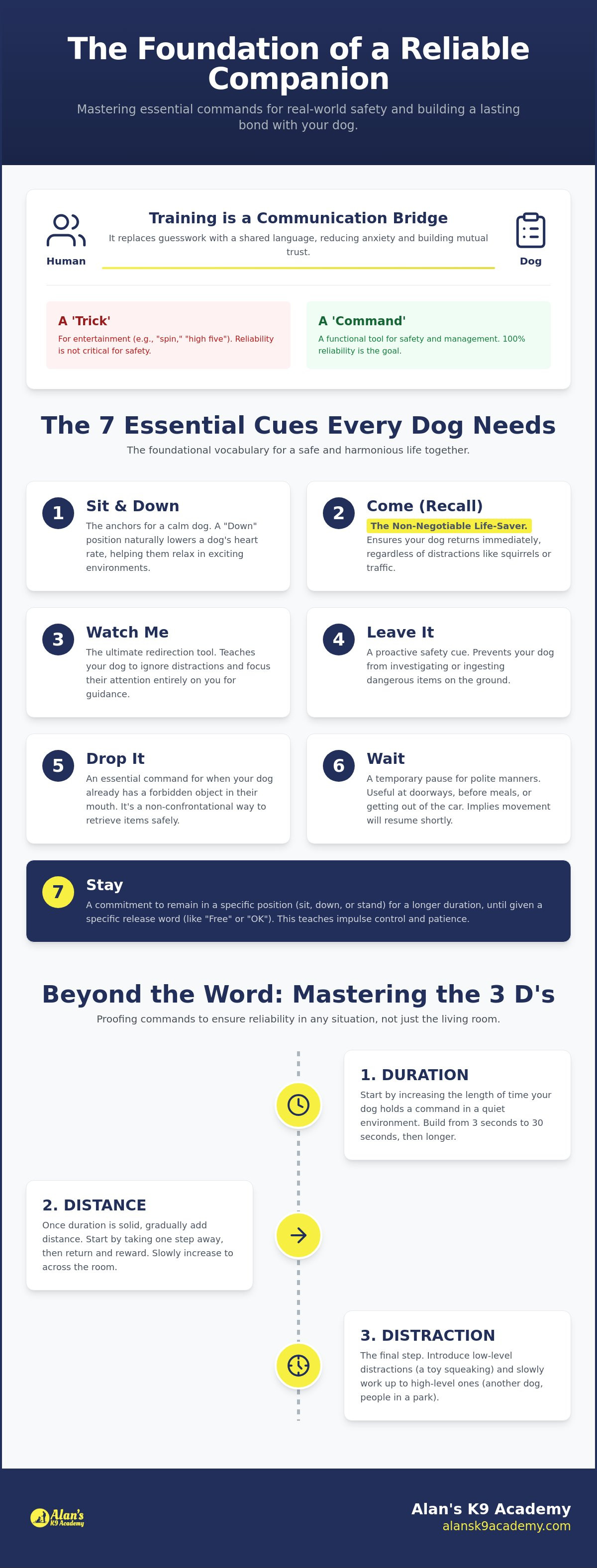
Tricks like "spin" or "high five" are wonderful for entertainment, but they won't help you manage a chaotic situation. Commands are functional tools for safety and management. Reliability is the metric that matters most. It's better to have a dog that performs three cues perfectly in a crowd than one who knows twenty tricks but only performs them in the kitchen. A critical part of this reliability is the release word. Using a consistent "Free" or "OK" tells your dog exactly when the job is done. This prevents them from deciding on their own when to break a "Stay" or "Down."
How Training Strengthens the Human-Canine Bond
Training is a powerful form of mental stimulation. It engages your dog's brain, which often prevents the destructive behaviors that stem from boredom. As you work together, you build a foundation of mutual trust. Humane, consistent leadership shows your dog that they can rely on you for guidance. This bond is the first step toward advanced goals, such as off-leash reliability or therapy dog work. You aren't just teaching obedience; you are creating a lifestyle of freedom and connection.
The Essential Basic Commands Checklist: 7 Cues Every Dog Needs
Building a reliable dog starts with a clear plan. Without a structured checklist, it's easy to get overwhelmed by the sheer volume of advice available online. Committing to a consistent routine of basic dog commands training ensures you aren't leaving your pet's safety to chance. These seven cues represent the essential vocabulary every dog needs to live harmoniously in a human world. They aren't just for show; they are the tools you will use every single day to manage your dog's behavior and keep them out of harm's way.
Sit and Down
These are the anchors of a calm dog. When your dog is in a "Down" position, their heart rate naturally lowers, helping them transition from a state of high arousal to one of quiet observation.
Come (Recall)
This is the non-negotiable life-saver. A reliable recall means your dog returns to you immediately, even if they are chasing a squirrel or heading toward a busy road.
Watch Me
Redirection is key in busy environments. This cue asks your dog to ignore the barking dog across the street and focus entirely on you.
Wait vs. Stay
Understanding the difference is vital for manners at the door. "Wait" is a temporary pause, perfect for leashing up or waiting for a food bowl. "Stay" is a commitment to remain in a specific position until you provide the release word we discussed earlier.
If you find that your dog listens at home but ignores you the moment you step outside, you aren't alone. Our in-home dog training sessions focus on these exact challenges, helping you generalize these behaviors in the real world where they matter most.
Safety & Boundaries: 'Leave It' and 'Drop It'
The "Leave It" command is a preventative cue designed to stop your dog from approaching or sniffing environmental hazards like toxic mushrooms or discarded trash. It is your first line of defense on Georgia trails where curious noses can quickly find trouble. Conversely, "Drop It" is a management tool for when your dog already has something in their mouth. This is essential for preventing resource guarding or ensuring they release a dangerous object, like a chicken bone or a child's toy, without a struggle.
Functional Living: 'Heel' and 'Place'
Functional living cues transform a chaotic household into a peaceful one. "Heel" is the foundation of a loose-leash walk, making your weekend trips to Marietta Square enjoyable rather than a physical struggle. Meanwhile, the "Place" command is a game-changer for home management. By sending your dog to a designated bed or mat, you can keep them calm during dinner or when guests arrive at the front door. These cues represent the higher levels of basic dog commands training, moving beyond simple obedience into true lifestyle integration.
Beyond the Word: Mastering the 3 D’s of Obedience
You have taught the cues. Your dog sits perfectly for their dinner. Yet, the moment you walk into a busy Woodstock park, those skills seem to vanish. This isn't a failure of intelligence. It's a lack of "proofing." True mastery of basic dog commands training requires moving beyond the initial learning phase and testing those behaviors against the three pillars of reliability: Distance, Distraction, and Duration.
Proofing is the process of teaching your dog that "Sit" means the same thing whether you are in a quiet hallway or surrounded by joggers and squirrels. Without this step, your dog's obedience remains situational. To build a dog you can trust anywhere, you must systematically increase the challenge while keeping their confidence high. If the leap is too great, the dog fails, and the bond suffers. We focus on small, winnable steps that lead to real-world reliability.
Duration and Distance: Building Patience
Duration is often the first D to master. It's the difference between a dog that sits for two seconds and one that stays until you release them. Start small. Reward your dog for holding a position for five seconds, then ten, then thirty. Once they are steady, you can introduce distance. Try giving a command from two steps away, then five, then from across the yard. A common mistake is increasing both distance and duration simultaneously. This often overwhelms the dog. If you are moving twenty feet away, keep the duration short. If you want a long stay, stay close to your dog. This balanced approach ensures they feel successful at every stage.
Distraction: The Ultimate Test of Reliability
Distraction is the final hurdle. It is easy to listen when nothing is happening. It's much harder when a neighbor’s dog is barking or a cyclist zooms past. We categorize these as "low-level" versus "high-level" distractions. Training through these requires a "paycheck" that matches the difficulty of the job. You might use standard kibble at home, but you need high-value rewards for the real world. At Alan’s K9 Academy, we prioritize training in your dog’s natural environment. By practicing in the places where your dog actually lives and plays, we ensure their basic dog commands training holds up when it matters most. You aren't just teaching a word; you are building a reliable response that overrides the environment.
Common Training Roadblocks and How to Troubleshoot Them
Even with the best intentions, your basic dog commands training journey will likely hit a few bumps. One of the most common complaints we hear is, "My dog only listens when I have a treat." This happens when the treat becomes a bribe rather than a reward. If your dog is checking your pockets before deciding to "Sit," you have accidentally taught them that the command is optional unless payment is visible. To fix this, you must transition from "luring" to "rewarding," where the treat only appears after the successful behavior.
Timing is another silent progress-killer. Dogs live in the moment. If you wait too long to mark a correct action, your dog won't know which specific movement earned the praise. You have a narrow window of about 1.5 seconds to mark the behavior with a "Yes!" or a click. If you miss that window, you might accidentally be rewarding the sniff or the ear-scratch that happened right after the "Down." Consistent timing creates the clarity your dog needs to learn quickly.
Selective hearing usually points to inconsistent enforcement. If you tell your dog to "Sit" three times before they actually do it, you have taught them that the first two times don't count. Give the command once. If they don't comply, use a gentle reset. If you are seeing signs of deep-seated anxiety, aggression, or fear that go beyond simple disobedience, it is time to seek professional help. These issues often require targeted behavior modification rather than just a standard training checklist.
Additionally, underlying physical discomfort such as chronic skin conditions can often be mistaken for behavioral issues; to see how specialized care can support your pet's overall well-being, you can learn more about 亞洲獸醫專科醫院.
The Role of Consistency in the Household
A dog can't learn if the rules change depending on who is holding the leash. If you use "Down" to mean lie down, but your spouse uses "Down" to mean get off the couch, the dog will stay confused. Everyone in the family must use the same verbal cues and hand signals. Setting firm "House Rules" ensures your dog doesn't get mixed signals. For example, if you are working on the "Stay" command we discussed earlier, an inconsistent release word from a family member will quickly undermine all your hard work.
Overcoming Age and Breed Myths
Many owners believe that high-drive breeds are "untrainable" or that an older rescue dog is "set in their ways." This simply isn't true. While a Border Collie might learn a cue faster than a Basset Hound, every dog possesses the capacity for growth. Any dog, regardless of age or breed, can achieve basic obedience with a customized plan. The key is adapting the motivation to fit the individual animal's personality. If you are struggling to bridge the gap between "treat-motivated" and "truly reliable," our in-home dog training and behavior modification programs provide the hands-on support you need to succeed.
Elevating Your Training with Alan’s K9 Academy
While a checklist is an excellent starting point, translating those steps into real-world reliability often requires a seasoned eye. Group classes can be helpful for socialization, but they frequently fall short when it comes to the specific triggers your dog faces in their own environment. Professional basic dog commands training is most effective when it happens where your life actually unfolds. At Alan’s K9 Academy, we bring the expertise of a Master K9 Trainer with over 35 years of experience directly to your front door. This ensures that the progress you make isn't just "classroom behavior," but a permanent change in how your dog interacts with the world.
We don't believe in one-size-fits-all methods. Every dog has a unique temperament, and every owner has different goals. Whether you are looking for simple household manners or the foundation for therapy and service dog training, we provide the structured guidance you need. Moving from the basics to advanced off-leash reliability is a journey that requires precision and a deep understanding of canine psychology. We are here to ensure you reach those goals safely and efficiently through our personalized in-home training programs in Cartersville and across North Atlanta.
Customized Plans for Your Unique Dog
We avoid "cookie-cutter" methods that ignore your dog's individual personality. Some dogs need high-energy motivation, while others require a softer, more reassuring touch. Our personalized approach allows us to address complex behavior modification needs alongside basic dog commands training. By working in your natural environment in Canton, Woodstock, or Roswell, we can troubleshoot real-world issues like door-bolting or leash reactivity right as they happen. This hands-on support turns the training process into a stress-free experience for both you and your companion.
Your Path to a Better Life Together
Investing in professional coaching early on prevents bad habits from becoming deeply ingrained. It is a commitment to a lifetime of freedom and clear communication. When you work with us, you join a community of responsible, successful dog owners throughout Bartow County who prioritize excellence. We are on a mission to improve the quality of life for families and their pets through compassionate, principled service. Don't let another day of frustration pass you by. Schedule your in-home evaluation with Alan’s K9 Academy today!
Your Path to a Confident and Reliable Companion
Mastering the 3 D's of obedience and following a structured checklist ensures that your dog isn't just "trained" in the kitchen, but reliable in the real world. You now have the tools to bridge the communication gap and turn stressful walks into meaningful moments of connection. Effective basic dog commands training is the essential foundation for every advanced goal you have, from off-leash adventures to therapy work.
If you are ready to move beyond the checklist and see real transformation, we are here to help. Led by Master K9 Trainer Alan Carr, our team brings over 35 years of professional experience directly to your door. We provide personalized in-home sessions across North Atlanta that address your dog's unique temperament in their natural environment. You don't have to navigate behavioral hurdles alone when expert guidance is just a call away.
Transform your dog's behavior with expert in-home training; Contact Alan’s K9 Academy!
Take the first step toward a more peaceful household today. Your dog is ready to learn, and we are ready to show you the way.
Frequently Asked Questions
How long does it take to train a dog in basic commands?
Most dogs can learn the mechanics of basic commands in two to four weeks of consistent daily practice. However, achieving true reliability under heavy distraction often takes several months of reinforcement. Every dog is an individual. Factors like age, temperament, and previous history will influence how quickly they progress. Patience is your best tool during this foundational period to ensure the training sticks long-term.
What are the first 5 commands every dog should learn?
The first five essential cues are Sit, Down, Come, Leave It, and Stay. These commands provide the necessary framework for safety and household management. Mastering these basics allows you to control your dog's impulses in common situations. Once your dog understands these cues, you can begin more advanced basic dog commands training that focuses on real-world reliability and off-leash freedom.
Can I train my dog myself or do I need a professional trainer?
You can certainly begin the training process yourself, but professional guidance often prevents common mistakes before they become permanent habits. A Master Trainer identifies subtle communication errors that owners often miss. If you feel overwhelmed or your dog shows signs of reactivity, professional in-home training provides a customized roadmap. This partnership ensures you build a lasting bond based on clear, humane boundaries.
What is the best age to start basic dog commands training?
You should start training as early as eight weeks old, as puppies are like sponges for new information. This early window is critical for setting life-long habits and preventing future behavioral issues—a principle of early development also championed by Jumpstart Learning Academy for young children. If you have an older dog, don't worry. Dogs of any age can learn new cues. The key is simply adjusting the pace and motivation to match their specific life stage and energy level.
What should I do if my dog ignores my commands when we are outside?
If your dog ignores you outside, you likely need to work on "proofing" in lower-distraction environments first. The outside world is full of competing motivators like squirrels and strange scents. You must ensure the reward for listening is more valuable than the distraction itself. Practice in your driveway or a quiet sidewalk before attempting a busy park. This gradual approach builds the confidence your dog needs to succeed.
Do I need to use treats forever when training basic commands?
You don't need to carry treats forever, but they are essential during the initial learning phase. Once your dog reliably performs a command, you should transition to an intermittent reinforcement schedule. This means you reward them randomly rather than every single time. Eventually, you can replace food with "life rewards" like praise, play, or getting to go for a walk. This keeps the behavior strong without constant bribery.
How often should I practice training sessions with my dog?
You should aim for short, focused sessions of five to ten minutes, two or three times a day. Dogs have relatively short attention spans, so long marathons often lead to frustration and burnout. Keeping sessions punchy and positive ensures your dog stays engaged and eager to work. Consistency is far more important than the total number of hours spent in a single day.
What equipment do I need for basic dog training at home?
You only need a few essential items to begin basic dog commands training at home. A standard flat collar or front-clip harness, a sturdy six-foot leash, and a bag of high-value treats are the basics. For practicing recall, a long line (15 to 30 feet) is incredibly helpful for maintaining safety while giving your dog more freedom. Avoid complicated gadgets and focus on tools that facilitate clear communication.