%20(620%20x%20150%20px)%20(14).webp)
%20(620%20x%20150%20px)%20(15).webp)
.webp)
_page-0001.webp)
.webp)
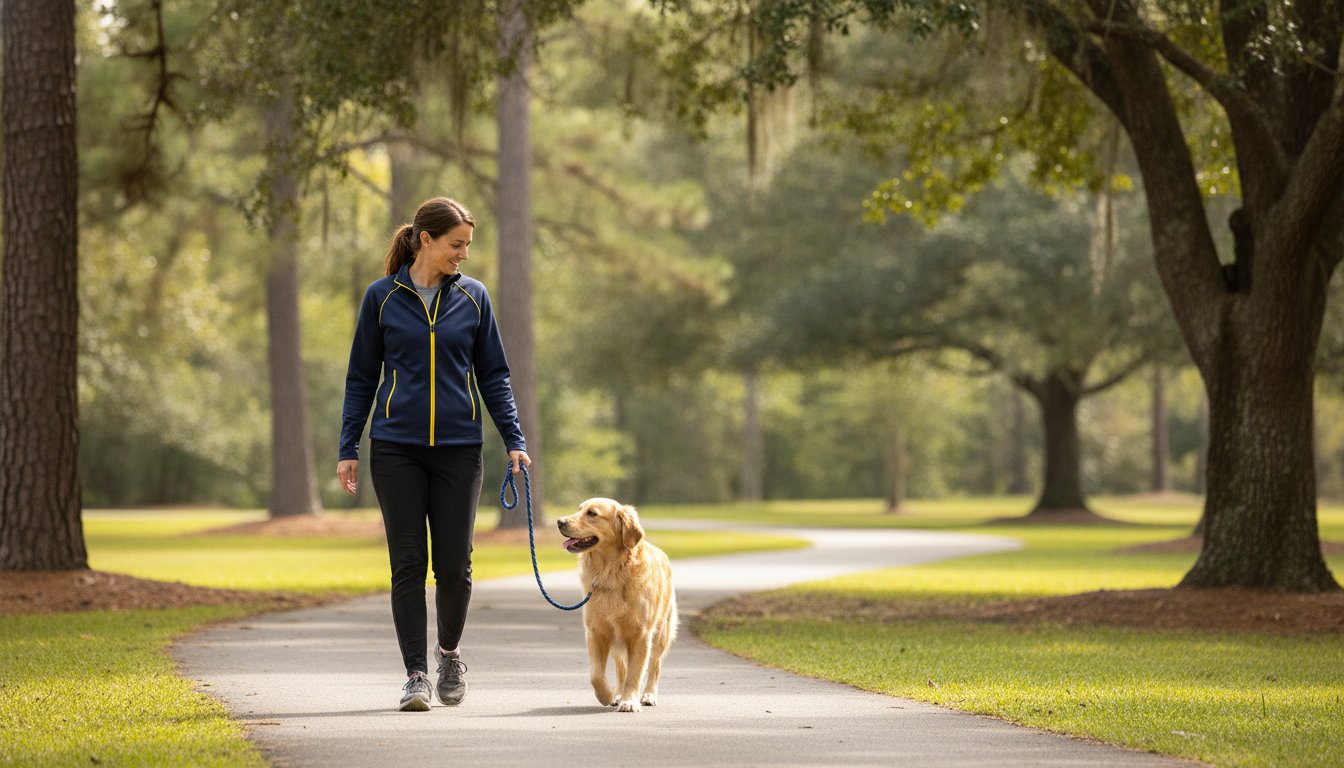
Kennesaw Dog Training for Leash Pulling: Reclaiming Your Walks in 2026
What if the secret to a perfect walk isn't found in a specialized "no-pull" harness, but in the silent conversation between you and your dog? If you've ever felt the sharp sting of a leash snapping taut or the embarrassment of being dragged through a crowded park, you know that gear alone rarely sol...
%20(5).gif)
What if the secret to a perfect walk isn't found in a specialized "no-pull" harness, but in the silent conversation between you and your dog? If you've ever felt the sharp sting of a leash snapping taut or the embarrassment of being dragged through a crowded park, you know that gear alone rarely solves the problem. When searching for Kennesaw dog training for leash pulling, most owners are looking for more than just a quick fix; they're looking for a way to enjoy their companion again without the physical strain and constant stress.
We understand that a walk should be the highlight of your day, not a chore you dread. It's frustrating when your dog seems to forget you exist the moment you step outside. We promise to help you master the art of the loose-leash walk through professional, in-home training tailored specifically for the challenges of your local environment. You'll learn how to establish clear communication that results in a dog walking calmly by your side, even in the busiest parts of downtown Kennesaw. This guide explores how shifting your approach from control to connection transforms every outing into a peaceful, reliable experience for both ends of the leash.
Key Takeaways
• Stop fighting the natural "opposition reflex" and learn how to communicate with your dog rather than relying on gear or physical force.
• Discover why effective Kennesaw dog training for leash pulling begins in your own home to eliminate distractions before heading to local parks.
• Master the "Source Principle," which ensures you remain the primary communicator and leader in your dog's life instead of a third-party trainer.
• Apply a balanced, humane philosophy developed by Master Trainer Alan Carr to achieve real-world reliability throughout 2026 and beyond.
• Follow a structured transition plan that moves your success from the driveway to high-distraction environments like Swift-Cantrell Park.
Understanding Leash Pulling: Why Your Kennesaw Walks Feel Like a Tug-of-War
Walking your dog in Kennesaw should be a peaceful way to start your morning. Instead, it often feels like a grueling workout for your shoulders and arms. Whether you're dodging squirrels at Kennesaw Mountain or trying to keep your dog focused near the busy crowds at Swift-Cantrell Park, the constant pulling is exhausting. Many owners assume their dog is trying to be "dominant" or is simply stubborn. In reality, this behavior is rarely about ego. It's usually a combination of biological instincts and a breakdown in communication. Effective Kennesaw dog training for leash pulling starts by understanding that the tension on the line is a symptom of a deeper disconnect between owner and companion.
The Science of Opposition Reflex
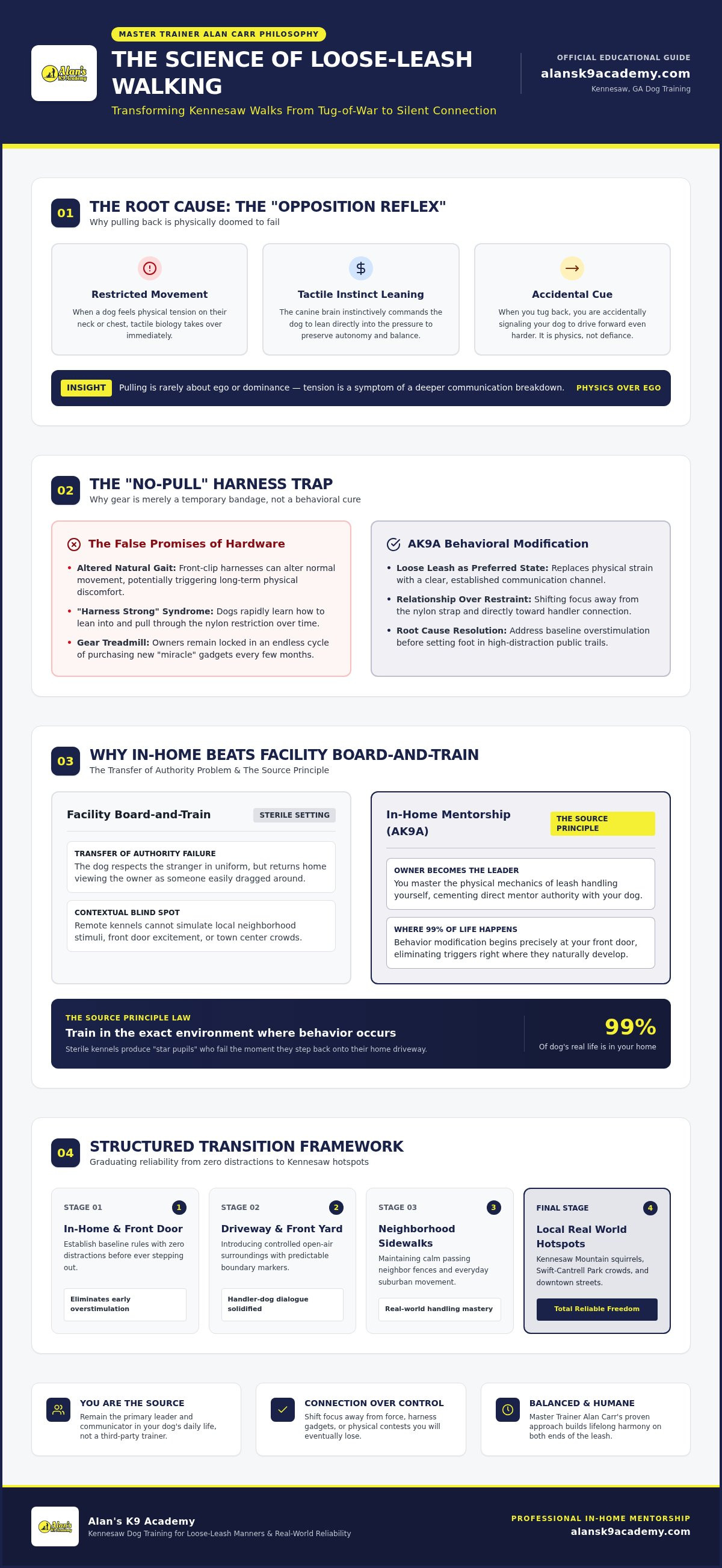
When you feel your dog lunge, your natural reaction is to pull back. This creates a cycle where the dog pulls even harder against you. This isn't defiance; it's physics. Opposition reflex is a tactile biological response to restricted movement. When a dog feels pressure on their neck or chest, their brain tells them to lean into that pressure to maintain balance and autonomy. By pulling back, you are accidentally signaling your dog to keep moving forward.
Professional dog training methods focus on teaching the dog that a loose leash is the preferred state. This means moving away from the physical contest that you will eventually lose. When tension becomes the primary language between you and your dog, the message gets lost in the noise. We want to replace that physical struggle with a clear, meaningful dialogue that doesn't rely on brute force. It's about shifting the focus from the leash to the relationship.
The Trap of "No-Pull" Harnesses
It's tempting to look for a hardware solution in 2026. You might have tried front-clip harnesses or head halters that promise an instant fix. While these tools can offer temporary management, they often mask the underlying issue. Front-clip harnesses can sometimes alter a dog's natural gait, potentially leading to long-term physical discomfort if used improperly over time. More importantly, many dogs simply learn how to pull through the restriction, becoming "harness strong."
These tools are bandages, not cures. True reliability comes from behavior modification rather than relying on a piece of nylon to do the work for you. Many owners find themselves in a cycle of buying new gear every few months, hoping the next "miracle" product will finally work. When we focus on Kennesaw dog training for leash pulling in the home, we address the root cause of the tension before you ever set foot on a public trail. By starting at the front door, we ensure the dog understands the expectations before the high-value distractions of the real world take over.
Why In-Home Training Beats Facility Board-and-Train for Leash Manners
Have you ever wondered why a dog can be a "star pupil" at a kennel but a complete disaster back in your own neighborhood? Many owners consider sending their pets away for intensive facility training, hoping to receive a "fixed" dog in return. However, leash manners are deeply contextual. The "Source" Principle teaches us that behavior modification must begin where the problem actually occurs: at your front door. Effective Kennesaw dog training for leash pulling isn't about what a dog does in a sterile facility. It's about how they respond to you while passing your neighbor's fence or heading toward the town center. In 2026, we've seen that the most reliable results come from training in the environment where the dog spends 99% of their time.
The Transfer of Authority Problem
The biggest flaw in facility-based programs is the lack of owner involvement. Dogs are masters at reading people. They quickly learn that a professional trainer has high expectations, but they may still view you as someone they can easily pull around. If you aren't the one establishing the rules, you aren't the one the dog will respect. By working with us in your home, you learn the physical mechanics of leash handling yourself. You become the mentor your dog looks to for guidance. This builds a foundation of trust that travels with you throughout North Atlanta, ensuring your dog listens to you, not just a stranger in a uniform.
Training in the "Real World" of Kennesaw
Real progress happens in the environments where you actually live and walk. A remote facility cannot replicate the specific distractions of Kennesaw State University foot traffic or the unique smells of your favorite local trail. We start in your quiet living room to establish a baseline of focus. Once the communication is clear, we move to the driveway and then into the community. This step-by-step approach to behavioral training for dogs ensures your companion can handle real-world triggers without reverting to old habits. Our goal is to make you the expert on your own dog. If you're ready to stop the tug-of-war, you can schedule an in-home evaluation to see the difference personalized coaching makes.
The AK9A Method: Building Clear Communication and Loose-Leash Reliability
Many owners feel stuck between two extremes: bribing their dog with a pocket full of treats or resorting to harsh, physical force. Neither approach creates a truly reliable partner. At Alan's K9 Academy (AK9A), we focus on "meaningful communication." This means establishing a "Follow" mindset where your dog chooses to stay by your side because they understand your expectations, not because they're being dragged or manipulated by food. When you choose Kennesaw dog training for leash pulling with us, you're investing in a system that prioritizes clarity and mutual respect over simple compliance.
Alan Carr’s 35-Year Legacy of Success
Alan Carr brings over 35 years of experience to every training session. As a Master K9 Trainer who's worked with thousands of dogs, he possesses a unique ability to read subtle behavioral cues that most owners might miss. This legacy of success is built on a foundation of Christian values and integrity, ensuring that every client receives compassionate, honest service. Alan doesn't just train your dog; he acts as a mentor for you. He shares the deep insights needed to maintain focus and calm in any environment. This high-level expertise is what allows us to solve problems that others might find impossible.
Balanced Training: The Best of Both Worlds
Our approach utilizes balanced, humane methods to bridge the gap between owner and dog. We use clear markers to tell your dog exactly when they're doing the right thing, reinforcing the calm, loose-leash behavior you desire. Simultaneously, we establish fair, consistent boundaries that your dog can actually understand and respect. It isn't about punishment; it's about providing the structure a dog needs to feel secure and confident.
This methodology is a core component of our dog obedience training programs, designed specifically for real-world reliability. By focusing on the relationship rather than just the equipment, we help you reclaim your walks. We transform your dog from a source of stress into a reliable companion who is a joy to take out in public. You'll move from a state of overwhelm to a feeling of complete control, knowing that your communication is finally being heard and understood.
Step-by-Step: Transitioning from Your Driveway to Swift-Cantrell Park
Achieving a peaceful walk in 2026 requires more than just a new collar; it requires a methodical progression of success. Many owners make the mistake of trying to fix behavior in the middle of a crowded park. This approach is often overwhelming for the dog and frustrating for you. Effective Kennesaw dog training for leash pulling follows a structured four-phase transition that builds reliability in layers. We don't ask your dog to perform in a high-stress environment until they've mastered the basics in a place where they feel safe and focused.
The journey begins with Phase 1: foundation work inside your home. Here, distractions are zero, allowing your dog to learn the "language" of the leash without the lure of squirrels or neighbors. Once your dog is consistently attentive, we move to Phase 2, which involves mastering the driveway and the immediate sidewalk. This is where we address the initial "pull" trigger that often happens the moment you cross the threshold. Phase 3 introduces controlled distractions within your Kennesaw neighborhood, such as distant traffic or a barking dog behind a fence. Finally, Phase 4 takes your training to local landmarks like Kennesaw Mountain or Swift-Cantrell Park, where we achieve total control amidst the real-world chaos of a busy weekend.
Mastering the "Leash Language"
Your physical presence speaks louder than any verbal command. Proper leash handling starts with a relaxed but secure grip and a balanced body position. Instead of using your arm strength to pull back, you'll learn to use your movement and core to guide your dog's direction. This prevents the physical struggle that leads to sore shoulders and frustrated pets. Leash slack is the ultimate goal of communication. When the leash is loose, it means you and your dog are finally speaking the same language, moving in harmony rather than in opposition.
Handling Real-World Distractions
Kennesaw trails can be narrow and unpredictable. When you see another dog approaching at Kennesaw Mountain, your first instinct might be to shorten the leash and tense up. This tension travels straight to your dog, signaling that they should be on alert. We teach you specific techniques for refocusing a dog that has become "locked on" to a distraction. By breaking their stare and reclaiming their attention before they lunge, you maintain the peace. This proactive approach is a cornerstone of professional in home dog training, ensuring you have the tools to handle any situation with confidence. If you're tired of the tug-of-war, reach out to Alan’s K9 Academy to begin your transformation today.
Start Your Kennesaw Dog Training Journey with Alan’s K9 Academy
Imagine a Saturday morning in 2026 where you step out your front door and your dog immediately looks to you for direction. No more lunging, no more sore shoulders, and no more avoiding other walkers in your neighborhood. Reclaiming this joy is entirely possible when you partner with a professional who understands the specific needs of your household. If you're ready to see real results, professional Kennesaw dog training for leash pulling offers the most direct path to a reliable companion. Your journey begins with a personalized in-home evaluation. This initial meeting allows us to observe your dog's behavior in their natural environment, identifying the exact triggers that lead to tension. During your first coaching session, we don't just work on the dog; we work on the partnership. You'll receive immediate, hands-on feedback that transforms how you communicate through the leash.
Customized Plans for Every Breed and Age
Every dog is an individual, and a one-size-fits-all approach never yields real-world reliability. A Great Dane requires a different set of physical mechanics and spatial awareness than a high-energy Jack Russell Terrier. We tailor the pace of our Kennesaw dog training for leash pulling to match your dog's unique temperament and your specific lifestyle goals. If your dog's pulling is fueled by leash reactivity or fear, we address those underlying behavioral issues simultaneously. This comprehensive strategy ensures that you aren't just managing a symptom, but building a confident, well-adjusted companion who can handle any environment in North Atlanta. Whether you have a rambunctious puppy or an older dog with deep-seated habits, we customize the training to ensure success is attainable and sustainable.
The AK9A Difference: Integrity and Results
Kennesaw families trust Alan's K9 Academy because we provide more than just a service; we offer a mission-driven partnership rooted in Christian values and integrity. With over 35 years of experience, Master K9 Trainer Alan Carr has seen every possible challenge and remains a steadfast mentor for owners. The long-term value of our program lies in the skills you gain as a handler. You won't be dependent on a trainer or a specific piece of gear to have a well-behaved dog. Instead, you'll have the knowledge and confidence to maintain those results for the life of your companion. We take pride in being a high-end, premium service that remains a relatable and compassionate local partner.
It's time to stop the frustration and start enjoying your time together again. Reclaiming your walks starts with a single conversation. We invite you to contact the academy today to schedule your in-home consultation. Let’s turn those stressful outings into the meaningful, calm experiences you both deserve. You don't have to settle for "good enough" when excellence is just a phone call away.
Take the First Step Toward Stress-Free Walks in 2026
Reclaiming your walks is about more than just physical control; it's about building a relationship where your dog chooses to follow your lead. Real change starts here. By shifting from gear-based management to meaningful dialogue, you transform every outing from a struggle into a shared joy. Whether you're navigating the trails at Kennesaw Mountain or strolling through your own neighborhood, the foundation of success lies in professional Kennesaw dog training for leash pulling. Master K9 Trainer Alan Carr brings over 35 years of experience as an award-winning behavioral specialist to help you achieve real-world reliability.
Stop letting the leash dictate your day and start leading with confidence. As a dedicated partner serving the Kennesaw and North Atlanta community since our inception, we're here to turn your frustrations into a lasting bond. Contact Alan’s K9 Academy today to schedule your in-home leash training evaluation in Kennesaw! You deserve a companion who walks calmly by your side, and we have the expertise to make that vision a reality. Let's make 2026 the year you finally master the art of the loose-leash walk.
Frequently Asked Questions
How many sessions will it take to stop my dog from pulling on the leash?
The number of sessions required varies based on your dog's age, history, and how consistently you practice between our meetings. While some owners see a significant shift in focus after the first session, true reliability usually takes a structured series of lessons. We focus on teaching you the mechanics of leash language so you can maintain progress long after we leave. Our goal is to ensure you have the skills to handle real-world distractions.
Do you use prong collars or e-collars for leash training in Kennesaw?
We utilize balanced, humane methods tailored to the specific needs of each dog and owner. This means we aren't limited to a single tool or philosophy. Whether we use a flat collar, a slip lead, or other professional equipment, our priority is always clear communication and your dog's well-being. During your in-home evaluation, we'll discuss which tools will best help you achieve loose-leash success while ensuring your companion remains confident and happy.
Can you help with a dog that is aggressive or reactive while on the leash?
Yes, we specialize in behavior modification for dogs struggling with leash reactivity or aggression. Pulling is often a symptom of underlying anxiety or over-excitement when seeing other dogs or people. Our Kennesaw dog training for leash pulling addresses these root causes by building a foundation of trust and focus. We'll work with you to implement specific strategies that keep your dog calm and attentive even when triggers appear on your neighborhood walks.
Is my dog too old to learn how to walk properly on a leash?
No dog is ever too old to learn better leash manners. While senior dogs may have years of practiced habits to overcome, they are often very capable of learning new communication markers. The key is adjusting the pace and intensity of the training to suit their physical abilities and temperament. We've successfully helped many older dogs in the area transition from constant pullers to relaxed, reliable walking companions through our personalized in-home coaching programs.
What is the difference between your in-home training and a group class at a park?
In-home training provides a personalized, distraction-free environment where we can focus entirely on your specific challenges and your dog's unique personality. Group classes are excellent for socialization and testing skills in busy environments, but they can be overwhelming for a dog that hasn't yet learned the basics of leash communication. Starting at home allows us to build a solid foundation before we ever ask your dog to perform around the heavy distractions found in a public park.
Do I need to buy special equipment before my first training session?
You don't need to purchase any new equipment before our first meeting. Part of our initial evaluation involves assessing your current gear and determining if it's actually helping or hindering your progress. We prefer to see how your dog naturally responds to your existing setup first. After we observe your walk and discuss your goals, we'll provide professional recommendations for any tools that might improve your communication and make your walks more enjoyable.
What happens if my dog only listens to the trainer and not to me?
This is exactly why we prioritize in-home coaching over board-and-train services. Our mission is to train you to be the leader your dog respects. If a dog only listens to the trainer, the training has failed its primary purpose. We spend a significant portion of every session coaching you on body positioning, leash mechanics, and timing. This ensures that the authority stays with you, creating a lasting bond of trust that works everywhere you go.
How do I handle my dog pulling when we visit Kennesaw Mountain or downtown?
Handling high-distraction areas like Kennesaw Mountain requires a strategy focused on distance and focus. If your dog begins to pull, we teach you how to reclaim their attention before they reach the end of the leash. By using the markers and communication techniques learned during our Kennesaw dog training for leash pulling sessions, you'll be able to navigate busy trails with confidence. We'll practice these specific scenarios together before heading to challenging local landmarks.