%20(620%20x%20150%20px)%20(14).webp)
%20(620%20x%20150%20px)%20(15).webp)
.webp)
_page-0001.webp)
.webp)
Indoor Dog Training Lessons: In-Home Coaching or Facility Classes?
What if the best place to train your dog is where you need the new behavior to happen? Indoor dog training lessons can give your dog practice around people, dogs, and other distractions, while coaching at home can focus on challenges tied to your own space. A dog who listens in class may still need...
%20(5).gif)
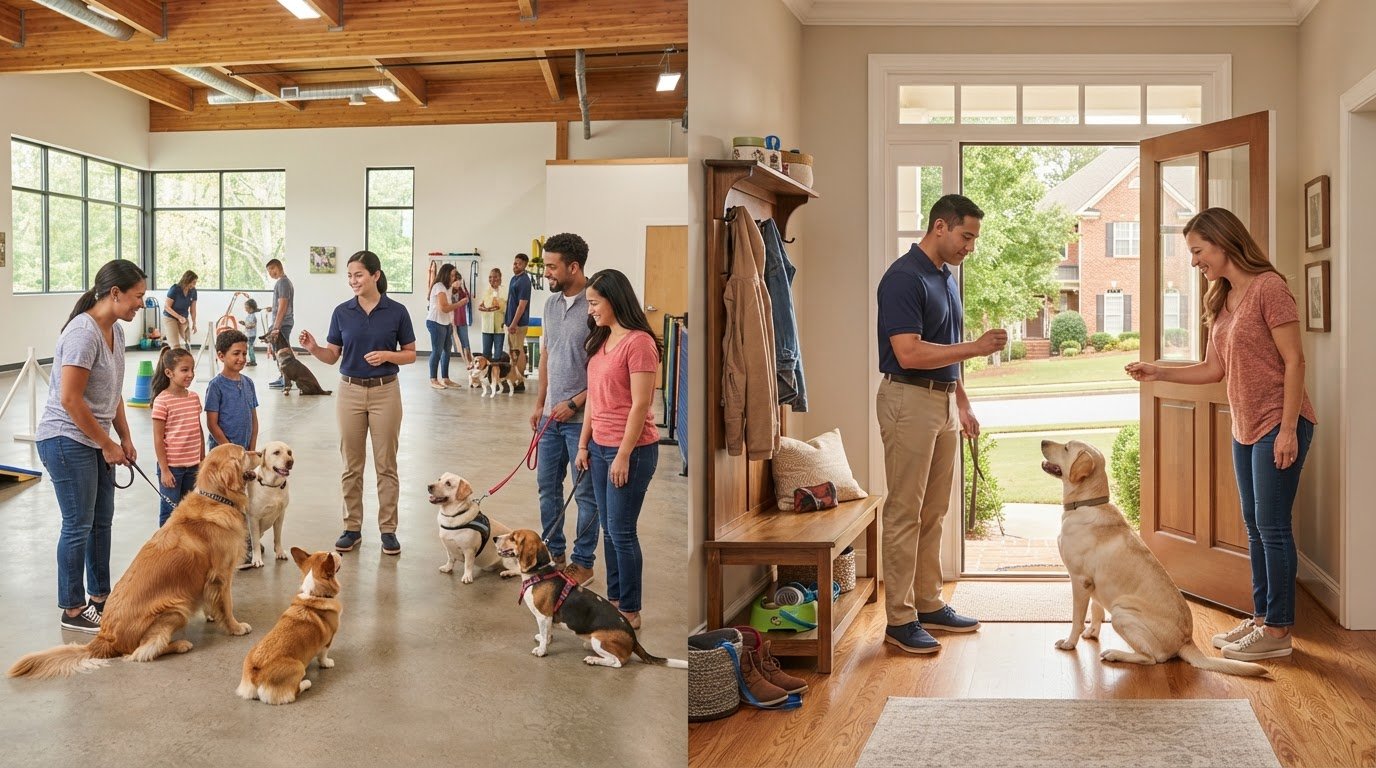
What if the best place to train your dog is where you need the new behavior to happen? Indoor dog training lessons can give your dog practice around people, dogs, and other distractions, while coaching at home can focus on challenges tied to your own space. A dog who listens in class may still need help greeting visitors calmly or settling near the front door.
It’s understandable to wonder whether your dog can focus in a group or whether a class will address the behaviors you see at home. The right setting depends on your dog, your goals, and the situations where you want skills to stick.
This guide compares group classes with personalized in-home coaching, including what you can practice in each setting and what may need additional work. You’ll learn how to weigh distractions, owner participation, location, and scheduling, plus what to ask a local trainer about class format and suitability. With a clearer picture, you can choose a practical starting point for building better communication with your dog.
Key Takeaways
• Indoor dog training lessons can offer practice around distractions, while in-home coaching can focus on behavior in your dog’s everyday surroundings.
• Start with the skill you want to build, then consider how comfortably your dog handles unfamiliar people, dogs, and activity.
• Before enrolling, ask about the class format, instructor involvement, group size, dog spacing, and how training progresses.
• Confirm the class location and whether lessons are indoors, since venues and availability can vary by provider.
• Alan’s K9 Academy offers in-home training, behavior modification, and structured group classes in Cartersville, Bartow County, and the North Atlanta Metro area.
What Do Indoor Dog Training Lessons Include, and What Can They Teach?
Indoor dog training lessons are instructor-led sessions held inside a training venue, away from your dog’s home. The venue may be a dedicated facility or another indoor space, so confirm the location and setup with the provider before enrolling. Depending on the trainer, instruction may be offered as a group class, as private lessons at a facility, or in only one of these formats.
Lessons may cover cues, everyday manners, and ways owners can communicate consistently with their dogs. Training methods, equipment, and lesson plans differ between providers. For background on common approaches and basic obedience, see this overview of Dog training. Before signing up, ask the trainer to describe a typical session, explain what skills the class covers, and tell you what you’ll practice with your dog between lessons.
How indoor group lessons typically work
In a group class, the instructor introduces an exercise, demonstrates or explains the skill, and guides owners as they practice with their dogs. Dogs may take turns working while others wait nearby, or practice at the same time with space between them. This provides opportunities to work around manageable activity, but it doesn’t mean dogs have to greet or play with one another.
Group size, curriculum, equipment, and progression vary by provider. Ask whether the specific class is indoors, how dogs are spaced, and whether its structure suits your dog. Being in a room with other dogs is exposure, not a guarantee of positive socialization or comfort. Some dogs can focus in that environment; others may find it stressful and need a different starting point.
Which training goals may suit a class setting?
Classes can be useful for practicing foundation skills such as responding to a cue, settling, or walking with attention while other activity is present. The aim is to build skills around distractions at a level the dog can manage, not simply to put dogs close together. Puppies and adult dogs may need different pacing, expectations, and class structures, so ask how the instructor accommodates age and experience.
A class may be less suited to a challenge tied closely to home or one that makes it difficult for your dog to learn around unfamiliar people or dogs. Persistent barking, intense reactions, or difficulty recovering after a distraction may call for an individual assessment before joining a group. Describe what happens, what tends to trigger it, and how your dog responds afterward. That conversation can help identify a practical first step without assuming every dog should begin in the same setting.
What Makes Indoor Dog Training Lessons Different from In-Home Coaching?
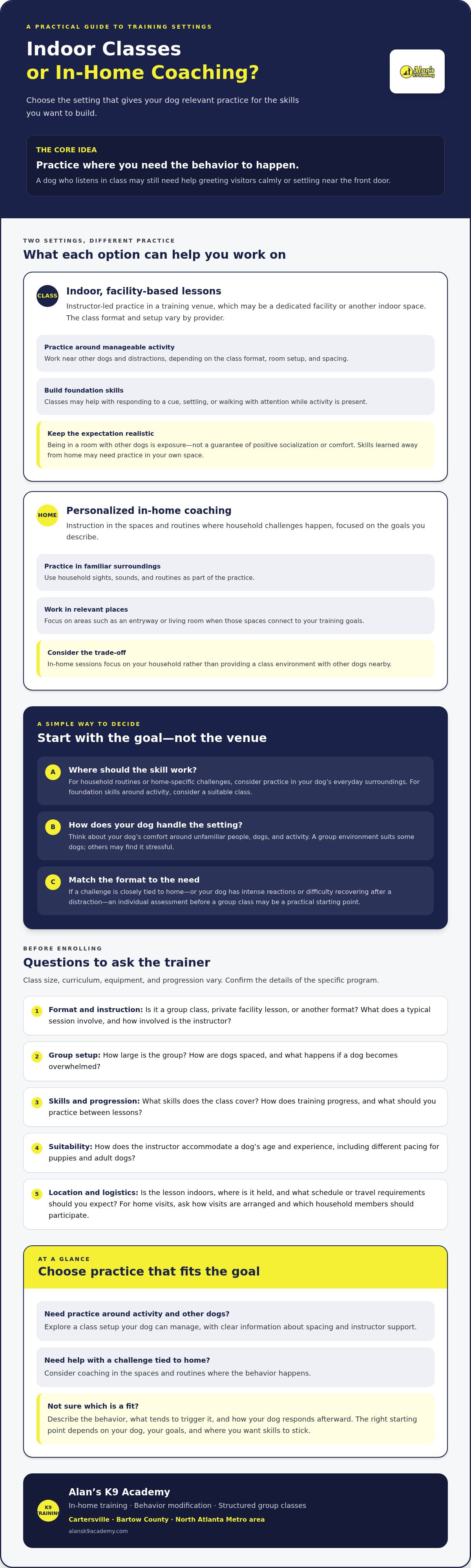
The setting changes what you and your dog can practice. Indoor dog training lessons may provide opportunities to work around instructor-led activity and other dogs. In-home coaching brings instruction into the spaces and routines where household challenges happen. Neither option is automatically better. Consider where your dog needs to use a skill, then choose a setting that gives you relevant practice.
| Consideration | Facility-based lessons | In-home coaching |
|---|---|---|
| Attention | Your dog may work near other dogs and activity, depending on the class setup. | Instruction can focus on your dog and household’s stated goals. |
| Distractions | Instructor-led activities can provide practice around manageable distractions. | Practice can use familiar household sights, sounds, and routines. |
| Home-specific practice | Skills learned away from home may need practice in your own space. | You can work in relevant areas, such as an entryway or living room. |
| Peer exposure | Other dogs may be nearby, with spacing and interaction determined by class management. | Sessions can focus on your household rather than a class environment. |
| Lesson logistics | Confirm venue, schedule, format, and travel requirements with the provider. | Ask how the trainer arranges visits and which household members should participate. |
What a facility setting can offer
A class can help you practice asking for attention while an instructor leads activities and other dogs are present. This offers a chance to build focus outside the home, but the level of distraction depends on the room, class format, and distance between dogs. Ask how the instructor manages spacing and what options are available if your dog becomes overwhelmed. For guidance on evaluating an instructor and class structure, review what to look for in a training class. Confirm the actual venue and indoor availability rather than assuming a provider has a dedicated facility.
What in-home coaching can address
At home, an instructor can observe the routines and spaces connected to your goals. For example, you might practice how you communicate with your dog around a doorway or during a familiar household routine. Personalized instruction can focus on your family’s priorities, though progress still depends on practice between sessions. For a closer look at this approach, read the professional in-home dog training guide. If everyday obedience is your focus, the North Atlanta dog obedience guide offers related context.
To compare group classes with in-home coaching, explore Alan’s K9 Academy’s dog training options.
Which Indoor Dog Training Lessons Fit Your Dog’s Needs?
Choose a class by starting with the behavior you want to practice, not simply the class that is closest or easiest to schedule. Are you building foundation skills, improving everyday manners, helping your dog gain confidence in new settings, or addressing a challenge that happens at home? Indoor dog training lessons can suit some goals, but your dog’s comfort and ability to learn in a shared space matter just as much as convenience.
Notice what happens when unfamiliar people or dogs are nearby. Can your dog still engage with you, even briefly? After a sudden sound or movement, can they settle and return their attention to you? These observations aren’t a formal test or diagnosis. They are useful details to share with a trainer when asking whether a group setting is a sensible starting point.
When a group lesson may be a reasonable fit
A group class may be worth exploring if your dog can respond to you around manageable activity and recover after ordinary distractions. Your dog doesn’t need to be perfectly calm or already know every cue. Ask how the instructor adjusts distance, pace, and participation so dogs can work at a level they can handle. A thoughtful trainer should discuss suitability with you, rather than assume a fit based only on a class description or an online search.
Before enrolling, describe how your dog behaves around other dogs and people. Ask what the instructor recommends if your dog struggles to settle, needs more space, or is not ready to participate in a particular exercise. Clear answers help you decide whether the class environment supports learning for both you and your dog. You can also ask how the instructor handles breaks and whether you can observe before your dog joins an exercise.
When to ask about one-on-one support first
Consider an individual conversation before group enrollment if your dog shows intense reactivity, fear, aggression, or anxiety, or if your main concern is highly specific to your household. A private session can give you space to explain what you’ve observed, ask questions, and discuss instruction tailored to your dog’s context. This doesn’t label your dog or predetermine the right plan. It gives a professional relevant information to consider before recommending a format.
If a behavior change may be connected to pain, illness, or another health concern, contact a veterinarian for guidance. Training advice can support communication and learning, but it shouldn’t replace veterinary input when health may be involved.
Owner preferences matter, too. A nearby class may fit your calendar, while a home session may better match the challenge you want to work on. Weigh both against your dog’s readiness and the skill you want to practice. The right first step is the one that gives your dog a fair chance to engage and gives you practical guidance you can use.
How to Choose Indoor Dog Training Lessons in Cartersville or North Atlanta
Use a simple process to narrow your options: define the skill you want to work on, consider how your dog handles people and dogs nearby, compare group and individual formats, then confirm the venue and suitability directly with the provider. A search for indoor dog training lessons doesn’t confirm that a particular class meets indoors or that its setup fits your dog.
For local owners, travel matters too. Ask whether the provider serves your community and where lessons take place. Alan’s K9 Academy serves Cartersville, Bartow County, and communities across the North Atlanta Metro area. Confirm current class locations and arrangements before planning a visit.
Questions to ask before enrolling
Get practical details before committing. Ask whether the class is indoors, where it meets, and which areas the provider serves. Then check the class schedule, prerequisites, equipment guidance, and what you should bring. These details help you judge whether the option works with your routine as well as your training goal. If your dog has not attended a group class before, ask what the first session involves and how you should prepare.
Instruction
How involved is the instructor during practice, and how does the class progress?
Group setup
How many dogs attend, how are they spaced, and what happens if a dog struggles to participate?
Individual needs
How does the instructor adapt for puppies, adult dogs, or dogs that need extra distance?
Other formats
Is individual coaching an option if a group setting isn’t the right first step?
How to evaluate the training approach
A clear trainer should be able to explain the techniques used, why they suit your dog, and how you’ll practice between sessions. Ask how the approach supports humane handling and adapts to your dog, rather than relying on vague assurances. Share relevant behavior history honestly, including situations that lead to fear, barking, or difficulty focusing. Specific examples help the provider discuss fit and participation responsibly.
Listen for practical guidance, not a promise that every dog will suit every class. A provider should be willing to discuss your questions, explain expectations, and help you consider another format if needed. The decision should balance your preferences with your dog’s readiness.
To compare local group classes and personalized in-home training, ask Alan’s K9 Academy about training options and confirm the current class format, location, and fit for your dog.
Explore Dog Training Options with Alan’s K9 Academy
Once you’ve considered your dog’s goals and comfort, discuss options that fit your situation. Alan’s K9 Academy offers personalized in-home training, behavior modification, and structured group classes for owners in Cartersville, Bartow County, and communities across the North Atlanta Metro area. Founded by Master K9 Trainer Alan Carr, the academy brings more than 35 years of professional dog instruction experience.
Match the service conversation to your training goal
In-home sessions let you and the trainer work on communication and practical needs in your household. If your concern is more complex, ask whether behavior modification may be an appropriate option and what information the trainer needs to understand your dog’s history. No specific result can be promised, but sharing clear examples can help shape a useful conversation.
Structured group classes may be worth discussing if your dog is ready to practice alongside others. Confirm the academy’s current class format and venue directly. Don’t assume group classes are held indoors just because you’re searching for indoor dog training lessons. Ask whether the location, setup, and class expectations suit your dog.
Take a simple next step in North Georgia
When you get in touch, explain what you’d like to work on and include details that can help the trainer assess fit:
• Your dog’s age, experience, and comfort around unfamiliar people and dogs.
• The behaviors you’ve observed, when they occur, and any relevant history.
• Your main training goal and preferred setting, such as home coaching or shared practice.
• Your location and any questions about travel, class schedules, or participation requirements.
Ask the academy to confirm whether group classes are currently available for your needs, where they take place, whether the venue is indoors, and what schedule and enrollment requirements apply. These details can change, so getting current information helps you plan without relying on assumptions. You can also ask what the trainer recommends if your dog needs more space or has difficulty participating in a group.
You don’t have to settle on a format before asking questions. Contact Alan’s K9 Academy about training options to discuss your dog’s goals, share relevant behavior history, and find out which available option may be a suitable next step.
Choose a Training Setting That Works for You and Your Dog
The right training environment is the one that supports the skills you want to build. Indoor dog training lessons can offer practice around shared activity, while in-home coaching lets you work on communication and challenges in your dog’s familiar surroundings. Consider your dog’s comfort with distractions, your specific goals, and the practical details of location and schedule before choosing.
Alan’s K9 Academy offers personalized in-home training, behavior modification, and structured group classes in Cartersville, Bartow County, and the North Atlanta Metro area. Founded by Master K9 Trainer Alan Carr, the academy brings more than 35 years of professional dog instruction experience. Ask about your dog’s needs, class suitability, and current venue details, including whether a group class is held indoors.
Ready to explore a practical next step? Talk with Alan’s K9 Academy about training options for your dog. Share your goals and questions to discuss which available service may fit your situation.
Frequently Asked Questions
Are indoor dog training lessons good for every dog?
No, indoor dog training lessons aren’t automatically the right fit for every dog. A shared setting may suit a dog who can engage with their handler around manageable activity, while another may find nearby people or dogs overwhelming. Consider your dog’s comfort, ability to recover after distractions, and training goal. If you’re unsure, describe what you’ve observed to a trainer and ask whether a group class or individual guidance is a better starting point.
Can indoor dog training lessons help with behavior problems at home?
They may help you practice cues and communication that can be useful at home, but facility-based practice doesn’t directly address every household situation. A dog who struggles with visitors, doorways, or everyday routines may benefit from coaching in the relevant home context. Indoor dog training lessons can complement that work, depending on the goal and the dog. For complex concerns, discuss the behavior with a professional before enrolling in a group class.
What is the difference between group dog training lessons and in-home training?
Group lessons give owners and dogs a chance to practice with an instructor and, depending on the setup, other dogs nearby. In-home training takes place in the dog’s familiar environment, where the owner can discuss household routines and specific challenges. Each setting offers different practice opportunities. Your choice should reflect where you want a skill to work, your dog’s comfort in a shared setting, and whether the goal calls for individualized attention.
How do I know if my dog is ready for a group training class?
Your dog may be ready to explore a group class if they can engage with you around manageable activity and recover after ordinary distractions. They don’t need to be perfectly calm or know every cue. Share your dog’s behavior history with the instructor and ask how the class handles spacing, breaks, and dogs who need extra room. A trainer can help assess suitability; a search result or class description can’t confirm fit on its own.
Are there indoor dog training lessons in Cartersville or North Atlanta?
Alan’s K9 Academy offers structured group classes and personalized in-home training in its North Georgia service area, including Cartersville, Canton, Woodstock, Marietta, Rome, Acworth, Kennesaw, Sandy Springs, Roswell, Alpharetta, Powder Springs, Dallas, Hiram, Jasper, Cumming, Holly Springs, Ball Ground, and Milton. However, confirm whether a current group class is indoors. Ask about its venue, schedule, enrollment requirements, and travel arrangements for your community before making plans.
What should I ask before enrolling my dog in indoor lessons?
Ask whether lessons are indoors, where they take place, and how many dogs attend. Find out how the instructor guides practice, spaces dogs, and adapts the pace for puppies, adult dogs, or dogs needing extra distance. Confirm prerequisites, schedule, equipment guidance, and what to bring. Explain your dog’s behavior history and ask what happens if they struggle to participate, or whether individual coaching may be a suitable alternative.
Can a dog take group classes and in-home training at the same time?
Potentially, yes. Group classes and in-home training can offer different kinds of practice, but it helps to coordinate the goals and approach. For example, you might discuss a household concern in a home session and ask whether class practice supports a related skill. Tell each instructor about the other training, follow guidance tailored to your dog, and watch how they respond. Ask the trainers whether combining formats makes sense for your dog’s needs.