%20(620%20x%20150%20px)%20(14).webp)
%20(620%20x%20150%20px)%20(15).webp)
.webp)
_page-0001.webp)
.webp)
In-Home vs. Board and Train: Which Dog Training Approach Fits Your Family?
What if the training option that seems fastest isn’t the one that makes everyday life easier? If you’re weighing in-home vs board and train, it’s understandable to want clear progress and know whether your dog will respond similarly once you’re back home together.Both formats can offer a path forwar...
%20(5).gif)
What if the training option that seems fastest isn’t the one that makes everyday life easier? If you’re weighing in-home vs board and train, it’s understandable to want clear progress and know whether your dog will respond similarly once you’re back home together.
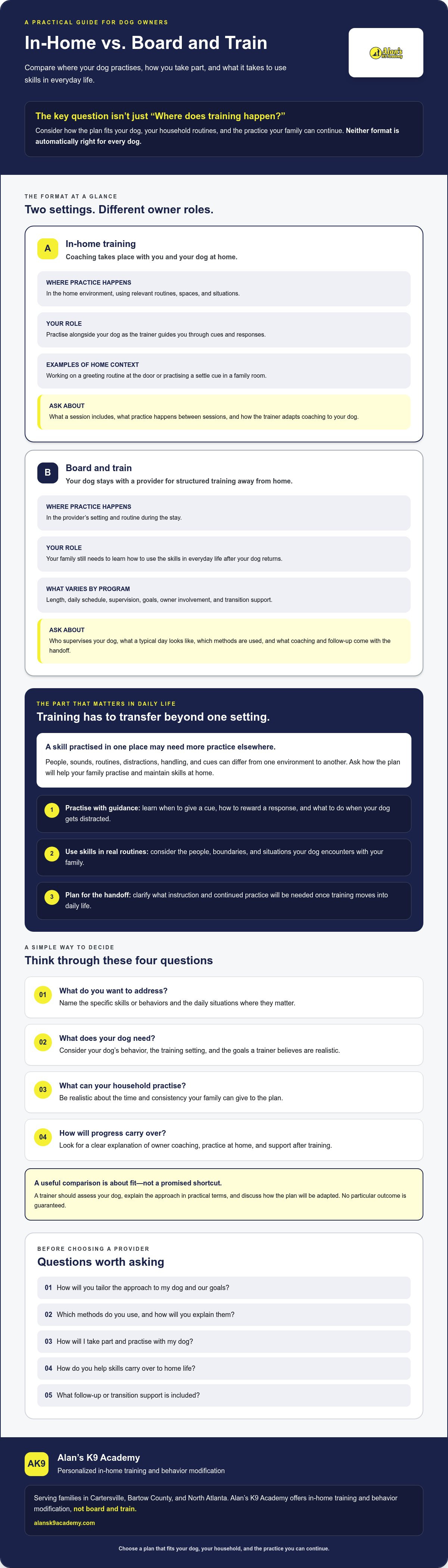
Both formats can offer a path forward, but they ask different things of your dog and your household. In-home coaching involves you in practice where daily routines and challenges happen. Board and train provides structured work away from home, but your family still needs to learn how to use the skills in everyday life. No format is automatically right for every dog. The fit, training plan, and your follow-through all matter.
This guide compares what each approach involves, how owners participate, and what to ask about transferring skills to home life. Alan’s K9 Academy offers personalized in-home training and behavior modification, not board and train, for families in Cartersville, Bartow County, and North Atlanta. The goal is to help you choose a realistic approach for both you and your dog.
Key Takeaways
• Compare in-home vs board and train by considering where your dog practises, how involved you’ll be, and how skills may carry over to home life.
• Neither format is universally better; your dog’s behavior, household routines, goals, and capacity to practise all matter.
• Use a step-by-step framework to define your goals, assess your dog’s needs, and evaluate training providers.
• Ask prospective trainers how they tailor their approach, involve owners, and help families maintain progress after training.
• Alan’s K9 Academy offers personalized in-home training and other listed services in Cartersville, Bartow County, and North Atlanta, but does not offer board and train.
In-Home vs. Board and Train: What Each Dog Training Format Means
Choosing a format can feel confusing when your dog’s behavior affects daily life. The key difference in in-home vs board and train is where coaching takes place and whether you practise alongside your dog throughout the process. Neither option is a shortcut or a guaranteed outcome. Start by considering your dog’s needs, your household routines, and the specific skills or behaviors you want to address.
What happens during in-home dog training?
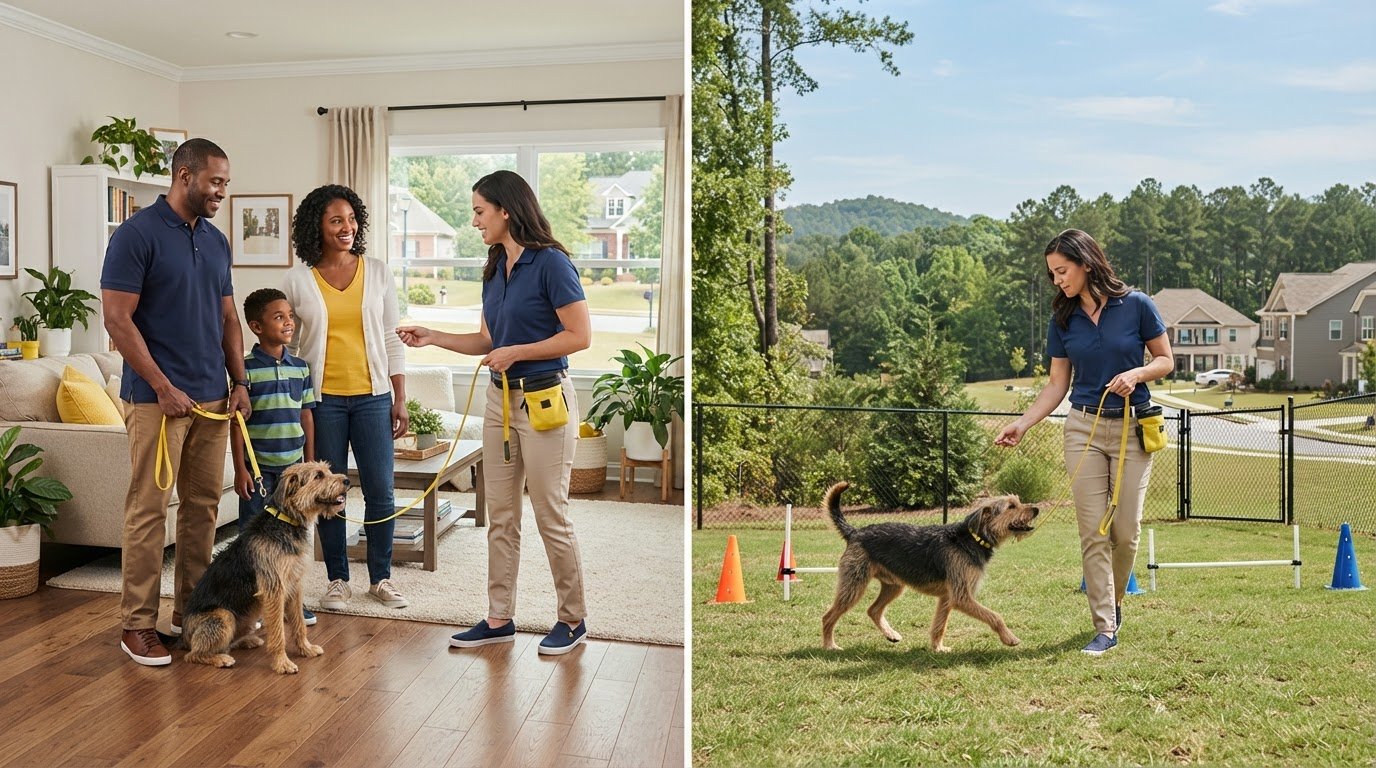
In-home training brings you, your dog, and a trainer together at home. The trainer can observe relevant routines, spaces, and situations, then guide you as you practise with your dog. For example, you might work on a greeting routine at the door or practise a settle cue in the room where your family spends time. You can learn how to give cues and respond consistently in the surroundings where you’ll use those skills.
Session structure and services vary by provider, so ask what a typical session includes and what practice you’ll do between sessions. Training methods also differ; this overview of dog training methods provides background on different approaches. Ask a prospective trainer to explain their methods in practical terms and how they’ll adapt coaching to your dog.
What does board and train usually involve?
In a board-and-train program, a dog stays with a training provider for a structured period and receives training away from home. The length, daily schedule, supervision, goals, and owner involvement vary by program. Don’t assume every provider follows the same curriculum or includes the same transition support. Dedicated pet care providers such as The Fur Seasons illustrate how individualized routines and professional attention can help dogs thrive when staying away from home.
Before deciding, ask who supervises your dog, what a typical day looks like, which methods are used, and how the handoff works. Find out whether you’ll receive coaching to practise the skills at home and what follow-up, if any, is included. These details clarify what the program covers and what you’ll be responsible for after your dog returns.
What should you expect from either format?
A dog performing a skill in one setting doesn’t mean training is complete. Cues may need practice around the people, routines, and distractions your dog encounters in daily life. A trainer should assess your dog’s behavior and discuss realistic goals rather than promise a particular result. Consider, too, how much time your household can give to the plan. Consistent practice can support learning, but each dog and household is different.
For families in Cartersville, Bartow County, and North Atlanta, Alan’s K9 Academy offers personalized in-home training and behavior modification, but does not offer board and train. In-home sessions bring the trainer, owner, and dog together for coaching in the home environment.
How In-Home and Board-and-Train Methods Shape Daily Learning
The setting affects what a dog practises day to day. At home, training can use the routines, boundaries, and distractions your dog encounters with your family. A residential program uses the provider’s setting and schedule during the stay. Neither setting covers every place your dog may go, so skills may need practice around new people, sounds, and routines.
How the training setting affects practice
A home session can focus on specific household situations, such as waiting calmly while someone opens the door or settling during a family meal. You can practise with the trainer’s guidance in the same space where the behavior usually occurs. That context can help identify what prompts a response and whether a routine could be adjusted.
During a board-and-train stay, a dog practises with the provider in that program’s environment and routine. Ask how the provider will introduce skills in different contexts, and remember that your home, handling, and cues may be unfamiliar to the dog. Whichever format you consider, ask how the training plan addresses humane methods. The AVSAB’s guidance on humane and effective training offers a useful reference.
Why owner coaching and the handoff matter
In guided practice, you can learn when to give a cue, how to reward a response, and what to do when your dog gets distracted. Hands-on experience can help you apply the same approach in everyday routines. If your dog has practised mainly with a trainer, ask what instruction you’ll receive before working on those skills at home.
A dog may practise with a trainer, but the people in the household maintain the skills in daily life. That’s why neither format should be assumed to be faster or more effective for every dog. Ask about the plan for practice and transferring skills, not just where training happens.
| Format | Owner role | Likely setting | Questions to ask |
|---|---|---|---|
| In-home | Practise with the dog during coaching | Your home and familiar routines | How will sessions address our household’s goals? |
| Board and train | Learn and practise skills during handoff | Provider’s environment and routine | What owner instruction and follow-up are included? |
Use this comparison to make the in-home vs board and train decision based on where learning happens and what your role will be afterward. If practising at home with professional guidance sounds like a fit, explore personalized in-home dog training from Alan’s K9 Academy, serving Cartersville, Bartow County, and North Atlanta.
Is Board and Train Better Than In-Home Training?
No format is universally better. The right fit depends on your dog’s needs, where those needs arise, your household, and how you’ll support training afterward. A residential program may offer a structured period of work away from home. In-home coaching lets the trainer observe your dog in familiar surroundings while you participate. Neither format guarantees results, and progress in one setting doesn’t automatically carry over to another.
When in-home coaching may be a practical fit
In-home coaching may suit families seeking help with household routines, puppy foundations, or behavior that’s most noticeable at home. Seeing those situations firsthand can help a trainer shape a plan around your dog and your family’s daily life. The trade-off is that owners need to make time to practise between sessions. Ask what practice will involve and how it connects to your goals.
When to investigate a residential program carefully
A residential stay may appeal if you’re considering structured training away from home, but look closely at what the provider actually offers. Ask who supervises your dog, which methods are used, how you’ll receive progress updates, and what transition support is included. For aggression, anxiety, or complex behavior, discuss your dog’s needs with a qualified professional and confirm through an individual assessment that any proposed program is suitable, rather than relying on a general promise.
One common misconception is that a dog will use every newly learned skill with its owner as soon as training ends. Dogs may respond differently with a new person, in a new place, or amid familiar household distractions. After a residential program, ask how you’ll learn the cues and handling, and how to practise them in everyday situations. With in-home coaching, ask what to work on between sessions and how the plan may adapt as your dog learns.
As you weigh in-home vs board and train, separate convenience from suitability. A busy schedule alone doesn’t establish which format is right. Consider whether you can participate, practise, and maintain the plan.
Needs
What behavior or skill are you addressing?
Setting
Where does the challenge occur, and where will practice happen?
Owner role
How much coaching and hands-on participation does your family want or need?
Follow-through
What instruction and practice will help carry learning into daily life?
The best choice depends on your dog’s needs, the setting, your role, and the follow-through you can realistically sustain.
How to Choose Between In-Home and Board and Train
Start with your dog’s needs, not a promise of speed or a crowded calendar. Use this five-step framework to compare options and choose a plan your household can realistically follow.
Define your goals.
Name the specific skills or behaviors you want to address, and identify where you’d like to see a change in daily life.
Assess the behavior.
Note when and where it occurs, what seems to trigger it, and who is involved. Share these details with a qualified professional so they can assess your dog individually.
Consider your availability.
Be honest about the time you can give to guided practice and follow-through. A busy schedule alone doesn’t determine which format is suitable.
Compare providers.
Ask about relevant credentials and experience, training methods, supervision, owner instruction, and how progress is communicated. A provider should explain the plan clearly and discuss whether it fits your dog.
Plan for follow-through.
Find out what you’ll need to practise after sessions or a residential stay, and what support is included as your dog returns to everyday routines.
Questions to ask before choosing a training provider
Good questions help you assess the plan, not just the format. Ask how the trainer evaluates a dog’s needs and adapts training, what you’ll practise at home, and what support follows the formal program. Discuss how safety and challenging behavior will be managed during sessions or a stay. For a closer look at owner-led coaching, read this professional in-home dog training guide.
Match the format to your dog and household
Consider where concerns arise, who shares the routines, and how willing your household is to practise. If behavior concerns are part of your decision, this dog behavioral training guide offers additional context. Prioritize an individualized plan and clear communication over claims of fast results.
For families considering in-home coaching in Cartersville, Bartow County, or North Atlanta, Alan’s K9 Academy offers personalized in-home training and behavior modification, but not board and train. Explore in-home training options to learn more about coaching with you and your dog together.
Dog Training in Cartersville & North Atlanta: Next Steps
If you’re weighing in-home vs board and train, it helps to know what local support is available. Alan’s K9 Academy serves Cartersville, Bartow County, and the North Atlanta Metro area with personalized in-home training and behavior modification, as well as group classes and therapy and service dog foundation training. The academy does not offer board and train.
In-home sessions bring you and your dog together with a trainer for coaching tailored to your household and goals. You can participate in the learning process and work on communication and routines alongside your dog. Owner participation is part of the format, not a promise of a particular outcome. Progress depends on your dog’s needs, the plan, and practice over time.
What Alan’s K9 Academy offers instead of board and train
Families looking for help with behavior can explore personalized in-home training or behavior modification. Group classes are another option, while therapy and service dog foundation training may suit specific goals. The right service depends on what you’re working toward and what fits your dog and household.
Alan’s K9 Academy was founded by Master K9 Trainer Alan Carr, who has over 35 years of professional dog instruction experience. That experience can inform a discussion about your dog’s needs and which available training option may be appropriate. No format suits every dog, so describe the situation clearly and ask what a realistic plan could involve.
Start with a conversation about your dog’s needs
Before reaching out, consider what you’d like to change, where the behavior happens, who lives with or regularly handles your dog, and what practice your household can manage. Sharing specific details helps a trainer understand the context. If obedience is your primary goal, the dog obedience training guide offers additional reading on real-world reliability.
You don’t need every answer before asking about fit. Explain your goals and concerns, then discuss which listed service aligns with them and what owner participation may involve. Families in Cartersville, Bartow County, and North Atlanta can Talk with Alan’s K9 Academy about their dog’s needs and possible next steps.
Choose a Training Path Your Family Can Follow
The best choice in the in-home vs board and train decision depends on your dog’s needs, where learning should happen, and the role you’re ready to take in practice. Neither format guarantees results, and skills learned in one setting may need continued work with you in everyday life.
Alan’s K9 Academy offers personalized in-home training, behavior modification, group classes, and therapy and service dog foundation training. The academy does not offer board and train. Founded by Master K9 Trainer Alan Carr, who has over 35 years of professional dog instruction experience, this award-winning local academy serves Cartersville, Bartow County, and North Atlanta.
Share your dog’s behavior, household routines, and goals to explore which available service may fit. Talk with Alan’s K9 Academy about your dog’s training needs. With a thoughtful plan and realistic practice, you can take a confident next step toward better communication with your dog.
Frequently Asked Questions
Is in-home dog training better than board and train?
Neither format is universally better; the right fit depends on your dog’s needs, your household, and how you’ll practise afterward. In-home coaching lets you work with your dog in familiar routines, while a residential program trains the dog away from home. In either case, ask how the provider will tailor the plan and help you practise skills in everyday situations. No format guarantees a particular result.
Can board and train change a dog’s behavior permanently?
No training program can guarantee a permanent behavior change. A dog may learn skills during a residential stay, but using them with you at home can take further practice. Ask how the provider prepares owners to handle cues, reinforce desired responses, and respond to setbacks after the dog returns. Long-term progress depends on the dog, the training plan, and continued practice in the situations that matter to your family.
How does in-home dog training work?
In-home dog training brings a trainer, you, and your dog together in your home. The trainer can observe relevant routines and guide you as you practise cues and responses with your dog. For example, you might work on a calm greeting at the door or a routine your dog struggles with at home. Session structure varies by provider, so ask what owner coaching and between-session practice involve.
Is board and train a good choice for an aggressive dog?
It depends on the individual dog and the nature of the behavior, so don’t choose a program based on a general promise. Discuss aggression with a qualified professional who can assess your dog and explain a suitable plan. If considering a residential program, ask who supervises the dog, how safety is handled, what methods are used, and how you’ll be coached to manage behavior after the stay.
Can a dog learn without the owner present?
Yes, a dog can learn skills while working with a trainer without the owner present. However, responding to that trainer in one setting doesn’t automatically mean the dog will respond the same way with you at home. Ask how you’ll learn the cues and handling, and what practice is recommended after training. Guided owner practice can help you apply skills in your own routines, though outcomes vary by dog.
How do I choose a dog trainer near Cartersville or North Atlanta?
Look for a trainer whose experience and methods fit your dog’s needs, and ask how they assess behavior, involve owners, and communicate progress. Alan’s K9 Academy is an award-winning local academy serving Cartersville, Canton, Woodstock, Marietta, Rome, Acworth, Kennesaw, Sandy Springs, Roswell, Alpharetta, Powder Springs, Dallas, Hiram, Jasper, Cumming, Holly Springs, Ball Ground, Milton, and the North Atlanta Metro area. Master K9 Trainer Alan Carr has over 35 years of professional instruction experience.
Does Alan’s K9 Academy offer board and train?
No. Alan’s K9 Academy does not offer board and train or standalone boarding. Its services include personalized in-home dog training, behavior modification, group classes, and therapy and service dog foundation training. In-home sessions involve the owner and dog together, with coaching tailored to the dog and household. To explore whether an available service fits your goals, share your dog’s behavior, home routines, and the changes you hope to work toward.