%20(620%20x%20150%20px)%20(14).webp)
%20(620%20x%20150%20px)%20(15).webp)
.webp)
_page-0001.webp)
.webp)
.png)
In-Home Training for Aggressive Dogs: 2026 Safety Guide
What if your dog's aggression isn't a permanent personality flaw, but a desperate cry for clearer communication? You're likely exhausted from the constant fear of a potential bite incident or the social isolation that comes when you can't safely host friends at home. It is a heavy burden to carry, a...
%20(5).gif)
What if your dog's aggression isn't a permanent personality flaw, but a desperate cry for clearer communication? You're likely exhausted from the constant fear of a potential bite incident or the social isolation that comes when you can't safely host friends at home. It is a heavy burden to carry, and the conflicting advice found online often makes the situation feel even more hopeless. Specialized in-home training for aggressive dogs provides the controlled, one-on-one environment necessary to address these triggers exactly where they happen. We believe that every dog deserves a chance at rehabilitation through a balanced, humane approach that prioritizes the safety of your family and the community.
Discover how professional in-home behavior modification can transform your aggressive dog into a calm, communicative companion. This 2026 safety guide will walk you through the latest industry standards and Georgia's specific liability laws regarding dangerous animals. We will preview the proven methods used to build real-world reliability, moving you from a state of constant overwhelm to a feeling of hope and control. By the end of this article, you'll understand how to navigate high-risk behaviors with confidence and restore the peaceful partnership you've always wanted with your pet.
Key Takeaways
• Identify the hidden root causes of aggression, such as fear or territoriality, and learn to recognize subtle warning signs like rigid posture before a bite occurs.
• Discover why in-home training for aggressive dogs is the most effective solution, as it addresses behavioral triggers in the exact environment where they happen.
• Explore how balanced behavior modification provides the clear communication and real-world reliability that simple "treat-only" methods often lack for serious issues.
• Implement immediate safety protocols, including the "Three-Second Rule" and the creation of a "Safety Zone," to protect your family during the rehabilitation process.
• Learn how partnering with a local Master Trainer in the North Atlanta area can help you move from social isolation to a customized plan for a calm household.
Understanding Canine Aggression: Why It Happens in Your Home
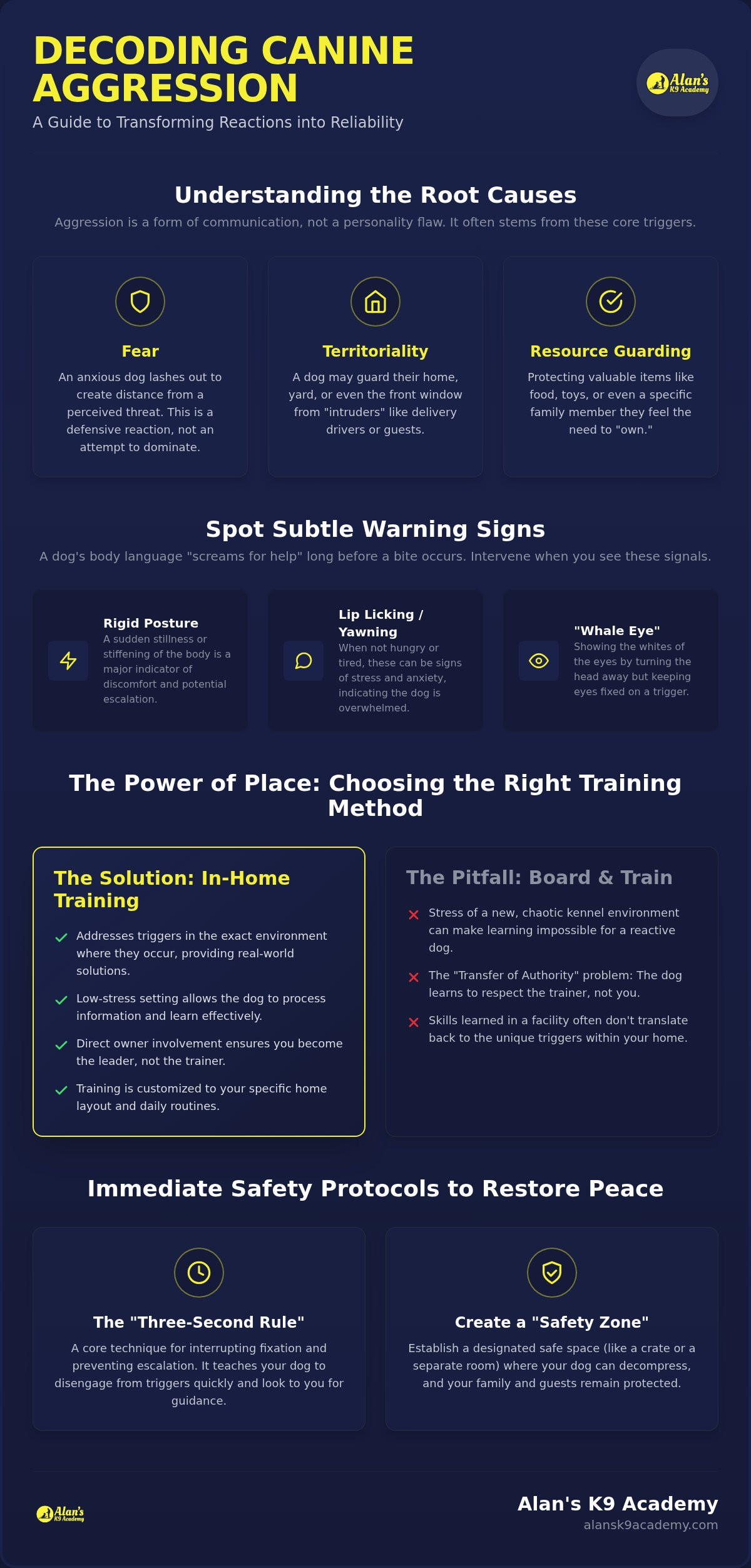
Aggression is rarely a random act of malice. Instead, it's a sophisticated, albeit destructive, form of communication. To effectively address these behaviors, we must look at the root causes. Most incidents stem from three specific areas: fear, territoriality, or resource guarding. Gaining a deep level of Understanding Canine Aggression is the first step toward reclaiming your home. Successful in-home training for aggressive dogs starts with decoding these signals before they escalate into dangerous encounters.
Many owners miss the early warning signs because they're looking for growls or barks. However, a dog's body language often screams for help long before a tooth is shown. You might notice subtle lip licking, a rigid posture, or "whale eye," where the whites of the eyes become visible. These are the moments to intervene. If these signals are ignored, the dog feels forced to escalate their response to get their point across. This is where the communication gap between humans and dogs becomes a safety risk.
It's also vital to distinguish between leash reactivity and true aggression. A dog lunging on a leash in Marietta might just be frustrated by the barrier, whereas a dog showing aggression in the living room is often dealing with a deep-seated emotional trigger. When you opt for in-home training for aggressive dogs, you're able to isolate these specific triggers in the environment where your dog feels most compelled to act.
The Difference Between Fear and Dominance
Misdiagnosing the 'why' behind a bite is the fastest way to fail a training program. Many people assume an aggressive dog is trying to be the 'boss,' but more often, they're simply terrified. An anxious dog lashes out to create distance, while a protective dog might be over-stepping their role. High-energy breeds often experience adrenaline-fueled responses that make them appear more aggressive than they actually are. We focus on identifying whether your dog is motivated by a need for safety or a perceived duty to guard, ensuring the modification plan matches their actual emotional state. Because physical discomfort can also be a hidden driver of reactivity, it is vital to rule out medical issues; you can learn more about Animal Hospital of Sullivan County and how they manage chronic pet health conditions that may impact behavior.
Life in the North Atlanta Metro area brings unique stressors for our companions. The constant arrival of delivery drivers in Cartersville or guests in Woodstock can turn a front window into a source of intense territorial stress. Resource guarding is another frequent challenge; your dog might guard their food bowl, a favorite toy, or even a specific family member they feel the need to "own." A threshold represents the exact emotional tipping point where a dog loses the ability to process information and instead reacts purely on instinctual drive. By identifying these thresholds, we can implement balanced methods that teach your dog how to choose calm communication over explosive reactions.
The Benefits of In-Home Training for Aggressive Behavior
Why would you take a reactive dog to a facility filled with other barking animals? For many owners, the stress of the car ride alone pushes the dog past their emotional limit before the lesson even starts. In-home training for aggressive dogs removes this chaotic variable. It allows your pet to remain in a low-stress environment where they can actually process new information. By applying clinical Behavior Modification Techniques in your living room, we address the specific triggers that cause friction in your daily life without the distractions of a kennel.
Direct owner involvement is the backbone of long-term success. If a trainer "fixes" your dog in a vacuum, the dog learns to respect the trainer’s authority, not yours. We ensure you're the one leading the exercises under our expert guidance. This approach creates a customized routine that fits your specific home layout. Whether you're managing a narrow hallway in Marietta or a large, fenced backyard in Cartersville, the training is tailored to the physical spaces where you live. If you're ready to stop managing the chaos and start enjoying your pet again, reach out to our team for a personalized assessment.
Why Board and Train Often Fails Aggressive Dogs
Board-and-train programs often suffer from the "transfer of authority" problem. A dog may behave perfectly for a professional in a remote facility, yet they often revert to old habits the moment they step back into your kitchen. The environment hasn't changed, so the old triggers remain just as potent. This is why we prioritize behavioral training for dogs within their own residence. It's about building a lasting bond between you and your companion that doesn't dissolve once the professional leaves. You need a partner who understands your dog’s behavior in your world, not a sterile training center.
Safety and Control in a Familiar Environment
Training at home lets us see your dog's natural behavior in their territory. We can observe exactly how they react to the mail carrier or the neighbor’s barking pet in real time. This real-world context is impossible to replicate elsewhere. It allows for controlled, safe exposure to triggers at a pace your dog can handle. To get started safely, you can prepare your family for a session using our professional checklist. This ensures everyone is on the same page and the environment is secure before the trainer arrives. Working in a familiar space gives both you and your dog the confidence needed to tackle difficult behavioral hurdles together.
The AK9A Approach: Balanced Methods and Communication
Why do so many owners feel like they've failed when high-value treats don't stop a growl? The reality is that serious behavioral issues require a more robust communication system than rewards alone can provide. Balanced training is the cornerstone of our philosophy because it addresses the dog’s entire emotional spectrum. We don't just rely on positive reinforcement. We build a "Communication Bridge" that uses clear, fair boundaries alongside rewards to ensure your dog understands exactly what is expected of them. This dual approach is vital for in-home training for aggressive dogs because it provides the structure and certainty they crave in high-stress moments. Master Trainer Alan Carr leverages 35 years of award-winning experience to ensure these methods are applied with precision, moving you from a state of confusion to a place of absolute clarity.
Most competitors overlook the communication gap between the owner and the dog, focusing only on "fixing" the animal. We believe the relationship is a two-way street. If your dog doesn't trust your guidance, they will continue to make their own, often aggressive, decisions. By establishing a consistent language within your own residence, we close this gap. This ensures that the progress made during our sessions translates into long-term reliability. Our in-home training for aggressive dogs is designed to empower you as much as it rehabilitates your companion, fostering a partnership built on mutual respect and clear expectations.
Behavior Modification vs. Basic Obedience
A "Sit" command is a trick; a calm state of mind is a lifestyle. Many dogs can perform perfectly in a quiet kitchen but lose control the moment a stranger enters their territory. We move beyond simple commands to focus on rehabilitating aggressive dogs at a foundational level. This systematic approach ensures your dog isn't just "obeying" out of habit but is actually making better choices in high-distraction environments. We aim for real-world reliability, giving you the confidence to navigate life in the North Atlanta Metro area without the constant fear of a reactive outburst.
Tools of the Trade: Humane and Effective
We believe in using the right equipment to facilitate a conversation, not a confrontation. Professional Expert Aggression Rehabilitation often involves tools that provide clear, tactile feedback. We strictly avoid harsh methods that cause unnecessary pain or shut a dog down emotionally. Instead, we focus on tools that allow for subtle, fair communication between you and your pet. Leash pressure serves as a tactile language that guides the dog toward the desired choice without the need for vocal conflict or physical force. This level of clarity reduces the dog’s frustration and significantly speeds up the transformation from a reactive animal to a calm companion.
Safety Protocols: Managing Your Dog While You Train
Safety is the foundation of rehabilitation. Without a clear management plan, the stress of daily triggers can lead to setbacks that stall your progress. Specialized in-home training for aggressive dogs focuses heavily on these immediate management strategies to protect your family and the community. We start by establishing a "Safety Zone" in your home. This is a dedicated area, such as a specific room or a secure crate, where your dog can relax without the pressure of guests or delivery drivers. It's about creating a controlled environment where mistakes don't lead to injuries.
Understanding the "Three-Second Rule" is a game changer for many owners. If your dog stares at a trigger, like a visitor or another pet, for more than three seconds, aggression is likely brewing. Interrupting that focus early prevents the escalation. We also emphasize muzzle conditioning as a tool of love, not a punishment. A muzzle is simply a safety belt; it provides a layer of security that allows you to remain calm and confident during high-stakes training moments. When you are calm, your dog is more likely to follow your lead. Handling guests and deliveries becomes a structured exercise rather than a source of panic when you have these protocols in place.
Short-Term Management vs. Long-Term Training
Management is what we do to prevent a bite today, while training is what we do to change the behavior for tomorrow. Using crates and tethers ensures your dog doesn't have the opportunity to practice bad habits while we work on the underlying issues. You must "stack the deck" for your dog’s success by removing the possibility of failure. This involves constant monitoring of body language to ensure your dog never reaches their emotional threshold. If you're ready to secure your household and start the path to a calmer life, schedule your in-home safety evaluation today.
The Role of Exercise and Mental Stimulation
Pent-up energy is often the fuel for reactive outbursts. A dog with no outlet for their physical and mental drives will naturally find less desirable ways to express that frustration. We use structured walks as a primary tool for building dog obedience training and real-world reliability. When you commit to in-home training for aggressive dogs, you're choosing a path that prioritizes the well-being of every family member. Indoor enrichment activities, such as scent work or puzzle toys, also help lower overall stress levels. These activities give your dog a productive job to do, which significantly reduces the intensity of their territorial or fearful responses.
Expert Aggression Rehabilitation in North Atlanta and Cartersville
You aren't just looking for a trainer; you're looking for a neighbor who understands the specific challenges of living in the North Atlanta Metro. Whether you're navigating the busy sidewalks of Marietta or managing a reactive dog in a quiet Cartersville cul-de-sac, the environment dictates the training needs. Specialized in-home training for aggressive dogs provides a level of customization that generic, facility-based programs simply cannot match. We believe that by coming to you in Kennesaw or Marietta, we can address the real-world triggers that disrupt your peace of mind exactly where they occur.
Georgia currently ranks in the top ten states for reported dog attacks, with over 500 bite claims filed annually. In our state, the average settlement for a dog bite incident is nearly $48,000. These numbers underscore why professional intervention is a necessity for high-risk behaviors. Our mission at Alan’s K9 Academy is to protect both your family and your companion from these legal and emotional risks. By working with a Master Trainer who has over 35 years of experience, you're gaining an ally who has seen every possible behavioral challenge in our local community and remains unfazed.
Personalized Training for Local Families
We provide tailored sessions in Woodstock, Canton, and Alpharetta that account for your specific lifestyle. Every neighborhood has its own set of stressors that can push a dog over their threshold. A dog in Alpharetta might struggle with high-traffic suburban noise, while a pet in Canton might react to wildlife or busy walking trails. We understand these local dynamics. We don't just teach your dog to listen in a vacuum; we teach them to remain calm when the delivery truck pulls up or when a neighbor walks by with their pet. This hands-on approach ensures that the behavior modification sticks when it matters most.
Your Next Steps to a Calmer Companion
Your journey toward a peaceful home starts with a professional in-home assessment. During this initial consultation, we observe your dog’s natural reactions in their territory and identify the specific communication gaps. Successful aggression rehabilitation requires a significant commitment from you as the owner. It isn't a "quick fix," but it is a permanent transformation when you follow the structured plan we provide. We are here to move you from a state of constant vigilance to a feeling of hope and control. Contact Alan’s K9 Academy today to schedule your assessment and take the first step toward a safe, communicative partnership with your dog.
Reclaiming Your Home and Peace of Mind
Living with a reactive dog is a heavy burden, but it doesn't have to be your permanent reality. You've learned that aggression is often a symptom of a communication breakdown that can be resolved with the right structure and guidance. By prioritizing in-home training for aggressive dogs, you address the root causes of dangerous behavior in the exact environment where your dog feels most triggered. This localized focus ensures that the progress you make during sessions translates into real-world reliability for your daily life.
Alan’s K9 Academy brings award-winning behavior modification directly to your doorstep. As a Master K9 Trainer with over 35 years of experience, Alan Carr has spent decades serving families across North Atlanta and Bartow County with balanced, humane solutions that work when other programs fail. You don't have to navigate this stressful path alone. Our mission is to transform your overwhelmed household into a sanctuary of safety and mutual respect.
Take the first step toward a safer, more communicative relationship with your companion today. Your dog's transformation into a calm, reliable partner is possible with professional expertise and a customized plan. Contact Alan’s K9 Academy for a Professional In-Home Assessment and start reclaiming the harmony your household deserves. We're ready to help you succeed.
Frequently Asked Questions
Is in-home training safe for a dog that has already bitten someone?
Yes, in-home training is often the safest path because it allows for a controlled environment. We implement strict safety protocols, such as muzzles and leashes, before the first session begins. This prevents the stress of a car ride or a busy facility from triggering another incident. By working in your residence, we manage risks while identifying the specific household triggers that led to the previous bite incident.
How many sessions will it take to stop my dog’s aggression?
Every rehabilitation timeline is unique because it depends on the severity of the behavior and your consistency with the homework. Most families see a significant shift in communication within the first few sessions. However, deep-seated aggression often requires a structured program over several weeks. We focus on building a foundation of trust and respect that lasts; we don't believe in rushing for a temporary fix that might fail under pressure later.
What is the difference between a dog behaviorist and a master trainer like Alan Carr?
A behaviorist often focuses on the "why" through a clinical lens, while a Master Trainer like Alan Carr focuses on "how" to achieve real-world results. With 35 years of award-winning experience, Alan combines behavioral science with hands-on, balanced techniques. This approach ensures your dog doesn't just understand a concept but actually follows through with calm behavior in high-distraction environments. We serve families across the North Atlanta Metro area with this results-oriented mindset.
Will you use "shock collars" on my aggressive dog?
We use balanced training tools that facilitate clear, humane communication. This may include modern E-collars used at very low, non-painful levels to get a dog's attention. Our goal is never to use "shock" as punishment. Instead, we use these tools as a tactile language to guide your dog toward better choices. We always prioritize the most humane method that achieves the reliability necessary for your family's safety and peace of mind.
Can you help with aggression toward other dogs on walks in Marietta or Kennesaw?
Yes, we specialize in resolving leash reactivity and dog-on-dog aggression in local parks and neighborhoods. Whether you're walking on the Kennesaw Mountain trails or through downtown Marietta, we help you master leash pressure and focus. Our in-home training for aggressive dogs extends to your immediate neighborhood to ensure you can enjoy walks without the constant fear of a reactive outburst. We provide the tools you need to handle real-world distractions in your local community.
Do you offer a guarantee for aggression rehabilitation?
We don't offer a money-back guarantee because we're working with living animals and human consistency. No ethical trainer can guarantee a specific behavioral outcome. However, we do commit to providing the highest level of professional expertise and a customized roadmap for success. We stand by our award-winning methods and provide the ongoing support you need to maintain a safe, communicative partnership with your dog. Our focus is on long-term transformation rather than a superficial, quick fix.
What if my dog is only aggressive toward specific family members?
This is a common issue often rooted in resource guarding or a lack of clear boundaries within the home. We work with the entire household to ensure everyone uses a consistent "Communication Bridge." By teaching the targeted family member how to lead with confidence and use balanced rewards, we shift the dog's perception of that person. This creates a unified front that discourages selective aggression and restores harmony to your residence in Cartersville.
How do I know if my dog is aggressive or just over-excited?
The difference lies in the dog's emotional state and body language. Over-excitement often involves loose, wiggly movements and a lack of focus. Aggression is characterized by rigid posture, intense staring, and a closed mouth. Our in-home training for aggressive dogs includes a detailed assessment to help you identify these subtle shifts. Understanding whether your dog is over-stimulated or truly reactive is the first step in applying the correct behavior modification plan.