%20(620%20x%20150%20px)%20(14).webp)
%20(620%20x%20150%20px)%20(15).webp)
.webp)
_page-0001.webp)
.webp)

In-Home Puppy Training in North Atlanta
The best dog training option in Atlanta is one tailored to your dog’s age, behavior, and daily environment, using science-based, humane methods. A master dog trainer in North Atlanta can work with puppies and adult dogs in the home, where everyday routines and challenges can shape what training need...
%20(5).gif)
The best dog training option in Atlanta is one tailored to your dog’s age, behavior, and daily environment, using science-based, humane methods. A master dog trainer in North Atlanta can work with puppies and adult dogs in the home, where everyday routines and challenges can shape what training needs to address.
When jumping, pulling, or difficulty settling makes home life harder, clear guidance can help. This article explains what in-home training can address, how humane methods support learning, and what to consider when choosing a trainer. Personalized instruction can also help you turn practical skills into routines you and your dog use every day.
Key Takeaways
• Use in-home sessions to work on puppy skills and adult-dog behaviors in the places they happen, with practice built around your household’s routines.
• Support puppy socialization with calm, positive experiences that help your puppy learn about people, places, and everyday situations.
• Look for humane, science-based training that rewards useful behaviors and adapts its approach to your dog’s needs.
• Consider personalized in-home training for household challenges, and behavior modification when unwanted behaviors need focused support.
In-home puppy and adult dog training
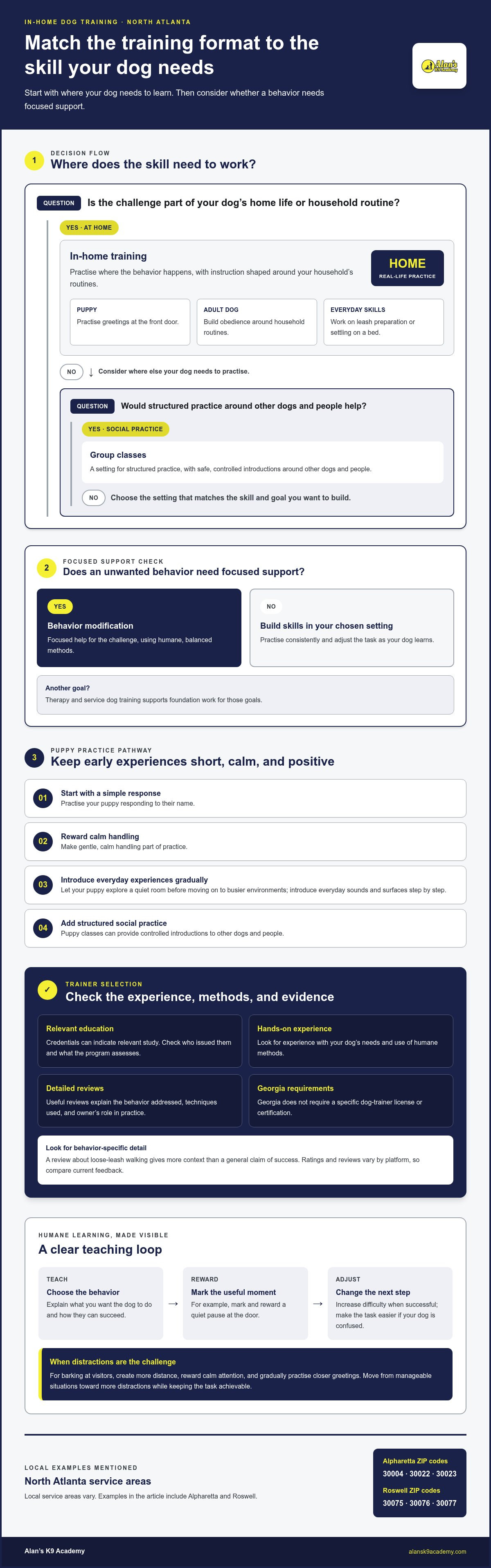
In-home training gives a trainer the chance to see how your dog behaves in familiar settings. A puppy who jumps at the front door, for example, can practise greeting visitors there. Adult dogs can build obedience skills around household routines, leash preparation, or settling on a bed. A master dog trainer in North Atlanta can tailor instruction to these everyday situations.
For puppy training and socialization, begin with short, positive experiences. Practise a response to your puppy’s name, reward calm handling, and introduce everyday sounds and surfaces gradually. Let your puppy explore a quiet room before moving on to busier environments. Puppy classes can provide structured practice around other dogs and people, with safe, controlled introductions.
When comparing trainers, consider relevant education, hands-on experience with your dog’s needs, and detailed client reviews. Look for examples that describe the behavior addressed, the techniques used, and the owner’s role in practice. A review about loose-leash walking provides more useful context than a general claim of success.
Georgia does not require a specific dog-trainer license or certification. Credentials can still indicate relevant study, so consider who issued them and what the program assesses, alongside the trainer’s practical experience and use of humane methods.
There isn’t one fixed list of top-rated trainers for North Atlanta; ratings and reviews vary by platform. Compare current feedback for trainers whose methods fit your goals. Local service areas vary, but North Atlanta examples include Alpharetta, ZIP codes 30004, 30022, and 30023, and Roswell, ZIP codes 30075, 30076, and 30077. Ask whether in-home sessions or group classes best match the skills your dog needs to practise.
Science-based, humane training methods
A useful training program explains which behavior you’re teaching, how your dog can succeed, and what reward follows. For example, mark and reward a quiet pause at the door before asking for a longer stay. This clear sequence helps your dog connect an action with its outcome. Adjust the reward and difficulty in response to your dog’s behavior.
Look for techniques that build skills without relying on fear or pain. If your dog barks at visitors, create more distance, reward calm attention, and gradually practise closer greetings. The setting matters: your dog may respond in a quiet room but struggle in a busy neighborhood. Practise in manageable situations, then gradually add distractions while keeping the task achievable.
Board-and-train programs can make it harder for owners to see daily handling and practise the same cues, which may limit how well skills transfer home. Before choosing any program, ask to observe a session and see how staff supervise dogs, provide rest, handle distress, and explain training steps; humane care should be visible in the animal’s routine.
For a lifetime of useful behavior, owners need to practise consistently after lessons. Ask the trainer to demonstrate each cue, explain reward timing, and watch you practise it yourself. A good plan identifies the next step when the dog succeeds and how to make the task easier if the dog becomes confused. If you want to practise where household routines happen, in-home dog training can connect instruction with your dog’s everyday environment.
Alan's K9 Academy: In-Home Dog Training
Alan's K9 Academy offers personalized in-home training for puppy skills, household routines, and adult dog behavior needs. When a behavior needs focused support, behavior modification can help address the challenge with humane, balanced methods. Group classes provide another setting to practise skills, while therapy and service dog training supports foundation work for those goals.
Choose the format that fits what you want your dog to learn and where those skills need to work. Contact Alan's K9 Academy to discuss your dog’s training needs.
Build the Next Step Into Everyday Life
Training progress grows through the choices you make between sessions: what you reward, how you guide your dog, and which skills you practise in daily routines. If you’re choosing a master dog trainer in North Atlanta, look for an approach that helps you take an active role and carry learning into real life. A clear plan can make the next step feel manageable for both you and your dog.
Alan's K9 Academy offers In-Home Dog Training, Behavior Modification, and Therapy & Service Dog Training to address different training goals. Share what you’d like to change or build, and take the next step at Contact Alan's K9 Academy. With thoughtful practice and compassionate guidance, you and your dog can keep moving forward together.
Frequently Asked Questions
What’s the best dog training option in Atlanta for my dog?
The best fit depends on your dog’s behavior and the skills you want to build. For a puppy struggling with household routines, one-on-one instruction at home can focus on those specific moments. For reactivity or anxiety, behavior modification offers focused guidance. Alan's K9 Academy uses balanced, humane methods, so discuss your goals and choose an approach that fits your dog.
Do you offer continued support after training?
Training builds lasting communication between you and your dog, helping you practise skills in everyday life. For example, use the same cue and reward timing when asking your dog to settle as visitors arrive. Take notes on the steps that work during training, and ask for clarification whenever you need help applying them at home.
How Do I Get Started?
Contact Alan's K9 Academy and describe your dog’s age, the behavior you want to address, and your main training goal. Include a concrete example, such as barking when the doorbell rings or pulling toward other dogs on walks. This gives the conversation a useful starting point for considering in-home training, behavior modification, or another suitable option.
What If There Isn’t a Dog Obedience Training School Near Me?
A nearby school isn’t the only path; in-home training can bring instruction into your dog’s familiar environment. Alan's K9 Academy serves Cartersville, Canton, Woodstock, Marietta, Rome, Acworth, Kennesaw, Sandy Springs, Roswell, Alpharetta, Powder Springs, Dallas, Hiram, Jasper, Cumming, Holly Springs, Ball Ground, and Milton. Ask about in-home instruction or group classes based on your dog’s learning goals.