%20(620%20x%20150%20px)%20(14).webp)
%20(620%20x%20150%20px)%20(15).webp)
.webp)
_page-0001.webp)
.webp)
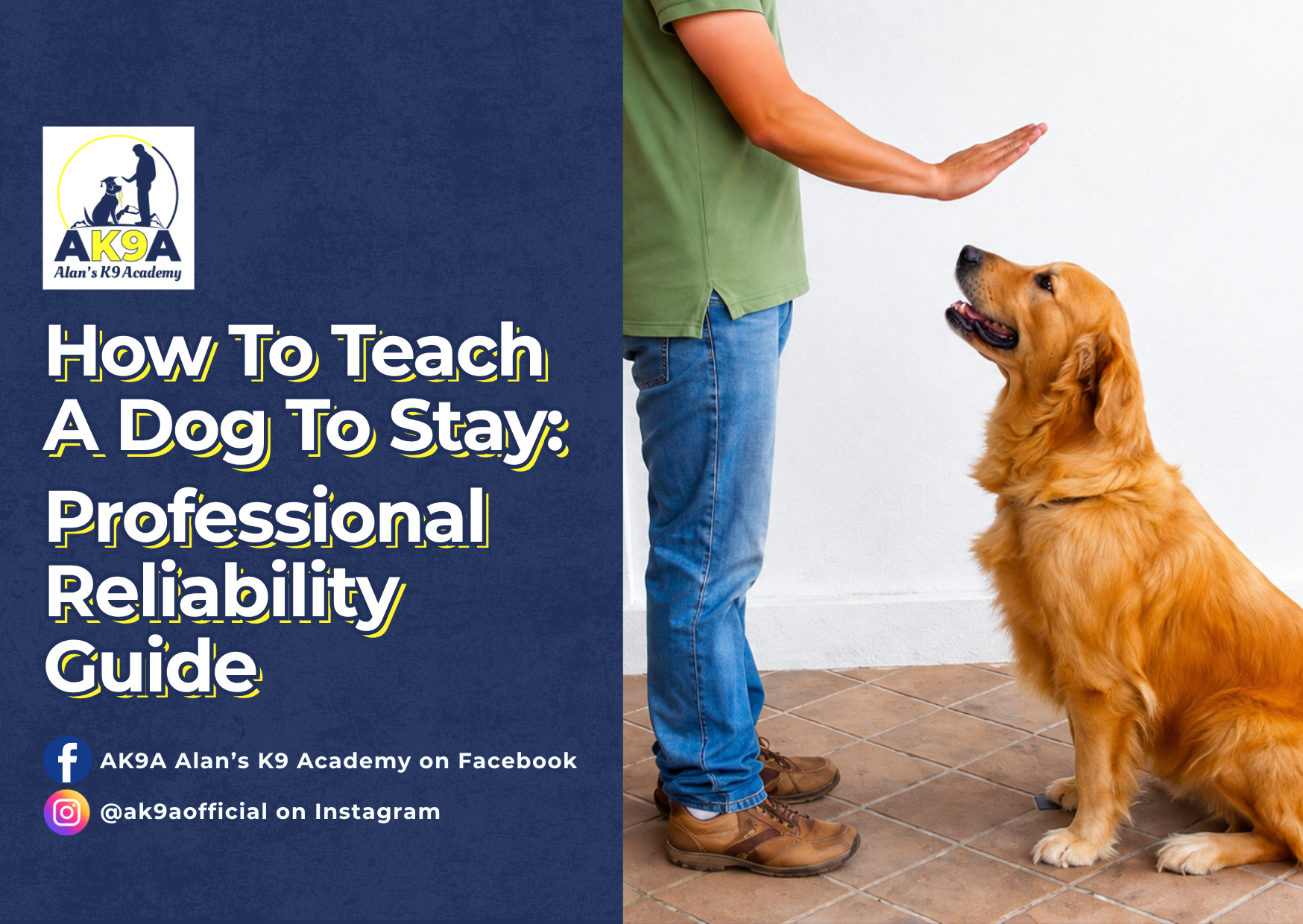
How to Teach a Dog to Stay: Professional Reliability Guide
You're at the front door with arms full of groceries, and as you nudge the door open, your heart stops because your dog is already mid-bolt toward the busy street. It's a terrifying moment that many owners face, leading to deep anxiety about safety and frustration with seemingly stubborn behavior. I...
%20(5).gif)
You're at the front door with arms full of groceries, and as you nudge the door open, your heart stops because your dog is already mid-bolt toward the busy street. It's a terrifying moment that many owners face, leading to deep anxiety about safety and frustration with seemingly stubborn behavior. If you've ever felt the embarrassment of your dog jumping on guests or the stress of a broken command, you aren't alone. Learning how to teach a dog to stay isn't just about obedience; it's about building a foundation of safety and mutual respect that gives you back your peace of mind.
We understand that you want a companion who remains calm and stationary even when the world gets loud or distracting. In this guide, you'll master professional techniques used by experts to ensure your dog stays put until you give the release word. We'll explore the essential framework of duration, distance, and distraction to help you achieve true off-leash reliability. By the end of this article, you'll have a clear, step-by-step roadmap to transform your training sessions into meaningful, real-world success that works where it matters most.
Key Takeaways
• Understand the critical psychological difference between a "Stay" and a "Wait" to ensure your dog knows exactly when immobility is required.
• Master the "3 Ds" framework to build the mental stamina your dog needs to remain stationary as you move away or distractions increase.
• Discover the professional sequence for how to teach a dog to stay, moving from quiet indoor practice to high-stakes outdoor environments.
• Identify and fix common training mistakes like "poisoning the cue" that often cause dogs to break their position prematurely.
• Learn how customized, in-home training sessions can target specific triggers like front-door bolting and guest arrivals for lasting reliability.
Why the 'Stay' Command is a Life-Saving Skill
Imagine your front door swinging open as a delivery driver arrives. In that split second, your dog’s impulse to greet the visitor or chase a squirrel across the street can lead to disaster. A reliable "Stay" isn't just a polite trick for guests. It is a life-saving tool. For many owners, the anxiety of a dog bolting into traffic is a daily reality. This is why learning how to teach a dog to stay with professional precision is the most important investment you can make in your pet's safety. It's about more than just obedience; it's about survival in a world full of unpredictable distractions.
Most owners struggle because they rely too heavily on treats as bribes. If the treat isn't more interesting than the distraction outside, the dog breaks. Professional reliability is built on a foundation of communication and impulse control, not just snacks. The most overlooked part of the command is the release word. Without a clear signal that the command has ended, your dog is left guessing. A dog that decides when to move isn't under command; they're just pausing. You must be the one who decides when the work is done. This clarity prevents frustration and ensures your dog remains calm and stationary until you say otherwise.
Stay vs. Wait: Choosing the Right Tool
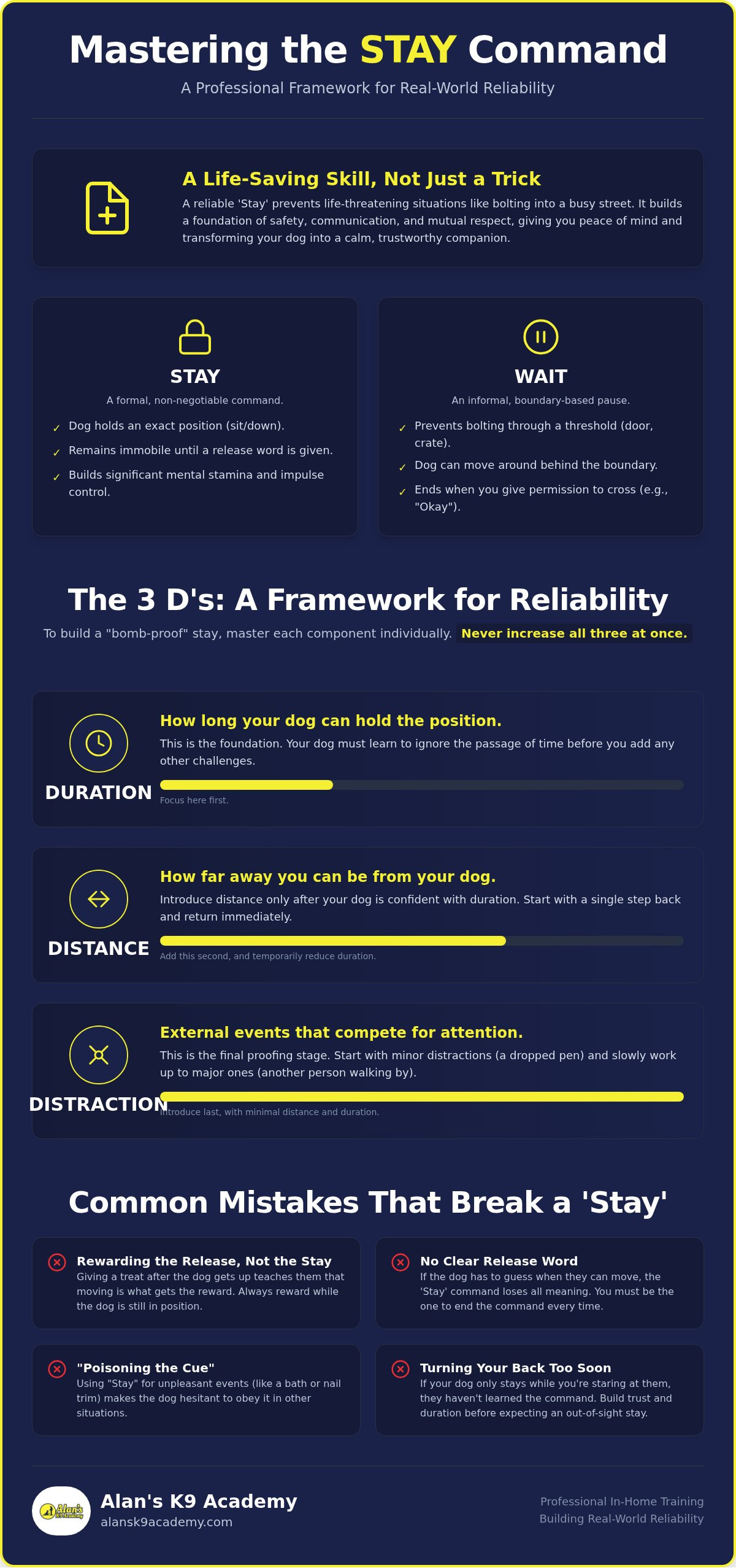
Confusion often starts with simple word choice. A "Stay" is a formal, position-holding command. It means your dog remains in a sit or down exactly where you left them until you return to their side or give a specific release word. It requires significant mental stamina. In contrast, a "Wait" is a boundary-based pause. You might use it at a car door or the crate to prevent a frantic exit. Mixing these two cues is a recipe for broken stays. When you use "Stay" casually at the door but don't follow through with a release, the word loses its meaning. It becomes background noise. Use the right tool for the right job to maintain clarity in your dog's mind.
The Communication Gap in Basic Obedience
Does your dog break their stay the moment you turn your back? This is a classic communication gap. If your dog only stays when you are staring at them, they haven't learned the command; they've learned to watch you for a treat. True reliability comes from applying fundamental Dog training principles that prioritize a partnership over a transaction. We focus on building trust so your dog feels secure holding their position even when you are out of sight. Mastering how to teach a dog to stay requires moving beyond the kitchen and into real-world environments. This level of focus is a core pillar of effective dog obedience training, ensuring your dog listens because they understand their role in your family unit.
Mastering the 3 Ds: The Professional Framework for Reliability
Does your dog hold a perfect stay in the quiet of your living room only to break the moment a leaf blows by outside? This happens because dogs don't naturally generalize their skills to new environments. To fix this, professional trainers use a specific framework called the "3 Ds". If you are looking for how to teach a dog to stay with total reliability, you must master Duration, Distance, and Distraction one at a time. Never increase all three simultaneously. If you ask for more distance, make the duration shorter. This systematic approach prevents frustration and keeps your dog's confidence high.
Professional trainers rely on three specific pillars to build this reliability:
Duration
The length of time a dog holds the position.
Distance
The space between you and your dog.
Distraction
External events that compete for your dog's attention.
Building Duration First
Duration is the dog's ability to ignore the passage of time. Before you ever take a step away, your dog must learn to hold their position while you stand right in front of them. Start small. Three seconds of immobility is a victory for a beginner. It is critical to deliver the reward while your dog is still in the sit or down position. This reinforces the act of staying rather than the act of getting up to collect the treat. We look for a "calm settle" where the dog's muscles relax and their focus remains steady. For North Atlanta families, our in-home dog training helps establish this foundation in the exact spots where your dog usually struggles, like the foyer or the kitchen.
Adding Distance and Distraction
Once duration is solid, you can begin layering in distance and distraction. Practicing distance in open spaces is safer when you use a "tether" or a long training lead. This gives you the freedom to move across the room or even out of sight while maintaining control. If your dog looks like they are about to break, calmly step back toward them to reduce the "pressure" of the distance. You can find excellent supplementary advice on these mechanics in the RSPCA's guide to teaching 'stay'. When you are refining how to teach a dog to stay, proofing the command means starting with low-value distractions, like a dropped sock, before progressing to high-value triggers like a squeaky toy or a doorbell. This methodical progression ensures your dog remains successful at every stage of the journey.
Common Mistakes That Lead to Broken Stays
Why does your dog break their stay the moment you reach for the doorknob? It is a question that haunts many owners. Often, the breakdown isn't a sign of a stubborn dog but a result of subtle errors in how we communicate. One of the most frequent mistakes is "poisoning the cue." When you repeat "Stay, Stay, Stay" like a broken record, the word becomes background noise. Your dog learns that the first few commands are optional and they only need to listen when your voice sounds urgent. A professional approach requires saying the command once and expecting compliance.
Another silent progress killer is the "borderline break." This happens when an owner rewards a dog just as they are standing up or shifting out of position. If the treat touches their nose after their butt has left the floor, you've accidentally rewarded the movement, not the immobility. Clarity is everything. This is why a clear release word like "Okay" or "Free" is non-negotiable. Without it, your dog is left to guess when the job is done. For a deeper look at these nuances, this expert guide from Cornell University explains why a release word is the anchor of a reliable stay.
The 'Treat Bribery' Trap
If your dog only stays when they see a piece of chicken in your hand, you aren't training; you're bribing. Showing the treat first creates a dog that only performs when the "paycheck" is visible. To master how to teach a dog to stay, you must transition from luring to command-based reliability. Keep the rewards hidden. We use balanced methods to address breaks. If your dog moves, calmly reset them to the exact spot they left without frustration. This teaches them that breaking doesn't result in a reward or an end to the session, but simply a restart of the work.
Environmental Inconsistency
Your dog might be a rockstar in your kitchen, but a North Atlanta park presents a different world of squirrels and joggers. Dogs are contextual learners. They don't automatically understand that "Stay" means the same thing on grass as it does on tile. If your dog struggles with reactivity or high-arousal triggers, they may need specialized behavioral training for dogs to manage their impulses before they can hold a long stay. Standardize your body language and hand signals so they remain consistent regardless of where you are. When you refine how to teach a dog to stay, you're teaching them to trust your leadership in every environment, not just the quiet ones.
Step-by-Step: Teaching the Professional 'Stay'
Transitioning from understanding the theory to hands-on practice requires a structured plan. If you've struggled in the past, it's likely because the steps were too large or the criteria were unclear. This professional sequence for how to teach a dog to stay focuses on building success through small, manageable victories. By following this roadmap, you move from the safety of your living room to the unpredictable nature of the real world with confidence.
The Initial Setup
Success begins with the right environment. Choose a quiet room where your dog feels comfortable and distractions are at zero. You'll want to use a flat collar and a standard 6-foot leash to maintain control without applying tension. For the first 50 repetitions, your goal is simple: reinforce the idea that staying put is the most rewarding choice they can make. Remember the "Golden Rule" of professional training: always return to your dog to deliver the reward. This teaches them that you are the one who returns, so there is no need for them to come to you.
Step 1
Establish a solid "Sit" or "Down" foundation. Your dog must be relaxed in their position before you give the next cue.
Step 2
Introduce your hand signal (typically an open palm toward the dog) and the verbal "Stay" simultaneously. Keep your tone calm and authoritative.
Step 3
Perform a "Half-Step" retreat. Simply shift your weight back or take one small step, then immediately return to your dog's side.
Step 4
Implement the mandatory release word. Use a clear, upbeat "Okay" or "Free" before the dog has a chance to move on their own.
Step 5
Begin gradual proofing. Once they are 90% successful indoors, move to your porch or driveway.
Proofing for the Real World
A reliable stay must work when a squirrel is darting across a Cartersville sidewalk or a car door is slamming in a Canton driveway. These North Atlanta distractions are the ultimate test of your partnership. If your dog breaks, don't get frustrated. Simply reset them and try a shorter distance or duration. Mastering how to teach a dog to stay in these high-stakes environments is where many owners hit a wall. If you find that local triggers are overwhelming your dog's progress, it might be time to consider professional in home dog training. Having an expert eye on your specific home environment can bridge the gap between "getting it" and total reliability. For personalized support that transforms your walks, schedule a session with our Master Trainer to see the difference professional techniques make.
When to Seek Professional Help for Advanced Reliability
Sometimes, the gap between a "good" stay and a life-saving one feels impossible to cross alone. If your dog’s inability to remain stationary is rooted in deep-seated anxiety or territorial aggression, a simple training guide might not be enough. Professional help becomes essential when a broken command leads to dangerous situations like front-door bolting or lunging at guests. A Master Trainer can identify subtle body language cues, like a slight weight shift or dilated pupils, that you might miss. These micro-signals often tell the real story of why your dog is breaking their position. When safety is on the line, guessing isn't an option.
High-drive breeds like Belgian Malinois, German Shepherds, or Pointers often require a more nuanced approach. Their biological urge to move and work can make a static command feel like a chore rather than a skill. Learning how to teach a dog to stay in these cases involves channeling that drive into focus rather than suppressing it. We create customized plans that respect the dog's heritage while demanding the reliability you need for a safe home life. This tailored approach ensures your dog is successful because they understand the "why" behind the work.
The Alan's K9 Academy Difference
With over 35 years of experience serving North Atlanta and Bartow County, Alan’s K9 Academy specializes in the "impossible" cases. We use balanced, humane methods that prioritize the relationship between you and your companion. Our goal is to move beyond basic obedience and achieve true off-leash reliability. Whether you're dealing with a rescue dog with a troubled past or a powerful puppy that needs boundaries, our hands-on approach ensures the "Stay" command is respected everywhere. We believe that professional training should be a mission to improve your quality of life, not just a business transaction.
Getting Started with Private Coaching
Your journey toward a well-behaved dog begins with a comprehensive in-home evaluation. We look at your dog's behavior in their natural environment to see where the communication is breaking down. This is also the perfect time to build a foundation for specialized work, such as therapy or service dog training. Mastering how to teach a dog to stay is a partnership, and we are here to mentor you through every step. Take the first step toward a more peaceful home today. Schedule your in-home evaluation with Alan's K9 Academy and see how professional support changes everything for you and your dog.
Take the Next Step Toward Off-Leash Reliability
Mastering the "Stay" command is about more than just obedience; it's about providing your dog with the safety they deserve. By focusing on the 3 Ds and maintaining a clear release word, you've already started the journey toward a more peaceful home. Learning how to teach a dog to stay is a foundational skill that opens the door to off-leash freedom and stress-free visits. Reliability isn't built overnight, but through consistent, meaningful partnership and the right professional techniques.
Alan's K9 Academy has spent over 35 years helping North Atlanta families achieve this level of control. Led by Master K9 Trainer Alan Carr, we provide customized plans for every breed to ensure success where it matters most. You don't have to navigate behavioral challenges alone. Our balanced, humane methods are designed to move you from frustration to a feeling of total control. Ready for a dog that actually listens? Book your in-home session today! We look forward to helping you and your companion thrive together in a safer, happier environment.
Frequently Asked Questions
What is the best age to start teaching a dog to stay?
Puppies can begin learning the foundation of this command as early as 7 or 8 weeks old. While their attention spans are short, starting in a quiet home in Marietta or Kennesaw allows them to build positive associations early. Keep sessions under five minutes. Focus on immediate rewards for even a second of immobility. This early start prevents the development of dangerous habits like door-bolting before they become deep-seated behavioral issues.
How do I stop my dog from breaking stay when they see another dog?
This requires high-level proofing with controlled distractions. If your dog breaks when seeing another pet at a park in Alpharetta or Roswell, you've likely increased the distraction level too quickly. Step back to a distance where your dog can remain calm. Gradually decrease that distance over several sessions. If the reaction is rooted in aggression or extreme excitement, specialized behavior modification may be necessary to manage those underlying impulses effectively.
Should I use a hand signal or a verbal cue for 'Stay'?
Using both simultaneously provides the clearest communication for your pet. Dogs are naturally more attuned to visual body language, so a clear, open-palm hand signal often helps them understand the command faster. Pairing this with a firm, calm verbal cue ensures they listen even if they aren't looking directly at you. This dual-signal approach is a core part of building real-world reliability in busy environments like Woodstock or Canton.
What is the difference between 'Stay' and 'Wait'?
A "Stay" command is a formal requirement for the dog to remain in a specific position until you return or give a release word. "Wait" is a less formal, boundary-based pause used for safety at car doors or crates. Mixing these up is a common reason owners struggle with how to teach a dog to stay effectively. Keeping these cues distinct prevents your dog from guessing when it is safe to move.
How long should a dog be able to stay at 6 months old?
At 6 months, most dogs can hold a steady stay for 30 to 60 seconds in low-distraction environments. Every breed develops at a different pace, so focus on successful repetitions rather than just watching the clock. If you're practicing in a more active area like a driveway in Cartersville, you might need to lower your expectations to 15 seconds. Consistency is always more important than duration during this developmental stage.
Why does my dog only stay when I have a treat in my hand?
This happens when the treat has become a bribe rather than a reward. If you always show the food first, your dog is only following the lure. To fix this, keep your rewards hidden in a pouch or pocket. You want your dog to listen to the command first, then receive the reward afterward. Transitioning away from visible lures is a critical step in how to teach a dog to stay with professional reliability.
Can I teach an older rescue dog to stay?
Absolutely. Older rescue dogs in Bartow County or Rome can learn this command just as effectively as puppies. While they may have previous habits to unlearn, their increased focus often makes the process smoother. We customize our in-home sessions to account for any past trauma or anxiety your rescue might have. This ensures the training is a positive, trust-building experience that improves the quality of life for your entire family.
What should I do if my dog breaks their stay while I'm walking away?
You are likely moving too far or too fast for your dog's current level of training. Return to the "half-step" method mentioned earlier. Take a tiny step back, then immediately return to reward them while they are still in position. Slowly build up to two steps, then three. If they break, calmly reset them to the original spot without frustration. This methodical approach builds the confidence they need to hold their ground.