%20(620%20x%20150%20px)%20(14).webp)
%20(620%20x%20150%20px)%20(15).webp)
.webp)
_page-0001.webp)
.webp)
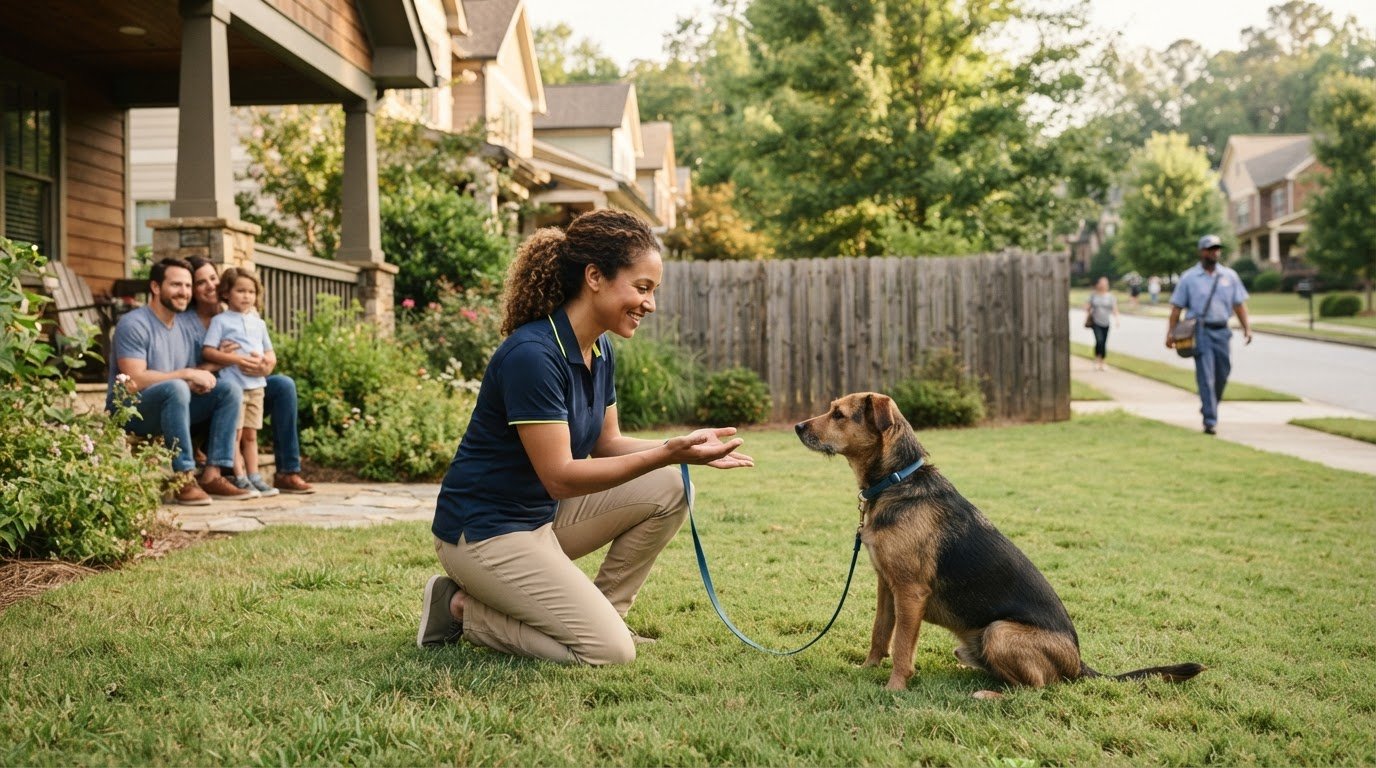
How to Stop Excessive Dog Barking: A Calm, Practical Guide
What if the first step to stop excessive dog barking is to pause before trying to silence it? When barking interrupts sleep, conversations, or the rhythm of home, it’s natural to want an immediate fix. But barking can signal fear, alertness, boredom, a need for attention, or a health concern, and th...
%20(5).gif)
What if the first step to stop excessive dog barking is to pause before trying to silence it? When barking interrupts sleep, conversations, or the rhythm of home, it’s natural to want an immediate fix. But barking can signal fear, alertness, boredom, a need for attention, or a health concern, and the right response depends on what’s driving it.
You’re not alone if the cause feels hard to pin down or quick fixes seem tempting. Lasting change starts with noticing when barking happens, then teaching and rewarding a calmer alternative. This guide will help you identify common triggers, track patterns, and try practical, consistent steps at home. You’ll also learn why punishment or barking devices may not address the underlying cause, when to check with a veterinarian, and when professional training can help you build a plan for your dog and household.
Key Takeaways
• Repeated barking can be disruptive, but its context can help distinguish an alert from a response to fear, boredom, or another trigger.
• Track when and where barking occurs, how long it lasts, and what follows to find patterns you can act on.
• To stop excessive dog barking, manage triggers and consistently encourage a calmer alternative.
• Shouting or using the same quick fix for every bark may not teach your dog what to do instead.
• If barking persists, escalates, or is difficult to manage, consider veterinary assessment for health changes and individualized training support.
Why Dogs Bark Excessively and Why the Trigger Matters
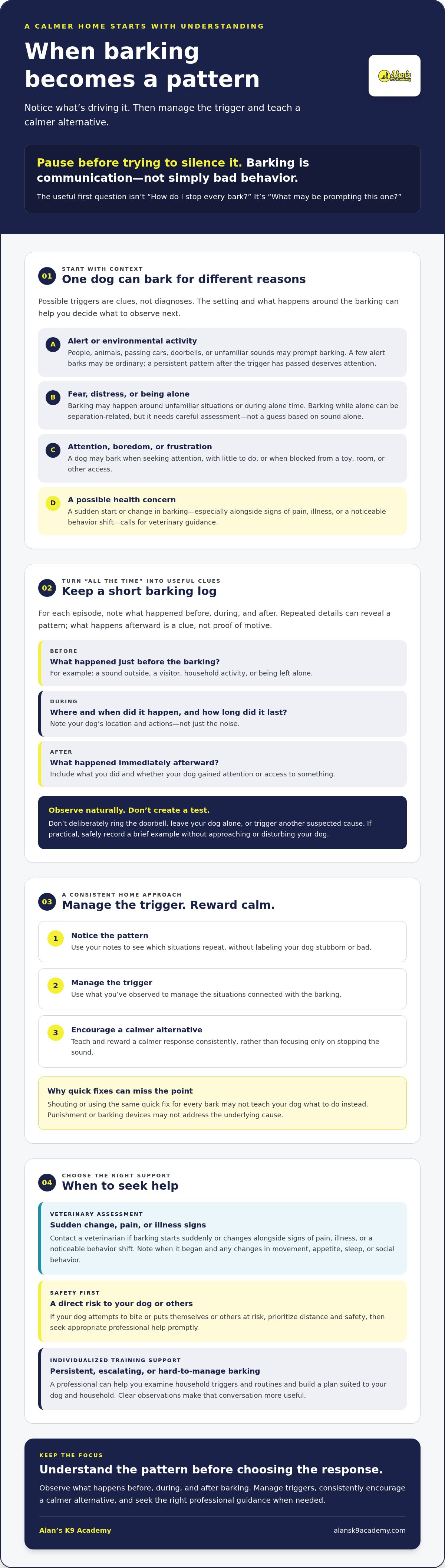
Repeated barking can wear everyone down. It can interrupt sleep, make conversations difficult, and leave you unsure whether to soothe your dog, redirect them, or ask for quiet. Barking is communication, not simply bad behavior. The useful first question isn’t how to silence every bark. It’s what’s prompting this one.
Excessive barking generally means barking that is persistent, disruptive, or out of proportion to the situation. A few alert barks when someone approaches may be ordinary. An alert bark is a brief response to something happening. A persistent pattern that continues after the trigger has passed deserves attention. Understanding the difference can help you choose a response that fits your dog’s needs and supports efforts to stop excessive dog barking. For background on barking as a canine vocalization, see The Sound of a Language.
What kinds of situations commonly trigger barking?
A dog may bark at people, animals, passing cars, doorbells, or unfamiliar sounds outside the home. Other barking may happen when a dog wants attention, feels frustrated by a barrier or restriction, has little to do, or is alone. These are possible contexts, not diagnoses. Notice what happened just before the barking, where your dog was, and what followed.
One dog can bark for different reasons in different situations. Barking at a visitor may be an alert response, while barking when you leave may happen in a separation-related context. Avoid assuming that one label explains every episode. The setting provides clues, and the pattern helps you decide what to observe next.
When should a change in barking prompt extra attention?
If barking starts suddenly or changes alongside signs of pain, illness, or a noticeable shift in behavior, contact a veterinarian for guidance. A health issue can affect behavior, and a trainer isn’t a substitute for veterinary assessment. Note when the change began, how often barking occurs, and any accompanying changes in movement, appetite, sleep, or social behavior.
For an ongoing pattern without immediate danger, careful observation can help clarify whether routine training support may be useful. If barking comes with a direct safety concern, such as a dog attempting to bite or putting themselves or others at risk, prioritize distance and safety, then seek appropriate professional help promptly. You don’t need to diagnose the cause before asking for guidance. Start by noting the change and sharing clear details with the right professional.
How to Identify What Is Behind Your Dog’s Barking
Once you’ve noticed a barking pattern, gather details before deciding how to respond. A short log can turn “my dog barks all the time” into useful clues about the situations that set it off. The ASPCA’s guide to excessive barking also outlines different barking contexts, which can help you look beyond a single explanation.
How can you spot a barking pattern at home?
For each episode, jot down what happened just before the barking, where and when it occurred, how long it lasted, and what happened immediately afterward. Include details such as whether your dog was at a window, near a doorway, greeting a visitor, on a walk, home alone, or amid household activity. Note what you did, too. If practical, safely record a brief example without approaching or disturbing your dog.
Look for repetition across entries. Does barking often follow a sound outside? Does it stop when someone comes over or when your dog gets access to something? What happens afterward is a clue, not proof of motive. A log helps you identify patterns without deciding your dog is stubborn or bad. Observing what happens before, during, and after barking gives you a clearer starting point for training.
Does your dog bark at people, noises, or being left alone?
Context helps distinguish possibilities. A dog who barks at a passerby through the window may be reacting to activity outside. A dog who barks while you’re on a call may have learned that vocalizing brings attention, while barking when blocked from a toy or another room could reflect frustration. Barking during alone time may be separation-related, but that pattern needs careful assessment rather than an assumption based on sound alone.
The same trigger can prompt different responses. A doorbell might lead one dog to bark briefly and move away, while another keeps barking or becomes distressed. Record your dog’s actions and the situation, not just the noise. Don’t deliberately ring the bell, leave your dog alone, or create another suspected trigger to test a theory. Observe naturally occurring moments and prioritize your dog’s comfort and safety.
If the pattern is hard to interpret at home, individualized in-home dog training can help you examine household triggers and routines with a professional. Clear observations make that conversation more useful, whether you’re working through the pattern yourself or seeking support.
What Barking Advice Helps and Which Quick Fixes Can Backfire?
Advice like “ignore it” or “tell the dog to be quiet” can sound simple, but different barking triggers call for different responses. Ignoring attention-seeking barking may sometimes help prevent the behavior from earning interaction. Ignoring a frightened or distressed dog, however, can miss the reason they’re vocalizing. First consider what’s happening around your dog and what your response might teach.
Should you ignore a barking dog or tell them to be quiet?
Shouting across the room often adds attention or excitement. Your dog may hear raised voices as part of the commotion, not as a clear lesson in what to do instead. A “quiet” cue is more useful when taught calmly and paired with a reward for settling, rather than repeated louder while barking continues.
If barking appears to be aimed at getting your attention, avoid turning each episode into a conversation or a game. When there’s a natural pause, reward a calmer behavior, such as settling on a mat or looking toward you quietly. If your dog is alarmed by a sound or seems distressed, don’t simply withhold help. Reduce the intensity of the situation where you can, and choose a response based on the likely trigger.
Why punishment alone may not resolve the cause
Stopping the noise in the moment doesn’t necessarily change what made your dog bark. A startling correction or intimidation may interrupt a response without teaching a useful alternative, and could add stress when fear or distress is involved. Avoid relying on punishment as the whole plan. To stop excessive dog barking in a lasting, humane way, address the trigger and teach a behavior your dog can succeed with.
Management can help while you work on training. If outside activity triggers barking at a window, limit access to that view or guide your dog to a calmer spot. If the doorbell sets off barking, reduce exposure during practice and plan visitor arrivals so your dog has more space. These steps aren’t a cure. They make it easier to practice without repeatedly rehearsing the same intense response.
Keep your response steady, and reinforce moments of calm when they occur. If barking becomes more intense, creates a safety concern, or increases stress at home, seek individualized guidance from a qualified professional. Fear and distress may need careful assessment. A plan should fit the dog and household rather than promise an instant fix.
How to Reduce Excessive Dog Barking with a Consistent Home Plan
A workable home plan doesn’t demand instant silence. It gives your dog a clear alternative and makes that choice easier to repeat. Start when your dog is calm: practice a familiar cue, such as “look” or “come,” away from the barking trigger. Then use the same simple sequence when a trigger appears: manage the situation, prompt the alternative, reward the response, and review what happened.
What should you do when barking starts?
If it’s safe and practical, create more distance from the trigger or reduce your dog’s access to it. You might guide them away from a busy window or move to a quieter part of the home. Then cue a behavior they already know, such as turning toward you or going to a resting spot. If your dog can’t respond, the situation may be too intense. Make it easier instead of repeating the cue louder.
Reward a pause, a glance toward you, or another calm response promptly. Choose a reinforcer your dog values, such as a small treat, praise, or a brief activity, depending on the moment. Rewards are clearest to dogs when they arrive promptly and the same calm response is reinforced consistently. Keep practice short and frequent. Sessions of 5 to 10 minutes can be easier to fit into daily routines than long, occasional drills.
How can you track progress without expecting instant silence?
Use a simple record to compare similar situations over time. Note how intense the trigger was, how many times your dog barked, how quickly they settled, and whether they could respond to the alternative cue. Progress may look like fewer repeated barks, more attention toward you, or a shorter recovery, not immediate quiet in every situation.
Make the plan clear for everyone in the household. Agree on the cue, the alternative behavior, and what earns a reward. If one person calls the dog away while another shouts or gives attention during barking, the mixed responses can make the routine harder to understand. A shared note on the fridge can help keep everyone aligned.
If barking increases, your dog seems distressed, or the plan isn’t manageable, reduce the difficulty and reassess the trigger rather than pushing through. To stop excessive dog barking, steady practice and thoughtful adjustments matter more than a perfect performance on day one. For personalized help applying a consistent plan at home, explore in-home dog training support.
When Professional Dog Training Can Help Stop Excessive Barking
Home practice can be useful, but you don’t have to figure out every barking pattern on your own. Consider individualized support if barking persists despite consistent effort, becomes more intense, creates a safety concern, or is difficult to manage within your household routine. A trainer can help you make sense of what you’ve observed and shape a practical plan around your dog and home.
If the barking began suddenly or comes with signs of pain, illness, or another health change, speak with a veterinarian first. Training can address behavior, but it doesn’t replace medical assessment. Once health concerns have been considered, professional coaching may help you work on the behavior in a structured, humane way.
What can an in-home trainer help you work through?
Barking often depends on the details of a dog’s surroundings: where the dog is, what they can see or hear, and how people in the home respond. In-home coaching lets an owner and trainer consider those household conditions, connect observations to practical exercises, and practice consistent responses in the setting where barking occurs.
Alan's K9 Academy provides in-home training and behavior modification. Founder Alan Carr has more than 35 years of professional dog-instruction experience. For a closer look at how coaching in the home can work, read this professional in-home dog training guide.
How do you take the next step with a barking concern?
Before an initial conversation, gather a few useful details: your trigger log, examples of when barking happens, what you’ve tried, and questions about the situations that concern you. Note any changes in your dog’s behavior, too. Clear information helps a professional understand your goals and discuss what kind of support may be appropriate.
If barking is part of a wider behavior concern, this dog behavioral training guide offers additional context. Alan's K9 Academy serves Cartersville, Bartow County, and North Atlanta communities. Check whether service is currently available in your specific city. If you’re ready to explore customized support, start a conversation about your dog’s barking and household routine. A thoughtful plan can begin with understanding the pattern, without promising an instant fix.
Build a Calmer Routine, One Response at a Time
To stop excessive dog barking, look for the situations behind it instead of treating every bark the same. Track what happens before and after barking, manage triggers where practical, and consistently reward a calmer alternative. Progress may come in small steps, such as your dog settling sooner or responding to a familiar cue. If the barking changes suddenly or may be connected to a health concern, consult a veterinarian. If it remains difficult to manage, individualized training can help you choose a practical next step.
Alan's K9 Academy offers personalized in-home training and behavior modification. Founder Alan Carr brings over 35 years of professional dog-instruction experience, and coaching can be tailored to the routines and situations where barking happens. Talk with Alan's K9 Academy about personalized dog training and discuss what you’re noticing at home.
With thoughtful observation, steady practice, and the right support, you can help your dog learn calmer responses and make home life more peaceful for everyone.
Frequently Asked Questions
Why does my dog bark at everything?
Dogs may bark at sounds, people, animals, activity outdoors, or changes in routine, and different episodes can have different causes. Your dog might alert you to someone at the door, bark from frustration when blocked from something, or vocalize when seeking attention. Track what happens before and after each episode, along with the setting and time. If barking changes suddenly or appears alongside signs of illness or pain, contact your veterinarian.
How do I stop my dog from barking at night?
Start by checking what seems to prompt the nighttime barking, such as outdoor sounds, activity near a window, or a change in routine. Note when it starts and what helps your dog settle. Where practical, reduce exposure to the trigger and guide your dog toward a familiar, quiet resting place. Reward settling calmly. If the behavior is new or comes with other health or behavior changes, ask a veterinarian for advice before assuming it’s a training issue.
Should I ignore my dog when they bark for attention?
Ignoring may help if your dog has learned that barking reliably earns attention, but it isn’t the right response to every kind of barking. First consider whether your dog may be frightened, distressed, or alerting to something. Avoid shouting, which can add excitement or attention. When your dog pauses or offers a calm alternative, such as looking toward you quietly, reward that behavior so they learn what you’d like them to do instead.
Can you train a dog to stop barking completely?
Training can help reduce unnecessary or disruptive barking, but barking is a normal way for dogs to communicate, so complete silence isn’t a realistic goal for every dog or situation. Focus on helping your dog respond more calmly to specific triggers and settle when appropriate. Keep expectations practical: progress may mean fewer repeated barks or quicker recovery, rather than no barking at all. A consistent plan should address the reason for the behavior, not just the sound.
What is the best way to stop a dog from barking at visitors?
Prepare before visitors arrive by giving your dog space from the doorway and reducing the intensity of the greeting where possible. Teach a familiar alternative, such as going to a resting spot or turning toward you, and reward calm responses. Practice the routine when your dog is relaxed instead of waiting for a difficult arrival. If your dog appears frightened or there’s a safety concern, keep people at a safe distance and seek individualized guidance.
Do bark collars stop excessive dog barking?
A bark collar may interrupt barking, but it doesn’t necessarily address the trigger, and some devices use aversive stimulation that may cause distress. Before trying an anti-barking device, consult a veterinarian to check whether an underlying health concern could be involved. Consider what your dog is communicating and whether a humane training plan can teach a calmer alternative. If you’re unsure about a device’s risks or suitability, ask your veterinarian or a qualified trainer.
When should I get professional help for my dog’s barking?
Seek individualized help if barking persists, escalates, creates a safety concern, or is difficult to manage at home. Sudden changes or possible illness call for veterinary advice first. Alan's K9 Academy offers in-home training and behavior modification, and founder Alan Carr has over 35 years of professional dog-instruction experience. The academy serves Cartersville, Canton, Woodstock, Marietta, Rome, Acworth, Kennesaw, Sandy Springs, Roswell, Alpharetta, Powder Springs, Dallas, Hiram, Jasper, Cumming, Holly Springs, Ball Ground, and Milton. Confirm current availability for your city.