%20(620%20x%20150%20px)%20(14).webp)
%20(620%20x%20150%20px)%20(15).webp)
.webp)
_page-0001.webp)
.webp)
How to Stop Dog Jumping on People: A Master Trainer’s Guide to Polite Greetings
Yelling "no" and pushing your dog away is likely the very thing teaching them to jump even more. It sounds counterintuitive, but for an over-excited pet, even negative attention is still a reward. This leaves many owners feeling a deep sense of embarrassment when guests visit or a genuine fear that...
%20(5).gif)
Yelling "no" and pushing your dog away is likely the very thing teaching them to jump even more. It sounds counterintuitive, but for an over-excited pet, even negative attention is still a reward. This leaves many owners feeling a deep sense of embarrassment when guests visit or a genuine fear that their dog might accidentally hurt a child or an elderly relative. If you are struggling with how to stop dog jumping on people, it's time to stop the physical struggle and start communicating in a way your dog actually understands.
We know how overwhelming it feels to lose control of your home the moment someone knocks. You deserve a relationship built on mutual respect and calm, predictable interactions. This guide shares the professional secrets to transforming those frantic leaps into polite, seated greetings using proven behavioral techniques. We'll explore the science of why dogs jump and give you a step-by-step plan to achieve stress-free door greetings and a more meaningful partnership with your pet.
Key Takeaways
• Understand that jumping is an instinctual drive for face-to-face communication, not a sign of dominance or "badness."
• Discover how to stop dog jumping on people by implementing the "Four on the Floor" framework, which ensures attention is only given when all paws are on the ground.
• Replace ineffective physical corrections with the "Default Sit," teaching your dog a calm, automatic way to ask for what they want.
• Master practical management strategies for guests, including the use of leashes to maintain control during high-excitement door greetings.
• Learn why in-home behavior modification is the gold standard for solving jumping, as it addresses the behavior in the exact environment where it occurs.
Why Dogs Jump: Understanding the Instinct Behind the Greeting
To solve a behavioral challenge, you first have to understand where it comes from. Jumping isn't a sign of dominance or a "bad" dog; it's actually an evolution of a natural greeting behavior rooted in puppyhood. When puppies greet adult dogs, they instinctively aim for the muzzle to lick it, which signals social bonding or a request for food. As your dog grows, that instinct to reach your face remains. Because humans are much taller than their canine companions, the dog has to launch themselves upward to reach that preferred eye level. If you are researching how to stop dog jumping on people, you are really looking for a way to redirect this biological drive.
This "Face-to-Face" drive is one of the most common dog behavior problems owners face. Dogs want to communicate, and in their world, eye level is the most effective place to do it. When you enter the room, your dog's excitement levels spike, often bypassing their ability to use impulse control. This high-arousal state makes it difficult for them to remember their manners. Common triggers for these vertical greetings include the front door opening, seeing the leash come out for a walk, or the sheer novelty of meeting a new person.
The Biology of the Greeting
Puppies use muzzle-licking to bond with their mother and other pack members, creating a foundation for social cohesion. When this translates to humans, the dog isn't trying to be "the boss." They are simply trying to say hello in the most biologically relevant way they know. Appeal behavior is a specific canine social action designed to elicit a positive, non-threatening response from another individual.
Jumping as a Self-Rewarding Behavior
Learning how to stop dog jumping on people requires recognizing that the act itself can be a thrill for the dog. The surge of adrenaline during a high-energy greeting acts as a powerful internal reward. If they manage to touch you, get a reaction, or even hear you yell, the behavior is reinforced. You must also distinguish between "happy jumping," driven by pure excitement, and "anxious jumping," where the dog uses movement to dissipate nervous energy. Both require a calm, structured approach to resolve, but the underlying emotion dictates how we manage the environment. Understanding this distinction is the first step toward a calmer home.
The Attention Trap: Why Common Fixes Often Fail
Why do so many well-meaning owners struggle when trying to learn how to stop dog jumping on people? The answer usually lies in the "Attention Trap." To an over-excited dog, any reaction from you is a win. If you yell, push, or grab their paws, you've just engaged in a high-arousal social interaction. You've given them exactly what they wanted: your undivided attention. Even negative attention is a reward for a dog seeking a connection, which is why your "corrections" often feel like an invitation to keep playing.
This is why common advice like "just turn your back" often fails in real-world practice. While it's a valid component of the Four on the Floor framework, it requires absolute consistency. If you ignore the jump but your guests laugh and pet the dog, the behavior is intermittently reinforced. This makes the habit even harder to break. Furthermore, dangerous old-school methods like kneeing a dog in the chest or stepping on their back paws can cause serious physical injury and permanently ruin the trust between you and your pet.
The Myth of 'Dominance' in Jumping
Let's clear up a harmful misconception. Your dog isn't trying to "alpha" you or take over the household by jumping. It's helpful to reframe this as a simple lack of impulse control rather than a struggle for power. They are simply overwhelmed by excitement and lack the structural training to handle that energy. Professional in home dog training focuses on building this impulse control where it matters most: at your front door.
Why 'No' Isn't a Training Plan
Telling a dog "No" provides zero information about what you actually want them to do. Dogs don't inherently understand human language; they understand consequences and patterns. Instead of just stopping a bad behavior, you must provide a replacement behavior that is physically impossible to perform while jumping. For example, a dog cannot maintain a "Sit" while simultaneously launching their front paws at your shoulders. If you feel like you've lost control of these greetings, seeking expert behavior modification can provide the customized roadmap you need to restore peace in your home.
When you finally stop rewarding the jump, be prepared for the "extinction burst." This is a phenomenon where the behavior actually gets worse right before it disappears. Your dog is essentially trying harder to get the reaction they are used to. If you remain calm and consistent during this surge, the behavior will eventually fade away as the dog realizes the old "game" no longer works.
The 'Four on the Floor' Framework: Teaching Alternative Behaviors
Transitioning from understanding the problem to implementing a solution requires a clear, actionable strategy. The 'Four on the Floor' framework is a simple but powerful rule: your dog only receives attention, touch, or treats when all four paws are firmly planted on the ground. This creates a binary world for your pet where jumping equals nothing, while staying grounded unlocks everything they want. If you're serious about learning how to stop dog jumping on people, this consistency is your greatest tool.
To make this work, you need to cultivate a 'Default Sit.' This means your dog learns that sitting is the automatic way to ask for a greeting, a meal, or a walk. Instead of waiting for a command, the dog offers the behavior because it's become their most successful communication strategy. To compete with the high-arousal triggers of a guest arriving, use high-value rewards that your dog rarely gets otherwise. Consider using:
• Small pieces of plain, cooked chicken or turkey
• Freeze-dried liver or specialized training treats
• A favorite toy that only appears during training sessions
Another effective redirection is the 'Find It' game. When you see your dog preparing to launch, toss a handful of treats directly onto the floor. This immediately shifts their focus from your face to the ground, using their nose to hunt for rewards. It's a simple way to manage their energy while rewarding them for keeping their feet down. This redirection helps bridge the gap between high excitement and the calm state required for a polite greeting.
Mastering the Essential Commands
A reliable greeting starts with foundational obedience. You must strengthen a rock-solid 'Sit' in low-distraction environments before testing it at the front door. Commands like 'Stay' or 'Wait' are equally vital for managing door greetings effectively. For a deeper dive into these foundational skills, review our basic dog commands training checklist to ensure your dog has the necessary basics for how to stop dog jumping on people.
The 'Step Back' Technique
Your body language speaks louder than your voice. If your dog approaches with high energy, use the 'Step Back' technique by calmly claiming your space. Stepping into the dog's space or backward away from them can disrupt their momentum. Timing is critical here; deliver the reward the exact second those front paws touch the floor. For dogs with extreme excitement, using a 'tether', a leash attached to a heavy piece of furniture, allows you to practice these greetings safely while maintaining physical control. This setup ensures you can step out of reach if the dog jumps, reinforcing that only 'Four on the Floor' gets the reward.

Real-World Practice: Managing Door Greetings and Guests
Training in a quiet living room is one thing, but applying those skills when the doorbell rings is where the real work begins. To truly master how to stop dog jumping on people, you must move from theory into controlled, real-world practice. The front door is often the highest point of arousal for a dog, so having a structured plan is essential to prevent the situation from spiraling into chaos. By following a methodical approach, you can reclaim your entryway and ensure every guest feels welcome and safe.
Follow these five steps to manage greetings effectively:
Step 1: Leash up.
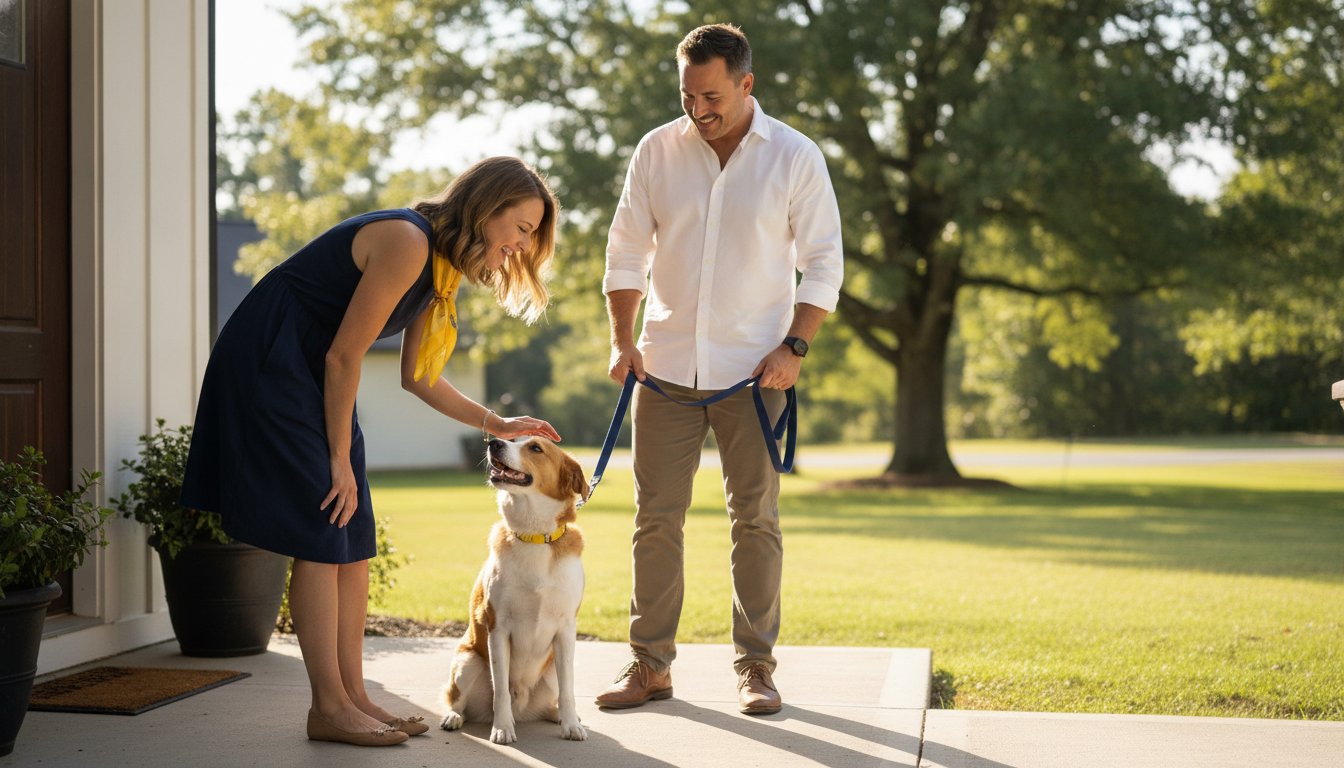
Put your dog on a leash before you ever open the door. This gives you immediate physical control and prevents the dog from charging the guest.
Step 2: Guest instructions.
Ask your visitor to completely ignore the dog. No eye contact, no talking, and definitely no petting until the dog is calm.
Step 3: Step on the leash.
Stand on the leash with just enough slack for your dog to sit comfortably. If they try to launch, the leash prevents the jump from connecting without you having to pull or jerk.
Step 4: Reward the calm.
The moment your dog chooses to sit or stand quietly, deliver a high-value treat and calm praise.
Step 5: Generalize.
Repeat this process with different friends and family members. Dogs don't always realize the rules apply to everyone until they've practiced with multiple people.
The Guest Management Script
One of the biggest hurdles in training is the well-meaning guest who says, "Oh, I don't mind if he jumps!" You have to be the advocate for your dog's education. Whether you're in Cartersville or Marietta, give your visitors a clear script before they enter. Tell them firmly: "We're training right now. Please don't pet him if he jumps, even if you don't mind." For an extra layer of control, use a 'Place' command to keep your dog on their bed or a specific rug until the initial excitement of the entry has faded. If these high-arousal moments still feel unmanageable, our professional behavior modification programs can help you bridge the gap.
Handling Jumping on Walks
Greetings aren't limited to your front door. When you're enjoying the parks in North Atlanta and a neighbor approaches, use the 'U-Turn' technique. If your dog begins to fixate and pull toward the person, simply turn and walk the other way until they regain focus on you. Maintain a 'bubble' of space that keeps your dog below their threshold of over-excitement. By rewarding them for staying grounded at a distance, you slowly teach them that calm behavior is the only way to get closer to the person they want to meet.
Why In-Home Behavior Modification is the Ultimate Solution
Why do some dogs act like perfect angels in a group class but turn into frantic kangaroos the moment you get home? The reality is that jumping is a context-specific behavior. It's deeply tied to the specific environment of your foyer, the sound of your doorbell, and the unique energy of your family members. If you want to master how to stop dog jumping on people, the most efficient path is to address the issue where it actually happens. This allows a professional to identify environmental triggers that a sterile training facility simply cannot reproduce.
Master K9 Trainer Alan Carr brings more than 35 years of hands-on experience directly to your living room. He doesn't just look at the dog's actions; he analyzes the entire social structure of the home. By observing how you and your guests interact with your pet in real-time, he can pinpoint exactly where communication is breaking down. Whether the root cause is over-excitement, a lack of clear boundaries, or underlying anxiety, a customized behavior modification plan provides the specific structure your dog craves. This personalized attention ensures that the training sticks because it's built around your real life.
Personalized Coaching for North Atlanta Families
We provide these high-end, results-oriented services to families throughout Woodstock, Canton, and Alpharetta. Our goal is to move beyond the "cookie-cutter" advice often found in generic training manuals. High-drive breeds or dogs with deeply ingrained habits require a more sophisticated, balanced approach. We focus on building a meaningful partnership between you and your companion. This ensures that the polite greeting becomes a permanent part of their personality rather than a temporary fix. You'll gain the confidence to invite guests over without a second thought.
Taking the Next Step Toward a Polished Dog
You don't have to live with the embarrassment of a jumping dog or the fear of a guest getting hurt. Booking a consultation for behavior modification or in-home training is the first step toward reclaiming your peace of mind. For those who require the highest level of reliability and focus, we also offer service dog foundation training North Atlanta. Your dog genuinely wants to please you. They just need a trusted mentor to show them the way. Let's work together to transform your dog's excitement into a calm, seated greeting that reflects the excellence of your bond.
Reclaim Your Entryway with Professional Support
Understanding that jumping is an instinctual drive for face-to-face contact allows you to stop reacting and start leading. By implementing the "Four on the Floor" framework and managing guest interactions with a clear script, you replace frantic greetings with a reliable "Default Sit." Mastering how to stop dog jumping on people isn't just about stopping a nuisance behavior; it's about building a bridge of mutual respect that lasts a lifetime.
Alan’s K9 Academy specializes in these real-world transformations. With over 35 years of experience, Master K9 Trainer Alan Carr provides customized behavior modification directly in your foyer, where the behavior actually occurs. We proudly serve families in Cartersville, Canton, and across the North Atlanta Metro to ensure lasting results in the environments that matter most to you.
You don't have to manage the excitement alone. Your dog genuinely wants to please you; they just need the right teacher to show them how to be a polite member of the family.
Frequently Asked Questions
How long does it take to stop a dog from jumping on people?
Most owners see a noticeable shift within two to four weeks of consistent training. However, the timeline for how to stop dog jumping on people depends heavily on how ingrained the habit is and whether everyone in the home follows the same rules. If you practice daily and prevent all rewards for jumping, you'll see progress quickly. For older dogs with years of practice, it may take longer to fully overwrite the old behavior.
Is it ever okay to let my dog jump on me if I enjoy it?
It is best to avoid letting your dog jump on you, even if you personally enjoy the affection. Dogs are not good at understanding context or "sometimes" rules. If they are allowed to jump on you when you're in jeans, they won't understand why it's wrong to jump on a guest in a silk dress. Consistency is the foundation of clear communication and a well-behaved pet.
Can an older dog learn to stop jumping, or is it too late?
You can absolutely teach an older dog new greeting manners; it is never too late for behavior modification. While senior dogs might have years of muscle memory to overcome, they often have better focus than scattered puppies. The process remains the same: stop rewarding the jump and start rewarding the sit. With patience and a clear plan, even a lifelong jumper can learn to stay grounded.
Why does my dog only jump on certain people and not others?
Your dog likely jumps on specific people because those individuals provide the most reinforcement, whether it's through high-pitched talking, petting, or even pushing them away. Dogs are masters at identifying who will "play the game." If one person is strictly consistent and another is "soft" on the rules, the dog will target the person who gives them the most attention, even if that attention seems negative.
What should I do if my dog jumps on a stranger during a walk?
Immediately shorten your leash and move your dog away from the stranger to stop the interaction. Apologize to the person, but focus your energy on resetting your dog's brain. Use a "U-turn" to create a bubble of space and ask for a sit once the dog has calmed down. This prevents the dog from getting a social reward for their rude behavior while maintaining safety in public spaces.
Does 'ignoring' really work for high-energy breeds like Labradors or Shepherds?
Purely ignoring a high-energy breed often results in the dog jumping harder to get your attention. For Labradors or Shepherds, you must combine ignoring the bad behavior with rewarding a specific alternative, like sitting. These breeds need a "job" during the greeting. If you just stand there, their high drive will push them to keep trying until they get a reaction, so give them a clear instruction instead.
Should I use a shock collar or prong collar to stop jumping?
How can I stop my puppy from jumping before it becomes a habit?
Start the "Four on the Floor" rule the very first day you bring your puppy home. When your puppy is small and cute, it's tempting to pick them up when they paw at your legs, but this reinforces the vertical greeting. Instead, always crouch down to their level to greet them while their feet are on the floor. This teaches them that they don't need to launch upward to get the love they want.