%20(620%20x%20150%20px)%20(14).webp)
%20(620%20x%20150%20px)%20(15).webp)
.webp)
_page-0001.webp)
.webp)
.png)
How to Stop a Dog from Pulling on the Leash: A Professional Trainer's 2026 Guide
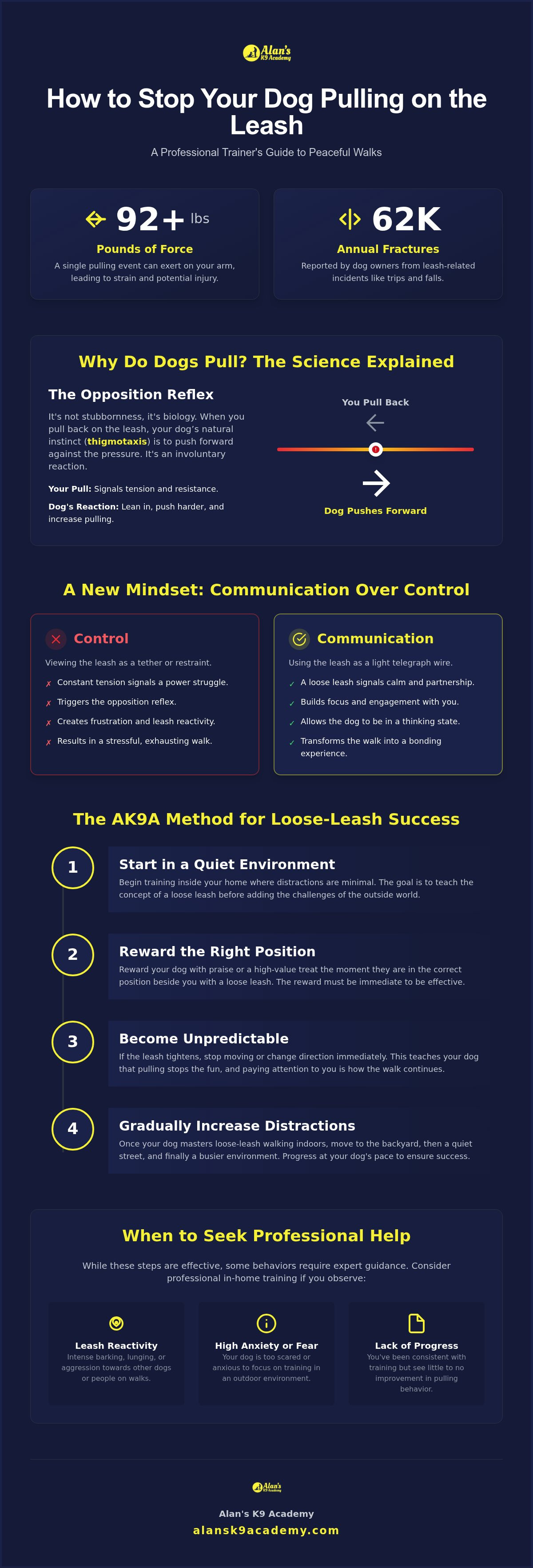
Did you know that a single pulling event during a walk can exert over 92 pounds of force on your arm, contributing to the nearly 62,000 annual wrist and finger fractures reported by dog owners? It's exhausting to deal with sore shoulders and the constant embarrassment of being dragged down the sidew...
%20(5).gif)
Did you know that a single pulling event during a walk can exert over 92 pounds of force on your arm, contributing to the nearly 62,000 annual wrist and finger fractures reported by dog owners? It's exhausting to deal with sore shoulders and the constant embarrassment of being dragged down the sidewalk. You want to enjoy the fresh air; instead, every walk feels like a high-stakes wrestling match where you're worried about your safety or your dog escaping. We understand that frustration, and we know that you just want a companion who listens.
The good news is that you can reclaim your morning strolls and your peace of mind. In this professional trainer's guide, you'll learn exactly how to stop dog pulling on leash by mastering the art of loose-leash walking through expert techniques designed to turn stressful outings into peaceful bonding experiences. We'll explore the biological science of the opposition reflex, the most effective gear for 2026, and a step-by-step communication plan to get your dog walking calmly by your side. By the end of this article, you'll have the tools to transform your daily routine from a tug-of-war into a true partnership.
Key Takeaways
• Understand the biological "opposition reflex" that causes your dog to instinctively pull against pressure.
• Shift your perspective to view the leash as a communication tool rather than a way to physically restrain your companion.
• Discover how to stop dog pulling on leash by identifying why common gear acts as a temporary band-aid rather than a long-term solution.
• Master a step-by-step training method that moves from the quiet of your home to the distractions of the real world.
• Recognize the specific signs that indicate your dog needs the customized support of professional in-home behavior modification.
Why Dogs Pull on the Leash: The Science of the Opposition Reflex
Have you ever wondered why your dog seems to turn into a sled dog the moment you step outside? Most owners think their dog is simply stubborn or trying to "dominate" the walk. In reality, the behavior is often rooted in a biological phenomenon known as the Opposition Reflex, or thigmotaxis. This is an instinctive physical reaction where a dog naturally leans into pressure. When you pull back on the leash, your dog’s body tells them to push forward against that tension. It isn't a battle of wills. It's a battle of biology. Learning how to stop dog pulling on leash begins with understanding that your own reactions might be fueling the very behavior you want to change.
While modern dog training methods have shifted toward science-based communication, many owners still accidentally "train" their dogs to pull. Every time your dog lunges and you follow, you've just rewarded that pull with the one thing they want: progress. For breeds with high prey drive, this cycle is even more intense. Before you can fix the walk, you need a solid foundation. That's why consistent basic dog commands training is the essential first step toward a calm companion. It establishes a language you both understand before you ever face the distractions of the neighborhood.
Biological Triggers vs. Learned Behavior
Your dog's instinct to lean into pressure is an ancient survival mechanism. In the wild, if an animal felt something pulling it, it would pull back to escape or stabilize. On a walk, this translates to a constant tug-of-war. We often become "human motors," subconsciously moving forward even when the leash is taut. This creates a learned behavior where the dog believes a tight leash is the "on" switch for walking. To master how to stop dog pulling on leash, you must break this cycle by becoming unpredictable. If your dog has a high prey drive, they aren't trying to be the boss; they're simply responding to an internal trigger that tells them to chase. We have to teach them that the reward comes from staying near you, not from the squirrel across the street.
The Emotional State of a Pulling Dog
A tight leash doesn't just hurt your arm. It changes your dog's emotional state. When a dog feels constant tension, it often leads to leash reactivity. This is where the dog becomes frustrated because they can't reach a stimulus or move naturally. This frustration can quickly look like aggression, but it's often just pent-up energy with nowhere to go. You can identify the root cause by watching their body language:
Anxiety
Tucked tail, scanning the environment, and pulling toward "safety" (usually home).
Excitement
High tail, whining, and pulling toward every scent or person.
Frustration
Barking or lunging when the leash stops them from moving.
Realize that walking isn't just physical exercise. It's mental work. When your dog is pulling, their brain is stuck in a "go, go, go" loop. By slowing down and requiring focus, you shift them from a reactive state to a thinking state. This transformation is what turns a stressful chore into a meaningful bonding experience.
The Psychology of the Leash: Communication Over Control
Think of the leash in your hand as a telegraph wire rather than a tether. Every time you tighten your grip or brace your shoulder, you're sending a signal of tension straight to your dog. Learning how to stop dog pulling on leash is less about physical strength and more about psychological connection. If your dog views the leash as a restrictive barrier, they'll naturally fight against it. When you transform that leash into a tool for communication, the entire dynamic of your walk changes. This shift requires you to project calm, assertive energy. Dogs, especially high-drive breeds common in North Atlanta like German Shepherds and Belgian Malinois, are incredibly sensitive to their owner's emotional state. If you're frustrated, they're reactive. If you're calm, they're attentive.
Loose-leash walking isn't just a command you give; it's a mindset you share. While many owners rely on positive reinforcement training methods to encourage good behavior, the real secret lies in engagement. You want to be the most interesting thing in your dog’s world. This is far more effective than physical restraint, which only triggers the opposition reflex we discussed earlier. By focusing on your relationship rather than just the equipment, you establish yourself as a trusted guide who provides direction and safety.
Mastering Leash Pressure
We have to teach our dogs that leash pressure is a request for a specific movement, not a cue to pull harder. In balanced training, we use pressure to guide the dog toward us. The moment they move in our direction and the leash goes slack, that "release" becomes the ultimate reward. It's a binary language: tension means "pay attention," and slack means "you're doing great." Instead of whole-arm yanking, which can cause injury, use subtle wrist movements. This precision allows for clear communication without the drama of a physical struggle. If you find your dog's size or drive makes this difficult to manage alone, our specialized behavior modification programs can help you master these nuances in your own driveway.
Building Engagement in Distracting Environments
The "Check-In" game is your best defense against the distractions of a busy neighborhood. Reward your dog every single time they choose to look at you without being asked. This builds a habit of constant engagement. When you're walking through the parks in Alpharetta or the sidewalk cafes in Marietta, you're competing with squirrels, other dogs, and heavy traffic. You have to win that competition. Start these focus exercises in your living room where it's easy to succeed. Only when your dog is consistently choosing you over the couch should you transition to the driveway, then the street, and finally the local park. This gradual progression ensures your dog stays in a "thinking" state rather than a "reactive" one.
Be Unpredictable
Change directions frequently to keep your dog guessing where you're going next.
Use High-Value Rewards
For high-drive dogs, a favorite toy or premium treat is necessary to beat real-world distractions.
Keep it Short
Ten minutes of high-engagement walking is better than forty minutes of frustrated pulling.
Leash Training Gear: Choosing the Right Tools for Your Dog
Walking into a big-box pet store can feel overwhelming. Rows of colorful nylon and complex webbing promise a "no-pull" miracle. However, gear is only as effective as the hand holding the leash. Safety is our first priority. You must match your equipment to your dog's specific size and strength to prevent accidents. While a standard flat collar works for many, it often fails to provide the feedback needed for a high-drive puller. If you're struggling with how to stop dog pulling on leash, the right tool acts as a bridge for communication, not a cage for restraint.
The Harness Myth
Many owners reach for a back-clip harness, thinking it's the most humane choice. While it's comfortable, it also directly triggers the opposition reflex we discussed earlier. These harnesses are virtually identical to the designs used for sled dogs. They encourage the dog to put their weight into their chest and drive forward. If you want to know how to stop dog pulling on leash, a back-clip harness is often your biggest obstacle. Front-clip harnesses are a popular alternative, but we consider them a temporary "band-aid." They work by physically redirecting the dog's body, which can cause orthopedic issues over time by restricting natural shoulder movement and altering their gait. We typically recommend harnesses only for young puppies or dogs with specific medical needs.
Balanced Training Tools Explained
For many of our clients, balanced training tools offer the clearest path to success. A martingale collar is an excellent choice for "escape artists" who can slip out of flat collars. It provides a gentle, limited-cinch pressure that signals the dog to slow down without the risks associated with traditional choke chains. Choosing the right leash is just as vital for maintaining control and safety:
4ft Leash
Best for high-traffic sidewalks or the initial stages of training where you need maximum proximity and control.
6ft Leash
The industry standard for neighborhood walks, providing a perfect balance of freedom and safety.
Fixed vs. Retractable
Avoid retractable leashes. They maintain constant tension, which effectively trains your dog that pulling is the only way to move forward.
Professional guidance ensures these tools are used humanely and effectively. We focus on teaching you how to use subtle cues to guide your dog, ensuring the equipment never causes pain or fear. This customized approach is what turns a walk from a physical struggle into a meaningful partnership.
Step-by-Step: The AK9A Method for Loose Leash Success
Many online guides suggest that when your dog pulls, you should simply "be a tree" and stop moving. If you own a high-drive breed like a Belgian Malinois or a determined Labrador, you've likely discovered that this rarely works. These dogs have plenty of patience; they'll just wait for you to move so they can lunge again. The AK9A method is an active, phased approach designed to teach your dog that you are the most relevant part of the walk. To truly master how to stop dog pulling on leash, you must move through these phases systematically, ensuring success at each level before adding more pressure.
Phase 1: The 'No-Distraction' Foundation
Start your training inside your home. Your hallway is the perfect "runway" because there are no squirrels or neighbors to compete with. Practice walking back and forth, rewarding your dog for staying by your side.
Phase 2: Introducing the 'Penalty Yard'
Move to your driveway or a quiet cul-de-sac. If your dog creates tension on the leash, you immediately reverse direction. This "penalty" means they are now further away from whatever they were trying to reach.
Phase 3: Real-World Application
Once your dog is consistent in the driveway, take the show on the road. Use controlled distractions, like a family member standing twenty feet away, to test their focus.
Mastering the walk is only half the battle for a well-behaved companion. You should also combine this leash work with polite greetings and jumping prevention. A dog that walks calmly but lunges at every person they pass isn't truly under control. Integrating these skills ensures your dog remains a gentleman in every social setting.
Technique: The Reverse Direction Turn
The moment you feel tension hit the leash, execute a smooth 180-degree turn and walk the other way. Don't jerk the leash; simply turn your body and move. This technique is far more effective than "being a tree" because it forces the dog to actively look for you to see where the walk is going. By keeping your dog guessing, you ensure their focus remains on your movement rather than the environment. This active redirection is the fastest way to show a high-drive dog that pulling actually gets them nowhere.
Technique: The 'Inside Turn' for Body Awareness
An inside turn involves turning into your dog's space, using your leg to gently guide their path. This builds spatial awareness and teaches the dog to respect your personal "bubble." When you turn into them, they have to move their feet to stay out of your way, which naturally brings their attention back to your body. Always reward them when they return to the "Sweet Spot," that area right next to your leg where the leash is perfectly slack. If you're struggling to find this rhythm with your dog, our in-home dog training programs provide the hands-on coaching needed to master these physical cues in your dog's actual environment.
When to Seek Professional In-Home Training in North Atlanta
Sometimes, the challenge goes beyond basic mechanics. If your training sessions in the local parks of Woodstock or on the busy sidewalks of Roswell still feel like a physical struggle, it might be time for expert intervention. While you now understand the theory of how to stop dog pulling on leash, real-world variables like intense leash reactivity or redirection require a professional eye. These aren't just bad habits; they are deep-seated emotional responses that can become dangerous if left unaddressed. Professional support ensures that you are reading your dog's subtle body language correctly before a pull turns into a lunge.
This is where Alan's K9 Academy makes the difference. Unlike the distracting, high-stress environment of a big-box store class, our training happens where the problems actually occur. Master K9 Trainer Alan Carr brings his 35+ years of experience directly to your home, ensuring that the progress you make is sustainable in your specific neighborhood environment. We focus on building a foundation of trust that carries over from your driveway to the most distracting environments in the North Atlanta Metro.
The Value of In-Home Behavior Modification
Training in your dog's own territory is the most efficient way to achieve lasting results. We address the unique triggers found in your daily routine, whether that's the neighbor's barking dog in Kennesaw or the heavy traffic in Alpharetta. We don't just focus on the dog; we empower you with the skills to maintain consistency long after we leave. This personalized approach is particularly vital for multi-dog households where the energy of one puller can quickly set off the others. By customizing every session, we ensure your specific lifestyle needs are met with precision and care.
Taking the Next Step Toward Peaceful Walks
Your journey toward a calm companion begins with a thorough consultation. Alan Carr will evaluate your dog's temperament and help you bridge the gap from knowing how to stop dog pulling on leash to actually achieving off-leash reliability. You'll join a community of North Atlanta owners who have successfully transformed their stressful walks into meaningful bonding experiences. From the quiet streets of Cumming to the bustling squares of Marietta, we are dedicated to helping you and your dog thrive together as a team.
Reclaim Your Walks and Your Peace of Mind
Walking your dog shouldn't feel like a chore or a physical struggle. By understanding the science of the opposition reflex and choosing the right tools, you've already taken the first steps toward a better relationship. Remember that loose-leash walking is a shared mindset. It requires patience, consistency, and clear communication. Whether you're practicing the reverse direction turn in your driveway or building focus in a busy park, your ultimate goal is a true partnership between you and your companion.
Mastering how to stop dog pulling on leash is entirely possible, even for high-drive breeds or dogs struggling with intense reactivity. If you're ready for expert support, we're here to guide you. Led by Master K9 Trainer Alan Carr, who brings over 35 years of experience, we specialize in behavior modification for leash reactivity. We serve families throughout Cartersville, Marietta, and the North Atlanta Metro, providing the hands-on, in-home training your dog needs to succeed in their actual environment.
Schedule your personalized in-home training session with Alan's K9 Academy today! You deserve to enjoy the fresh air without the stress of a tug-of-war. Let's turn those difficult outings into the peaceful bonding experiences you've always imagined.
Frequently Asked Questions
Why does my dog pull only at the beginning of the walk?
Your dog is likely experiencing a surge of high arousal and excitement as they transition from the house to the outdoors. This initial burst of energy makes it difficult for them to focus on your cues. To manage this, try practicing focus exercises inside the home or in the driveway for five minutes before heading out. This helps lower their baseline stress level so they can start the walk in a calmer state of mind.
Is a retractable leash okay for a dog that pulls?
No, retractable leashes are generally discouraged for dogs that struggle with pulling. These leashes maintain constant tension on the collar, which inadvertently teaches your dog that pulling is the only way to move forward. They also offer very little control in emergency situations. Switching to a fixed four or six-foot leash is a critical step in learning how to stop dog pulling on leash effectively.
How long does it take to train a dog to stop pulling on the leash?
While you may see immediate improvements using the right tools, true habit change typically takes four to six weeks of daily, consistent practice. Training is a marathon, not a sprint. The duration depends on your dog's age, drive, and how long the pulling behavior has been reinforced. Short, focused sessions of ten to fifteen minutes are far more effective for long-term success than occasional long walks.
Can an older dog learn to walk on a loose leash if they've pulled for years?
Absolutely, older dogs are fully capable of learning new walking habits even after years of pulling. While it may take slightly longer to override their muscle memory, dogs are remarkably adaptable. The key is establishing a clear, new language of communication. By using balanced methods and consistent rewards, you can show your senior companion that walking calmly is a much more rewarding experience than struggling against the leash.
What is the best harness for a dog that pulls extremely hard?
For dogs that pull with extreme force, front-clip harnesses like the Blue-9 Balance Harness or the 2 Hounds Design Freedom No-Pull Harness are top recommendations for 2026. These designs help redirect your dog's momentum back toward you. However, remember that gear is a temporary aid. The ultimate goal is to move toward a flat collar or martingale as your dog learns to respond to your body language and cues.
Should I use treats to stop my dog from pulling?
Treats are an excellent way to reward your dog for choosing to walk by your side, but they shouldn't be used as a constant lure. If you only show the treat to get them to stop pulling, they're just following food, not learning how to stop dog pulling on leash. Instead, deliver the reward when the leash is slack and they are looking at you. This reinforces the specific behavior of staying in the "sweet spot."
What do I do if my dog pulls when they see another dog?
If your dog lunges toward other dogs, the first step is to increase the distance between you and the distraction. Move to the other side of the street or behind a parked car before your dog reaches their "threshold." Once you have enough space, use high-value rewards or a quick direction change to reclaim their focus. If this behavior persists, it may indicate leash reactivity that requires specialized behavior modification.
Additionally, if your dog’s reactivity includes disruptive barking, click here to explore bark-reduction tools from Educator Collars that can help you regain control during training.
Is leash pulling harmful to my dog's neck or throat?
Yes, chronic pulling can lead to serious physical issues, including tracheal collapse, thyroid damage, and neck strain. A 2025 review of hospital data found that fractures are common for owners, but the physical toll on the dog is just as significant. This is why matching the right gear to your dog's size is vital. Using a harness or a wide martingale collar can help distribute pressure more safely while you work on foundational training.