%20(620%20x%20150%20px)%20(14).webp)
%20(620%20x%20150%20px)%20(15).webp)
.webp)
_page-0001.webp)
.webp)
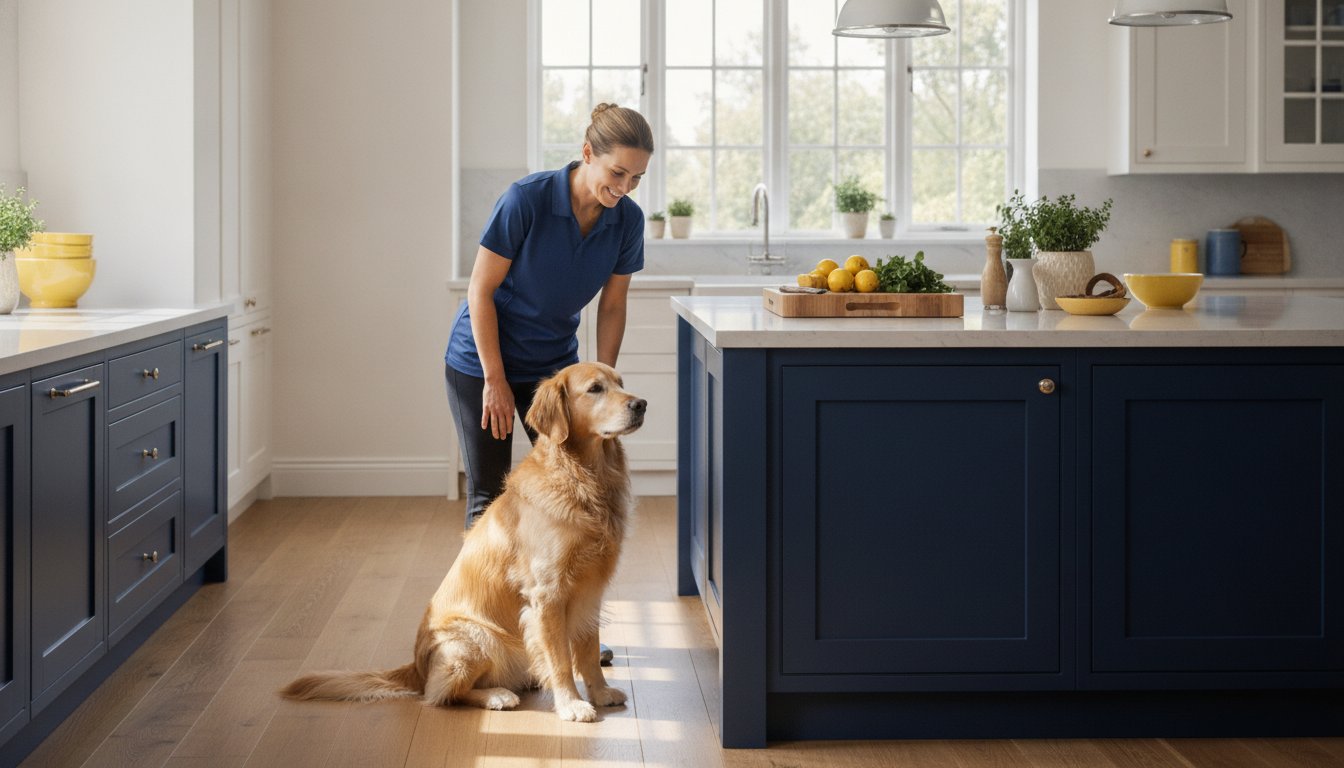
How to Stop a Dog from Counter Surfing: A Master Trainer’s Guide (2026)
You turn your back for thirty seconds to grab the mail, only to return to an empty plate and a dog looking suspiciously satisfied. It's more than just a lost dinner. It's that sinking feeling in your stomach when you realize the scavenged meal contained toxic onions or dark chocolate. If you feel li...
%20(5).gif)
You turn your back for thirty seconds to grab the mail, only to return to an empty plate and a dog looking suspiciously satisfied. It's more than just a lost dinner. It's that sinking feeling in your stomach when you realize the scavenged meal contained toxic onions or dark chocolate. If you feel like you're living in a state of constant kitchen surveillance, you aren't alone. Many owners struggle with a "stealth snacker" who waits for the perfect moment to strike. Learning how to stop a dog from counter surfing isn't about hovering over them 24/7. It's about changing the way your dog perceives your kitchen boundaries entirely.
Every dog can learn to respect the "invisible line" of your countertops. No more ruined meals. In this guide, we're sharing the professional behavioral strategies and practical training steps used to permanently end these scavenging habits. You'll discover how to build reliable impulse control and create a stress-free environment where your groceries are finally safe. We'll walk through a proven methodology that moves beyond temporary fixes to achieve real-world reliability, even when you aren't in the room to supervise.
Key Takeaways
• Identify the self-rewarding nature of scavenging to understand why traditional corrections often fail to change the behavior.
• Adopt a "Zero Opportunity" management strategy using physical barriers to prevent your dog from practicing the habit.
• Master practical training steps, including "Leave It" and "Off," to teach your dog how to stop a dog from counter surfing through impulse control.
• Establish real-world reliability with a balanced approach that ensures your dog respects boundaries even when you are out of sight.
• Learn how in-home behavior modification targets the specific triggers of your kitchen environment for permanent results.
Understanding the Root Causes of Canine Counter Surfing
Why does your dog keep jumping up even after you've said "No" a thousand times? To your dog, your kitchen isn't just a place where meals are prepped; it's a high-stakes treasure map. Counter surfing is an opportunistic, self-rewarding scavenging behavior rooted in a dog’s natural drive to forage. While we see a ruined dinner, your dog sees a successful hunt. This drive is so powerful that the "high" of finding a single scrap of food often completely outweighs the memory of a past verbal correction.
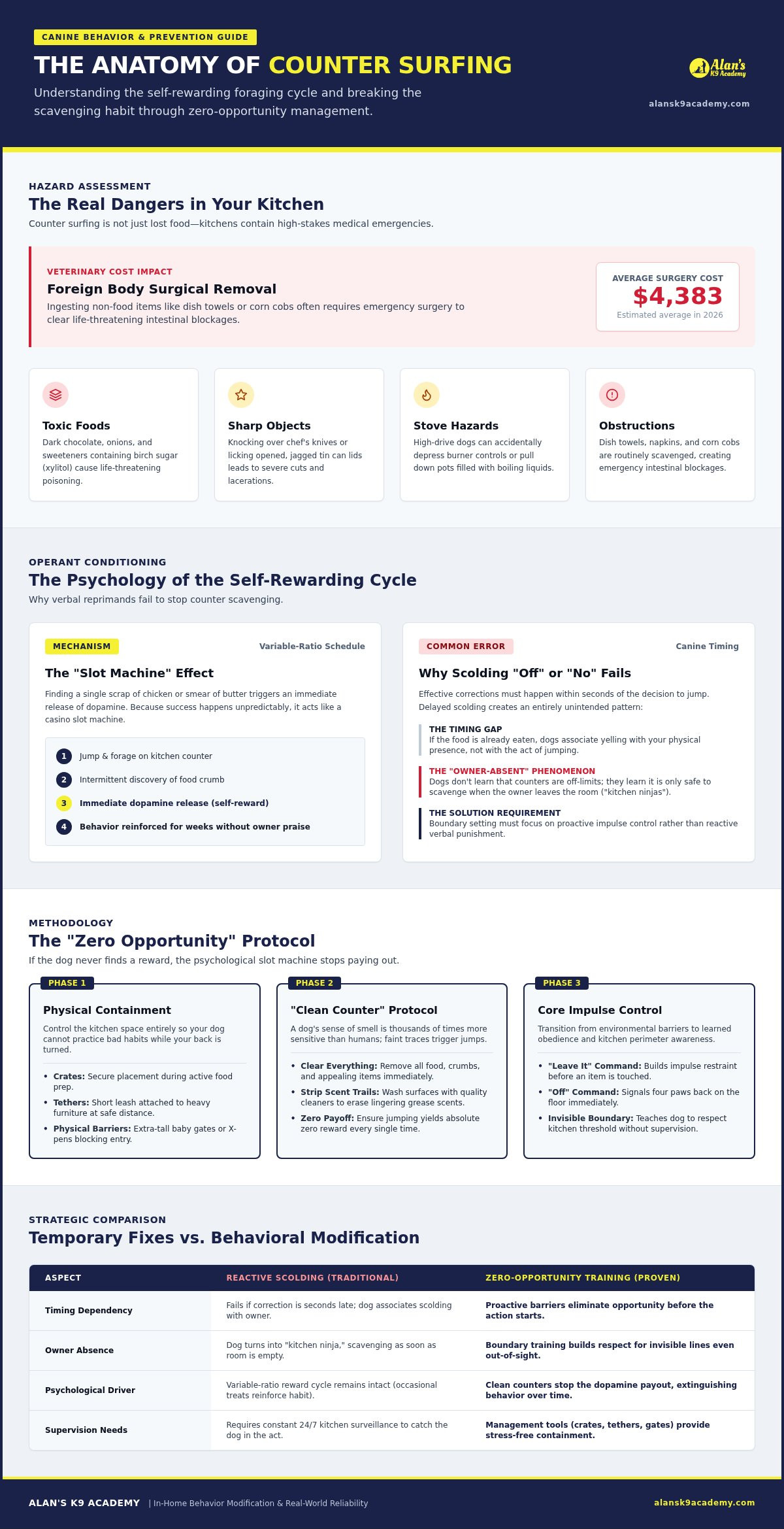
It's vital to distinguish between a dog that is truly hungry and one that is scavenging out of boredom or habit. Most modern pets aren't starving, but they are hardwired to seek out resources. This habit isn't just annoying; it’s dangerous. Kitchens are full of hazards that can lead to emergency room visits, including:
Toxic Foods
Scavenging items like dark chocolate, onions, or products containing "birch sugar" (xylitol) can cause life-threatening reactions.
Sharp Objects
Dogs can easily knock over chef's knives or lick sharp can lids.
Stove Hazards
High-drive dogs may accidentally turn on burners or pull down pots of boiling liquid.
Foreign Body Obstructions
Ingesting dish towels or corn cobs can lead to intestinal blockages, which cost an average of $4,383 for surgical removal in 2026.
The Psychology of the 'Self-Rewarding' Cycle
When your dog finds a crumb of chicken or a smear of butter, their brain releases a flood of dopamine. This creates a powerful reinforcement loop. In the context of canine scavenging, self-rewarding behavior refers to an action that provides its own immediate, high-value reinforcement, which bypasses the need for any external owner praise. This is where the principles of operant conditioning come into play. Because your dog only finds food occasionally, they are on a "variable-ratio schedule." This is the same psychological trick that keeps people playing slot machines. A single successful "find" can reinforce the act of checking the counters for weeks, making it a very difficult habit to break without a professional strategy. If you want to learn how to stop a dog from counter surfing, you have to break this internal reward cycle first.
Why Traditional Scolding Often Fails
Most owners try to stop the behavior by shouting "Off" or "No" when they catch their dog in the act. The problem is canine timing. For a correction to be effective, it must happen within seconds of the choice to jump. If you scold your dog after the sandwich is already gone, they don't associate the yelling with the jump; they associate it with your presence. This leads to "owner-absent" behavior. Your dog doesn't learn that the counter is off-limits. They simply learn that it's only safe to scavenge when you are out of the room. We see this often in North Atlanta homes where dogs are perfectly "obedient" while the owner is watching but turn into kitchen ninjas the moment the back door closes. Real reliability requires moving beyond simple scolding toward meaningful boundary setting.
Immediate Management Strategies to Prevent Scavenging
You can't effectively train a dog that is currently eating your steak. Before we dive into active impulse control, we must establish a "Zero Opportunity" policy. Management isn't a permanent fix, but it's the essential foundation that stops the bleeding. If your dog never finds a reward on the counter, the psychological slot machine stops paying out. This breaks the reinforcement loop and prevents the behavior from becoming even more ingrained while you work on long-term solutions.
Environmental management involves controlling the space so your dog cannot fail. While you're busy prepping a meal, use a crate or a "tether", a short leash attached to a heavy piece of furniture, to keep your dog at a safe distance. This prevents them from practicing bad habits the moment your back is turned. This AKC guide to counter-surfing prevention confirms that managing the environment is the first step in any successful behavioral plan. By using physical barriers like extra-tall baby gates or X-pens, you remove the choice to scavenge entirely.
The 'Clean Counter' Protocol
A clean counter is more than just an empty one. Dogs possess a sense of smell thousands of times more sensitive than ours; a faint scent of bacon grease or a breadcrumb is enough to trigger a jump. Clear away all food, crumbs, and enticing smells immediately. Use high-quality cleaning products to strip away scent trails that lead your dog’s nose to the granite. Be aware that non-food items like sponges, mail, or even used tissues can be high-value "toys" for a bored dog. If it's on the counter, it's a potential reward that keeps the habit alive.
Creating Dog-Free Zones in Open Floor Plans
Many of our clients in Marietta and Alpharetta live in open-concept homes where the kitchen flows directly into the living room. This layout makes learning how to stop a dog from counter surfing feel like a challenge because there are no doors to close. You can define the kitchen perimeter using floor markers like colored tape or low-profile mats to create a visual "no-go" zone. These markers help your dog understand exactly where the boundary lies. If you're struggling to manage a high-drive dog in a large, open space, Alan's K9 Academy offers in-home behavior modification programs to help you design a customized management plan for your specific floor plan. Consistent management allows you to reset your dog's expectations of the space before moving into active training.
Core Training Techniques for Impulse Control
Management prevents the habit, but training builds the character. If you want to know how to stop a dog from counter surfing permanently, you must address their lack of impulse control. This process isn't about being mean or restrictive. It's about teaching your dog that they get better rewards for staying on the floor than they do for jumping up. We focus on three core commands: Leave It, Off, and Place. By rewarding the choice to ignore the counter, you turn a scavenging dog into a respectful companion.
We also use the "Off" command to tell a dog to return all four paws to the floor. Never use physical force, shouting, or kneeing to push a dog down. These tactics often cause fear or are seen as an invitation to play. Instead, wait for them to jump, say "Off" calmly, and reward them the second they land. The real magic happens when you reward the choice. When your dog walks past the counter and doesn't jump, that is the moment to provide a meaningful, high-value reward.
Teaching a Reliable 'Leave It' Command
"Leave It" is a life-saving skill. In the kitchen, it tells your dog that the item on the counter is strictly off-limits. This is critical because many common ingredients, such as grapes, chocolate, or macadamia nuts, appear on the ASPCA's list of hazardous people foods. Start training with a low-value treat in your closed hand on the floor. Once they look away, reward them with a high-value treat from your other hand. Gradually move this exercise to the edge of the counter, using your hand to cover the treat if they try to grab it. For a deeper look at mastering these reactions, see our guide on behavioral training for dogs.
The Power of the 'Place' Command
The "Place" command is your best friend during meal preparation. It involves training your dog to go to a specific bed or mat and stay there until you give a release word. This creates a clear "work zone" for you and a "relaxation zone" for them. Building duration and distance is key. Start by rewarding them for staying on the mat for five seconds, then ten, then thirty. Unlike a "Stay" command which implies a temporary pause in movement, "Place" is a functional station that gives the dog a clear job to do while you are busy in the kitchen. This stationing technique provides a reliable way to keep high-drive dogs out of trouble while you cook.
Correcting the Habit: Consistency and Real-World Reliability
Consistency is the absolute bedrock of behavioral change. If you want to master how to stop a dog from counter surfing, every person in your home must follow the exact same rules. One family member allowing a "sneak peek" at the counter or leaving a plate within reach can undo weeks of hard work. This creates intermittent reinforcement; it's the same psychological trick that makes slot machines addictive. You might also notice an "extinction burst" during this phase. This is a temporary increase in the intensity or frequency of the behavior. Your dog is frustrated that the old habit isn't paying out, so they try harder. Stay the course. This spike is a clear sign that the old reinforcement loop is finally breaking.
Many high-drive dogs are "closet surfers" who wait for the click of the door or the sound of your car leaving. If you catch your dog on a Wi-Fi camera, resist the urge to shout through the speaker. This rarely teaches the dog about the counter; it only teaches them to be wary of the camera's noise. Use that footage to identify where your management failed. In 2025, the ASPCA Animal Poison Control Center handled a call approximately once every 53 seconds, driven heavily by these unsupervised scavenging moments. If you are struggling with a dog that only surfs when you're gone, our behavior modification programs provide the hands-on support needed to bridge the gap between owner-present obedience and real-world reliability.
Timing and Meaningful Feedback
Timing is everything in canine communication. We follow the two-second rule. Feedback must occur within two seconds of the choice to be effective. If you catch your dog in the act of jumping, a clear, fair correction helps them understand the boundary immediately. This isn't about being harsh; it's about being understood. If you wait until they've already eaten the food, you've missed the window. For more on building this level of focus and reliability, check out our guide on dog obedience training.
Avoiding Common Mistakes
Stop luring your dog down with treats. If you show your dog a cookie to get them to jump off the counter, you are accidentally rewarding the jump. You've essentially paid them for the bad behavior. Instead, use your "Off" command and only reward them once they have been calmly on the floor for several seconds. If they have already grabbed a dangerous item, don't chase them. Chasing turns the theft into a high-stakes game of keep-away. Use an emergency trade for a high-value toy to retrieve the item safely without reinforcing the behavior.
Professional Behavior Modification in North Atlanta
Training a dog in a sterile facility is one thing. Teaching them to respect the boundaries of your specific kitchen layout is quite another. Kitchen-specific issues like scavenging are best solved in the home environment where they occur. An in-home setting allows a professional to see exactly what triggers your dog's interest. Is it the height of the island? Or perhaps a subtle body language cue you're giving off while prepping dinner? By working where the problem happens in your Cartersville or North Atlanta home, we ensure the results are real-world reliable. This isn't just about obedience; it's about changing the way your dog lives in your space.
A Master Trainer can identify subtle antecedents that most owners miss. We look at the sequence of events that happen right before your dog decides to jump. By identifying these moments, we can intervene before the behavior even starts. Professional help is a meaningful investment in your household's safety and long-term peace. It moves you away from a state of constant vigilance and into a partnership built on mutual respect and clear communication. You shouldn't have to live in a home where you're constantly worried about your next meal being snatched.
Customized Plans for High-Drive Breeds
Not all dogs scavenge for the same reasons. Working breeds like Belgian Malinois, German Shepherds, or highly motivated Labradors require specialized boundary training that accounts for their intense drive. These dogs aren't just looking for a snack; they are looking for a job to do. We tailor the intensity of our training to your dog's specific temperament, ensuring they find more satisfaction in their "Place" than in a stolen piece of bread. If you're ready to move beyond generic advice for your high-energy companion, our in home dog training sessions provide the customized structure these breeds crave to succeed.
The AK9A Difference: 35 Years of Expertise
At Alan's K9 Academy, we believe that every dog is capable of transformation. Master K9 Trainer Alan Carr brings over 35 years of experience to every session, specializing in rehabilitating complex behaviors that others might find "impossible." We use balanced, humane methods to build a bridge of communication between you and your companion. This approach is especially effective for dogs that have failed with "positive-only" methods, as it provides the clear boundaries a scavenger needs to understand how to stop a dog from counter surfing. We don't just offer a service; we offer a mission to improve the quality of life for families across Woodstock, Marietta, and Kennesaw. Contact Alan's K9 Academy today for a hands-on consultation and let's turn your kitchen back into a stress-free zone.
Reclaim Your Kitchen and Your Peace of Mind
Living with a kitchen scavenger doesn't have to be your permanent reality. By combining the management strategies we've discussed with targeted impulse control training, you can break the self-rewarding cycle for good. Remember that consistency across your entire household is the secret to real-world reliability. When you stop the "slot machine" of the countertops from paying out and reward the choice to stay on the floor, your dog learns that boundaries are both clear and beneficial. Mastering how to stop a dog from counter surfing is the first step toward a safer, stress-free home where your meals are finally secure.
If you're dealing with a high-drive dog or feel overwhelmed by the process, you don't have to do it alone. Led by Master K9 Trainer Alan Carr, who brings over 35 years of professional experience, we specialize in solving even the most difficult behavioral challenges. We're proud to serve families in Cartersville, Marietta, and throughout North Atlanta with hands-on, customized support. Schedule your personalized in-home training session with Alan's K9 Academy today and take the first step toward a more harmonious life with your companion. You've got this, and we're here to help.
Frequently Asked Questions
How long does it take to stop a dog from counter surfing?
Success depends on the dog's history and your consistency, but you can see significant improvement within two to four weeks. If a dog has practiced the habit for years, it takes longer to overwrite that reinforcement loop. The key is preventing all "wins" during this period. For families in Cartersville or Marietta, our in-home sessions help accelerate this timeline by addressing the specific layout and triggers of your kitchen.
Will my dog ever be able to be alone in the kitchen?
Yes, but only after they have demonstrated reliable impulse control for several months without supervision. You shouldn't rush this transition. Start by leaving the room for thirty seconds and gradually increase the duration. If your dog is a high-drive breed, they might always need a "clean counter" policy to stay successful. We focus on building real-world reliability so you don't have to hover over them forever.
Are 'scat mats' or 'booby traps' effective for counter surfing?
We don't recommend booby traps like shaker cans or mouse traps because they can cause fear-based issues or even physical injury. While electronic mats can act as a deterrent, they don't actually teach the dog how to stop a dog from counter surfing through choice. They only teach the dog to avoid the mat. A balanced training approach focuses on communication and boundaries rather than relying on gimmicks.
My dog only counter surfs when I leave the room. What should I do?
This is a classic case of "owner-absent" behavior where the dog has learned that the rules only apply when you're watching. You need to tighten your environmental management immediately. Use baby gates or crates in your North Atlanta home when you can't supervise. We also use "set-ups" where we monitor the dog from another room. This allows us to provide a correction at the exact moment they jump.
Can older dogs learn to stop scavenging, or is it too late?
It is never too late for an older dog to learn new boundaries. While a senior dog in Woodstock or Kennesaw may have years of practice, they are still capable of changing their behavior through consistent reinforcement. The process might take more patience since you're undoing a long-term habit. We customize our behavior modification plans to suit the physical needs and learning pace of older companions to ensure they remain successful.
What are the most dangerous foods my dog might find on the counter?
Several common kitchen items are highly toxic to dogs. Chocolate, grapes, raisins, and onions are among the most frequent causes of emergency vet visits. You should also be extremely careful with sugar-free products containing xylitol, which manufacturers often list as "birch sugar" or "wood sugar." Even a small amount swiped from a counter can lead to liver failure or life-threatening hypoglycemia within an hour of ingestion.
How do I stop my puppy from starting the counter surfing habit?
Prevention is the most effective strategy for puppies. Keep your counters completely clear and use physical barriers like crates or tethers to prevent them from ever reaching the "jump" stage. If they never find a reward, the behavior never becomes a habit. We help new puppy owners in Roswell and Alpharetta establish these boundaries early. This proactive approach saves you from having to rehabilitate a deeply ingrained problem later.
Does 'Leave It' work for things the dog has already grabbed?
No, "Leave It" is meant to prevent a dog from picking something up in the first place. Once the item is in their mouth, you should use the "Drop It" command. If your dog has grabbed something dangerous, don't chase them. Instead, offer a high-value trade, such as a favorite toy or a piece of cheese. This prevents a game of keep-away and ensures you can retrieve the item safely without a struggle.