



How to Proof Dog Commands Around Distractions and Noise
Reliable recall isn’t built by testing a dog at full difficulty; it’s built one rung at a time. The practical answer to how to proof dog commands with distractions is to start in a familiar, quiet setting, then gradually increase the challenge. Move up when the dog performs correctly about 80% of th...

Reliable recall isn’t built by testing a dog at full difficulty; it’s built one rung at a time. The practical answer to how to proof dog commands with distractions is to start in a familiar, quiet setting, then gradually increase the challenge. Move up when the dog performs correctly about 80% of the time, changing only one variable at a time.
It’s frustrating when your dog responds beautifully at home but seems to forget a cue around traffic, people, or other dogs. That doesn’t mean training has failed; it means the behavior needs practice in different situations. This guide explains how to proof dog commands with distractions through gradual exposure, varied handlers and positions, and carefully managed challenges. You’ll learn how to build a sensible progression, keep activity manageable, and strengthen recall without asking your dog to cope with more than they’re ready for.
Key Takeaways
• Build reliability across location, distraction, distance, and duration so your dog can respond in more than one familiar setup.
• Introduce sounds and activity at a manageable level, and increase the challenge after five clean repetitions in a row.
• Practice cues with different handlers and positions to strengthen your dog’s response beyond one person or posture.
• Use a gradual distraction ladder for recall, adjusting the setup when your dog struggles instead of making the next step harder.
What does ‘proofing’ mean in dog training?
Keep practice brief and frequent, and end while your dog is still engaged. A professional adjusts each session to your dog’s focus, building on successful responses instead of repeating a drill until concentration fades.
•
Build Reliable Cues Through Focused Practice
Start with one clear task, such as coming when called, before adding competing demands. A cue is reliable when your dog performs the behavior promptly after hearing it, so assess both speed and accuracy. If your dog hesitates or needs repeated cues, return to an easier setup rather than treating the response as dependable. Each repetition should have a clear purpose.
•
Change One Training Variable at a Time
Ask the professional to adjust one challenge while keeping the rest familiar. Proofing separates four variables: location, distraction, distance, and duration. For example, the trainer might add a mild sound while staying in the same room, then change distance in a later exercise. Difficulty can increase when the dog succeeds about 80% of the time in that setup. Changing several variables together makes it harder to identify what affected the response.
•
Practice in Varied Environments
Practice familiar cues in different settings so your dog learns that they apply beyond one room. Move from a quiet space to a new location, keeping the task manageable and checking whether your dog still responds promptly. An obstacle course can introduce controlled changes in movement and position, such as giving a cue before or after an obstacle. Simplify the course if it distracts from the task.
Gradual desensitization to noises and other stimuli
Introduce sounds and activity in controlled stages, keeping each situation manageable. Your dog can practice around other dogs, people, traffic, and wildlife from a distance where they can still respond to you.
•
Introduce Noises and Other Stimuli Gradually
Begin with a familiar cue and one mild stimulus, such as a quiet recording or a soft knock. Watch whether your dog can still respond, then adjust the sound or distance before adding another challenge. At home, practice might include visitors, door knocks, recorded noises, or people walking past the yard. Avoid combining triggers at first so you can tell which sound or movement affects your dog.
•
Increase Distractions and Difficulty Gradually
Raise the challenge only after your dog completes five clean repetitions in a row. You might make a recording slightly louder, then later introduce a different sound or a moving person. Each change should test one new difficulty, not several at once. If your dog stops responding, reduce the challenge and rebuild success before progressing. This keeps the next step manageable rather than overwhelming.
•
Train Around Other Dogs, People, and Traffic
Choose a controlled setup where the professional can adjust distance and movement. For example, a calm dog can stand 50 yards away while the trained dog responds to a familiar cue; a squirrel may be manageable at 100 yards but not at 10. People can begin by walking past before approaching, while traffic remains at a distance that lets the dog stay engaged. The trainer increases proximity only while the dog can respond, and uses treats or praise after successful cues. For tailored practice in everyday settings, explore professional in-home dog training.
Proofing different handlers and positions
A cue can seem reliable with one person, then falter when another gives it. A professional tests who delivers the cue and how the handler is positioned, while rewarding clear responses.
• Start with the familiar handler and a well-known cue, such as “sit.” Check whether your dog responds to the spoken cue without extra gestures or repeated prompts. Once the response is clear, invite a friend or family member to give the same cue. Keep the wording consistent so your dog responds to the cue rather than trying to interpret a new phrase.
• Change the handler’s position in a planned sequence. Give the cue while standing face-to-face, then while seated nearby, and later while turned slightly away. Each position tests whether your dog understands the cue beyond one familiar posture. If your dog hesitates, return to the last position where the response was clear before trying another variation.
• Reward the correct response promptly with a treat or praise. For example, when your dog comes to a second handler after a recall cue, mark the success and deliver the reward right away. This connects the behavior to the cue, even when the voice or body position changes. Don’t wait until after several unrelated actions to reward.
• Build focus before asking your dog to respond around a new handler. Use a “watch me” cue to bring their attention back, then give a familiar command once they’re engaged. Look for a response instead of escalating with louder cues or repeated calls. Short, clear repetitions help show whether your dog understands the command or is following one person’s movements.
How a professional builds a distraction-proofing ladder
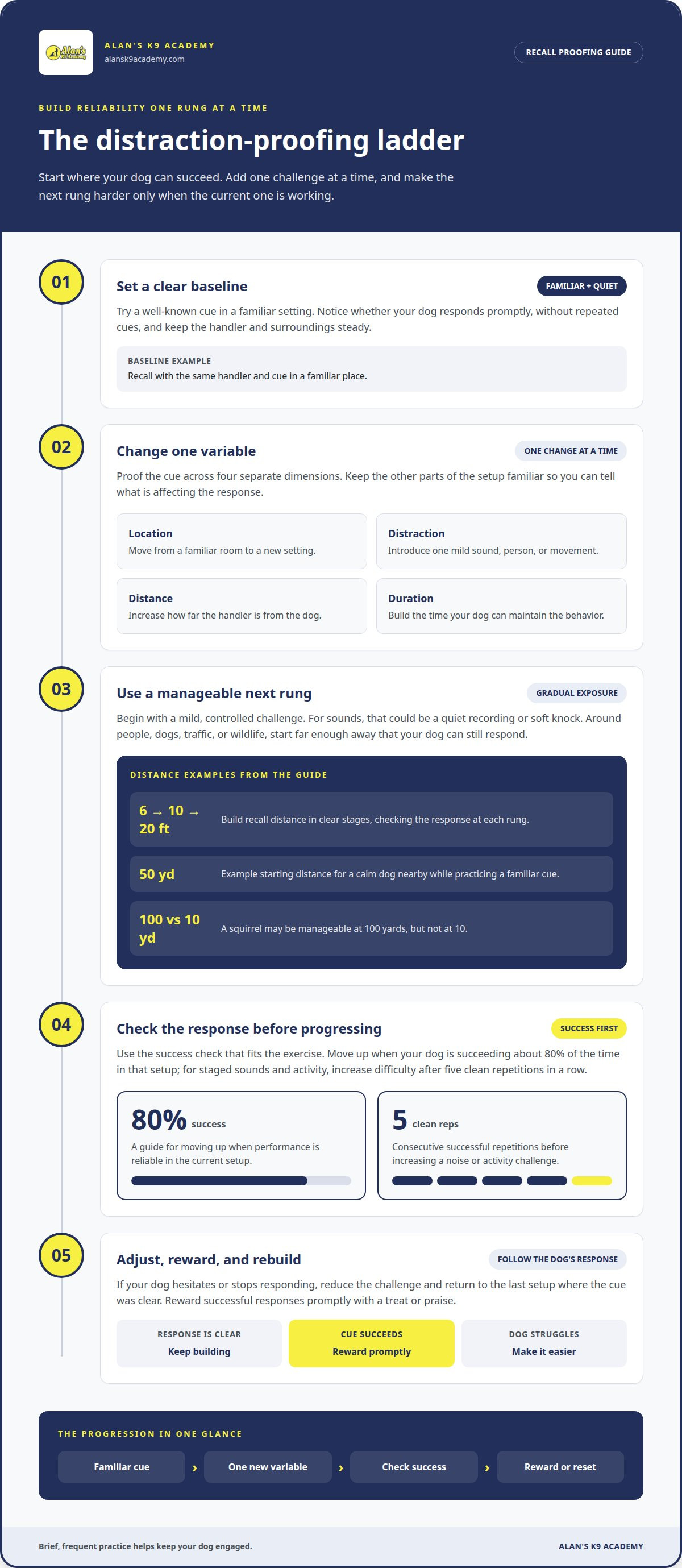
If you’re learning how to proof dog commands with distractions, build a progression around your dog’s actual responses. Start with a manageable recall situation, then choose the next step by noticing what shifts your dog’s focus, such as distance, location, or nearby movement.
• Establish a baseline before adding challenges. Observe recall in a familiar setting, noting how your dog responds to the cue, handler position, and surroundings. This helps you choose a sensible first change. For example, keep the same handler and cue while moving to a different spot, rather than changing several parts of the exercise at once.
• Build distance in clear stages. The trainer may work with the handler at 6 feet, then 10 feet, and later 20 feet. Each distance becomes a separate rung, giving the professional a chance to assess the response before moving farther away. If recall becomes less reliable, the trainer returns to the last successful distance and adjusts the progression.
• Plan new locations as individual practice opportunities. A professional may visit somewhere unfamiliar three times this month and work there for 5-10 minutes before leaving. The short session lets the trainer observe how the new setting affects the dog without making every part of the outing a recall challenge. The first cue can remain familiar while the surroundings change.
• Use what you observe to choose the next step. The practical answer to how to proof dog commands with distractions is to advance only when the current setup produces a clear response. Note which conditions helped, then revisit a moderately challenging setup after a routine break. A few sessions can show whether the behavior needs rebuilding before you resume harder practice.
Build a customized recall progression with professional help planning your dog’s training ladder.
Alan's K9 Academy
Alan's K9 Academy helps dog owners build more dependable responses through personalized training and behavior support. When recall or familiar cues break down around noise, people, or other dogs, a professional can assess the situation and shape a gradual practice plan around the dog’s needs.
In-home dog training can bring practice into the settings where distractions actually occur, while behavior modification can address challenges that interfere with focus and responsiveness. The goal is to develop practical skills that carry beyond one quiet training space, with progress guided by the dog’s behavior.
If you’d like professional support building more reliable commands around distractions, contact Alan's K9 Academy.
Make dependable responses part of everyday life
A cue learned in training is most useful when it also helps your dog navigate everyday routines. Identify where responses still break down, then shape practice around those real situations. Learning how to proof dog commands with distractions takes observation and a progression suited to your dog, not an expectation that every cue will work everywhere at once.
Alan's K9 Academy can help you work toward that goal through In-Home Dog Training, Behavior Modification, and Therapy & Service Dog Training. Professional guidance can help clarify which skills to strengthen and how to move practice forward in a way that fits your dog.
Contact Alan's K9 Academy to discuss your dog’s training needs. A more reliable response starts with a thoughtful next step.
Frequently Asked Questions
How can a professional help keep a proofed recall reliable?
Include maintenance practice so recall doesn’t become tied to one setup. Add a few repetitions at moderate difficulty to regular sessions, then occasionally revisit a harder situation to see whether the response holds. If recall weakens after a routine change, return to a familiar setup and rebuild before increasing the challenge again.
How can a professional make a hard distraction easier for a dog?
Make the distraction less intense without abandoning the recall goal. For example, use a calm, stationary person instead of someone running, or choose a quieter time and a more distant viewing point. Watch whether your dog can disengage and respond, then adjust the setup if their attention stays fixed on the distraction.
How many repetitions does a professional typically use before increasing difficulty?
Wait for five clean repetitions in a row before making the exercise harder. “Clean” means your dog completes the requested behavior correctly each time in that setup. Then change one part of the exercise rather than combining a new location, handler, and distraction. If your dog struggles, return to an easier version.
Should a professional raise the collar level under distraction?
There isn’t one collar level that fits every dog or situation. Alan's K9 Academy describes its approach as customized, with appropriate training tools selected for the dog’s temperament and needs. A professional should assess the dog and the training context, rather than relying on a collar adjustment alone to address a missed cue. Positive reinforcement can also support the desired response.
When can a professional safely take the long line off?
Assess your dog’s recall across controlled setups before transitioning away from a long line. Your dog needs to respond reliably as distance and distractions change, not just in one familiar place. Test the next step in a suitable environment, and keep using the line when your dog still needs support to respond.
Why might a dog listen at home but not outside, and how can a professional address it?
Home may offer familiar sights and sounds, while outside brings new movement, scents, and competing activity. A professional can identify which part of the outdoor setting interrupts the response, then arrange a less demanding practice situation. For example, the trainer might begin near a quiet building entrance before working closer to a busy path, adjusting the setup to the dog’s response.