%20(620%20x%20150%20px)%20(14).webp)
%20(620%20x%20150%20px)%20(15).webp)
.webp)
_page-0001.webp)
.webp)
.png)
How to Pick a Service Dog Puppy: 2026 Selection Guide
You can spend two years and thousands of dollars on professional training, but if a dog lacks the innate genetic temperament for the job, you simply cannot train them into a service role. It's a hard truth that many owner-trainers learn too late. When you are living with a disability, the stakes for...
%20(5).gif)
You can spend two years and thousands of dollars on professional training, but if a dog lacks the innate genetic temperament for the job, you simply cannot train them into a service role. It's a hard truth that many owner-trainers learn too late. When you are living with a disability, the stakes for learning how to pick a service dog puppy are incredibly high. You don't just need a pet; you need a reliable teammate who remains unfazed by a crowded mall or a sudden siren. We understand the anxiety of wondering if you are making a significant mistake or falling for the empty promises of a backyard breeder.
This 2026 selection guide provides the expert criteria needed to identify high-probability prospects and minimize the risk of a training "wash-out." Think of a professional evaluation as insurance for your future freedom. You will learn how to evaluate a litter for working aptitude, which questions to ask breeders to ensure they are ethical, and why the "sweetest" puppy might not be the best candidate. By the end of this article, you will have a clear, professional checklist to help you choose a prospect with the highest probability of success.
Key Takeaways
• Understand why selection is 90% of service dog success and how to identify the genetic traits that prevent a training "wash-out."
• Learn why the "Fab Four" breeds remain the gold standard for accessibility work and why high-drive breeds often prove too challenging for most users.
• Discover the critical health clearances and early socialization protocols you must verify when learning how to pick a service dog puppy from a breeder.
• Master the 49-day gold standard for temperament testing and the specific aptitude markers that reveal a puppy's potential for public access.
• See how a professional third-party evaluation serves as essential insurance for your emotional and financial investment before the puppy comes home.
The High Stakes of Selection: Why Your Choice Matters
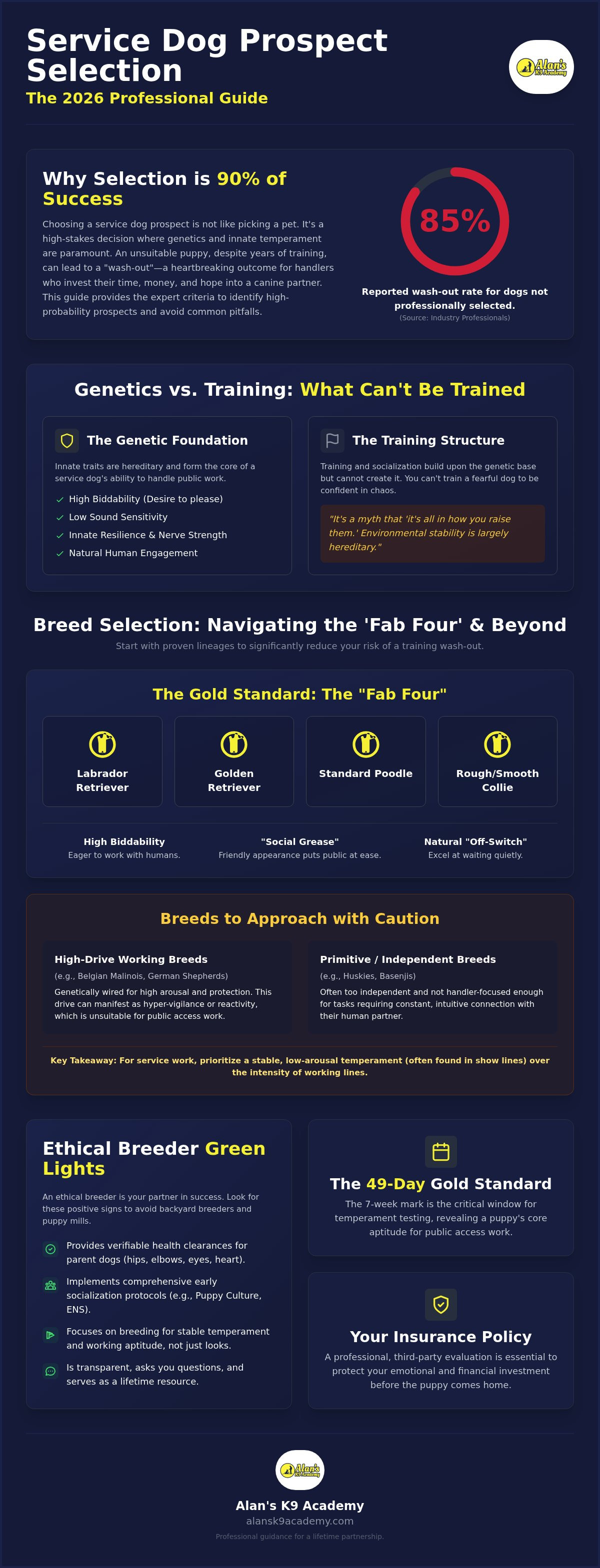
Choosing a puppy for service work isn't like picking a family pet. A "Service Dog Prospect" is a puppy that exhibits specific, measurable genetic predispositions for work. This includes high biddability, low sound sensitivity, and a natural desire to engage with humans. Most puppies are "pet quality." They're lovely and loyal, but an assistance dog must be elite. When you're learning how to pick a service dog puppy, you're looking for the top tier of candidates who can handle the immense pressure of public work.
In the industry, we talk about the "wash-out." This happens when a dog fails to meet the standards for public access or tasking. It's an emotional gut-punch. You've spent months bonding and training, only to find your partner can't handle a crowded airport or a busy restaurant. The financial and emotional cost of choosing the wrong puppy is staggering. It doesn't just cost money; it puts your independence on hold for another two years while you start the process over from scratch.
The 85% Rule: Understanding the Failure Rate
Some industry professionals report a failure rate as high as 85% for dogs that weren't professionally selected for service work. This isn't a training failure. It's a mismatch of biology. Unrealistic expectations often lead to trainer burnout and deep frustration for the owner. We frequently see clients fall into the "rescue trap." While adopting a shelter dog is noble, the lack of known genetic history makes them high-risk for service work. Without knowing the parents' temperaments, you're gambling with your future quality of life. Professional service dog foundation training North Atlanta begins with the right candidate; anything else is an uphill battle.
Genetics vs. Environment: What Can't Be Trained
You've likely heard the myth that "it's all in how you raise them." It's simply not true. While socialization is vital, environmental stability is largely hereditary. You can't train a naturally fearful dog to be confident in a chaotic environment. We look for puppies with a solid foundation of resilience. This is why understanding how to pick a service dog puppy requires looking past the "cute" factor to the dog's DNA. Genetic nerve strength is the innate ability to handle public stress without shutting down or reacting.
Breed Selection: Navigating the 'Fab Four' and Beyond
Choosing the right breed is the first major hurdle in your journey. While any dog can technically be trained for a task, the "Fab Four"-Labradors, Golden Retrievers, Standard Poodles, and Rough or Smooth Collies-dominate the industry for a reason. These breeds have been selectively bred for generations to work alongside humans without the intense guarding or hunting instincts that can complicate public work. When you are researching how to pick a service dog puppy, starting with these proven lineages significantly reduces your risk of a training wash-out.
High-drive breeds like Belgian Malinois or German Shepherds are often "too much dog" for the average service user. These dogs are genetically wired for high arousal and protection. In a service context, that drive often manifests as hyper-vigilance or reactivity. This can lead to protective behavior, which is a direct violation of the standards for Service Animals under the ADA. Similarly, primitive breeds like Huskies or Basenjis are often too independent for psychiatric tasks that require constant, intuitive focus on a handler.
Why Golden Retrievers and Labradors Lead the Pack
Biddability is the secret sauce. It's the internal desire to check in and work for the human partner rather than following a scent or a squirrel. These breeds also provide "social grease." In a public setting, a friendly-looking Labrador puts people at ease, whereas a more "intimidating" breed might cause unnecessary friction during daily errands. Crucially, they possess a natural "off-switch." A service dog’s life involves a lot of quiet waiting in restaurants, offices, or theaters. These dogs excel at doing nothing until they are called into action.
The Working Line vs. Show Line Dilemma
Don't be fooled by the term "working line." For a service dog, a working line Shepherd or Malinois is often far too intense. These dogs are bred for high-stress tasks like police work. For public access, you generally want the stable, low-arousal temperament often found in well-bred show lines. Understanding how to pick a service dog puppy means prioritizing stability over intensity. We also advise extreme caution with "Doodles" and other designer mixes. Because they are a crossbreed, their genetic temperament and coat type are unpredictable. You need consistency, not a surprise. If you're feeling overwhelmed by these choices, our experts can guide you through service dog training and selection to ensure you find a reliable partner.
Size also dictates function. Mobility work requires a dog with the height and skeletal structure to provide physical support, while medical alert prospects can be smaller and more portable. Always match the dog's physical capabilities to your specific disability needs before falling in love with a look.
Evaluating the Breeder: Red Flags and Green Lights
Your breeder is the architect of your future partner's foundation. While the "Rescue Trap" is a common pitfall for those trying to save money, a professional service dog journey requires a breeder who treats their work like a science. When you're researching how to pick a service dog puppy, the breeder's transparency is your greatest asset. They should be able to provide documented proof of the lineage's health and temperament history. If a breeder avoids your questions or can't show you where the puppies are raised, it's time to look elsewhere.
The Importance of Orthopedic Soundness
A service dog must be physically robust to handle the demands of a long career. This is especially critical for mobility dogs that provide physical bracing or pulling. You need to see official certifications for both parents before you even look at a puppy. Non-negotiable clearances include OFA (hips and elbows), PennHIP, and cardiac and eye certifications. Early-onset hip dysplasia is a career-ending diagnosis. It's an emotional tragedy to spend two years on training only for a dog to retire at age three because of chronic pain. Once you've secured a physically sound candidate, starting in home dog training ensures that physical potential isn't wasted by poor early habits.
Socialization Protocols: Puppy Culture and ENS
The window between birth and eight weeks is when a puppy's brain is most plastic. You must ask breeders about their specific socialization program. Are they using Early Neurological Stimulation (ENS)? These specific handling exercises improve cardiovascular performance and stress tolerance later in life. Selecting a Service Dog Prospect means choosing a breeder who intentionally exposes puppies to different floor surfaces, sudden sounds, and various people. A "kennel-blind" breeder who ignores temperament flaws in their own dogs is a major red flag. They should be able to tell you exactly why a specific puppy is or isn't a good fit for your needs.
A significant green light is a breeder who insists on matching the puppy to the handler. If they let you "pick the cute one" based on a photo, they don't understand the stakes of service work. Ethical breeders use temperament testing to ensure you get the right temperament, not just the right look. Finally, check the contract. A high-quality contract should specifically use the term "service dog prospect" and include a health guarantee covering genetic defects. This document is your insurance. It proves the breeder stands behind the stability and health of the animal they've produced.
Temperament Testing: The 7-Week Evaluation
Timing is everything. In the world of service dog selection, 49 days (exactly seven weeks) is considered the gold standard for puppy aptitude testing. At this age, a puppy’s neurological development is nearly complete, yet they haven't yet entered their first major fear period. This brief window allows us to see the dog's true personality before environmental experiences begin to mask their genetic foundation. When you are learning how to pick a service dog puppy, you must rely on objective data rather than your "gut feeling" about which puppy is the cutest.
We utilize the Volhard Puppy Aptitude Test (PAT) to categorize a puppy's responses to various stimuli. For a service prospect, we generally look for "middle of the road" scores. You don't want the socially dominant puppy who tries to chew on your shoelaces and ignores your commands; you also don't want the shy puppy who trembles in the corner. You're looking for the candidate who shows high social attraction by following a leader and accepting gentle restraint without panic or aggression.
Key Traits of a Successful Prospect
Focus and eye contact are your first indicators of potential. A successful prospect will naturally want to engage with a human stranger. If a puppy is more interested in exploring the room or chasing a sibling than looking at you, they likely lack the biddability needed for task training. Understanding how to pick a service dog puppy also requires testing for touch sensitivity. For medical alert or psychiatric support roles, a puppy with low-to-medium sensitivity is ideal. They need to be aware of your physical presence without being so sensitive that a heavy hand or an accidental bump in a crowd causes them to shut down. We also look for sight and sound stability, ensuring the puppy doesn't "spook" at every new object or noise.
The 'Recovery' Metric: The Most Important Test
This is the most critical part of the evaluation, yet it's often overlooked by novice owners. The recovery test measures how quickly a puppy bounces back from a startling event. We might drop a metal umbrella or create a sudden, loud clap nearby. A successful prospect will startle, which is a normal survival instinct, but they will quickly investigate the object. If a puppy recovers within seconds and approaches the "scary" item with a wagging tail, they have the nerve strength for public access work.
We strictly differentiate between a "startle" and "fear." A startle is a momentary physical reaction; fear is a lasting emotional state. A puppy that hides, refuses to come out, or trembles for minutes after a loud noise is an automatic wash-out. You simply cannot train a dog out of a deep-seated genetic fear response. To ensure you are making a sound investment, you can schedule a professional service dog evaluation to have an expert test the litter for you. This step provides the professional insurance you need before bringing a puppy home.
Professional Selection in North Atlanta: Setting Up for Success
Bringing a new prospect home is an exhilarating moment, but it’s also where the real work begins. Even if you have spent weeks studying how to pick a service dog puppy, the emotional attachment to a litter can easily cloud your judgment. It is hard to remain objective when a puppy falls asleep in your lap. This is why we recommend a neutral, third-party evaluation. A professional eye sees past the wagging tails to identify the subtle behavioral markers that indicate long-term viability. At Alan's K9 Academy, we specialize in helping handlers across the North Atlanta area, including Cartersville and Canton, navigate this high-stakes selection process with total confidence.
In-Home Evaluations and Breeder Visits
We provide professional breeder visit services for clients across the North Atlanta Metro, including Marietta, Roswell, and Alpharetta. Master Trainer Alan Carr brings over 35 years of experience to every evaluation. He identifies subtle red flags, such as environmental avoidance or poor recovery, that a novice might overlook. We don't just look for a "good dog." We customize the search based on your specific disability-related tasks. Whether you need a dog for mobility support or medical alert, the selection criteria change to match your lifestyle. Having an expert on-site acts as insurance for your emotional and financial investment.
Foundation Training: The Bridge to Service Work
Once you have selected your candidate, the first 100 days are vital for setting expectations. This period isn't about complex tasks; it’s about engagement and environmental neutrality. Starting with in-home puppy training Cartersville provides the structured environment a prospect needs to thrive. We use balanced, humane methods to build a strong work ethic from day one. This foundation is the bridge that leads from a promising puppy to advanced therapy dog training or specialized service roles. We move your puppy through a methodical progression, ensuring they remain confident and focused in real-world settings.
The journey toward a fully trained service dog is long, but you don't have to walk it alone. If you are ready to take the first step toward independence, contact Alan's K9 Academy to schedule a professional prospect evaluation. We help you move from a state of overwhelm to a feeling of control over your future partnership. By learning how to pick a service dog puppy with professional guidance, you are giving yourself the best possible chance at a life-changing success story.
Take the First Step Toward Your New Partnership
Your journey toward independence shouldn't be a gamble. As we've explored, selecting a high-probability prospect requires looking past the cute exterior to find genetic resilience and biddability. By prioritizing the "Fab Four" breeds and insisting on rigorous orthopedic clearances, you set the stage for success. However, the true test lies in that 7-week evaluation where we measure a puppy's ability to recover from stress. Learning how to pick a service dog puppy is a technical skill that demands objectivity and expertise.
Don't leave your future to chance. Alan’s K9 Academy has served the North Atlanta Metro for years, bringing 35+ years of Master K9 Trainer experience to every evaluation. We use balanced, humane training methods to help you identify the perfect teammate and guide you through those critical first months. Schedule a Professional Puppy Prospect Evaluation with Alan’s K9 Academy today to ensure your investment leads to a lifetime of reliable service. You've waited long enough for the right partner; let's make sure you find them together.
Frequently Asked Questions
Can I use a rescue dog as a service dog prospect?
Yes, you can use a rescue dog, but it's statistically much riskier than a purpose-bred puppy. Without knowing the dog's genetic history or early socialization, you're more likely to encounter hidden behavioral issues. Most successful service dogs come from lines specifically bred for stability and biddability. While adoption is noble, the "wash-out" rate for shelter dogs is significantly higher in professional service work.
What is the best age to temperament test a puppy for service work?
The gold standard for temperament testing is 49 days, or exactly seven weeks old. At this specific age, a puppy’s neurological development allows for a clear view of their innate personality before environmental influences take over. Testing too early or too late can lead to inaccurate results. This window is when we look for the specific traits needed when learning how to pick a service dog puppy.
Do I need a specific breed for a psychiatric service dog (PSD)?
You don't legally need a specific breed, but consistency is vital for psychiatric work. Breeds from the "Fab Four," like Golden Retrievers or Poodles, are often preferred because they lack the hyper-vigilance found in herding or guardian breeds. A psychiatric service dog needs to remain calm and intuitive without becoming reactive to your own emotional distress or environmental changes during a typical day.
How much does it cost to have a professional evaluate a litter?
Professional evaluation fees vary depending on the travel distance and the size of the litter being tested. Because every situation is unique, we recommend contacting a trainer directly for a customized quote. Investing in an expert evaluation acts as insurance for your future. It helps you avoid the high emotional and financial costs of a dog that eventually fails training due to poor aptitude.
What happens if my puppy 'washes out' of service dog training?
If a puppy "washes out," they typically transition into life as a well-loved family pet. Some handlers choose to rehome the dog to a family where they can thrive without the pressure of a working role. This allows the handler to begin the search for a new prospect. It's a difficult emotional process; professional selection is the best way to minimize this risk from the start.
Is a male or female puppy better for service work?
Neither gender is inherently superior for service work; individual temperament is the deciding factor. Some handlers find that males are more "fun-loving" while females can be more independent, but these are generalities. When learning how to pick a service dog puppy, we focus on the specific aptitude scores of the individual animal rather than their sex to ensure the best possible match for your needs.
Does the puppy's energy level matter for medical alert tasks?
Energy level is critical for medical alert tasks because the dog must remain attentive for long periods. A dog with excessively high energy might become restless or distracted, missing a vital alert. Conversely, a dog with too little energy may lack the drive to perform tasks consistently. We look for a moderate, steady energy level that allows for both intense focus and physical endurance.
Can Alan’s K9 Academy help me find a breeder in Georgia?
Yes, we assist clients across the North Atlanta Metro in identifying ethical breeders and evaluating litters. Alan’s K9 Academy provides the professional guidance you need to navigate the local landscape in Georgia. We help you avoid "backyard breeders" and find a prospect with the genetic foundation required for a successful working career. Our 35 years of experience ensures you make an informed choice.