



How to Handle a Dominant Dog Around Friends and Other Dogs
Trying to control a dog through force can make tense situations harder to manage. If you’re wondering how to handle a dominant dog around friends or other dogs, prioritize safety, create space, and seek an individual professional assessment instead of attempting confrontational corrections.It’s unde...

Trying to control a dog through force can make tense situations harder to manage. If you’re wondering how to handle a dominant dog around friends or other dogs, prioritize safety, create space, and seek an individual professional assessment instead of attempting confrontational corrections.
It’s understandable to feel worried when your dog growls, lunges, guards a person or object, or reacts unpredictably around visitors. These behaviors deserve thoughtful attention, but the label “dominant” doesn’t explain every cause. The right plan depends on what happens, where it happens, and your dog’s history.
This article explains when serious behavior concerns may emerge, how a professional assesses risks around family, friends, and other dogs, and why obedience training must be tailored to the individual dog and owner. You’ll also learn how humane, balanced behavior training can build practical skills and safer routines without relying on risky confrontations or promising the same outcome for every dog.
Key Takeaways
• Serious behavior concerns can emerge as a dog matures, so pay attention to changes rather than assuming a past calm period guarantees future comfort.
• Prioritize distance and safe management around visitors and other dogs; avoid physical confrontations that could escalate risk.
• Look at the situation and your dog’s body language to distinguish possible fear, guarding, aggression, or ordinary boundary-setting.
• Individualized professional training can help build practical skills and safer routines for both you and your dog.
Aggression toward family friends and other dogs
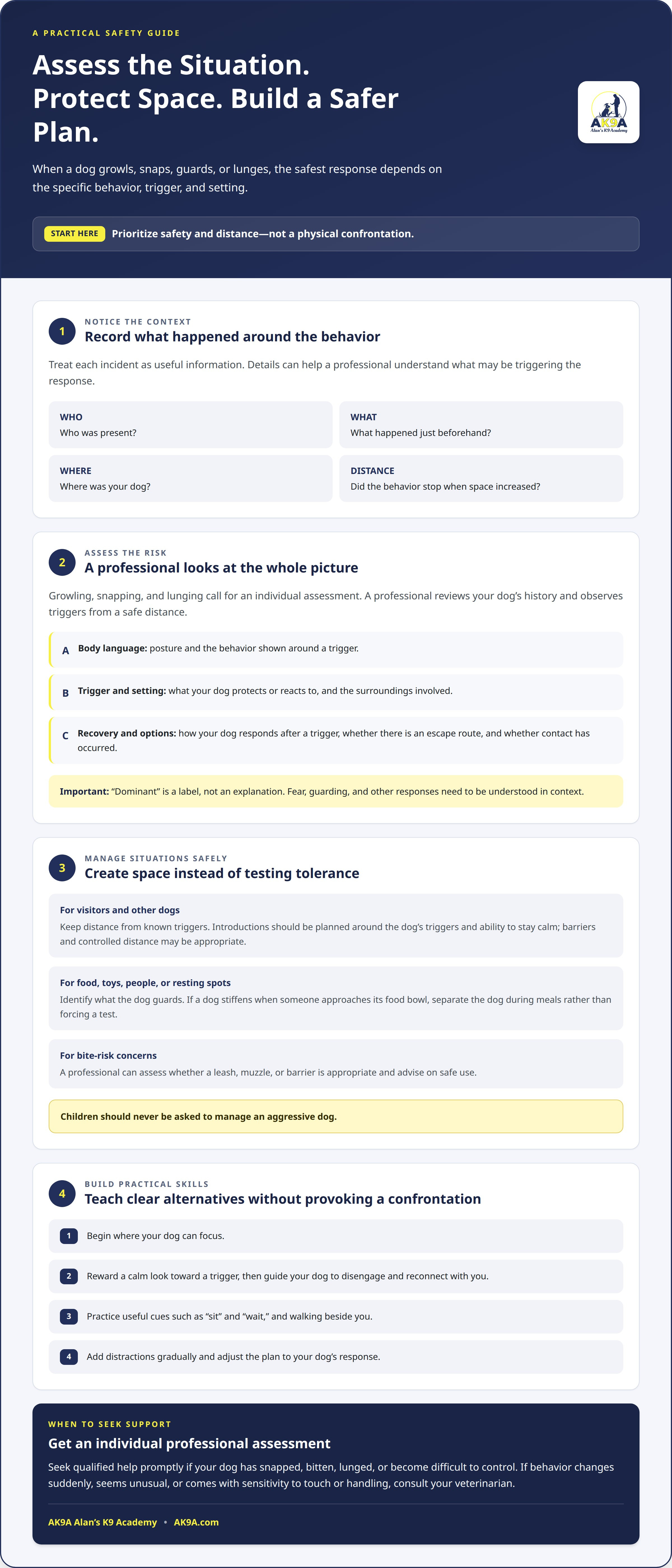
Growling at a visitor, snapping when someone approaches a resting place, and lunging at another dog each call for a different safety plan. Treat every incident as useful context: note who was present, what happened just beforehand, where your dog was, and whether the behavior stopped when distance increased.
Dog-bite liability and leash laws vary by state and city. Check the current state and local requirements where you live, including rules for public spaces and reported bites.
A professional assesses growling, snapping, or lunging by reviewing your dog’s history and observing triggers from a safe distance. The assessment considers body posture, recovery after a trigger, access to an escape route, and whether your dog has made contact. These details inform practical management.
For resource guarding, a professional identifies whether your dog protects food, toys, a person, or a resting spot, then builds a plan tailored to that trigger. For example, a dog that stiffens when someone approaches its food bowl needs separation during meals, not a forced test of its tolerance.
Introductions to children, visitors, other dogs, or unfamiliar places should be planned around the dog’s known triggers and ability to stay calm. A professional can set controlled distance, use barriers, and decide when an introduction should stop; children should never be asked to manage an aggressive dog. Dogs preparing for specific roles around people need distinct training needs, including those addressed through therapy and service dog training.
A bite-risk assessment considers your dog’s behavior, incident history, triggers, and surroundings to determine whether a leash, muzzle, or barrier is appropriate. A professional can advise on safe equipment use and management, while helping keep visitors and other dogs away from situations that could provoke another incident.
2. Obedience training and corrections
For a reactive dog, professional obedience training should build communication and impulse control without provoking a confrontation. A trainer can reward a calm look toward a trigger, then guide your dog to disengage and reconnect with you. Skills such as “sit,” “wait,” and walking beside you give your dog clear alternatives. Begin practice where your dog can focus, then gradually add distractions.
Strong corrections and physical dominance techniques can increase danger around an aggressive dog. Avoid alpha rolls: a reported case involving a 90-pound German Shepherd ended with a woman receiving over 100 stitches. Forceful leash or electronic-collar corrections can also intensify a response or make the trigger feel more threatening. A professional should choose humane, balanced methods around the individual dog’s behavior and safety needs.
Seek a qualified professional promptly if your dog has snapped, bitten, lunged, or become difficult to control. Look for relevant experience with aggression, clear explanations of training methods, and a willingness to tailor the work to you and your dog. Certification is one credential to consider, but it doesn’t by itself demonstrate experience with your dog’s specific behavior. For severe or complex concerns, discuss veterinary behavior support with your veterinarian.
A professional plan can combine obedience skills with careful behavior modification. For example, the trainer may work on calm attention at a distance before practicing around a mild distraction, then adjust based on the dog’s response. The owner learns how to give consistent cues and reinforce safe choices in everyday settings. If aggressive behavior is disrupting walks or interactions, individualized behavior modification can address the triggers and practical skills involved.
Do not use strong leash or electronic-collar corrections to address dominance when the dog is large and the handler is small, and do not use an alpha roll to address a dominant dog’s behavior. Household rules work best when owners are 100% consistent in enforcing them.
Consistency can start with simple routines: teach puppies to sit before you put down their food bowl. If your dog jumps for attention, wait until it is calm and sitting before responding. To encourage walking at your side, reward your dog for staying beside you. Predictable responses help make calm behavior worthwhile in everyday interactions.
3. Understanding so-called dominant behavior
“Dominant” can describe very different actions, from blocking a doorway to growling near a resting spot. Understanding how to handle a dominant dog starts with identifying the behavior, its trigger, and what happened immediately afterward. For example, note whether growling began when someone approached a bed or reached toward a food bowl. The label alone doesn’t explain the cause or point to a safe response.
Age can provide context, but it doesn’t predict an individual dog’s behavior. Serious dominance or handler aggression may emerge between 15 and 36 months, with around 18 months commonly reported. Some dogs seem settled with their families until 12 to 18 months, then show new reactions. Dominant handler aggression in puppies younger than 10 months is extremely rare. These patterns aren’t a diagnosis.
Consider the situation before interpreting a response as a challenge. A dog that backs away when a visitor reaches over may be uncomfortable; one that stiffens near a chew may be guarding it. Record the person, object, location, and distance involved. Learning how to handle a dominant dog means using these details to understand the behavior, not forcing a confrontation or assuming one explanation fits every incident.
Consult a veterinarian when your dog’s behavior changes suddenly, seems unusual, or coincides with sensitivity to touch or handling. Describe specific examples, such as a new growl when someone touches a particular area. Your veterinarian can assess whether a medical concern needs attention before you proceed with a training plan.
Connect your observations to daily routines. If your dog guards a resting place, prevent visitors from approaching it while a professional assesses the pattern. If reactions happen near the front door, record which visitor actions come first. Clear details help replace assumptions with practical next steps for your dog and household.
4. How can I tell whether my dog is showing aggression, fear, guarding, or normal boundary-setting?
One behavior rarely tells the whole story. Consider the trigger, your dog’s body language, and what happens next. A dog that barks when a stranger approaches may be frightened, protective, or reacting to the person’s movement. A single signal can’t confirm the reason. Record the situation and sequence of actions for a professional assessment.
Fear-related behavior may include backing away, lowering the body, or trying to escape when someone comes closer. A dog that feels trapped might growl or snap if the person keeps approaching. Aggressive behavior can include lunging, snapping, or biting, but those actions still need context. The same growl can be a warning in different situations, so don’t punish the signal or force contact.
Guarding is more likely when a reaction occurs around a particular resource. For example, your dog may stiffen, hover over a toy, or growl when someone reaches toward a valued object. Note which resource is present and how close the person or animal is. Don’t take the item by force or test your dog’s response. Create distance and arrange an individual assessment.
Normal boundary-setting may look like moving away, turning the head, or briefly signaling discomfort when a dog wants space. Consider the full pattern: whether your dog can disengage, whether the behavior escalates, and whether the same trigger repeatedly prompts a response. A professional weighs these details alongside your dog’s history and environment rather than assigning a label based on one incident. If the behavior changes suddenly or handling becomes painful, contact a veterinarian to assess possible medical causes.
The author describes bringing out an aggressive Great Dane-Border Collie cross that weighed close to 80 kilograms. The author says the training strategies had worked for more than 100,000 dog owners dealing with dog dominance aggression.
AK9A Alan’s K9 Academy
AK9A Alan’s K9 Academy helps owners address troubling behavior with individualized training focused on safety, practical skills, and consistent follow-through. For dog owners in Cartersville, an evaluation can clarify concerns such as growling, guarding, or lunging and guide a plan tailored to the dog and household.
Training takes place one-on-one in clients’ homes and appropriate real-world environments. This allows the trainer to consider where concerns arise and coach owners on practical skills for daily life. The approach is balanced, humane, and tailored to each dog and owner. Private, personalized training can support behavior goals and clearer communication.
Contact AK9A Alan’s K9 Academy through AK9A.com about an evaluation when you’re ready to discuss your dog’s behavior.
Build a Safer Path Forward
Knowing how to handle a dominant dog starts with moving beyond labels and focusing on the behavior, its triggers, and everyone’s safety. A thoughtful plan can make everyday routines more manageable while building skills suited to your dog and household.
AK9A Alan’s K9 Academy offers personalized in-home training and behavior modification, with practical guidance tailored to each dog and owner. Its services also include therapy and service dog training. An individual evaluation can help determine what support best fits your concerns and training goals.
With clear guidance and consistent practice, you can take the next step toward safer, calmer interactions.
Frequently Asked Questions
When Does Dominance or Dog Aggression start?
Serious dominance or handler-aggression concerns may emerge between 15 and 36 months, with around 18 months commonly reported. Some dogs also change behavior after appearing settled with their families at 12 to 18 months. These ages describe possible patterns, not a timetable or diagnosis. A sudden change or behavior that creates safety concerns deserves an individual assessment, whatever the dog’s age.
How can professional training address a dog’s behavior at doors and on stairs?
A trainer can assess what happens at a specific doorway or stairway, such as rushing ahead, blocking passage, barking at visitors, or reacting when someone approaches. The plan can teach a clear routine for these locations and help you practice it safely. For example, door training may include managing visitor access while your dog learns a calmer response to the doorbell.
What does dominance in dogs actually mean, and is the dominance theory supported by research?
Dominance describes a relationship between animals in a particular context, not a dog’s fixed personality or proof that it wants to control its family. Treating every growl, refusal, or push through a doorway as a bid for rank oversimplifies behavior. A useful assessment focuses on the specific trigger, your dog’s response, and what changes that response, rather than relying on a dominance label.
Article by
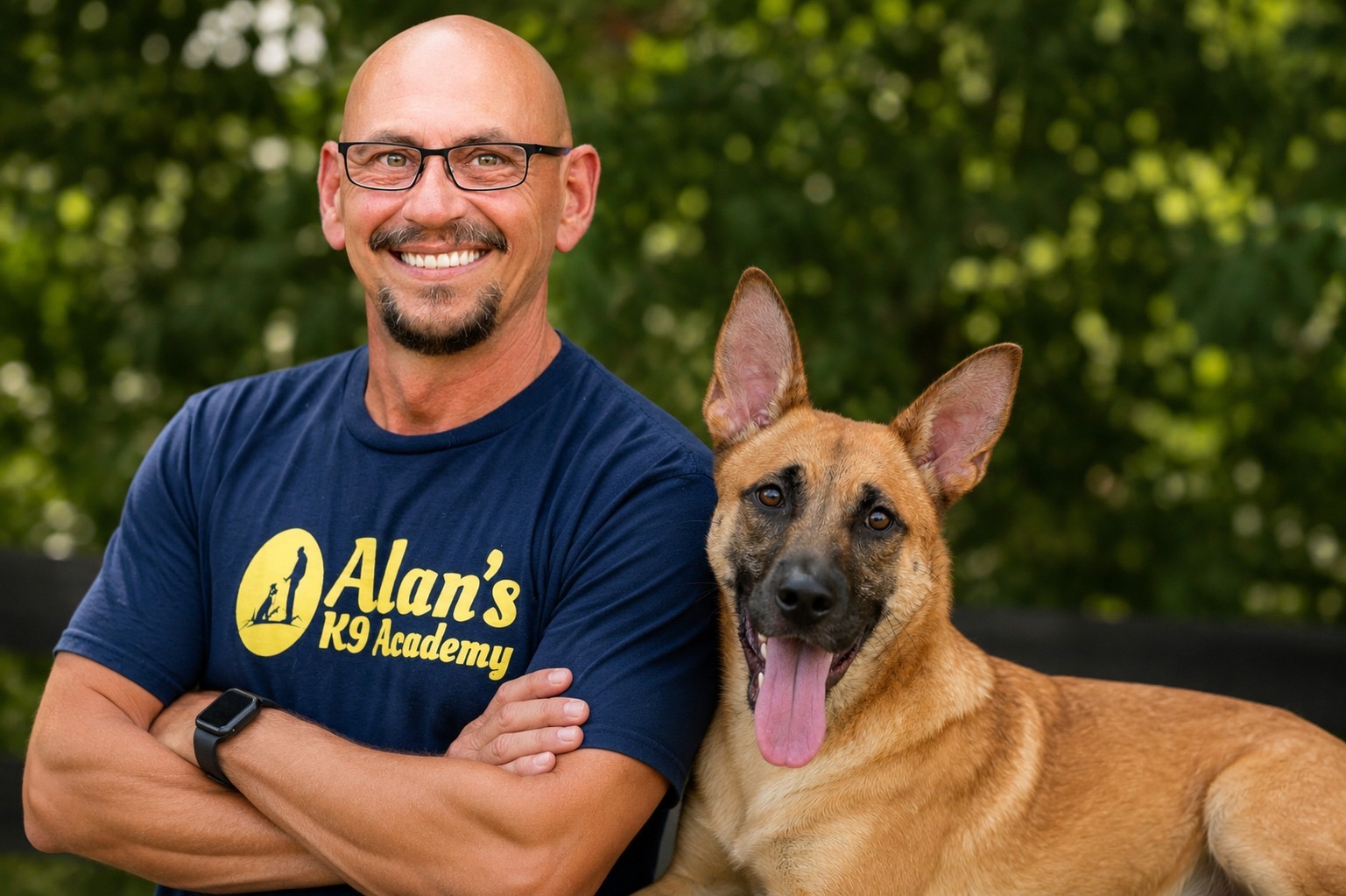
Alan Carr
Alan Carr is the founder of AK9A Alan’s K9 Academy, a military veteran, and a former police K9 handler and trainer with more than 35 years of professional dog-training experience. He specializes in personalized in-home training, puppy development, obedience, off-leash reliability, and behavior modification. His approach emphasizes clear communication, humane balanced training, and helping owners build lasting relationships with their dogs. AK9A serves North Metro Atlanta and Northwest Georgia. Learn more at AK9A.com.
Disclaimer
Every dog and household is different. This article provides general education and does not replace an individualized training assessment. For aggression, bite risks, or serious behavioral concerns, seek professional guidance before attempting training exercises.