



Help My Dog Is Scared of Everything in Marietta: Causes and Support
Fear isn’t stubbornness; it can reflect limited early exposure, a frightening experience, or discomfort. If you need help because your dog is scared of everything in Marietta, consider whether limited early exposure, a frightening experience, or discomfort may be contributing to the fear.It’s stress...

Fear isn’t stubbornness; it can reflect limited early exposure, a frightening experience, or discomfort. If you need help because your dog is scared of everything in Marietta, consider whether limited early exposure, a frightening experience, or discomfort may be contributing to the fear.
It’s stressful when everyday moments, from seeing children or other dogs to stepping outside, leave your dog trembling or trying to retreat. Those reactions call for patience, not pressure. A veterinarian can assess whether pain may be involved, while a professional can identify fear triggers and understand how your dog responds.
This article explains common causes of fear and how gradual desensitization and counter-conditioning can help your dog feel more comfortable around triggers. You’ll also learn why a tailored behavior-modification plan matters and what professional support can look like when everyday life feels overwhelming for you and your dog.
Key Takeaways
• Fear can appear as body-language changes such as a tucked tail, ears held back, or growling, so the full context matters when assessing what a dog is communicating.
• A professional can look for patterns in when fear appears and tailor gradual desensitization and counter-conditioning to the dog’s responses.
• Fear around children or other dogs calls for careful attention to distance, intensity, and the dog’s comfort, rather than forcing an interaction.
• When going outside feels overwhelming, understanding which parts of the experience trigger fear can help shape a more supportive behavior-modification plan.
Causes of fear in dogs
A dog can seem scared of everything when several triggers overlap. A passing child, a barking dog, or a car ride may each feel unpredictable. The visible reaction is only part of the picture. A professional looks for patterns: what happened before the fear, how close the trigger was, and whether your dog responds differently in familiar places.
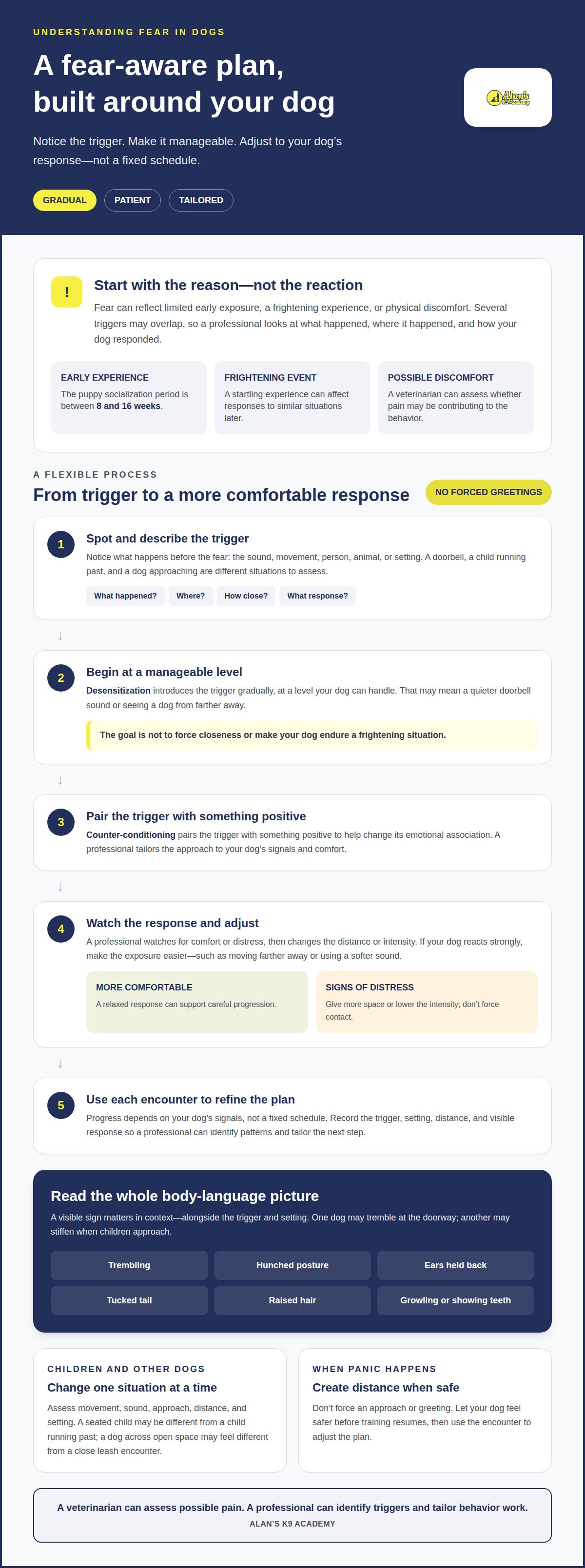
Early experience can shape those patterns. The critical puppy socialization period occurs between 8 and 16 weeks of age. During this stage, limited exposure to ordinary sights, sounds, people, or environments may leave some situations unfamiliar later. A frightening encounter can also affect how a dog responds to similar experiences. For example, a dog startled by a loud noise outdoors may become wary near that location.
Physical discomfort matters, too. A veterinarian can help determine whether pain is contributing to fearful behavior. Consider this possibility when behavior changes suddenly or touch, movement, or a particular activity seems to cause distress. A behavioral assessment can document what happens; a veterinary evaluation can address possible medical causes.
Fear can show up in several ways, not just hiding or retreating. Your dog may tremble, hunch, pin its ears back, tuck its tail, or raise its hair. Growling or showing teeth can also signal discomfort. Read these signs in context, including the trigger and setting. A dog that stiffens when children approach needs a different assessment from one that trembles at the doorway.
Anxiety medication isn’t automatically right for every fearful dog. A veterinarian may consider it when fear seriously disrupts daily routines or makes behavior work difficult, after assessing your dog’s health and symptoms. Medication decisions belong with the veterinarian, who can explain potential benefits and risks for your dog.
Keeping a record of fearful episodes can help a professional identify patterns. Note the trigger, setting, distance, and visible response, such as retreating from another dog on a walk. These details help distinguish a broad fear response from specific associations and guide the next assessment.
Desensitization and counter-conditioning
Desensitization and counter-conditioning adjust how a dog encounters a trigger and help build a more positive association. A professional tailors the process to your dog’s signals and comfort.
Describe how professional training can help a fearful dog feel safe at home.
At home, a professional identifies situations that cause fear and adjusts how your dog encounters them. If a doorbell makes your dog retreat, for example, training might begin with a quieter version of the sound at a manageable intensity. Your dog isn’t forced closer or expected to endure a frightening situation. Avoiding overwhelm matters because it can make learning harder.
Desensitization means introducing a trigger gradually, at a level your dog can handle. Counter-conditioning pairs that trigger with something positive to help change its emotional association. A professional watches for signs of comfort or distress, then adjusts the exposure. If your dog reacts strongly to a sound from another room, the plan might start farther away or with a softer sound.
Responding to a Dog’s Fear or Panic Episodes
A professional can help you recognize what triggers a fear episode and respond without adding pressure. During a panic episode, create distance from the trigger when it’s safe. Don’t force your dog to approach or remain exposed. A frightened dog needs the chance to feel safer before training resumes.
If a dog panics when a visitor enters, for example, a professional can assess the room, the visitor’s position, and the dog’s behavior. This helps you avoid crowding the dog or forcing a greeting. Afterward, the professional can use what happened to refine the plan, including the trigger’s intensity and your dog’s response.
Progress depends on the dog’s signals, not a fixed schedule. A professional may begin with an easier version of a trigger, then adjust as the dog becomes more comfortable. For support with fear at home, In-Home Dog Training can provide a setting-specific approach.
Fear of children and other dogs
A child and an unfamiliar dog can trigger fear for different reasons. A professional assesses each situation separately, considering the trigger’s movement, sound, distance, and setting. Your dog may stay calm around a seated child but react when a child runs past. That distinction helps shape a plan for the specific event instead of treating every child as the same trigger.
Children may move quickly, speak loudly, or reach toward a dog. A professional identifies which details prompt the strongest response and plans controlled exposure without forced greetings. The aim is to keep your dog below its fear threshold, where it can still learn comfortably. A child at a distance may present a different challenge from a child approaching.
Other dogs bring different variables. A direct approach, barking, or a close encounter on a narrow path can feel more intense than seeing a dog across an open space. During an assessment, a professional observes how your dog responds as distance and context change. This helps distinguish fear of all dogs from discomfort in specific situations, such as leash encounters or energetic play.
For children
assess reactions to movement, voices, reaching, and proximity.
For dogs
assess responses to approach, barking, play, and leash encounters.
These observations guide gradual desensitization and counter-conditioning. A professional might begin with a calm child or dog visible at a comfortable distance, then adjust exposure based on your dog’s behavior. A relaxed response can support careful progression; signs of distress mean the situation needs more space or less intensity. Don’t force contact to test your dog’s reaction.
In Marietta, the setting where fear appears matters, whether it’s a busy sidewalk or a quiet open area. A plan can prioritize safe distance and predictable encounters before moving to more challenging situations. This measured approach helps clarify whether fear relates to a particular person, dog, movement, or environment, giving training a focused starting point.
Fear of going outside
A dog that freezes at the doorway may fear more than the outdoors itself. A professional examines where the response begins: seeing the leash, hearing traffic, crossing the threshold, or reaching the sidewalk. Pinpointing that moment helps distinguish a doorway concern from sensitivity to cars, unfamiliar sounds, open spaces, or passing people.
The setting matters. Your dog might leave home comfortably during a quiet period but become distressed near a busy road. Another dog may walk calmly until a truck rumbles past. A professional considers these differences, your dog’s body language, and how quickly fear builds. That assessment identifies a workable starting point instead of treating every outdoor situation as equally difficult.
Gradual exposure should match your dog’s current comfort. A trainer may begin at the open doorway, then progress toward the porch or a quieter stretch of pavement, depending on your dog’s response. If your dog stiffens, retreats, or stops taking in its surroundings, the exposure may be too intense. The professional can adjust distance, duration, or location instead of pushing farther.
At the doorway
determine whether the leash, open door, or view outside triggers fear.
On the route
note whether traffic, people, dogs, or particular sounds change the response.
Across settings
compare quieter and busier locations to clarify the pattern.
Counter-conditioning can help change your dog’s association with an outdoor trigger. For example, a professional may pair a distant traffic sound with something your dog values, keeping the sound at a manageable level. The trainer watches for distress and changes the setup when needed. Forced walks or repeated exposure beyond your dog’s comfort can intensify fear rather than build confidence.
If your dog avoids the doorway or struggles on walks, request professional help with outdoor fear and a tailored behavior plan.
Alan's K9 Academy
Alan's K9 Academy helps families address fear through individualized behavior modification and professional guidance. Turn to a trainer when your dog’s reactions to children, other dogs, or outdoor situations make everyday routines difficult, or when you need a clearer plan based on your dog’s triggers.
Training can focus on the situations your dog finds challenging, with gradual exposure adjusted to its responses. Share what happens, where the fear begins, and how your dog reacts. That context helps shape a practical approach for home and real-world settings. The aim is safer, more comfortable experiences without forcing interactions or rushing progress.
If you’d like professional support for your dog’s fear, contact Alan's K9 Academy to discuss the next step.
Take the Next Step Toward More Comfortable Days
If you need help because your dog is scared of everything in Marietta, start by clarifying what your dog needs. Fear affects routines in different ways, so useful professional support focuses on your dog’s specific reactions and difficult situations. You don’t have to interpret every response on your own.
Alan's K9 Academy offers In-Home Dog Training and Behavior Modification for personalized support, along with Therapy & Service Dog Training. A conversation can help you explain what you’re seeing and consider a suitable next step for your dog. Progress starts with a plan grounded in your dog’s needs, not pressure to rush.
Contact Alan's K9 Academy to discuss support for your fearful dog. With thoughtful guidance and a patient approach, you can work toward everyday experiences that feel more manageable for both of you.
Frequently Asked Questions
Why Is My Dog Scared of Everything?
A dog may seem scared of everything when several situations feel unpredictable or overwhelming. Fear can also carry over to similar settings, such as becoming wary of an entire walking route after a frightening encounter. Notice whether your dog’s response changes with people, sounds, locations, or activities. Those differences help a professional determine whether the fear is broad or tied to specific triggers.
Why is my dog scared of everything, and when should I see a veterinarian?
Arrange a veterinary assessment if fear appears suddenly or coincides with discomfort during movement or handling. Pain can affect behavior, and a veterinarian can help determine whether it contributes to your dog’s reactions. If you need help because your dog is scared of everything in Marietta, a behavioral assessment can add context about triggers, but it doesn’t replace medical evaluation when health concerns arise.
What training methods can a professional use for a dog with generalized fear or anxiety?
A professional may use gradual desensitization and counter-conditioning, then adapt the plan as the dog’s responses change. For generalized fear, the assessment can map different settings, such as the home, car, and neighborhood, rather than focusing on one trigger alone. Alan’s K9 Academy describes its training as balanced and customized, incorporating positive reinforcement, clear communication, structure, and appropriate tools.
How do I find a certified positive-reinforcement dog trainer in Marietta, Georgia?
First clarify whether you’re seeking a particular credential or training that uses only positive reinforcement, since these describe different things. Alan’s K9 Academy uses a balanced, customized approach that includes positive reinforcement alongside clear communication and structure. It does not describe that approach as exclusively positive-reinforcement training, so this distinction matters if that specific method is essential to your choice.
How can a professional safely socialize a fearful dog without overwhelming it?
Safe socialization doesn’t require greetings or close contact. A professional can plan controlled exposure where your dog observes a person or another dog from a manageable distance, then adjust the setup to your dog’s response. Calmly watching a dog across an open space, for example, can be useful without requiring an approach. The aim is comfortable exposure, not testing how much your dog can tolerate.
Are there local dog training classes or behavior resources in Marietta and Cobb County?
Alan’s K9 Academy offers Group Classes and Behavior Modification for dog owners in Marietta and nearby communities. Its service area includes Cartersville, Canton, Woodstock, Rome, Acworth, Kennesaw, Sandy Springs, Roswell, Alpharetta, Powder Springs, Dallas, Hiram, Jasper, Cumming, Holly Springs, Ball Ground, and Milton. Group classes provide a trainer-led learning setting; individualized behavior support addresses concerns specific to a dog.