%20(620%20x%20150%20px)%20(14).webp)
%20(620%20x%20150%20px)%20(15).webp)
.webp)
_page-0001.webp)
.webp)

Emotional Support Dog Training: Skills, Boundaries, and Next Steps
What if better training could make life with your dog calmer without changing the dog’s legal status? Emotional support dog training can build practical skills for home and everyday routines, but a class, certificate, or online registration doesn’t make a dog an ESA or grant public access rights. If...
%20(5).gif)
What if better training could make life with your dog calmer without changing the dog’s legal status? Emotional support dog training can build practical skills for home and everyday routines, but a class, certificate, or online registration doesn’t make a dog an ESA or grant public access rights. If you’re unsure how emotional support, therapy, and service dogs differ, or whether your dog’s anxiety or behavior might affect daily life, you’re not alone. The terminology and online claims can be confusing.
This guide explains what training can realistically accomplish, what it can’t, and why your dog’s individual needs matter. You’ll learn which foundations support calm behavior, how emotional support animals differ from therapy and service dogs, and where legal boundaries come into play. We’ll also cover when to seek a qualified trainer for behavior support and when to consult a healthcare professional about an ESA. With clear expectations and compassionate, customized guidance, you can choose next steps that support both you and your dog.
Key Takeaways
• Use emotional support dog training to build useful everyday skills, not to establish legal status or public access rights.
• Compare emotional support, therapy, and service dog roles by their purpose, training, handler relationship, and access rights.
• Choose practical behavior goals, then use short, consistent practice and reinforcement to work toward them.
• When evaluating a trainer, ask about methods, your role, your dog’s welfare, and how progress will be assessed.
• Alan’s K9 Academy offers personalized training and behavior modification, as well as therapy and service dog foundation training. These services are distinct from ESA certification or legal advice.
What Emotional Support Dog Training Can and Cannot Help With
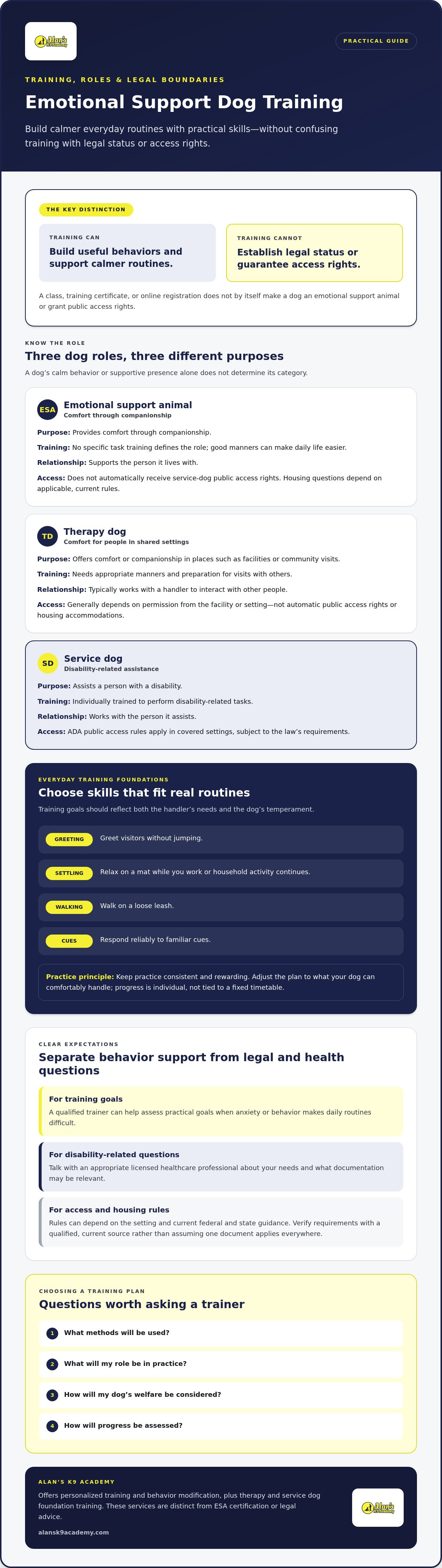
Want your dog to be a steady, reassuring companion, but feel unsure what that involves? It’s a reasonable question. An emotional support animal offers comfort through its presence and companionship. Unlike a service dog, it isn’t defined by performing a specific trained task for a person with a disability. The Emotional support animal overview offers background, but check current legal guidance for the rules that apply to your situation.
That distinction matters for training. Training can build useful behaviors and support calmer routines, but it doesn’t establish an animal’s legal status or guarantee access rights. A dog may become easier to manage at home without becoming a service dog, and a training certificate alone doesn’t determine whether someone qualifies for an accommodation. Think of training as a way to improve everyday life together, not as a shortcut to recognition.
What does emotional support dog training involve?
Useful emotional support dog training focuses on practical skills that fit your routines. That might mean greeting visitors without jumping, settling on a mat while you work, walking on a loose leash, or responding reliably to familiar cues. These skills can make shared activities more predictable, but they don’t promise a clinical or therapeutic outcome.
The right priorities depend on both the handler’s needs and the dog’s temperament. A dog who becomes overwhelmed around visitors may need gradual, carefully managed practice. Another dog may benefit from learning to relax while household activity continues. Keep practice consistent and rewarding, and adjust the plan to what your dog can comfortably handle. Progress is individual, not tied to a fixed timetable.
Does training make a dog an emotional support animal?
No. Obedience training may improve behavior, but it doesn’t independently establish legal eligibility. A purchased certificate or online registration doesn’t settle questions about legal status either. If you’re seeking support related to a disability, talk with an appropriate licensed healthcare professional about your needs and what documentation may be relevant.
Legal protections can depend on the setting and current federal and state rules. Don’t assume an ESA has the same access rights as a service dog, or that one document applies everywhere. Verify the rules with a qualified, current source before relying on them.
If your dog’s anxiety or behavior makes daily routines difficult, that’s useful information, not a reason to give up. A qualified trainer can help assess practical training goals, while a healthcare professional can address disability related questions. Keep those roles clear as you seek support for both you and your dog.
Emotional Support, Therapy, and Service Dogs: Understand the Differences
These roles can look similar from the outside, but their purpose and training differ. A dog’s calm behavior or supportive presence alone doesn’t determine its category. This comparison can help you identify the right questions before choosing a training path or relying on an access rule.
| Role | Purpose | Typical training | Handler relationship | Access rights |
|---|---|---|---|---|
| Emotional support animal | Provides comfort through companionship. | No specific task training defines the role. Good manners can make daily life easier. | Supports the person it lives with. | Doesn’t automatically receive the public access rights provided to service dogs. Housing questions depend on applicable, current rules. |
| Therapy dog | Offers comfort or companionship to people in settings such as facilities or community visits. | Needs appropriate manners and preparation for visits with others. | Typically works with a handler to interact with other people. | Access generally depends on permission from the facility or setting, not automatic public access rights or housing accommodations. |
| Service dog | Assists a person with a disability. | Is individually trained to perform disability related tasks. | Works with the person it assists. | ADA public access rules apply to service dogs in covered settings, subject to the law’s requirements. |
How is an emotional support dog different from a service dog?
The key distinction is the work the dog is trained to do. A service dog performs specific tasks related to a person’s disability. Emotional comfort from companionship, by itself, isn’t a trained task. The ADA National Network explains this distinction in its guide to Service Animals and Emotional Support Animals. Service dog public access rules don’t automatically extend to an ESA, and emotional support dog training doesn’t change that boundary.
How do therapy dogs fit into the comparison?
Therapy dogs are prepared to visit or work with people beyond their own handler, such as during an organized facility or community visit. That role differs from an ESA’s supportive relationship with its handler and from a service dog’s disability related task work. Therapy dog status doesn’t automatically create public access rights or housing accommodations.
If you’re exploring task based work, read this service dog foundation training guide to understand how that path differs from ESA support. For hands on help with foundational skills or behavior concerns, explore personalized dog training and behavior modification.
Rules can vary by setting and may change. Before relying on a housing accommodation or access right, check current federal and state guidance for your circumstances. A qualified trainer can help assess training goals, but legal eligibility questions belong with appropriate legal or healthcare professionals.
Which Skills Help an Emotional Support Dog Thrive in Everyday Life?
Useful skills aren’t about impressive demonstrations or a label. They’re the everyday behaviors that make home life and routines more predictable for you and comfortable for your dog. A dog who can settle while you read, walk without pulling, and respond when you call may be easier to live with. Training, however, can’t promise a particular emotional or clinical outcome.
Calm behavior grows through predictable routines and gradual skill practice, not pressure to perform. Keep sessions short, reward behaviors you want to see again, and practice first where your dog already feels comfortable. When a skill becomes reliable in that setting, add manageable distractions one at a time.
Which foundation skills should owners prioritize?
Choose skills that connect directly to your daily routine. Start with a few practical foundations:
Settling on a mat
Reward your dog for relaxing in a designated spot while you work, read, or prepare a meal. Keep the resting area quiet and don’t use it to force interactions.
Polite greetings
Reinforce four paws on the floor or a brief sit. Give your dog space if visitors feel overwhelming.
Leash manners
Practice walking beside you in a familiar, low distraction area before trying busier routes.
Responding to you
Reward your dog for turning toward you when called or responding to a familiar cue, then build reliability gradually.
Use consistent cues and routines so your dog can learn what to expect. If your dog struggles, make the exercise easier rather than repeating the cue louder or pushing through frustration. Small, repeatable successes show what your dog is ready to practice next.
How should training respond to anxiety or reactivity?
Obedience coaching can teach skills such as checking in with you or moving away from a trigger, but it isn’t treatment for a diagnosed anxiety condition. Pay attention to your dog’s behavior and the situation. Turning away, freezing, trying to retreat, or becoming unusually tense can signal that an interaction or setting is too difficult. Increase distance, offer a calmer option, and avoid forcing greetings or contact.
If behavior changes suddenly, consult a veterinarian to discuss possible health factors. For persistent fear, aggression, or distress that disrupts daily life, seek qualified behavior support. A customized plan can focus on safe, observable goals and adjust the challenge to your dog’s responses. Emotional support dog training should help you build practical routines together while respecting your dog’s limits.
How to Choose an Emotional Support Dog Training Plan
A useful plan starts with the life you and your dog share, not a promise of a particular label or outcome. Emotional support dog training should focus on observable behaviors that make daily routines safer and more manageable. For background on customized coaching at home, see this professional in-home dog training guide.
Define daily goals.
Choose specific situations to improve, such as settling during meals or greeting visitors with less jumping. A clear goal gives you something practical to work on.
Assess current behavior.
Note what happens, including the setting, triggers, and your dog’s response. This starting point can help distinguish a skill gap from a situation that feels too difficult for your dog.
Select a few priorities.
Work first on the behaviors that matter most for comfort and safety. Avoid adding multiple new expectations at once.
Practice at a manageable level.
Begin in a familiar environment, reward the behavior you want, and adjust the challenge based on your dog’s response. If your dog shows distress, make the exercise easier or pause.
Review and adapt.
Keep brief notes on what you practiced and how your dog responded. Look for patterns over time, not guaranteed results from a single session.
How can owners set realistic training goals?
Make goals easy to observe. For example, track whether your dog can remain on a mat while you eat, or greet someone at the door with four paws on the floor. Record the starting behavior and review progress consistently. Your dog’s learning pace, environment, and welfare signals should guide the plan. Change the approach if practice creates stress instead of helping your dog succeed.
Ask a prospective trainer how they choose methods, how you’ll take part between sessions, and how they’ll assess progress. Discuss how the plan supports your dog’s comfort and what happens if an exercise is too challenging. The right support should fit your household and your dog, not rely on a one size fits all checklist.
When should a professional trainer or veterinarian be involved?
Sudden, severe, or unexplained behavior changes call for veterinary input, since health factors may be involved. Persistent fear, reactivity, or safety concerns may need a qualified trainer and behavior modification rather than basic obedience alone. Confirm that the trainer’s experience, services, and location match your needs before starting.
For personalized in-home training or behavior modification support, ask Alan's K9 Academy about training options and whether its services fit your goals and location.
Getting Local Training Support from Alan's K9 Academy
Professional guidance can help turn broad concerns into a practical plan for your household. Alan's K9 Academy provides personalized in-home dog training, behavior modification, group classes, and therapy or service dog foundation training. Founded by Master K9 Trainer Alan Carr, the academy brings more than 35 years of professional dog instruction experience to its work with dogs and their owners.
What training support may fit your dog and household?
In-home coaching can focus on communication and obedience where you and your dog spend time. If a concern is more complex, such as persistent fear or reactivity, ask whether behavior modification may be appropriate. Share what you’ve observed, when it occurs, and what you hope to change so the academy can discuss whether its services fit your needs.
Therapy and service dog foundation training is a separate path for dogs being considered for those roles. It isn’t ESA certification, legal advice, or a determination of legal status. If you’re exploring a specific role, explain your goal and ask whether the foundation training matches it. For ongoing behavior challenges, the dog behavioral training guide offers more context as you consider support.
What should you ask before starting?
A focused first conversation can help clarify expectations. Consider asking:
• Which behaviors or goals can the service address?
• What will I need to practice with my dog between sessions?
• How will we decide whether the approach is working for my dog?
• Is the service I’m asking about available in my location?
Alan's K9 Academy serves Cartersville, Bartow County, and North Atlanta Metro communities. Its listed local communities include Cartersville, Canton, Woodstock, Marietta, Rome, Acworth, Kennesaw, Sandy Springs, Roswell, Alpharetta, Powder Springs, Dallas, Hiram, Jasper, Cumming, Holly Springs, Ball Ground, and Milton. Confirm current availability for your location and the specific training you’re seeking. If you’re ready to discuss your dog’s needs, contact Alan's K9 Academy to talk through a suitable next step.
Take the Next Step Toward a Better Daily Routine
Meaningful progress starts with realistic goals for the dog in front of you. Emotional support dog training can help build practical skills for home and everyday routines, but training doesn’t establish legal status or replace guidance from a healthcare professional. A plan should respect your dog’s temperament and adjust when a behavior or setting proves difficult.
If you’d like hands on support, Alan's K9 Academy offers personalized in-home training, behavior modification, and therapy or service dog foundation training. Founded by Master K9 Trainer Alan Carr, the academy brings more than 35 years of professional dog instruction experience to its work with owners. Local coverage includes Cartersville, Bartow County, and the North Atlanta Metro area. Confirm that the service you’re considering is available for your location and goals.
Discuss your dog’s training goals with Alan's K9 Academy. A thoughtful conversation can help you identify a practical next step for you and your dog. Move forward with clarity, patience, and a plan built around your partnership.
Frequently Asked Questions
Is emotional support dog training legally required?
Training is not generally what establishes an emotional support animal’s status, though practical manners can make daily life safer and easier. Legal criteria depend on the situation, and rules may change, so don’t rely on training alone to determine eligibility. For current housing guidance, check authoritative information from the relevant government agency. For individual questions about disability related needs, speak with a qualified healthcare professional who can assess your circumstances.
Can an emotional support dog go anywhere a service dog can?
No. Emotional support animals and service dogs aren’t interchangeable under the Americans with Disabilities Act. An ESA’s presence may provide comfort, but ESA status alone doesn’t grant the same general public access rights as a service dog trained to perform disability related tasks. Housing is a separate context with its own rules, which can change. Check current authoritative guidance before making plans, and remember that a training certificate doesn’t change access rights.
What training should an emotional support dog have?
Focus on practical foundations: settling on a mat, greeting people politely, walking on a leash without pulling, and responding reliably to the handler. The right priorities depend on your dog’s temperament and everyday routine. Emotional support dog training can make daily management more predictable, but it can’t guarantee a clinical benefit or give a dog a legal designation. Build skills gradually, using practice your dog can handle comfortably.
How long does emotional support dog training take?
There’s no universal timeline. Progress depends on your dog’s history and behavior, how consistently you practice, and the goals you choose. Track observable changes, such as calmer greetings or settling during a meal, and adjust the plan if your dog shows stress or difficulty. Learning is gradual, not a guaranteed schedule. If fear, aggression, or ongoing distress complicates practice, seek guidance from a qualified trainer.
Can any dog be trained as an emotional support dog?
Dogs vary in temperament, health, confidence, and comfort with daily routines, so the same expectations won’t suit every dog. Training can build useful skills, but it can’t make every dog comfortable in every setting or determine legal eligibility. Put your dog’s welfare first. Discuss health concerns with a veterinarian, and ask a qualified trainer to assess behavior challenges before choosing goals or expecting your dog to manage demanding situations.
Do emotional support dogs need an official certificate?
An online certificate or registration doesn’t independently establish legal eligibility or access rights. Requirements depend on the context, and sellers’ broad promises shouldn’t replace current authoritative guidance. Check the relevant government information for housing or other circumstances, since rules can change. If you have questions about disability related needs, consult an appropriate licensed healthcare professional. A trainer may help with behavior and manners, but training documents don’t settle legal questions.
Can Alan’s K9 Academy train my emotional support dog?
Alan’s K9 Academy offers personalized in-home training, behavior modification, and therapy or service dog foundation training. Its training services address behavior and skills, not ESA certification or legal status. The academy serves Cartersville, Canton, Woodstock, Marietta, Rome, Acworth, Kennesaw, Sandy Springs, Roswell, Alpharetta, Powder Springs, Dallas, Hiram, Jasper, Cumming, Holly Springs, Ball Ground, and Milton. Describe your dog’s goals and location, then ask whether the requested training is an appropriate fit and currently available there.