%20(620%20x%20150%20px)%20(14).webp)
%20(620%20x%20150%20px)%20(15).webp)
.webp)
_page-0001.webp)
.webp)
.png)
Dog Trainer Guide: Stress-Free Crate Training
It’s 3:00 AM, and the persistent, heart-wrenching whine from the hallway has once again pulled you out of a deep sleep. You want to help your dog feel settled, but right now, the crate feels more like a cage than a bedroom. Finding a skilled dog trainer for crate training is about more than just end...
%20(5).gif)
It’s 3:00 AM, and the persistent, heart-wrenching whine from the hallway has once again pulled you out of a deep sleep. You want to help your dog feel settled, but right now, the crate feels more like a cage than a bedroom. Finding a skilled dog trainer for crate training is about more than just ending the noise; it is about shifting the psychological dynamic between your dog and their space.
We understand the guilt that comes with closing that door and the frustration of coming home to a chewed-up rug. You aren't alone in this struggle, and it isn't your fault that standard "let them cry it out" advice has failed you. It is a common hurdle that many dedicated owners face while trying to balance their pet's safety with their own need for a peaceful home.
This guide will show you how professional, in-home techniques can turn an anxious pet into a calm, confident companion who views their crate as a safe harbor. By focusing on the dog's specific environment, we can replace stress with structure and transform your daily routine.
We will walk through the expert steps to eliminate destructive behavior, master housebreaking, and finally restore the quiet, restful nights your family deserves. It's time to move from a state of overwhelm to a feeling of total control.
Key Takeaways
• Reframe the crate as a psychological sanctuary by tapping into your dog’s natural denning instincts rather than using it as a tool for punishment.
• Master a gradual, two-phase professional process that builds your dog's confidence and "stay muscle" without triggering anxiety or panic.
• Identify the specific root causes of "crate hate" to solve behavioral roadblocks effectively while avoiding the pitfalls of the "cry it out" myth.
• Discover why partnering with an in-home dog trainer for crate training is the gold standard for creating lasting results in your pet's actual living environment.
• Learn how customized techniques and decades of hands-on experience can turn housebreaking and home safety into a stress-free reality for your family.
What is Professional Crate Training and Why Does It Matter?
Think of the crate as your dog’s personal bedroom; it is a private retreat where they can truly relax and feel secure. Many owners feel a pang of guilt when they close the crate door, but this usually stems from a misunderstanding of canine psychology. When you hire a professional dog trainer for crate training, the first step is often shifting your own perspective. We don't view the crate as a cage. Instead, we see it as a vital safety tool that facilitates clear communication between you and your pet.
This approach relies on the "Den Instinct," a biological drive inherited from your dog's ancestors. In the wild, canines sought out small, protected crevices to sleep and raise their young. This nesting behavior provides a sense of security that an open floor plan simply cannot offer. This Overview of Crate Training highlights how modern techniques lean into these natural behaviors to foster a sense of peace. Without professional guidance, owners often inadvertently create "crate hate" by using the space for punishment. This can lead to long-term separation anxiety and destructive habits. A skilled dog trainer for crate training establishes clear boundaries from day one, ensuring the crate remains a positive environment for everyone in the home.
The Difference Between a Cage and a Sanctuary
The way you perceive the crate directly influences how your dog reacts to it. If you approach the crate with hesitation or apology, your dog picks up on that tension and begins to mirror your anxiety. High-energy breeds, such as those we often work with in Marietta and Alpharetta, desperately need a "safe place" to switch off their brains and rest. Without it, they remain in a constant state of hyper-vigilance, which leads to exhaustion and irritability. In professional canine instruction, the "Safe Harbor" concept defines the crate as a predictable, stress-free zone where a dog can decompress without external pressures.
Essential Benefits for Your Household
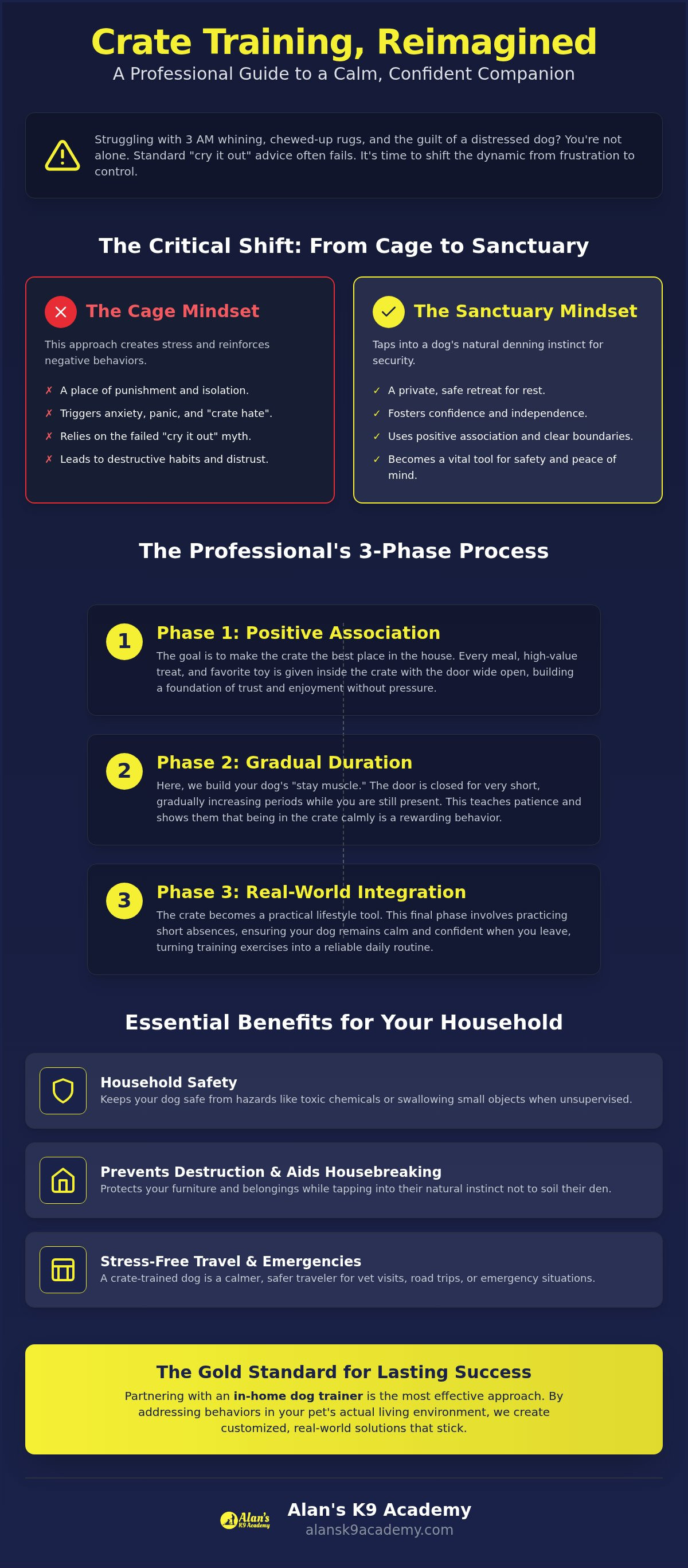
Beyond the psychological wins, structured crate training offers tangible lifestyle improvements that make pet ownership more enjoyable. By utilizing the dog's natural cleanliness, we can significantly speed up the housebreaking process. A dog is naturally inclined not to soil the area where they sleep, which helps them develop better bladder and bowel control. Additionally, professional crate training provides the following benefits:
Preventing Destruction
You can leave your home in Cartersville or Alpharetta with peace of mind, knowing your furniture, shoes, and electrical cords are safe from curious teeth.
Household Safety
It keeps your dog away from potential hazards, such as toxic cleaning supplies or small objects, when you cannot provide direct supervision.
Travel and Emergencies
Whether it is a routine trip to the vet or an emergency evacuation, a crate-trained dog is a much safer and calmer traveler.
By investing in professional guidance, you are not just buying a piece of equipment; you are implementing a comprehensive system for safety and behavioral health.
The Professional Process: How to Crate Train Your Dog Step-by-Step
Building a reliable crate routine is a methodical process, not a weekend sprint. We break this down into three distinct phases to ensure your dog feels supported rather than abandoned. Finding a dog trainer for crate training ensures you don't miss the subtle cues that indicate whether your dog is learning or simply surviving. Professional timing is the secret sauce here. If you let a dog out while they are barking, you've just taught them that noise equals freedom. If you wait too long and they hit a state of panic, you've damaged their trust. A balanced approach provides clear feedback so the dog understands exactly what behavior leads to success.
Phase 1 focuses on Positive Association. Every meal, high-value treat, and favorite toy should appear inside the crate with the door wide open. Phase 2 introduces Gradual Duration. We help your dog build their "stay muscle" by slowly increasing the time the door remains closed while you are still in the room. Finally, Phase 3 is Real-World Integration. This is where the crate becomes a lifestyle tool rather than a training exercise. As noted in the Oregon Humane Society's Crate Training Guide, the goal is to create a positive link between your dog and their new space. Our in-home dog training sessions allow us to tailor these phases to your specific puppy and floor plan.
Choosing and Placing the Right Crate
Size is critical. If the crate is too large, your puppy will sleep in one corner and use the other as a bathroom. It should be just big enough for them to stand up, turn around, and lie down comfortably. For a North Atlanta home, placement matters. We recommend a high-traffic area like the living room during the day so they don't feel isolated, but perhaps a quieter spot for overnight rest. Skip the loose blankets if your dog is a shredder; stick to durable, safety-rated mats and chew-proof toys to ensure they remain safe while unsupervised.
The "First Night" Strategy
The first 24 hours are often the most stressful for new owners in Marietta or Alpharetta. You must distinguish between "attention crying," which consists of short, rhythmic yips, and "panic barking," which is characterized by frenzied, breathless howling. To anchor the crate successfully, place a high-value reward, such as a hollow toy stuffed with dog-safe peanut butter, inside the crate right as you close the door. This keeps their brain occupied during the initial transition. Stay strong and avoid the urge to "rescue" them during minor whining, as consistency now prevents months of struggle later.
Solving 'Crate Hate': Troubleshooting Common Behavioral Roadblocks
"Crate hate" isn't just a puppy problem. For many rescue dogs or adult pets with a history of confinement trauma, the sight of a wire door can trigger a genuine physiological response. Identifying the root cause, whether it is boredom, fear, or clinical separation anxiety, is the first step toward a solution. Many owners are told to just "let them cry it out," but this is a dangerous myth. While it might work for a stubborn puppy testing boundaries, it can deeply traumatize a dog experiencing real panic. You shouldn't have to choose between your dog's mental health and your home's safety.
When you partner with a dog trainer for crate training, the focus shifts to desensitization. This involves breaking down the process into tiny, non-threatening steps. We might start with the dog simply looking at the crate from across the room and receiving a reward. We slowly bridge the gap until they choose to enter on their own terms. A behavior specialist identifies subtle stress signals, like lip licking, yawning, or dilated pupils, that most owners miss until the barking starts. This hands-on approach ensures we move at the dog's pace, not a calendar's pace.
Managing Excessive Whining and Barking
Don't fall into the "Demand Barking" trap. If your dog learns that a loud enough protest earns an immediate release, they will bark longer and louder next time. We use calm-down cues and structured releases to build patience and emotional regulation. Our in home dog training sessions are essential here. They allow us to see the exact environment where these triggers occur. We can then adjust your home setup in Alpharetta or Marietta to reduce outside stimuli that might be fueling the noise.
Crate Training vs. Separation Anxiety
Sometimes the crate becomes the trigger itself. If a dog has severe separation anxiety, confinement can escalate their panic, leading to self-injury or broken teeth. In these cases, we might look at alternative confinement options like exercise pens or "dog-proofed" laundry rooms as a temporary bridge. Professional behavior modification is about creating a path back to crate success by addressing the underlying fear of being alone. This customized approach is why having a seasoned dog trainer for crate training is vital for complex cases in Cartersville or Alpharetta. We help you build a meaningful bridge from fear to confidence, ensuring your dog feels safe even when you aren't in sight.
Why In-Home Training is the Gold Standard for Crate Success
Dogs are contextual learners, which means they don't always generalize behaviors from one location to another. A puppy might be perfectly calm in a sterile training facility but become a frantic mess the moment they are crated in your actual living room. This is why choosing a dog trainer for crate training who comes to you is the most effective way to see lasting results. We need to work in the environment where the behavior actually happens. By training in your home, we address the specific triggers, such as the doorbell or the sound of the garage door, that influence your dog's emotional state.
Customization is the heartbeat of our approach. Your floor plan and your family's daily rhythm dictate where the crate should go and how it is used. We don't just hand you a generic schedule; we build a system that fits your life. This includes addressing "Door Dashing," where a dog bolts out of the crate the moment the latch turns. We practice controlled releases in your specific hallway or kitchen, ensuring your dog learns patience exactly where they need it most. My role as a Master Trainer is to act as a mentor for you, the owner. Professional coaching ensures you have the skills to maintain these boundaries long after the session ends.
The North Atlanta Lifestyle and Your Dog
Busy professionals in Marietta or Alpharetta often struggle with balancing a demanding work schedule and a puppy's needs. We specialize in integrating crate routines into high-energy households, including those with multiple pets or young children. If you live in the surrounding area, our in-home puppy training Cartersville guide offers additional local context for setting your dog up for success. We ensure the crate becomes a helpful tool for your lifestyle, not a source of added stress.
One-on-One Coaching vs. Group Classes
Group environments are often too distracting for foundational crate work. In a crowded class, your dog’s focus is on the other dogs, not on learning to settle. Private, in-home sessions allow for immediate professional feedback. I can see the subtle shift in your dog's body language and adjust our "balanced" approach in real time. With over 35 years of experience, I tailor every drill to your dog's specific drive and temperament. This level of personal attention is something a generic group class simply cannot match. If you are ready to transform your dog's behavior with a customized plan, contact us to start your in-home training journey.
Selecting the Right Dog Trainer for Crate Training in North Atlanta
Choosing a partner to guide your dog's behavioral development is a significant decision that impacts your family's daily peace. It isn't just about finding someone who knows the mechanics of a crate latch. You need a dog trainer for crate training who understands the nuances of your home’s environment and your pet's unique temperament. Excellence in this field is defined by a combination of technical mastery, a proven local reputation, and a methodology that balances discipline with deep compassion. In a market flooded with weekend-certified hobbyists, looking for these pillars of professional authority is essential.
Experience is the ultimate teacher in canine behavior. With over 35 years of hands-on work, Alan Carr has seen every possible scenario, from the hyper-aroused puppy to the traumatized rescue dog that refuses to step near a kennel. This level of expertise allows for a "can-do" attitude even when owners feel they’ve reached a breaking point. At Alan’s K9 Academy, we operate with a foundation of integrity and Christian values. We don't view our work as a mere business transaction. It is a mission to improve the quality of life for families in Cartersville, Marietta, and Alpharetta by restoring order and confidence to the home.
Questions to Ask Your Potential Trainer
Before you commit to a program, you must ensure the professional’s philosophy aligns with your goals. Don't be afraid to ask direct questions to gauge their level of customization. Consider these three critical inquiries:
What is your philosophy on 'balanced' training for crate issues?
You need to know how they handle both positive reinforcement and necessary boundaries.
Do you offer customized plans for adult rescues with anxiety?
Crate training an older dog with a history of trauma requires a vastly different approach than training a fresh puppy.
How do you involve the family in the training process?
Success depends on everyone in the house being on the same page.
Your Journey with Alan's K9 Academy
Your path toward a harmonious home begins with a comprehensive in-home assessment. We move beyond basic obedience to build a legacy of clear communication between you and your companion. While the crate is the starting point for safety and housebreaking, our ultimate goal is to guide you toward off-leash reliability and total trust. We transform your stressed household into a structured partnership where your dog thrives. If you're ready to move from overwhelming whining to calm confidence, schedule your in-home consultation with Alan's K9 Academy today. We are here to help you lead your dog with authority and heart.
Restoring Peace and Partnership to Your Home
Your dog deserves to feel safe, and you deserve a full night’s sleep. We have explored how shifting your perspective from confinement to a "safe harbor" can fundamentally change your pet's behavior. By leveraging the natural den instinct and following a structured, step-by-step process, you can eliminate the stress of nighttime whining and destructive chewing. Success isn't about luck; it's about using the right communication tools in the right environment.
Finding the right dog trainer for crate training means choosing a mentor who understands the unique rhythm of your North Atlanta household. Whether you are in Cartersville, Marietta, or Alpharetta, the key to lasting results lies in customized, in-home instruction that addresses your dog's specific triggers. Master K9 Trainer Alan Carr brings over 35 years of experience as an award-winning behavior modification specialist to every session. You don't have to navigate these behavioral challenges alone anymore.
Transform your dog's behavior with professional in-home training from Alan's K9 Academy. It is time to replace the frustration of "crate hate" with the calm confidence of a well-balanced partnership. We are ready to help you and your companion thrive together in a home that feels like a sanctuary for everyone.
Frequently Asked Questions
How long does it typically take to crate train a dog professionally?
Most dogs achieve a foundational level of comfort within 7 to 21 days when following a structured, professional plan. Every dog is an individual; a high-strung puppy might take longer than a calm adult, and consistency is the deciding factor. By working with a dog trainer for crate training, you can often accelerate this timeline by avoiding common mistakes that set progress back weeks.
Is it ever too late to crate train an adult dog or a rescue?
It's never too late to introduce an adult dog or a rescue to the benefits of a crate. While puppies are often blank slates, older dogs may carry previous trauma or "crate hate" that requires a slower, more methodical desensitization process. We focus on building trust first, ensuring the dog never feels trapped. With patience and the right behavior modification techniques, even seniors can learn to love their private sanctuary.
My dog cries the moment I close the door, should I let them out?
You should generally avoid letting your dog out while they are actively crying or barking to get your attention. Doing so teaches them that noise is the key to the door. Instead, wait for a brief moment of silence, even just two seconds, before opening the latch. If the crying escalates into frantic panic, it's a sign you've moved too fast and we need to reset the training to a level where they feel successful.
What should I do if my dog has an accident in their crate?
Clean the mess immediately using an enzymatic cleaner to remove all pheromones that might attract them back to the same spot. If accidents happen frequently, the crate might be too large, allowing them to sleep in one corner and soil the other. You should also re-evaluate their potty schedule or consult a professional dog trainer for crate training to ensure the confinement periods match their physical bladder capacity.
Can I use a crate for a dog with severe separation anxiety?
A crate can be a helpful tool for separation anxiety, but it isn't a standalone cure. For dogs with severe panic, the crate can sometimes feel like a trap, leading to self-injury. We often use the crate as a safe harbor in conjunction with broader behavior modification. If your dog shows signs of extreme distress, we may recommend alternative confinement until they are psychologically ready for a traditional crate.
Is crate training considered cruel by modern training standards?
Modern training standards view the crate as a vital safety and communication tool rather than a form of punishment. When used correctly, it taps into a dog's natural denning instinct to provide a stress-free environment. It is only considered cruel if used for excessive periods or as a way to neglect a dog's need for social interaction and exercise. Our balanced approach ensures the crate remains a positive, voluntary space.
How long can a dog stay in a crate during a work day?
Adult dogs should generally not stay in a crate for more than 4 to 6 hours at a time without a break for exercise and potty relief. Puppies require much more frequent breaks, usually every 2 to 4 hours depending on their age. If you work a full 8-hour day in Marietta or Alpharetta, it's essential to arrange for a midday visit to ensure your dog's physical and mental well-being is maintained.
Do I need a different type of crate for a puppy versus an adult dog?
You don't necessarily need to buy two separate crates; many professional models come with a metal divider panel. This allows you to purchase an adult-sized crate and adjust the internal space as your puppy grows. This prevents them from having enough room to soil one end of the crate while they are still housebreaking. Ensure the material is durable enough to withstand the chewing habits of a developing puppy.