%20(620%20x%20150%20px)%20(14).webp)
%20(620%20x%20150%20px)%20(15).webp)
.webp)
_page-0001.webp)
.webp)
Dog Socialization Group Classes: Build Calm, Confident Skills in 2026
What if socialization isn’t about greeting every dog, but staying calm when other dogs are nearby? It’s natural to wonder whether a group setting will help or overwhelm a shy, excitable, or reactive dog. Well-structured dog socialization group classes focus on coached practice, communication, and ca...
%20(5).gif)
What if socialization isn’t about greeting every dog, but staying calm when other dogs are nearby? It’s natural to wonder whether a group setting will help or overwhelm a shy, excitable, or reactive dog. Well-structured dog socialization group classes focus on coached practice, communication, and calm attention, not forced interactions or unstructured play.
The right next step depends on your dog’s comfort and behavior. In this article, you’ll learn what useful socialization practice looks like, how to recognize whether your dog may be ready for a group, and when personalized training may be a better starting point. You’ll also see how practicing around real-world distractions can help you work on skills for walks and everyday outings.
At Alan's K9 Academy, structured group classes are part of a broader approach focused on lasting communication between dogs and their owners. Master K9 Trainer Alan Carr brings more than 35 years of professional dog instruction experience, and the academy uses balanced, humane methods to help owners practice with guidance. The goal is to build useful skills at a pace that respects your dog, then keep practicing beyond class.
Key Takeaways
• Use your dog’s body language and comfort level to decide whether a group setting is a suitable next step.
• In dog socialization group classes, build skills gradually: observe, reconnect with your handler, practice a cue, and recover.
• Choose practice that matches your goal, whether that means coached group learning or more individualized support.
• Prepare by identifying your goals, refreshing familiar cues, and following your veterinarian’s guidance on health and vaccinations.
• Learn how Alan’s K9 Academy’s structured group classes can support socialization, obedience practice, and stronger communication in everyday settings.
What Dog Socialization Group Classes Teach Beyond “Meeting Other Dogs”
Socialization doesn’t require greeting every dog or enjoying every interaction. In dog socialization group classes, a more useful goal is helping your dog stay composed around people, dogs, unfamiliar places, sounds, and activity. A dog who can notice another dog, remain connected to you, and move on calmly is practicing an important social skill, even without saying hello.
Socialization is learning to stay comfortable and responsive around everyday experiences; obedience is practicing specific behaviors or cues. The skills support each other, but they aren’t the same. A dog might know “sit” at home and still find a busy sidewalk difficult. The broader concept of socialization of animals includes learning through experience and association, which helps explain why the quality and pace of exposure matter.
Unplanned exposure in a crowded public place can leave a dog with little room to pause or move away. Structured practice is different: the handler and dog have a clear task, and the challenge can be adjusted. The aim isn’t to push through discomfort. It’s to create manageable opportunities to notice distractions, make a useful choice, and settle again.
What does healthy dog socialization look like?
Look for a simple pattern: your dog notices a person or dog, responds to your voice or cue, and recovers without remaining overwhelmed. Recovery might look like turning away, sniffing, loosening body tension, or returning attention to you. Your dog doesn’t need to be perfectly still or focused every moment. What matters is whether they can re-engage and regain composure.
Distance and choice matter more than close contact. A comfortable pass on a walk may be better practice than a nose-to-nose greeting. At a gathering, success might mean settling on a mat while unfamiliar people move nearby. Every dog’s comfort level is different, so watch their response and give them space instead of insisting on interaction.
Why practice with a trainer and other owners?
It can be difficult to read your dog, manage a leash, and decide what to do next all at once. Coaching can help you notice signals such as a fixed stare, turning away, or relaxed attention returning to you. You can then respond promptly and reinforce the choices you want to see. That feedback makes practice more purposeful for both ends of the leash.
A structured group setting also offers real distractions without leaving you to manage every encounter alone. Nearby dogs and people create opportunities to practice calm observation and handler focus, while coaching helps keep the challenge appropriate. For puppies, learning familiar cues and having positive experiences early can support later group practice. In-home puppy training in Cartersville can help establish those foundations in a familiar environment.
How Structured Group Classes Build Focus Around Real-World Distractions
A dog can know a cue in a quiet room and still struggle to respond when the environment gets busy. Structured dog socialization group classes offer a coached way to practice around distractions, with attention and communication at the center. The goal isn’t to demand perfect focus. It’s to help your dog notice what’s happening, reconnect with you, and recover at a manageable pace.
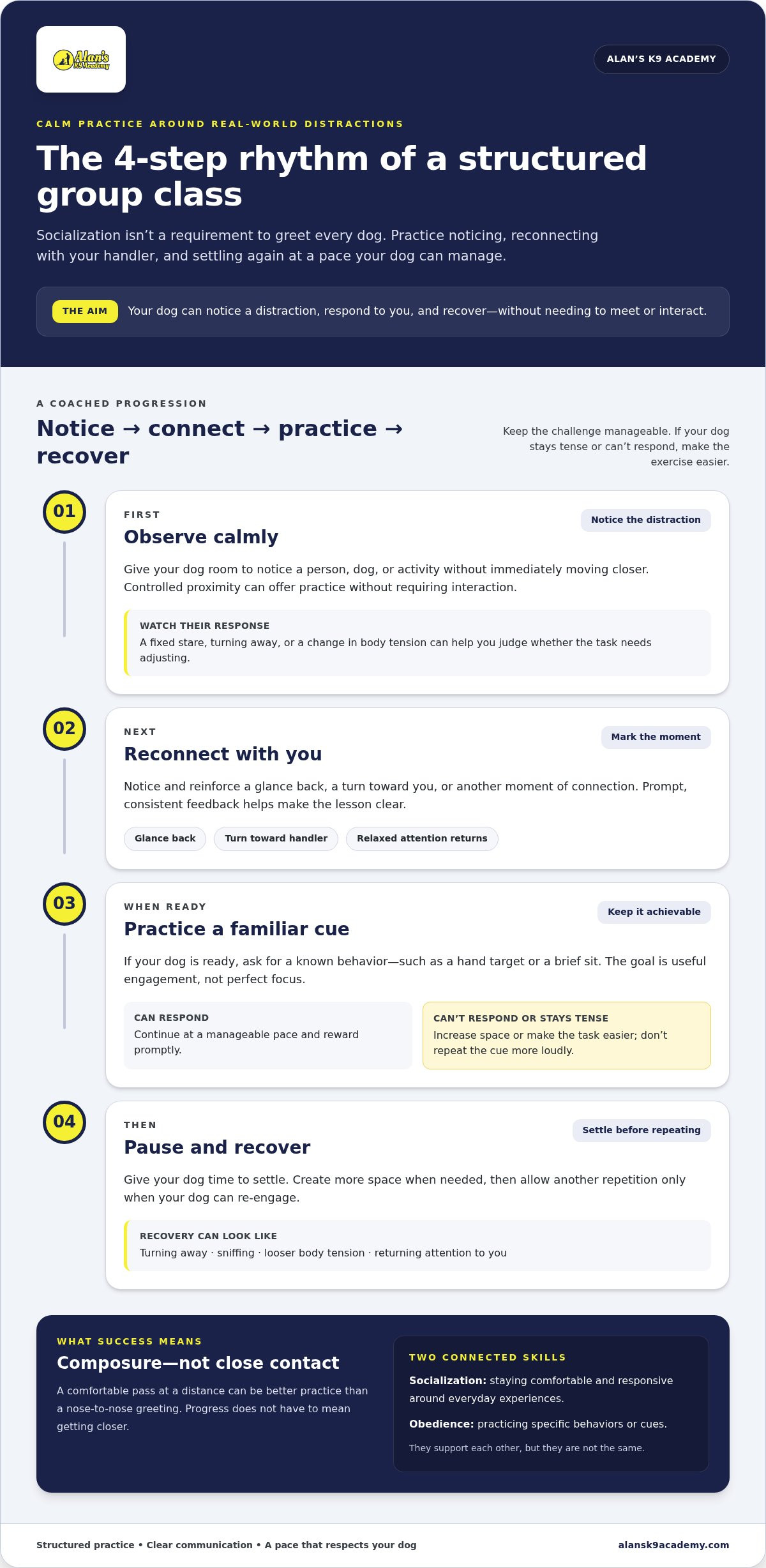
Gradual exposure gives a dog room to notice, learn, and recover; overwhelming intensity can make it harder to respond. A practical progression is simple:
Observe calmly
Let your dog notice a distraction without immediately moving closer.
Orient to you
Mark and reward a glance back, a turn toward you, or another moment of connection.
Practice a cue
Ask for a familiar behavior, such as a hand target or brief sit, if your dog is ready.
Recover
Pause, create more space if needed, and let your dog settle before another repetition.
The order matters. If your dog can’t respond or stays tense, the exercise may be too difficult in that moment. A trainer can adjust distance, movement, or task length based on what your dog is showing. Progress isn’t measured by getting closer to every distraction. Sometimes success means working farther away so your dog can still think and engage.
What skills can dogs practice in a class setting?
With other dogs and people nearby, dogs can practice attention, settling, responding to familiar cues, and moving calmly with their handler. Controlled proximity can provide useful exposure without requiring dogs to meet or interact. For example, your dog might wait while another team moves at a distance, then walk with you as the activity changes. These repetitions can support everyday skills, but a skill practiced in class may still need work in a new place.
How do owners help skills carry beyond class?
Your timing helps make the lesson clear. Notice when your dog checks in or relaxes, use a consistent cue, then deliver a reward promptly in a way that doesn’t draw your dog toward a distraction. Pay attention to body language, too. If your dog stops responding, stiffens, or tries to move away, make the task easier rather than repeating the cue more loudly.
Between classes, look for brief, manageable chances to practice in ordinary settings, such as watching activity from a comfortable distance or walking calmly past a mild distraction. Ask household members to use the same cues and reinforce the same useful choices. Consistency makes it easier for your dog to understand what you’re asking. For broader reliability goals, dog obedience training in North Atlanta connects everyday cue work with real-world practice. Alan's K9 Academy offers structured group classes and personalized training support. Explore Alan's K9 Academy training to consider a practical next step for your dog.
Group Classes, Dog Parks, or Private Coaching: Which Fits Your Dog?
There isn’t one right setting for every dog. The best starting point depends on what your dog can handle comfortably today and what you want to practice. A busy environment may create exposure, but exposure alone doesn’t teach a dog how to respond. Consider the purpose and support each option provides before choosing what to do next.
Structured group classes
Offer coached opportunities to practice attention and calm behavior around other dogs and people. You can receive guidance while your dog works at a level suited to their response.
Dog parks
Provide informal, often unpredictable contact and activity. They aren’t a substitute for coached skill-building because owners may have limited control over the distance, pace, or interactions their dog encounters.
Individualized coaching
Lets the training plan and level of distraction be tailored to one dog’s behavior and needs. This can help establish foundational skills before adding a group environment.
A group setting isn’t automatically right for every dog at every stage. Choosing more support first isn’t a setback; it can make practice more manageable and purposeful.
When are group socialization classes a good fit?
Your dog may be ready to learn in a group when they can notice other dogs and still engage with you, even if they need reminders or extra space. Group practice can suit owners who want coaching, feedback, and the chance to learn alongside other handlers. Readiness is individual, so pay attention to your dog’s response rather than relying on age or a one-size-fits-all checklist.
Notice whether your dog can take food or respond to a familiar cue, turn back toward you, and settle after noticing activity. These aren’t pass-or-fail requirements. They’re useful clues about how much support or distance may help your dog participate comfortably. A trainer can help you interpret your dog’s behavior and adjust the challenge.
When might one-on-one support be a better starting point?
Intense fear, repeated lunging, or difficulty disengaging from people or dogs can make a group environment too challenging at first. If your dog stays highly aroused or can’t reconnect with you even when given space, individualized coaching can provide room to work on the behavior and build a foundation before practicing around a group.
Alan's K9 Academy offers personalized in-home training and behavior modification alongside structured group classes, so support can match your dog’s needs as skills develop. For dogs whose reactions affect everyday life, dog behavioral training guidance can help you understand behavior-focused training options. Group classes may become a useful next step when your dog is better able to work around distractions, but no setting guarantees a particular outcome. Progress comes from thoughtful practice and attention to the dog in front of you.
How to Prepare for Dog Socialization Group Classes in Cartersville and North Atlanta
A little preparation can make dog socialization group classes more useful for you and your dog. You don’t need to arrive with perfect skills. Instead, bring a clear picture of what your dog finds easy, what feels challenging, and what you hope to practice. That information gives a trainer a practical starting point for guidance.
Before attending, follow your veterinarian’s guidance on your dog’s health and vaccination decisions. If you’re unsure whether a health concern affects participation, seek veterinary advice before introducing your dog to a group setting.
What should owners observe before the first session?
Notice how your dog responds to ordinary distractions on walks or from a comfortable viewing distance. Can they take food, respond to a familiar cue, or turn back toward you after noticing another dog? Observe recovery, too. A dog who needs extra time to relax is sharing useful information, not failing a test.
Use this checklist to prepare for a coaching conversation:
Choose a goal
Pick one practical aim, such as checking in with you near other dogs, rather than expecting instant playfulness.
Note triggers
Record what raises excitement or worry, including the type of distraction and the setting.
Estimate workable distance
Notice how close a distraction can be before your dog has difficulty focusing.
Track recovery
Write down what helps your dog settle and how long it takes to re-engage.
Keep notes brief and factual. “Barked when a dog approached on the sidewalk, then took a treat after we moved farther away” gives a trainer more to work with than a broad label like “bad with dogs.” Bring familiar cues your dog already understands, and share your observations honestly. There’s no need to rehearse a perfect performance.
How can progress be measured after class?
Look for small, repeatable changes rather than a dramatic overnight transformation. You might notice your dog can work at a slightly closer distance while staying responsive, recovers sooner after a distraction, or checks in with you more consistently. Record the context, too, since a skill that appears in one setting may need practice elsewhere.
• How far away was the distraction when your dog could still respond?
• How quickly did your dog return to a calmer state?
• Did your dog check in with you without a prompt?
• Could you see similar responses in another everyday setting?
These notes can help you and your coach decide what to practice next. Alan’s K9 Academy serves Cartersville, Bartow County, and North Atlanta communities with structured group classes and personalized training support. If home routines are central to your goals, professional in-home dog training can provide guidance in that setting. Explore dog training with Alan’s K9 Academy and take a thoughtful next step toward practice that fits your dog.
Build Better Social Skills with Alan’s K9 Academy Group Classes
Social skills grow through thoughtful practice, clear communication, and support that respects each dog’s needs. Alan’s K9 Academy offers structured group classes for socialization and obedience practice, helping owners work on skills with guidance and distractions present. The purpose isn’t to force interaction or expect every dog to progress in the same way. It’s to build a stronger working relationship between you and your dog.
Master K9 Trainer Alan Carr brings more than 35 years of professional dog instruction experience to the academy’s training approach. Classes are part of a broader support system that includes personalized in-home training and behavior modification. The focus can stay on what you and your dog need to practice, whether you’re strengthening familiar cues or working toward calmer attention around activity.
What makes coached group practice valuable?
Real distractions can make it harder for a dog to respond as they do at home. In a coached setting, you can practice while other dogs and people are present, with guidance to help you notice your dog’s responses and adjust your handling. Balanced, humane methods support communication and meaningful participation, rather than treating a quiet dog or close interaction as the only measure of progress.
Useful practice can be small: your dog checks in with you, settles briefly, or responds to a familiar cue while activity happens nearby. These moments show what your dog can manage and where more support may help. Group learning offers a chance to work on skills with coaching, but it doesn’t promise a particular result or replace attention to each dog’s comfort.
What is a practical next step for local dog owners?
Start with one social skill you’d like to strengthen. Perhaps you want your dog to walk more calmly near other dogs, settle while people are nearby, or respond to you when something catches their attention. A focused goal turns a broad concern into something you can observe and practice. You don’t need to have every answer before you begin.
Make a few notes about what tends to trigger excitement or worry, how your dog responds, and what they already do well. For instance, your dog may find passing dogs difficult but respond reliably to a familiar cue at a comfortable distance. Sharing both challenges and strengths gives a trainer a more complete picture of your starting point and keeps the conversation practical.
Alan’s K9 Academy serves dog owners in Cartersville, Bartow County, and North Atlanta Metro communities. If you’re ready to explore structured practice that supports lasting owner-dog communication, explore training with Alan’s K9 Academy. A clear goal and an honest picture of your dog’s needs are a strong place to start.
Choose One Skill and Keep Building
Your dog doesn’t need to become the most outgoing dog in the room. A meaningful next step might be calmly noticing a distraction, checking in with you, or recovering more easily after an exciting moment. Choose one skill that would make daily life easier, then use it to guide your next training decision. Progress can begin with a small, realistic goal.
If you’re considering dog socialization group classes, think about the kind of support that will help you and your dog practice with confidence. Alan’s K9 Academy offers structured group classes alongside other training support, with a focus on communication that lasts beyond the learning session.
Explore training support for you and your dog, and take the next step at a pace that respects your dog. With a clear goal and thoughtful practice, you can keep building a stronger partnership together.
Frequently Asked Questions
Can adult dogs benefit from socialization group classes?
Yes, adult dogs can benefit from carefully paced social learning; age alone doesn’t determine whether practice is useful. An adult dog might work on staying composed when a visitor enters, walking past dogs without pulling, or focusing on the handler in a new setting. Start with skills the dog can already manage, then build gradually. If your dog has a history of difficult reactions, personalized guidance can help shape an appropriate starting plan.
How often should a dog attend socialization classes?
The right frequency depends on your dog’s comfort, recovery after practice, and the skills you’re building. More sessions aren’t automatically better if your dog is tired or finds the environment stressful. Follow the training plan you discuss with your coach, and use short, low-pressure practice moments between classes to reinforce familiar skills. If your dog seems less settled over time, share that change with the trainer and adjust the approach.
What should I bring to a dog socialization class?
Bring your dog on a secure leash, along with rewards your dog enjoys and can take comfortably around distractions. Water, waste bags, and a familiar mat can also be helpful, depending on the setting and activity. Keep equipment simple so you can handle your dog safely and respond promptly. Before class, write down your goals and any relevant behavior or health concerns, then follow the trainer’s instructions about what to bring.
Is socialization the same as letting dogs play together?
No. Socialization can involve calm observation and handler focus without direct dog-to-dog contact. Play is only one kind of interaction, and not every dog enjoys it or needs it to learn social skills. For example, a dog can practice remaining settled while another dog moves nearby. Let your dog’s comfort guide interactions; close greetings and extended play aren’t necessary measures of progress.
Can a reactive dog attend a group socialization class?
Possibly, but a group class may not be the right first setting for every reactive dog. If your dog repeatedly lunges, shows intense fear, or can’t disengage from a trigger, start with individualized guidance to assess what distance and practice level are manageable. Alan’s K9 Academy offers behavior modification and personalized in-home training to address behavior needs as part of a suitable training plan.
How do I know whether my dog is making progress in class?
Compare your dog’s responses over time in similar situations, rather than judging one class in isolation. You might notice your dog can stay engaged through a longer exercise, needs fewer reminders, or returns to the task more readily after a pause. Ask your trainer to help interpret changes in context. A brief note after each session, including what felt easier or harder, can make patterns clearer.
Should I ask my veterinarian before taking my dog to a group class?
Ask your veterinarian for guidance if you have questions about your dog’s health, vaccination status, or ability to participate safely around other dogs. This is especially useful for puppies, dogs with ongoing health concerns, or dogs recovering from illness. Owners in Cartersville, Canton, Woodstock, Marietta, Rome, Acworth, Kennesaw, Sandy Springs, Roswell, Alpharetta, Powder Springs, Dallas, Hiram, Jasper, Cumming, Holly Springs, Ball Ground, and Milton can share relevant health guidance with their training coach.