%20(620%20x%20150%20px)%20(14).webp)
%20(620%20x%20150%20px)%20(15).webp)
.webp)
_page-0001.webp)
.webp)
Dog Anxiety Behavior Modification: The Complete 2026 Home Guide
What if the calming treats, tight wraps, and viral gadgets aren't actually solving your dog's panic? When you're watching your dog pace, bark uncontrollably, or chew through door frames the moment you pick up your keys, the exhaustion and heartbreak are overwhelming. You want to know how to stop the...
%20(5).gif)
What if the calming treats, tight wraps, and viral gadgets aren't actually solving your dog's panic? When you're watching your dog pace, bark uncontrollably, or chew through door frames the moment you pick up your keys, the exhaustion and heartbreak are overwhelming. You want to know how to stop the spiral without making their fear worse, but contradictory online advice leaves you stuck. Lasting relief doesn't come from suppressing outward symptoms. It requires systematic dog anxiety behavior modification that reshapes your dog's emotional responses directly inside your living environment.
You shouldn't have to carry constant guilt whenever you leave the house or live in fear that your dog will hurt themselves during a panic episode. We're here to help you move past temporary fixes. In this guide, you'll learn how to identify hidden triggers, master practical desensitization and counterconditioning protocols, and build true confidence without relying indefinitely on sedatives. Ahead, we outline the step-by-step roadmap you need to help your dog relax independently and restore long-term peace to your home.
Key Takeaways
• Recognize subtle stress signals early to interrupt the cortisol cycle before panic and destructive behaviors take hold.
• Implement structured dog anxiety behavior modification to reshape underlying emotional responses through sub-threshold desensitization instead of symptom suppression.
• Avoid the trap of temporary gadgets and punitive corrections, which mask surface signs while increasing internal panic.
• Apply a practical 4-step in-home protocol to deconstruct overwhelming triggers into manageable steps and build calm independence.
• Identify when severe panic calls for hands-on, in-home behavioral coaching tailored directly to your dog's everyday living space.
Understanding Canine Anxiety: Root Causes and Stress Signals
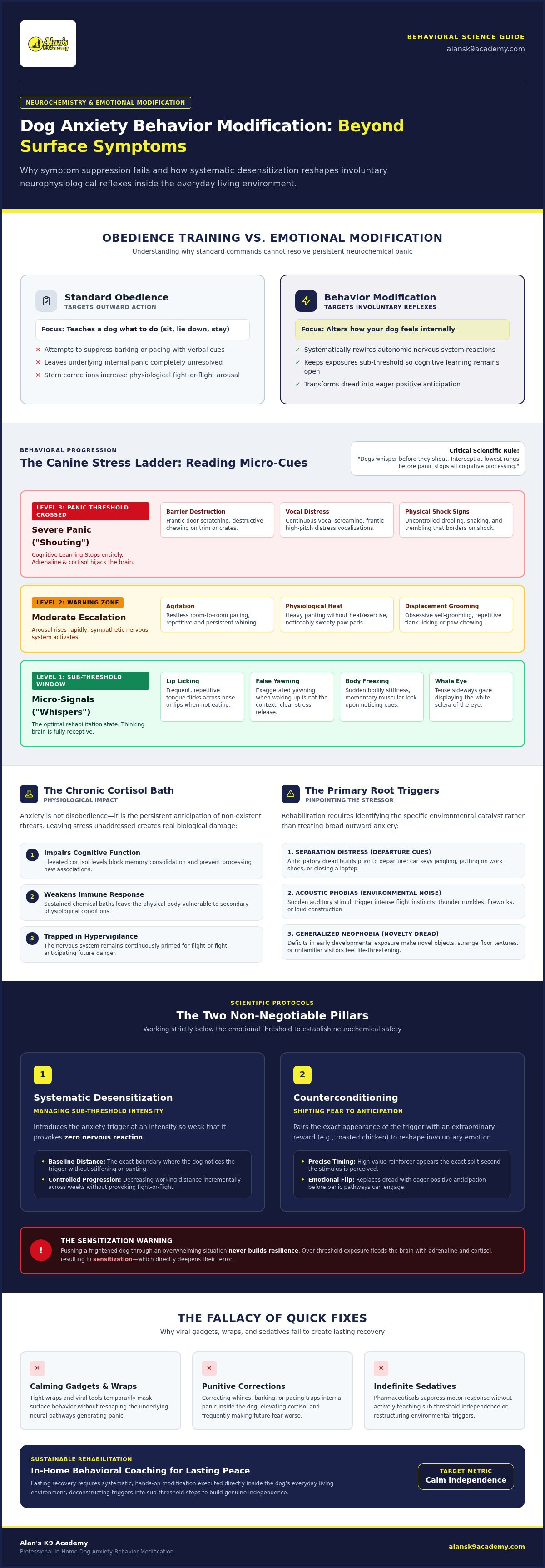
Canine anxiety is not simple disobedience. It is an emotional and physiological response to perceived danger, chronic uncertainty, or isolation. While transient fear is a normal reaction to an immediate threat that resolves once the danger passes, anxiety is different. It is the persistent anticipation of future threats that may not exist. When left unaddressed, chronic stress floods a dog's system with elevated cortisol levels. This constant chemical bath impairs cognitive function, weakens immune response, and keeps your dog's nervous system trapped in a perpetual state of hypervigilance. Effective dog anxiety behavior modification begins by identifying this state before panic completely hijacks your dog's ability to process information.
Every dog communicates through a behavioral stress ladder. Intercepting anxiety at the lowest rungs prevents your companion from crossing their threshold into irreversible panic, where learning stops entirely. Through the systematic application of behavior analysis, we can map these subtle body language cues to specific environmental pressures and step in before distress escalates.
Identifying Subtle Physical and Behavioral Warning Signs
Dogs rarely bite or panic without warning. They whisper before they shout, and learning those early whispers changes everything:
Micro-Signals
Subtle displacement behaviors like frequent lip licking, yawning when not tired, sudden body stiffness, and "whale eyes" (showing the whites of the eyes).
Moderate Escalation
Restless pacing, repetitive whining, sweaty paw pads, panting without heat exertion, and obsessive self-grooming or flank licking.
Severe Panic
Frantic door scratching, destructive chewing on trim or crates, drooling, vocal screaming, and trembling that borders on shock.
Common Triggers: Separation, Environmental Noise, and Novelty
Pinpointing the exact stressor is vital for lasting rehabilitation. In separation distress, anticipatory dread builds long before you walk out the door. Simple departure cues, such as jangling your car keys, slipping into work shoes, or closing your laptop, send heart rates skyrocketing. Acoustic phobias present another hurdle, where sudden environmental noises like thunder, fireworks, or nearby construction rumbles trigger intense flight instincts. Finally, lack of early developmental exposure often leaves adult dogs with generalized neophobia, making novel objects, strange flooring, or unfamiliar visitors feel genuinely life-threatening. Recognizing these root triggers allows us to craft a targeted plan rather than treating surface symptoms.
Core Pillars of Dog Anxiety Behavior Modification
Standard obedience training teaches a dog what to do, such as sitting or lying down on cue. True dog anxiety behavior modification is fundamentally different: it alters how your dog feels. Suppressing outward symptoms like whining or barking with stern commands leaves internal panic unresolved and often makes fear worse. Lasting recovery relies on scientifically proven behavior modification techniques that reshape involuntary physiological reflexes. If you want to explore the wider foundations of emotional reshaping, read our comprehensive guide to behavioral training for dogs.
One foundational rule governs every successful anxiety plan: the moment your dog crosses their emotional threshold, learning stops. High stress floods the brain with adrenaline and cortisol, shutting down cognitive processing. Pushing a frightened dog through an overwhelming situation never builds resilience. It only causes sensitization, deepening their terror.
Systematic Desensitization: Managing Sub-Threshold Distances
Systematic desensitization introduces an anxiety trigger at an intensity so weak that it provokes zero nervous reaction. Start by identifying your dog's baseline threshold distance, which is the exact point where they notice the trigger without stiffening, panting, or turning away. By keeping all exposures strictly below this threshold, your dog's thinking brain stays engaged. Over controlled, progressive sessions across several weeks, you incrementally decrease that working distance without triggering a fight-or-flight reflex.
Counterconditioning: Shifting Fear to Eager Anticipation
Counterconditioning changes a negative emotional state into an enthusiastic, positive one. The exact moment the scary stimulus appears, you present an extraordinary reward, like roasted chicken or liver puree. When the trigger disappears, the high-value rewards vanish immediately. This strict contingency teaches your dog that the scary trigger reliably predicts wonderful things. Over time, classical conditioning replaces dread with a reflexive feeling of security.
Executing these protocols with precise mechanical timing inside your daily living space can feel daunting. If you need guided support to read subtle shifts in body language, scheduling private in-home dog training gives you hands-on feedback to ensure every session moves forward safely.
Why Quick Fixes Fail and Punishment Escalates Anxiety
Every desperate pet parent looks for a silver bullet. When your home is in chaos and your dog is suffering, reaching for an over-the-counter fix is completely understandable. Yet retail products alone cannot resolve the complex emotional wiring behind panic disorders. Without structured dog anxiety behavior modification, treating symptoms at the surface only masks escalating distress underneath. Worse, applying old-school punitive corrections to anxious behaviors often turns an insecure companion into a volatile safety risk.
True behavioral rehabilitation doesn't come from a bottle or a battery-operated gadget. Leading veterinary researchers, including specialists at the Duffield Institute for Animal Behavior, consistently highlight that long-term recovery depends on systematic environmental adjustments and retraining emotional responses directly in the real world.
The Reality of Calming Supplements and Gadgets
Herbal chews, synthetic pheromone diffusers, and compression wraps dominate pet store shelves. While these tools can take the edge off mild jitters, they fall flat against full-blown sympathetic nervous activation. A weighted vest provides mild tactile reassurance; it doesn't teach an isolated dog how to self-soothe when left alone for hours. Use these aids strictly as secondary comfort measures while you carry out active desensitization protocols.
The Dangerous Trap of Aversive Corrections for Fear
Shouting at an anxious dog for whining, or using prong or shock collars to halt pacing, carries devastating consequences:
Internal Panic Multiplies
Punishment confirms your dog's worst fear: the environment is truly unpredictable, dangerous, and unsafe.
Suppression Without Resolution
A dog might freeze or quiet down out of pure terror, a psychological state called learned helplessness. The panic hasn't stopped; it's trapped inside.
Removed Warning Systems
Punishing growling or barking silences the dog's vocal alarms. Stripped of their early communication tools, inhibited dogs frequently escalate straight to sudden, defensive bites.
Rehabilitating an anxious dog demands calm leadership, structural clarity, and humane boundaries. When you swap punitive reactions for patient guidance, your dog learns that you are a dependable protector rather than another source of stress.
A 4-Step Actionable Protocol for In-Home Modification
Clinical manuals discuss theoretical behavioral frameworks, but living room reality is messy. To truly help your companion, you need a structured framework that fits your family's daily rhythm. Applying systematic dog anxiety behavior modification at home requires transforming complex behavioral psychology into concrete, bite-sized tasks. When you establish consistent structure where your dog spends their days, confusion disappears and meaningful progress begins. For a closer look at how structured routines operate in domestic settings, explore our complete breakdown of in home dog training.
This progressive four-step protocol rebuilds your dog's autonomic coping mechanisms from the ground up:
Step 1 & 2: Environment Setup and Trigger Breakdown
First, eliminate immediate rehearsals of panic. If your dog barks frantically at pedestrians, apply static-cling frosted window film to street-facing glass and run a white noise machine near exterior walls. Preventing cortisol spikes gives your dog's nervous system room to settle.
Second, deconstruct complex triggers into isolated components. Does your dog panic when you prepare to leave? Pick up your car keys, set them back down, and sit on the couch without leaving. Put your coat on, walk into the kitchen, and take it off. Break departure rituals into meaningless micro-events until the cues lose their predictive power. Set up a simple phone or pet camera to monitor baseline tolerance times without your physical presence distorting their reactions.
Step 3 & 4: Mat Relaxation and Graduated Exposure
Third, teach an incompatible calm behavior using an assigned portable mat. Instead of simply telling your dog what not to do, guide them onto the mat and reward calm body postures. Look for autonomic release signals like heavy sighs, weight shifting onto one hip, and facial softening. Deliver pea-sized rewards between their front paws to keep their head down and energy grounded.
Fourth, generalize this relaxation to real-world departures. Once your dog settles reliably on cue, begin graduated micro-absences:
• Step outside the front door for two seconds, then return calmly before any whining starts.
• Keep returns neutral, skipping energetic greetings that make your arrival feel momentous.
• Gradually stretch the duration to thirty seconds, two minutes, and ten minutes over several weeks.
If you hit a plateau or feel overwhelmed balancing daily life with training protocols, don't face it alone. Contact Alan's K9 Academy to schedule personalized, hands-on guidance right inside your living room.
When to Seek Professional In-Home Behavioral Coaching
Patience and consistent daily drills solve many mild concerns, but severe distress requires experienced intervention. If your dog exhibits frantic self-mutilation, chews through drywall, shatters glass during thunderstorms, or lunges defensively when startled, independent training is no longer safe. High-stakes fear requires specialized hands-on coaching before someone gets hurt. In these complex cases, structured dog obedience training creates stabilizing routines that restore mutual trust.
Professional guidance stops the endless cycle of trial and error. Expert mentorship identifies the subtle mechanical mistakes that accidentally reinforce anxious behavior, ensuring that your customized dog anxiety behavior modification plan delivers lasting relief rather than temporary management.
The In-Home Advantage for Anxious Dogs
Transporting an already fearful dog to an unfamiliar commercial facility often backfires. The barking of other dogs, strange smells, and slick clinic floors spike adrenaline, masking their everyday responses. True progress happens where the panic actually lives:
Authentic Context
In-home coaching evaluates how your dog reacts to your specific doorbell, tight hallways, staircases, and boundary fence lines.
Reduced Sensory Overload
Working in familiar territory keeps your dog's stress levels below threshold, allowing them to absorb new coping skills without shutting down.
Family Integration
Every household member learns consistent body language, voice cues, and handling mechanics directly in the shared environment.
Transforming Your Home with Alan's K9 Academy
You don't have to navigate severe canine panic alone. Alan's K9 Academy specializes in private, in-home behavior modification across Cartersville, Bartow County, and the North Atlanta Metro area. Led by Master K9 Trainer Alan Carr, who brings over 35 years of real-world behavioral experience, our academy resolves deep-seated fears, barrier reactivity, and separation distress using balanced, humane techniques.
Instead of cookie-cutter drills, we evaluate your dog's unique temperament and provide a tailored blueprint that fits your household routine. We coach you step-by-step through real-world scenarios, giving you the skills to lead with quiet authority and restore peace to your living room. Take the first definitive step toward a relaxed household today. Schedule your in-home behavioral consultation with Alan's K9 Academy to begin your dog's personalized transformation.
Restoring Calm and Confidence to Your Everyday Life
Living with canine panic is exhausting, but you don't have to stay trapped in a reactive cycle of managing sudden crises. True relief begins when you replace temporary gadgets with methodical sub-threshold desensitization, break down daily triggers, and reinforce autonomic relaxation. By applying structured dog anxiety behavior modification where your dog lives, you address the root emotional cause of their stress, transforming constant fear into genuine security.
With over 35 years of specialized canine coaching led by Master Trainer Alan Carr, Alan's K9 Academy delivers award-winning in-home behavioral training throughout Bartow County and the North Atlanta Metro area. Our humane, balanced protocols focus on clear communication between you and your companion, giving you the hands-on skills needed for lifelong stability. You don't have to carry the weight of this struggle alone. Schedule your personalized in-home behavioral consultation with Alan's K9 Academy today, and take the first confident step toward lasting household peace.
Frequently Asked Questions
How long does dog anxiety behavior modification typically take to show results?
Initial improvements often appear within two to four weeks of consistent sub-threshold work, but comprehensive dog anxiety behavior modification typically requires several months of steady practice. Brain neurochemistry and conditioned reflexes do not shift overnight. The exact timeline depends heavily on the severity of the trauma, your dog's genetic baseline, and daily owner follow-through across real-world situations in your living environment.
Can you completely cure a dog's severe anxiety with training?
While severe anxiety is rarely erased like an infection, it can be reliably managed and transformed into peaceful, predictable living. Systematic behavioral protocols teach dogs how to self-soothe and recover quickly from startling events. With consistent management and patient human guidance, dogs that once panicked over departures or loud noises learn to navigate daily household routines calmly and independently.
What is the difference between basic dog training and behavior modification?
Basic obedience teaches voluntary, cognitive skills on cue, such as sit, stay, or heel. In contrast, behavior modification targets involuntary emotional states, addressing physiological fear, barrier reactivity, or panic. Instead of forcing compliance through commands, behavior work alters how the dog perceives its environment using systematic desensitization and counterconditioning, changing panic into emotional stability from the inside out.
Can punishment or shock collars fix anxiety-related barking and reactivity?
No, punitive tools make internal anxiety significantly worse. Shock collars or harsh physical corrections suppress outward barking or lunging through intimidation, but the internal terror remains unaddressed. This suppression frequently backfires, creating learned helplessness or triggering sudden defensive bites without warning. Humane, balanced guidance addresses the root fear rather than punishing an overwhelmed animal for communicating distress.
Should I use calming medication alongside behavioral modification programs?
In moderate to severe cases, working with your veterinarian to explore pharmaceutical support can be beneficial. Prescribed medication raises a dog's panic threshold, lowering acute cortisol levels so their thinking brain can absorb learning. However, medication alone is not a cure. It acts as a supportive bridge that allows structured dog anxiety behavior modification protocols to take hold effectively.
Why is in-home training better than board and train for anxious dogs?
Boarding facilities expose anxious dogs to unfamiliar kennels, noise, and strange handlers, which often spikes their stress and yields temporary behaviors that fail to transfer back home. In-home coaching directly addresses real triggers, from front doorbells to neighborhood fence lines in communities like Cartersville, Canton, and Woodstock. Working directly in your living environment educates you alongside your dog for permanent household results.
What are the earliest signs that my dog is overwhelmed during training?
Watch for subtle displacement gestures before overt barking or bolting occurs. Early indicators include quick tongue flicks over the lips, yawning when rested, sudden physical stiffness, looking away, and refusing high-value treats. If your dog exhibits these micro-signals, they have reached their threshold. Immediately increase your working distance from the trigger to keep their emotional state receptive and calm.