%20(620%20x%20150%20px)%20(14).webp)
%20(620%20x%20150%20px)%20(15).webp)
.webp)
_page-0001.webp)
.webp)
Custom Dog Training Plans: A Practical Guide
What if the next step in training wasn’t another generic tip, but a plan built around your dog’s real life? Customized dog training plans account for your dog’s behavior, learning pace, household routines, and the situations you want to handle with more confidence. If advice that works for other dog...
%20(5).gif)
What if the next step in training wasn’t another generic tip, but a plan built around your dog’s real life? Customized dog training plans account for your dog’s behavior, learning pace, household routines, and the situations you want to handle with more confidence. If advice that works for other dogs hasn’t clicked at home, it doesn’t mean you’re doing something wrong. Your dog may need a different starting point or a smaller step.
A useful plan makes that starting point clear. It breaks bigger goals into achievable steps, gives everyone in the household consistent cues, and helps you recognize progress in everyday moments. You’ll learn how an individualized plan is created and adjusted, what practical changes to track at home, and how professional guidance can help your family stay on the same page.
Alan's K9 Academy provides personalized in-home dog training and behavior modification, with coaching shaped around the dog and the environment where learning needs to happen. Founded by Master K9 Trainer Alan Carr, with more than 35 years of professional dog instruction experience, the academy focuses on building lasting communication between dogs and their owners. Here’s how to turn your dog’s specific needs into a steady, workable training path.
Key Takeaways
• See what sets customized dog training plans apart from general advice, and how they reflect both your dog’s needs and your household.
• Learn a practical way to turn a training goal into observable progress, then adjust the next step based on your dog’s response.
• Compare templates, apps, group classes, and one-on-one coaching to understand what each can contribute to practice and feedback.
• Make training easier to sustain by fitting short practice into familiar routines and agreeing on consistent cues as a household.
• Explore how personalized in-home training and behavior modification from Alan's K9 Academy can support communication between dogs and owners in Cartersville and North Atlanta.
What Makes Customized Dog Training Plans Different from Generic Advice?
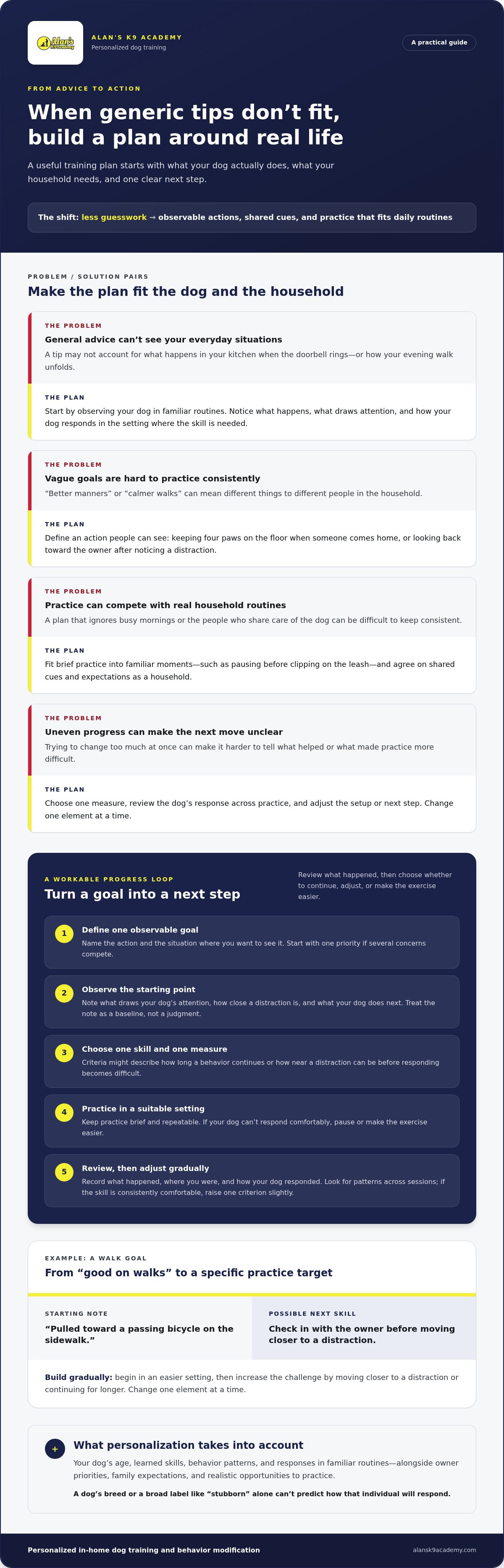
Generic advice can be a useful starting point, but it can’t see what happens in your kitchen when the doorbell rings or how your evening walk unfolds. Customized dog training plans shape goals and practice around an individual dog, the people in the household, and the situations they want to handle more smoothly. Instead of asking your family to follow a fixed recipe, a personalized approach responds to what your dog actually does and what matters most in daily life.
Conflicting tips can make it hard to know which cue to use. Slow or uneven progress can also leave you wondering whether you chose the wrong goal. A useful plan narrows the focus to one manageable next step rather than trying to teach every skill at once. Broad principles of dog training offer helpful context, but applying them well means observing the dog and adapting practice to the setting.
Which details make a dog training plan personal?
Personalization starts with observation, not assumptions. A trainer and owner can consider the dog’s age, skills already learned, behavior patterns, and responses in familiar routines. Does the dog stay engaged while the family prepares dinner? What happens when a visitor enters? These moments can reveal useful starting points. Breed or a broad label like “stubborn” can’t, by itself, predict how an individual dog will respond or what support will help.
The household matters just as much. A goal needs to fit the owner’s priorities, the family’s expectations, and the real opportunities to practice. If mornings are rushed, a brief pause before clipping on the leash may be more practical than adding a separate training session. If several people interact with the dog, the plan should make shared cues and expectations clear. Consistency is easier when practice fits into life instead of competing with it.
How do household goals become useful training objectives?
Turn broad wishes into visible actions in specific situations. “Better manners” could mean keeping four paws on the floor when a family member comes home. “Calmer walks” might mean looking back toward the owner after noticing a distraction. These objectives describe something people can observe, discuss, and practice. They also leave room to adjust the setup or next step based on the dog’s response.
A household goal doesn’t have to match a formal obedience performance standard. If your priority is calmer greetings, the first objective might be helping your dog pause near the entry while a familiar person comes inside. Agree on what that pause looks like and how to respond if the dog gets too excited. A shared definition makes practice clearer without demanding perfection or setting an unrealistic timeline. Small, relevant steps give everyone a common direction.
How a Customized Dog Training Plan Turns Goals into Measurable Progress
A goal becomes easier to work on when you know what your dog does now and what small change comes next. Customized dog training plans turn an intention into a sequence: define the goal, observe a baseline, choose a skill to practice, repeat it in a suitable setting, then review the dog’s response. That review helps you decide whether to keep practicing, adjust the setup, or take a gradual next step.
How should owners define a clear training goal?
Replace vague labels such as “good on walks” with an action you can observe. For example, you might want your dog to walk with a loose leash past a quiet driveway. Specify where the behavior matters and what you’d like to see there. If several concerns compete for attention, choose one priority first. A focused goal makes it easier for everyone to practice the same skill and notice what changes.
Before practicing, observe your dog in that situation without trying to change everything at once. Note what draws their attention, how close a distraction is, and what they do next. A simple record might say, “pulled toward a passing bicycle on the sidewalk.” This isn’t a judgment. It’s a starting point for choosing a manageable skill, such as checking in with you before moving closer to a distraction.
How can practice and criteria show progress?
Choose one clear measure for the skill. Criteria are the conditions that define success, such as how long a dog maintains a behavior or how near a distraction can be before the dog struggles to respond. In the walking example, begin in an easier setting, then gradually increase the challenge by moving closer to a distraction or continuing for longer. Change one element at a time so you can tell what helped or made practice harder.
Keep practice brief and repeatable. A short opportunity during a regular walk may fit better than adding a long session to an already busy day. If your dog can’t respond comfortably, pause or make the exercise easier. The OSU Indoor Pet Initiative for dog behavior offers additional information about behavior and enrichment that can help owners think about the conditions surrounding practice.
When should a customized training plan change?
After practice, record what happened, where you were, what distractions were present, and how your dog responded. Look for a pattern across sessions rather than judging progress from one difficult moment. If the skill is consistently comfortable, raise one criterion slightly. If your dog repeatedly struggles to respond, reduce the difficulty or change the setting. A setback is useful information about the current step, not proof that your dog can’t learn.
Review your dog’s response before making the next training step harder. If you’d benefit from help observing behavior and adapting practice to your home routines, personalized in-home dog training provides hands-on guidance for you and your dog.
Customized Dog Training Plans vs. Templates, Apps, and Group Practice
Different training formats can help in different ways, but none replaces understanding your dog’s needs. A template may keep practice organized, an app can offer reminders, a group class provides a shared learning environment, and one-on-one coaching can focus on your household’s specific challenges. Choose based on what you’re working on, the kind of feedback you need, and where your dog needs to practice.
Templates
give you a place to write goals, cues, exercises, and observations. They can bring structure to practice, but they don’t watch your dog or interpret what happened.
Apps
can make instructions and progress notes easy to revisit. They may help organize practice, while adapting a step still depends on your observations and judgment.
Group classes
let dogs and owners practice skills around other people and dogs, with an instructor guiding the class. The shared setting can be useful, though each dog’s priorities and learning pace remain individual.
One-on-one coaching
can focus on the details of your dog’s behavior and home environment. Direct observation connects instruction to real situations and lets the coach offer feedback as practice unfolds.
What can a training template or app help owners organize?
A written plan or digital tool can reduce the mental load of remembering what to practice. Record the goal, cue, exercise, and a short note about your dog’s response. For instance, you might note that your dog responded to a cue in a quiet room but not while family members were moving around. That record helps you spot patterns and decide what to work on next.
These tools can support self-guided practice, but they can’t replace observation. Notice whether the exercise is too easy, too difficult, or unclear to your dog, then adjust accordingly. A checklist can show what you did, but it can’t see your timing or your dog’s body language.
When can individualized coaching add useful support?
Direct observation can be especially helpful when a challenge depends on a specific home routine, such as excitement at the entryway or difficulty settling while the household is active. A coach can help refine your timing, clarify the criteria for a skill, and help participating family members use consistent cues. Alan's K9 Academy offers personalized in-home dog training, connecting practice to the environment where these moments happen. Learn more about professional in-home dog training.
Group practice and individual coaching can serve different purposes. A class offers opportunities to work around activity beyond the home, while one-on-one guidance can focus closely on household needs. The format alone doesn’t guarantee progress. Customized dog training plans work best when the practice setting fits the goal and the routine is consistent enough to help you notice what your dog is learning.
How to Follow a Customized Dog Training Plan at Home
A training plan only helps if it fits the life you actually live. Rather than adding an ambitious schedule to an already busy week, attach practice to predictable moments: before a walk, during a quiet pause after dinner, or while greeting a family member. A brief opportunity that happens regularly can be easier to maintain than a long session that keeps getting postponed. Choose a moment when you can give your dog attention and keep the exercise manageable.
Keep a simple record so practice stays connected from one person to the next. Detailed charts aren’t necessary. Note the situation, the cue, what your dog did, and any distractions that seemed to affect the response. These observations can help your family see whether the current step is becoming familiar or needs to be simplified.
How can a family keep training cues consistent?
Agree on the cue words and the behavior each one requests. If one person says “down” to ask the dog to lie down and another uses it to mean “get off the couch,” the dog receives mixed information. Write shared cues and expectations somewhere everyone can refer to, and use the same response when the dog succeeds. Consistency doesn’t require every family member to practice in exactly the same way; it means the dog gets a clear, familiar message.
Make the routine realistic for each person. One family member may practice before a morning walk, while another reinforces the same skill during a calmer moment later in the day. Record what was practiced, not just whether it “worked.” For example, note whether the dog responded in a quiet room or while someone was moving nearby. That context helps household members continue from the same point without assuming the dog should respond identically in every situation.
What should owners do when progress stalls?
If a skill seems to fall apart, look at the setting before repeating the cue more often. A busy room, an unfamiliar visitor, or several distractions at once may make the exercise harder than the dog can handle right now. Return to a simpler version, such as practicing with fewer distractions or at a greater distance, and build gradually as your dog is able to respond. Change one aspect at a time so you can tell what helps.
Some behavior concerns are persistent or complex, and a written routine may not give you enough support to interpret what you’re seeing. Professional dog behavior modification guidance can help you understand the behavior and shape practical next steps. Alan’s K9 Academy provides personalized in-home dog training and behavior modification, with coaching that takes household routines into account. If hands-on support would help you follow your plan with confidence, explore personalized in-home dog training.
Customized Dog Training Plans in Cartersville and North Atlanta
Training feels more relevant when it accounts for the places and routines where you and your dog spend time. Alan’s K9 Academy provides personalized in-home dog training and behavior modification for families in Cartersville, Bartow County, and the North Atlanta Metro area. In-home coaching can focus on the dog’s behavior in familiar surroundings and the goals that matter to the people who live there, rather than treating every household as if it faces the same challenge.
A local, hands-on perspective can connect practice with real situations: a puppy learning household routines, a dog building reliability around distractions, or a family working through a behavior concern. Customized dog training plans become useful when owners understand what to practice and how to carry clear communication into everyday life. Progress takes practice, and the next steps can be shaped around the dog and family.
How does in-home coaching connect training to everyday life?
In-home coaching allows relevant behaviors to be considered in the setting where they happen. Owners can work on cues and routines with guidance that reflects the dog’s environment, rather than relying only on practice in a separate location. For families establishing early skills, in-home puppy training in Cartersville can support foundations that fit life with a new dog.
Master K9 Trainer Alan Carr brings more than 35 years of professional dog instruction experience to the academy’s work. That experience supports a focus on communication between owners and dogs: helping people understand what they’re asking, respond clearly, and make practice meaningful in familiar routines. The aim is not simply to rehearse a skill, but to help owners and dogs work together in real-life situations.
What can owners expect from professional training support?
Alan’s K9 Academy uses balanced, humane training methods, with instruction shaped around both the dog’s needs and the owner’s goals. Support may involve personalized in-home training, behavior modification for more complex challenges, or structured group classes. Each format offers a different practice setting, while the focus remains on clearer communication and practical skills for everyday life.
Owners may be working toward puppy obedience, greater off-leash reliability, or more confidence handling a behavior challenge. These goals call for practice and thoughtful guidance, not a promise of a particular outcome. Training can help clarify priorities, shape useful next steps, and support owners as they build consistent communication with their dogs.
For families across Cartersville, Bartow County, and the North Atlanta Metro area, local guidance can bring training closer to the routines that matter most. Explore personalized dog training support from Alan’s K9 Academy and find a practical path forward for you and your dog.
Take the Next Step Toward Better Communication
Your dog doesn’t need a perfect training routine to begin making progress. Start by choosing one moment you’d like to feel more confident about, then consider what kind of support would help your household follow through. A thoughtful plan can grow with your dog, making each next step more manageable and keeping your shared goals in view.
If you’re ready to turn your priorities into practical next steps, explore personalized dog training support. Alan’s K9 Academy, founded by Master K9 Trainer Alan Carr, brings more than 35 years of dog instruction experience to its work with families in Cartersville, Bartow County, and the North Atlanta Metro area. With guidance shaped around your dog and home, customized dog training plans can help you build clearer communication one step at a time. Progress starts with a plan that fits your life.
Frequently Asked Questions
What is a customized dog training plan?
A customized dog training plan is a practical approach shaped around a particular dog’s needs and the owner’s priorities, rather than a one-size-fits-all sequence of lessons. It might focus on helping a young dog settle during family meals or making leash routines easier to manage. Alan’s K9 Academy provides personalized training for households in Cartersville, Canton, Woodstock, Marietta, Rome, Acworth, Kennesaw, Sandy Springs, Roswell, Alpharetta, Powder Springs, Dallas, Hiram, Jasper, Cumming, Holly Springs, Ball Ground, and Milton.
How do you create a training plan for a dog?
Start by choosing one situation you want to improve, then describe what you’d like your dog to do in that moment. For instance, if your dog rushes through the front door, the goal might be waiting while you open it. Consider what the dog already does, choose a skill that supports the goal, and practice in a manageable setting. If the behavior is unclear or difficult to assess, in-home coaching can help identify a useful starting point.
Can a customized training plan help with behavior problems at home?
Yes, a customized training plan can help owners approach behavior problems by focusing practice on the situations and routines where they occur. For example, a dog that barks when someone approaches the home may need a plan that accounts for what the dog notices and how the household responds. Behavior modification can provide added guidance for complex concerns. The aim is to support safer, clearer communication, not to promise a particular outcome or replace veterinary care.
How long does it take for a customized dog training plan to work?
There isn’t one timeline that applies to every dog or goal. Progress can depend on the behavior, the dog’s learning history, how challenging the situation is, and how consistently the household practices. Look for small changes, such as responding in a familiar setting or recovering more readily after a distraction. If progress feels uneven, review the conditions around practice and consider adjusting the step rather than assuming your dog can’t learn.
Can the whole family follow the same dog training plan?
Yes. Family members can share a plan by agreeing on cue words, what each cue means, and how to respond when the dog gets it right. A note on the refrigerator or a shared phone document can help everyone stay aligned. For example, decide who handles the leash routine and what the dog is expected to do before the door opens. Keep the plan simple enough that each person can follow it during ordinary household moments.
Is a dog training app or a professional trainer better?
It depends on the support you need. An app can help you remember exercises, cues, and practice notes, while a professional trainer can observe your dog and offer feedback based on what happens during practice. If you’re unsure why a behavior changes from one setting to another, direct coaching may help you understand the difference. The two approaches can complement each other: use digital reminders to organize practice and professional guidance to clarify next steps.
What should I track in my dog's training plan?
Record details that help explain the dog’s response: the skill practiced, who worked with the dog, where it happened, and what was going on nearby. You can also note whether the dog responded on the first cue or needed a pause before trying again. Over time, these notes can show whether a skill is familiar to different family members or still depends on one person or setting. Keep tracking brief enough to maintain as part of your routine.