%20(620%20x%20150%20px)%20(14).webp)
%20(620%20x%20150%20px)%20(15).webp)
.webp)
_page-0001.webp)
.webp)
Cherokee County GA Dog Trainer: How to Choose the Right Training
What if the right training plan starts with your dog’s everyday life, not a one-size-fits-all class? Choosing a Cherokee County GA dog trainer can feel overwhelming when you’re comparing methods and looking for support that fits your values, household, and goals. The first step is to identify where...
%20(5).gif)
What if the right training plan starts with your dog’s everyday life, not a one-size-fits-all class? Choosing a Cherokee County GA dog trainer can feel overwhelming when you’re comparing methods and looking for support that fits your values, household, and goals. The first step is to identify where you need practical progress, whether the challenge happens at home, on walks, or around distractions in public.
Training works best when you and your dog learn as a team, with guidance tailored to the behaviors you want to change and the skills you want to build. This guide explains how to compare training approaches, choose a format for your dog and family, and understand what personalized support can look like.
At Alan’s K9 Academy, Master K9 Trainer Alan Carr brings more than 35 years of professional dog-instruction experience to in-home training, behavior modification, and structured group classes. Coaching can begin with the routines and behaviors you see at home and connect those skills to everyday situations beyond it.
Key Takeaways
• Before comparing options, write down the behavior, situations, and household goals you want training to address.
• When choosing a Cherokee County GA dog trainer, consider experience, training approach, owner participation, and how progress is defined.
• Compare in-home coaching, behavior modification, and group classes by the setting and support your dog needs.
• Match the training format to your goal, from puppy obedience and household concerns to off-leash reliability or therapy and service foundations.
• Regular practice helps you and your dog apply coaching to everyday life.
Finding a Dog Trainer in Cherokee County, GA: Start With Your Dog’s Needs
When barking, pulling, anxiety, or obedience struggles disrupt family routines, it can be hard to decide what to tackle first. You don’t need to have every answer before seeking support. Start by noting what your dog does, when and where it happens, and what you would like daily life to look like instead. These details help a Cherokee County GA dog trainer understand whether your priorities call for foundational skills, in-home coaching, or specialized behavior support.
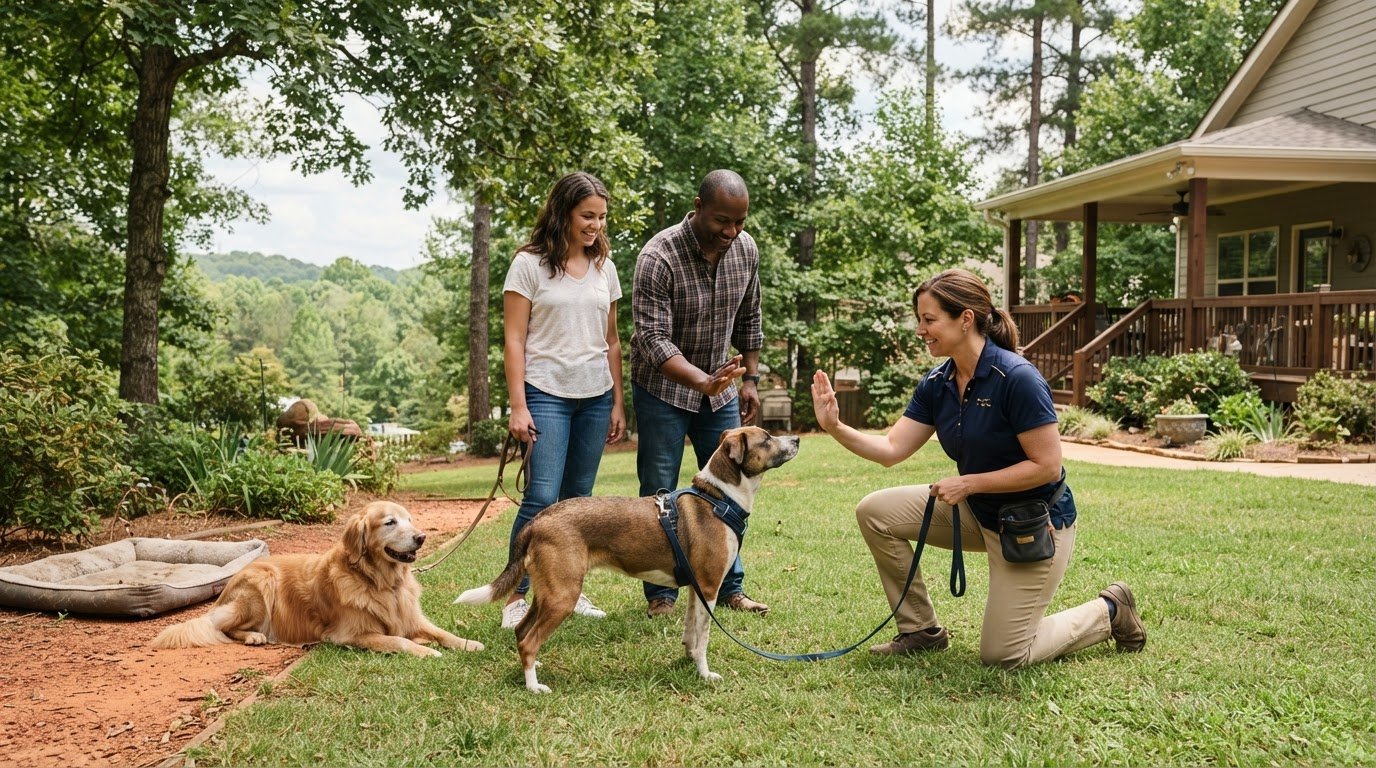
Alan’s K9 Academy serves Cherokee County communities including Canton, Woodstock, Holly Springs, and Ball Ground. A good training plan starts by listening to your concerns, explaining the approach clearly, and coaching you as well as your dog. You are part of the working team, not simply watching someone else handle your dog.
Which challenges can professional dog training address?
Training goals range from puppy obedience and leash manners to off-leash reliability. Behavior modification provides tailored guidance for concerns such as aggression or anxiety. The same broad label can describe very different situations, though. A dog who reacts to visitors at the front door may need a different plan from one who becomes distressed when left alone.
Describe the scene rather than relying only on a label. Note what happens just before the behavior, where it occurs, who or what is nearby, and how your household responds. For example, “barks and lunges when another dog approaches on walks” gives a clearer starting point than “bad with dogs.” Training methods vary; this overview of dog training methods offers context for approaches you may encounter.
Why the household and training setting matter
Home is where many everyday patterns are easiest to observe: the doorbell routine, greetings, mealtimes, or movement between rooms. Practicing in that familiar setting connects training to the situations your family wants to change. As skills develop, coaching can also relate to goals beyond the house, such as calmer walks or more reliable responses around distractions.
Owner participation helps make skills part of ordinary routines. You can learn to give cues clearly, reinforce the behavior you want, and respond consistently when challenges arise. For example, if a dog struggles during greetings, describe what happens when someone arrives and what you would like the dog to do instead. That shared practice supports clearer communication between you and your dog.
Customized training is a plan shaped around your dog’s needs, your household routines, and the real-life environments where you want skills to work.
How to Evaluate a Cherokee County Dog Trainer’s Methods and Experience
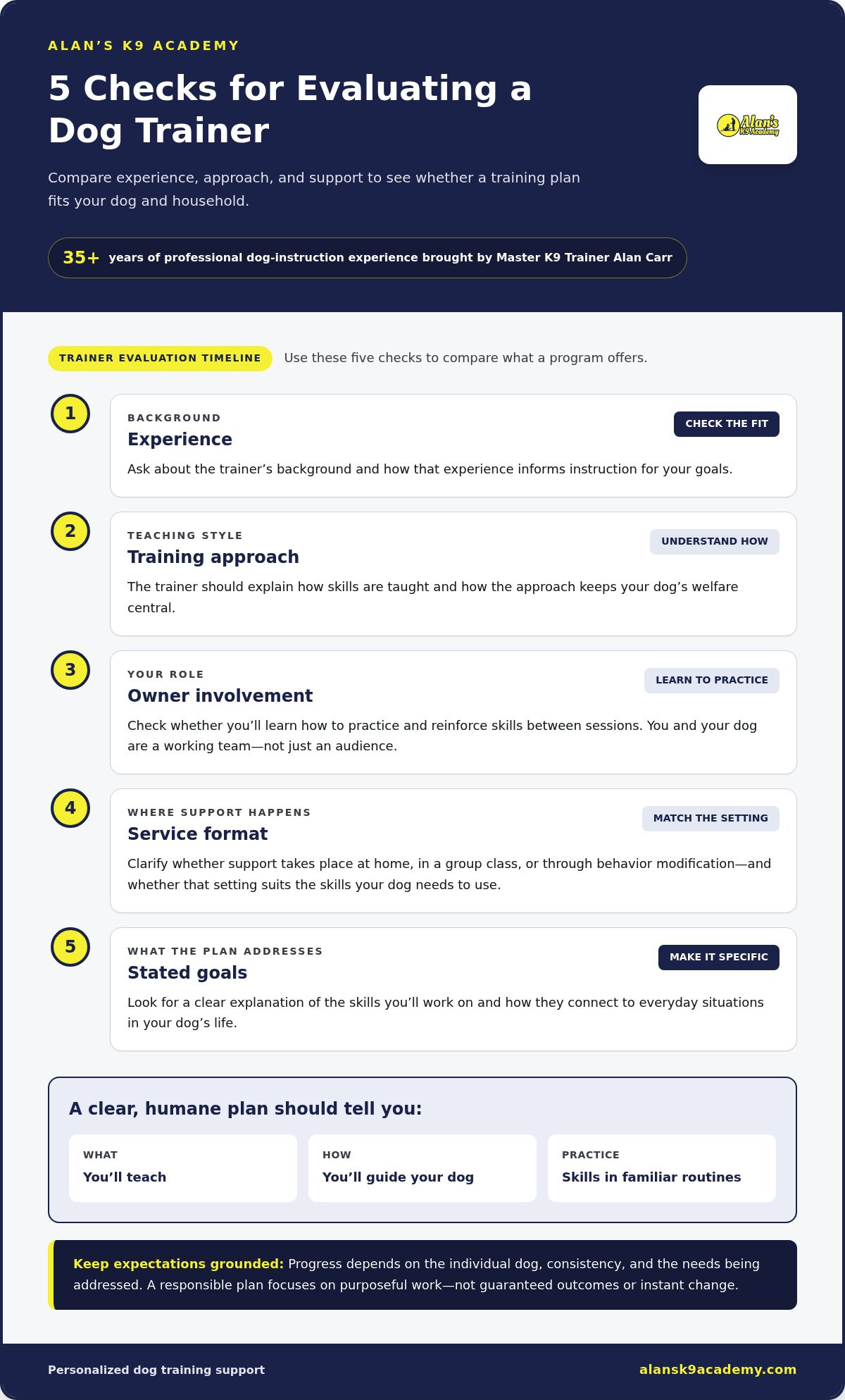
A trainer’s experience matters, but so does how that experience becomes useful guidance for your family. A clear plan should explain which skills you’ll work on, how to practice them, and how the approach fits your dog’s behavior and household routines. Alan Carr, Master K9 Trainer, brings over 35 years of professional dog-instruction experience to coaching owners and dogs as a team.
Use these areas to compare what a training program offers and how it fits your goals:
| What to consider | What it helps clarify |
|---|---|
| Experience | The trainer’s background and how it informs instruction for your goals. |
| Training approach | How the trainer teaches skills while treating the dog humanely. |
| Owner involvement | Whether you’ll learn how to practice and reinforce skills between sessions. |
| Service format | Whether support takes place at home, in a group class, or through behavior modification. |
| Stated goals | Which skills the plan addresses and how they relate to everyday situations. |
What should a clear, humane training plan explain?
Balanced, humane training is tailored to the dog while keeping the dog’s welfare central. The trainer should make the plan understandable: what you’ll teach, how you’ll guide your dog, and what you can practice in familiar routines. For a broader perspective on trainer selection, review the American Veterinary Society of Animal Behavior’s guidelines for choosing a dog trainer.
Clear coaching gives you practical steps and a meaningful role in training. Rather than relying on vague promises of instant change, look for a plan that explains what you and your dog will learn and practice. Progress depends on the individual dog, consistency, and the needs being addressed, so responsible training focuses on purposeful work rather than guaranteed outcomes.
How experience supports customized instruction
Professional instruction can help a trainer recognize that similar behaviors may occur in different contexts and need different approaches. Experience should support thoughtful assessment and adjustments as you and your dog practice, not a promise that every dog will follow the same timeline or respond in the same way. For more on what personalized home-based coaching can involve, read this professional in-home dog training guide.
If you’re considering a Cherokee County GA dog trainer, focus on whether the plan makes sense for your dog and gives you a meaningful role in the work. Explore Alan’s K9 Academy for information about its personalized training support.
In-Home, Behavior, or Group Training: Compare Your Cherokee County Options
The right format depends on what you want to work on and where your dog needs to use those skills. A Cherokee County GA dog trainer can help match the setting and support to your dog’s needs while keeping you involved in practice. No single option fits every dog or goal.
| Training format | Setting and focus | Owner participation |
|---|---|---|
| In-home coaching | Your home and its routines, with attention to everyday behaviors and foundational skills. | You practice with your dog in familiar situations and learn how to carry skills into daily routines. |
| Behavior modification | Customized support for complex concerns, including aggression, anxiety, or other challenging behavior patterns. | You describe the behavior and its context, then work with the trainer on a tailored plan. |
| Group classes | A structured class environment for practicing obedience and socialization around other people and dogs. | You handle and guide your dog through class exercises and practice between sessions. |
When personalized in-home training may fit best
In-home coaching can fit goals tied to household routines, such as door greetings, settling during family activities, or following cues in familiar rooms. The trainer can work in that setting while you learn to guide your dog and reinforce skills between professional sessions. For a closer look at this format, read the in-home dog training comprehensive guide.
When behavior modification or group classes may fit
Behavior modification provides specialized, individualized guidance when aggression, anxiety, or another complex concern calls for focused attention. The dog’s behavior, triggers, and environment help shape the work. Group classes serve a different purpose: they provide structured opportunities to practice obedience and socialization while you actively guide your dog. For more on behavior-focused support, explore the dog behavioral training guide.
Consider where your dog struggles and what kind of practice would help. A household concern may point toward in-home coaching, a complex behavior may call for modification support, and a dog ready to work around others may benefit from a group setting. The Certification Council for Professional Dog Trainers provides information about the certified professional dog trainer credential, another factor readers may consider when learning about training professionals.
Alan’s K9 Academy offers personalized in-home training, behavior modification, and structured group classes for Cherokee County families. Review the dog training options and consider which setting best supports your goals.
Choosing a Dog Trainer in Cherokee County for Your Training Goals
A clear goal makes it easier to choose training that fits your dog and household. Before selecting a format, consider what you want to change, where you need new skills to work, and how regularly you can practice. Turn a broad concern into a practical next step with this simple process:
Define your goal.
Be specific about the skill or behavior you want to address. For a puppy, that might mean learning basic cues; for a dog who struggles at home, it could mean calmer routines around visitors.
Describe the situations.
Note what happens, where it happens, and what tends to come before it. Separate immediate management needs, such as creating space during a stressful situation, from longer-term goals like building a reliable response.
Identify a suitable format.
In-home coaching can focus on household routines. Behavior modification offers specialized guidance for complex concerns, while group classes provide structured practice around others. Off-leash reliability and therapy or service foundations call for training goals suited to those skills.
Commit to practice.
Consider how training can fit into your family’s routine. Your participation and consistent reinforcement help carry lessons beyond professional instruction.
Turn a broad concern into a clear training goal
Instead of saying “my dog won’t listen,” describe the moment: your dog ignores a recall cue in the yard, pulls toward distractions on walks, or jumps on guests at the door. Then identify what you’d like to see instead. Observable goals give you and the trainer something specific to work toward without assuming a fixed timeline for progress.
For challenging behavior, include relevant context such as the setting, triggers, and household response. These details help clarify what needs attention first and which skills you want to build over time.
Match the goal to practical, real-world coaching
Think about where the skill needs to hold up. A home-based concern may be best addressed through in-home instruction; a complex behavior may call for customized behavior modification; and a dog ready to practice around others may benefit from a structured class. Whatever the format, owner coaching and practice between sessions help make training part of everyday life. For ideas on building obedience skills in real-world settings, read the North Atlanta dog obedience training guide.
The right choice matches your dog’s needs, the training setting, and the goals you can practice as an owner. Alan’s K9 Academy offers personalized training options for these goals.
Start Dog Training With Alan’s K9 Academy in Cherokee County
Choosing a training path is easier when you can explain what’s happening and what you’d like everyday life to look like. Alan’s K9 Academy provides personalized in-home dog training, behavior modification, therapy and service dog foundations, and structured group classes. Each option gives you a way to work toward practical skills with your dog, with the format shaped around the concerns and goals you bring.
Founded by Master K9 Trainer Alan Carr, the academy draws on more than 35 years of professional dog-instruction experience. Its balanced, humane approach emphasizes coaching owners and dogs as a working team. You learn how to guide your dog and practice skills in ways that support clearer communication at home and beyond.
What to prepare before discussing your dog’s training
A few clear observations can make the conversation more useful. Write down the behavior you’re concerned about, where it occurs, and how often you’ve noticed it. Include what tends to happen just before the behavior and how people in the household respond.
• Your dog’s age and the skills you hope to build
• Household routines or settings where the concern appears
• Typical triggers and how frequently you observe the behavior
• The everyday changes you’d like training to support
If there are safety concerns, describe them plainly. Don’t recreate a risky situation to demonstrate the behavior. A careful description provides context without putting your dog or anyone else in harm’s way.
A local training partner focused on clearer communication
Personalized guidance can help you turn observations into practical steps and reinforce skills as part of ordinary routines. In-home instruction addresses the household setting, while behavior modification and group classes offer different kinds of structure and practice. Therapy and service dog foundations provide focused support for those training goals.
Alan’s K9 Academy serves Cherokee County communities including Canton, Woodstock, Holly Springs, and Ball Ground. The academy also serves Cartersville, Marietta, Rome, Acworth, Kennesaw, Sandy Springs, Roswell, Alpharetta, Powder Springs, Dallas, Hiram, Jasper, Cumming, and Milton. Whether you’re working through a household concern or building new skills, owner participation connects professional instruction with the way you and your dog live day to day. If you’re looking for a Cherokee County GA dog trainer, sharing your dog’s age, main concern, typical triggers, and hoped-for changes is a useful first step.
Talk with Alan’s K9 Academy about your dog’s training goals.
Choose a Training Path That Fits Your Dog
The right training starts with clear goals: describe the behavior you’re seeing, where it happens, and what you’d like to change. Then match the support to the need, whether that’s personalized in-home coaching, behavior modification, or structured group classes. Your participation and regular practice help make new skills part of everyday life.
Alan’s K9 Academy serves Cherokee County communities including Canton, Woodstock, Holly Springs, and Ball Ground, as well as Cartersville, Canton, Woodstock, Marietta, Rome, Acworth, Kennesaw, Sandy Springs, Roswell, Alpharetta, Powder Springs, Dallas, Hiram, Jasper, Cumming, Holly Springs, Ball Ground, and Milton. Master K9 Trainer Alan Carr brings over 35 years of professional dog-instruction experience to the award-winning academy’s balanced, humane approach. If you’re looking for a Cherokee County GA dog trainer, you can take the next step with a clearer picture of your dog’s needs and your family’s goals.
With thoughtful guidance and teamwork, you can build clearer communication and practical skills for life together. Talk with Alan’s K9 Academy about your dog’s training goals.
Frequently Asked Questions
How do I choose a dog trainer in Cherokee County, GA?
Choose a Cherokee County GA dog trainer by considering relevant experience, humane methods, and coaching that includes you as well as your dog. Master K9 Trainer Alan Carr has over 35 years of professional dog-instruction experience. Look for a plan that considers your dog’s age, behavior, triggers, and household routines, then connects your goals with a suitable format, such as in-home training, behavior modification, or group classes.
Does in-home dog training help with behavior problems?
In-home training can address concerns that appear in household routines, such as difficulty settling, door greetings, or following cues around familiar distractions. Coaching in that setting lets you and the trainer focus on the context where the behavior occurs. For aggression, anxiety, or more complex patterns, behavior modification provides specialized, individualized guidance alongside practical steps for the household.
What is the difference between private dog training and group classes?
Private in-home training focuses on your dog and household, allowing coaching to address specific routines, skills, and concerns in a familiar setting. Group classes offer structured practice with other people and dogs, supporting obedience and socialization while you guide your dog through class exercises. Both formats involve owner participation. The better fit depends on your goals, your dog’s needs, and the setting where you want skills to develop.
Can a dog trainer help with aggression or anxiety?
Yes. Professional behavior modification can provide tailored support for aggression, anxiety, and other complex behavior concerns. Understanding the behavior, its triggers, where it occurs, and how household routines may affect it helps shape appropriate coaching. Progress varies by dog and situation, so expect a thoughtful process focused on practical steps and consistent owner participation, not a guaranteed outcome or instant change.
How long does it take to train a dog?
There isn’t one timeline that applies to every dog. Progress depends on your dog’s starting skills, the goals you’re working toward, the complexity of any behavior concerns, and how consistently you practice between sessions. Learning a basic cue and addressing a complex behavior pattern involve different needs. A trainer can help define observable goals and adjust instruction as you and your dog work toward them.
What should I tell a dog trainer about my dog?
Share your dog’s age, the behavior or skill you want to address, and what you observe before and after it happens. Note typical triggers, where the behavior occurs, how often you see it, and relevant household routines. Explain your goals in concrete terms, such as calmer greetings or a more reliable recall. Describe safety concerns clearly, but don’t recreate a risky situation to demonstrate them.
Does Alan’s K9 Academy serve Canton and Woodstock, Georgia?
Yes. Alan’s K9 Academy serves Canton and Woodstock, as well as Cartersville, Marietta, Rome, Acworth, Kennesaw, Sandy Springs, Roswell, Alpharetta, Powder Springs, Dallas, Hiram, Jasper, Cumming, Holly Springs, Ball Ground, and Milton. Training options include personalized in-home dog training, behavior modification, therapy and service dog foundations, and structured group classes. Owner participation helps build communication and practical skills for everyday life.