



Canine Good Citizen Test Prep in Roswell for CGC Skills
The Canine Good Citizen title is based on a 10-skill test that assesses a dog’s manners and an owner’s responsible handling. Canine Good Citizen test prep in Roswell can help you understand what each skill involves and prepare for the evaluation with professional guidance.It’s natural to wonder whet...

The Canine Good Citizen title is based on a 10-skill test that assesses a dog’s manners and an owner’s responsible handling. Canine Good Citizen test prep in Roswell can help you understand what each skill involves and prepare for the evaluation with professional guidance.
It’s natural to wonder whether the test is only about obedience. It also assesses how a dog responds in everyday situations, such as meeting people and passing another dog politely. Dogs of any breed or age may participate, but an approved evaluator must assess the test.
This article explains what the CGC program is, why the title can be useful, and how dogs practice calm greetings. You’ll also get a clear overview of all 10 test skills, so you can see what preparation involves and what support may help your dog feel more confident.
Key Takeaways
• Understand how general obedience classes can build a foundation for the CGC evaluation.
• See how earning the title may support plans such as pursuing therapy dog certification.
• Learn what polite greetings with people and other dogs look like during the test.
• Get an overview of the 10 skills evaluators assess, from basic manners to handling distractions.
What is Canine Good Citizen (CGC)?
The American Kennel Club’s Canine Good Citizen program assesses manners and responsible handling through a 10-skill test. Dogs of any breed or age can participate. Skills include basic obedience such as sit, down, and stay, alongside calm behavior around people, dogs, and distractions.
Obedience classes can help dogs build reliable responses before practicing those skills in varied situations. Classes also give handlers a chance to work on timing, leash control, and clear cues. Preparation can take place in a class, with a private trainer, or at home, but an approved evaluator must conduct the test.
Readiness depends on the dog’s current behavior, not just familiarity with commands. A useful assessment considers whether the dog responds to the handler, stays manageable near people and dogs, and recovers from everyday distractions. For example, a dog that knows “sit” at home may need practice responding around other dogs.
Roswell has hosted CGC-related preparation in the past. A therapy-dog preparation class ran Wednesdays from 6:00 pm to 7:00 pm, November 4 through December 16, 2020, at Roswell Veterinary Associates in Roswell, Georgia. That historical schedule is an example, not a current class calendar.
Class and testing costs depend on the provider. A CGC preparation class typically focuses on practicing test skills, handling distractions, and preparing the dog and handler for evaluation. The specific format depends on the class.
Dogs can take the CGC test without attending a preparation class. They may prepare through private training or at-home practice, but an approved evaluator must conduct the test. For Canine Good Citizen test prep in Roswell, look for obedience classes that address CGC skills and evaluation.
Preparation time depends on the dog’s existing skills and how consistently they hold up around distractions. Test day centers on an evaluator’s assessment of all 10 skills, including manners and handling. If a dog misses one or more items, the evaluation is not passed; focused practice can address the specific skill before another assessment. A tailored Canine Good Citizen test prep plan in Roswell can target those areas.
Benefits of earning the CGC title
The Canine Good Citizen title gives you and your dog a clear, skills-based milestone. Preparing involves learning and practicing good manners together, including calm handling around people, dogs, and everyday distractions. That shared work can make routines like walking through a busy area or welcoming a visitor more manageable.
The title can also be useful beyond training. Some landlords require CGC certification when renting a home or apartment, so the credential may support a housing application. Requirements vary by property, and earning the title doesn’t replace other rental criteria. Treat it as evidence of tested manners, not a promise of approval.
For therapy work, CGC is an important foundation. The title is a prerequisite for many therapy dog certifications, but it isn’t itself therapy certification. Dogs and handlers still need to meet the requirements of the therapy organization they pursue. If your goal is visiting people in care or community settings, use the CGC skills as a starting point for further preparation.
CGC achievement can also give a team a meaningful way to recognize progress. The evaluation offers a defined goal: demonstrate the program’s 10 skills with an evaluator. Passing can mark the result of consistent learning and teamwork. It also comes before the official AKC CGCA title, which requires a dog to earn CGC first.
Use the title to guide your next step. If your aim is therapy work, focus on the skills that support calm, responsive behavior around people and varied environments. Therapy and service dog training can help handlers build toward those goals with structured guidance.
Polite greetings with people and dogs
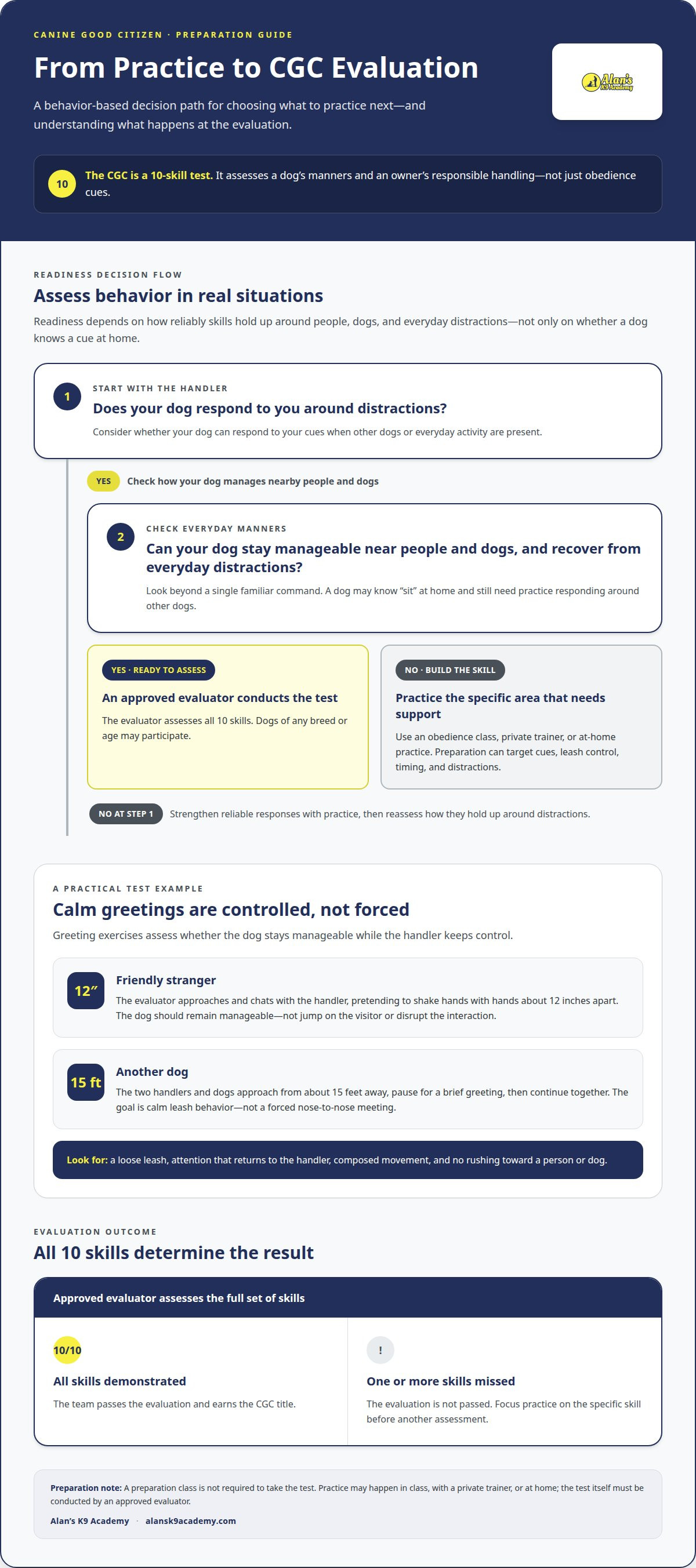
CGC greeting exercises assess manners while a handler keeps the dog under control. During the friendly-stranger exercise, the evaluator approaches and chats with the handler. They pretend to shake hands, keeping their hands about 12 inches apart. The dog is expected to remain manageable rather than jump on the visitor or disrupt the interaction. This tests behavior in a social moment, not just a response to a familiar cue.
A greeting with another dog has a different focus. The two handlers and dogs approach from about 15 feet away. They pause, greet briefly, then continue with their handlers. The goal is calm behavior on leash, not a forced nose-to-nose meeting. A dog that can notice another dog and stay responsive to its handler demonstrates useful control in a common public situation.
Polite behavior is visible in details such as a loose leash, attention that returns to the handler, and no attempt to rush toward a person or dog. The handler’s role matters, too. Clear leash handling and composed movement help keep a greeting orderly, giving the dog room to respond without crowding the other participant.
Dogs of any breed or age can participate in the CGC program. Readiness for a greeting exercise still depends on the dog’s behavior in that setting. A dog that reacts with fear or intense excitement may need behavior modification before close greeting practice. A professional can assess triggers and work toward calm, safe handling at a pace suited to the dog.
Preparation should reflect the test’s social demands. A trainer can arrange controlled encounters with different people and dogs, then observe whether the dog stays manageable as distance changes. For example, the handler can practice passing another dog without letting the leash tighten or the greeting become prolonged. These sessions build practical manners and help owners learn when to guide their dogs onward.
The 10 Canine Good Citizen test skills
The CGC evaluation covers 10 distinct skills, from polite handling to calm responses in public. Together, they show whether a dog can stay manageable while the handler moves through ordinary situations. Knowing the test items helps you identify which skills need focused practice before an evaluator assesses the team.
Accepting a friendly stranger
The dog stays composed as a stranger approaches and speaks with the handler.
Sitting politely for petting
The dog accepts gentle contact without jumping or becoming difficult to manage.
Appearance and grooming
The dog allows routine handling, such as an evaluator checking its ears and paws.
Walking on a loose leash
The dog walks with the handler without pulling throughout the course.
Walking through a crowd
The team passes close to at least three people while maintaining control.
Sit, down, and stay
The dog responds to cues and stays as the handler walks to the end of a 20-foot line. A 15-foot line attached to the leash may be used instead.
Coming when called
The handler moves 10 feet away before calling the dog.
Reaction to another dog
Two handlers and dogs approach from about 15 feet away, greet, then move on.
Reaction to distractions
The dog remains manageable near examples such as a person using crutches, positioned 5 feet away, or a bike at least 10 feet away. A dropped pan, folded chair, or passing cart stays no closer than 5 feet.
Supervised separation
The handler goes out of sight for 3 minutes while the evaluator holds the leash.
These skills form a practical course, not just a set of isolated commands. Practice in real-world settings helps dogs maintain attention in different situations, a useful foundation for therapy dog goals. Preparation can focus on the items that challenge your dog, such as staying settled near a crowd or responding to a recall.
Prepare your dog for the CGC skills with structured professional guidance.
Alan's K9 Academy
Alan's K9 Academy helps handlers build practical skills for better everyday behavior and training goals. If your dog needs support with leash manners, distractions, or calm responses around people and dogs, personalized instruction can address those challenges while strengthening communication between you and your dog.
Group classes provide a setting to practice skills around other dogs and handlers. For behavior concerns that make those situations difficult, behavior modification can focus on the dog’s specific needs. Therapy and service dog training can also support handlers working toward broader goals that build on dependable manners.
Choose guidance when you want a professional to help identify what needs work and shape a suitable training approach. Contact Alan's K9 Academy to discuss your dog’s training needs.
Take the Next Step Toward Confident Practice
Your dog’s next training goal can start with one practical decision: which skill needs the most support in everyday life? A handler preparing for the Canine Good Citizen evaluation may want help with leash manners, greetings, or focus around distractions. Canine Good Citizen test prep in Roswell can give you a clear direction for building those skills with professional support.
Alan's K9 Academy offers in-home dog training, behavior modification, and therapy and service dog training. The right fit depends on your dog’s behavior and your goals, whether you’re working through a specific challenge or building foundations for future therapy work. Thoughtful preparation keeps the focus on useful skills your dog can carry into real situations.
Start with a conversation about what your dog finds challenging and what you hope to accomplish. Contact Alan's K9 Academy to discuss preparation, and take the next step with a plan suited to you and your dog.
FAQs
Who Can Participate in CGC?
A dog and its owner or regular handler participate as a team. The program focuses on companion-dog manners and responsible ownership, so the handler’s role matters alongside the dog’s behavior. Preparation can include practicing how to guide the dog calmly through everyday interactions. The CGC goal is a demonstrated partnership, not simply a collection of commands.
Where can I find Canine Good Citizen test prep classes in Roswell, Georgia?
Roswell-area handlers can explore trainer-led Group Classes through Alan's K9 Academy. A class environment can help you see how your dog responds while other teams are present. If a dog’s behavior makes group participation difficult, individualized guidance may help address those concerns before joining a class. The most suitable format depends on your dog’s needs and your training goals.
What is covered in the AKC Canine Good Citizen test?
The AKC evaluation looks at how a dog behaves with its handler in everyday situations, rather than testing specialized tricks. It considers the dog’s manners and the handler’s responsible guidance as they move through the exercises. The overall aim is to demonstrate reliable, appropriate behavior in a range of ordinary interactions, giving owners a practical benchmark for their teamwork.
What are the requirements for dogs and handlers taking the CGC test?
The dog and handler need to demonstrate the expected behaviors together during the evaluation. The handler should be ready to follow the evaluator’s directions and manage the dog calmly through each exercise. Preparation classes are not required; owners may prepare through private training or practice at home. The dog’s ability to remain manageable in the testing setting is central.
How much do CGC prep classes and testing cost in Roswell?
Alan's K9 Academy training prices are customized after an evaluation that considers the dog’s age, temperament, previous training, behavior concerns, and owner goals. Scheduling an evaluation is the way to receive a tailored recommendation and price. Costs for a class or CGC testing depend on the organizer’s arrangements, so ask about those charges when reviewing a specific event.
When and where are upcoming CGC classes and test dates near Roswell?
Class and test dates are set by the organizations running sessions and the evaluators conducting tests. A past Roswell therapy-dog preparation class met at Roswell Veterinary Associates, but that historical event does not establish a current schedule. When planning, review an event’s stated location and dates, and whether its format includes a CGC evaluation.