%20(620%20x%20150%20px)%20(14).webp)
%20(620%20x%20150%20px)%20(15).webp)
.webp)
_page-0001.webp)
.webp)
Best Dog Training Methods: 2026 Guide
What if the loudest voices in the dog training world are actually making it harder for you to lead your pet? It's a frustrating reality in 2026. "Internet experts" often push rigid, one-size-fits-all ideologies that leave owners feeling overwhelmed and stuck. You're likely searching for clarity on w...
%20(5).gif)
What if the loudest voices in the dog training world are actually making it harder for you to lead your pet? It's a frustrating reality in 2026. "Internet experts" often push rigid, one-size-fits-all ideologies that leave owners feeling overwhelmed and stuck. You're likely searching for clarity on what dog training method is best for my dog, yet you're often met with conflicting advice that feels either too passive or unnecessarily harsh. We know how exhausting it is to invest your time and money into training that doesn't stick. You deserve a solution that respects your dog's unique spirit while delivering the "can-do" results you need for a peaceful home.
In this guide, we'll help you cut through the digital noise and discover the most effective training methodologies tailored for today's world. We'll provide a clear, professional breakdown of the pros and cons of major approaches, from positive reinforcement to balanced, humane techniques. You'll gain a "diagnostic" sense of which method fits your dog's specific temperament and behavioral needs. Our goal is to move you from a state of overwhelm to a feeling of total control. By the end, you'll have the confidence to choose a path that creates a reliable, meaningful partnership with your companion for years to come.
Key Takeaways
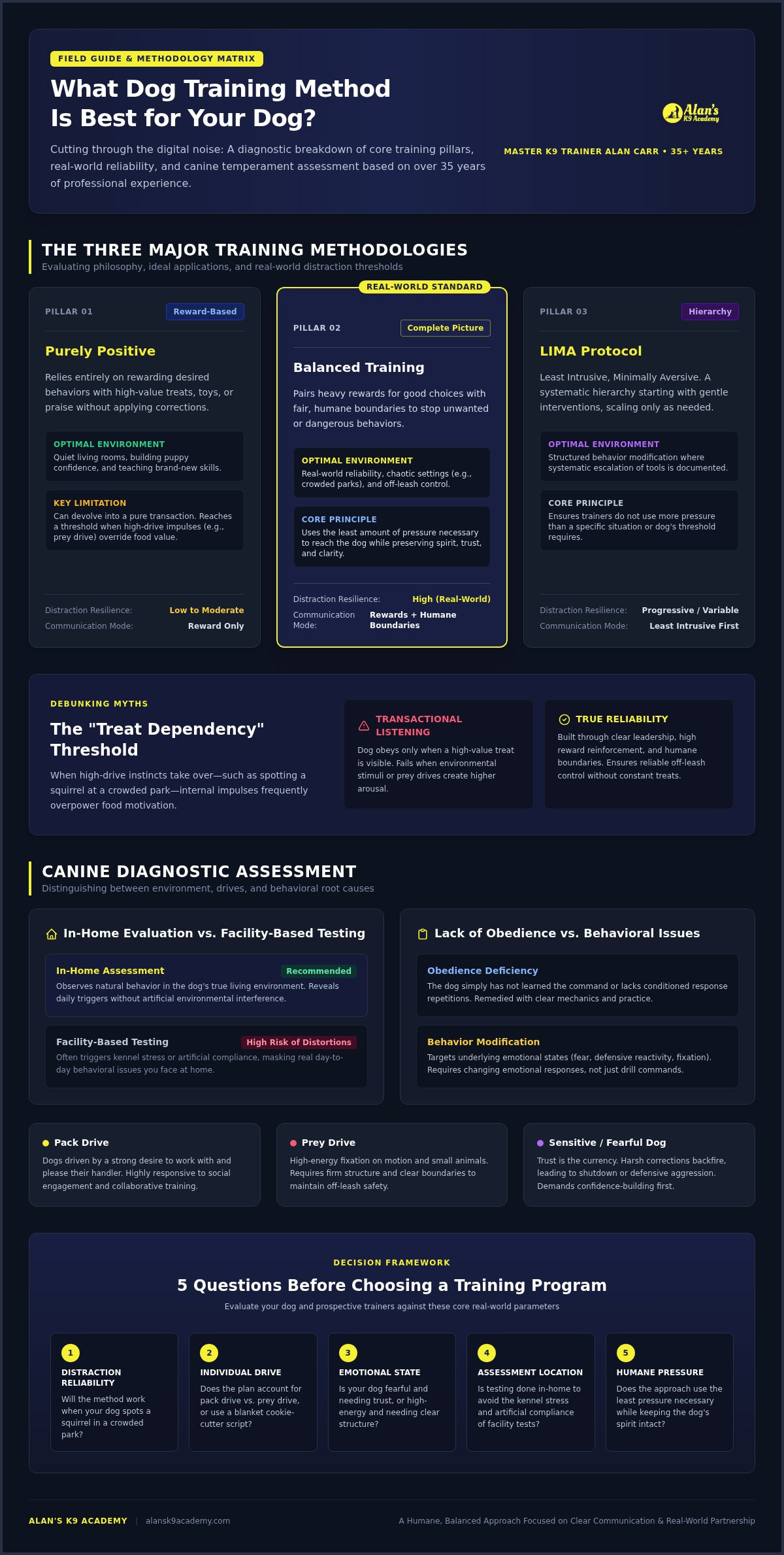
• Compare the three major training pillars-Purely Positive, Balanced, and LIMA-to understand how each handles high-distraction, real-world environments.
• Learn to assess your dog’s unique temperament and drive to ensure your chosen approach matches their specific behavioral and emotional needs.
• Use our five-question framework to finally determine what dog training method is best for my dog before you invest in a professional program.
• Debunk the "treat dependency" myth and discover which methodologies provide the most reliable off-leash control and long-term results.
• Understand why a balanced, humane approach focused on clear communication creates a more meaningful, stress-free partnership with your pet.
Decoding Dog Training Philosophies: What Are the Options?
You've likely seen the heated debates online. One group claims treats are the only way, while another insists on strict discipline. It's confusing for any owner. When you're trying to figure out what dog training method is best for my dog, you need a framework that makes sense in the real world, not just in a textbook. Master K9 Trainer Alan Carr has spent over 35 years watching these dog training philosophies and methods evolve. He's seen that while ideologies sound great on paper, they often fail when your dog spots a squirrel at a crowded North Atlanta park. There is no magic wand. Success comes from matching the right approach to the specific animal in front of you.
Purely Positive Reinforcement: The Reward-Based Approach
This methodology relies entirely on rewarding desired behaviors with high-value treats, toys, or praise. It's an excellent way to build confidence in young puppies or to teach a brand-new skill in a quiet living room. We love using positive reinforcement to foster a love for learning. However, it has its limits. High-drive dogs or those struggling with severe aggression often reach a threshold where a piece of chicken can't compete with their internal impulses. If your dog only listens when you have a treat in hand, you don't have reliability; you have a transaction. It's a great starting point, but it isn't always enough for complex behavioral issues.
Balanced Training: Clear Communication and Boundaries
Balanced training is about providing a complete picture of communication. We use heavy rewards to encourage good choices, but we also introduce fair, humane boundaries to stop dangerous or unwanted behaviors. This approach aims for real-world reliability. You need to know your dog will listen even in chaotic environments where treats aren't enough. In a professional, balanced context, "humane" means using the least amount of pressure necessary to reach the dog while maintaining their spirit and trust. It's about clear leadership that helps a dog feel secure. When you ask what dog training method is best for my dog, the answer often lies in this middle ground where clarity meets compassion.
Then there's LIMA (Least Intrusive, Minimally Aversive). This is a systematic hierarchy that starts with the gentlest possible intervention and only scales up if necessary. It’s a principled way to ensure we aren't using more pressure than a situation requires. Whether you're looking for basic manners or complex behavior modification, the goal is always the same: a happy, functional life for you and your pet. We don't train for the sake of an ideology. We train for the real world, focusing on the unique needs of your companion.
Assessing Your Dog: Temperament vs. Behavioral Issues
Determining what dog training method is best for my dog begins with a simple truth: you must train the animal in front of you, not the one you wish you had. A fearful rescue who hides under the sofa needs a fundamentally different roadmap than a high-energy Malinois with an intense prey drive. We find that an in-home assessment is the only way to see your dog’s true nature. Facility-based testing often triggers kennel stress or artificial compliance, which masks the behavioral issues you actually face daily. By observing your pet in their own environment, we can distinguish between a lack of obedience-simply not knowing a command-and a deeper need for behavior modification, which targets their underlying emotional state.
Understanding "Drive" is critical for long-term success. Pack drive makes a dog eager to please you, while prey drive might make them fixate on every squirrel in the neighborhood. High-drive dogs often require more structure to stay safe; sensitive dogs need more encouragement. If you're struggling with complex issues, our in-home evaluation can help pinpoint exactly where your dog falls on this temperament spectrum. We don't guess; we assess to ensure the method fits the dog's unique genetics and personality.
The Sensitive or Fearful Dog
Trust is the currency of training for an anxious pet. If a dog is operating from a place of fear, harsh corrections often backfire, causing them to shut down or escalate into defensive aggression. We focus on building a foundation of security before we ever ask for strict compliance. This often involves incorporating behavioral training for dogs to rehabilitate their confidence. While we respect American Veterinary Medical Association guidelines regarding canine welfare, we also know that clarity is kindness. For a fearful dog, knowing exactly what is expected of them reduces the stress of uncertainty and helps them feel safe in their own skin.
The High-Drive or Reactive Dog
When a dog is "over-threshold"-meaning they're so excited or reactive they can no longer hear your voice-purely reward-based methods often fall short. Imagine your dog barking at a squirrel in Marietta Square. In that moment, a piece of kibble cannot compete with the adrenaline of the chase. This is where clear communication becomes a safety issue. We teach dogs a reliable "No" signal so they understand when a behavior is non-negotiable. It’s about matching the energy of the dog with a calm, authoritative presence from the owner. You don't need to be loud; you just need to be clear. Choosing what dog training method is best for my dog means finding the balance that ensures they can enjoy public spaces without losing control of their impulses.
Pros and Cons: Comparing Methods for Real-World Success
"A method is only as good as the communication it creates between the owner and the dog at the other end of the leash." This principle is the cornerstone of our work when helping owners decide what dog training method is best for my dog. While purely positive reinforcement is wonderful for building initial trust and teaching new tricks, it often lacks the speed and reliability necessary for addressing common canine behavioral issues in high-stakes environments. Balanced training provides a more comprehensive vocabulary. It uses rewards to mark success and fair, humane boundaries to discourage unwanted choices. This dual-track system typically leads to faster results because it removes the guesswork for your pet.
One major hurdle for many owners is the "Treat Dependency" myth. You might worry that your dog will only listen if you have a pocket full of chicken. In reality, it is often the reward-only systems that suffer most from this dependency. If the distraction is more exciting than the treat, the dog simply chooses to ignore the owner. A balanced, humane approach uses rewards to teach the behavior but transitions to structure to ensure the dog listens even when rewards aren't present. This creates a pet that responds out of respect and understanding, not just a desire for a snack.
Reliability Under Distraction
Think about your backyard in Woodstock or Canton. A squirrel darting across the fence is a high-level challenge on what we call the "Distraction Ladder." Purely positive methods often crumble at this stage because the internal reward of the chase is more powerful than any treat you can offer. For true safety and peace of mind, dog obedience training must be tested in these real-world scenarios. Balanced methods provide the off-leash reliability you need, ensuring your dog honors your commands regardless of the chaos happening around them.
The Impact on the Owner-Dog Bond
There is a persistent misconception that introducing clear boundaries or corrections will "scare" a dog or damage your relationship. As a "Compassionate Expert," I've seen the exact opposite. Dogs don't find structure scary; they find it incredibly reassuring. Clear boundaries actually reduce canine anxiety by taking the weight of decision-making off the dog's shoulders. When your pet knows exactly what the rules are, they feel more secure and confident. This clarity doesn't break the bond; it strengthens it by building a foundation of mutual respect and reliable communication.
The Choice Framework: 5 Questions to Ask Before You Hire
Choosing a trainer is a high-stakes decision for your family. You aren't just buying a few hours of time; you're choosing a mentor who will shape the relationship you have with your pet for years. To truly determine what dog training method is best for my dog, you must look past the marketing and ask hard questions. A professional should provide clear, direct answers that give you confidence rather than more confusion. Use these five questions as your vetting framework:
What happens when my dog does it right?
A balanced approach uses high-value rewards like treats, toys, or praise to reinforce good choices.
What happens when my dog does it wrong?
If a trainer says they simply ignore bad behavior, ask them how they handle a dog lunging at a car. Real-world safety requires clear boundaries.
Have you worked with this specific breed or issue for 30+ years?
Mastery takes time. Alan Carr’s 35 years of experience means he has likely solved your specific problem hundreds of times before.
Will you train me to be the leader, or just train the dog?
You are the one living with the dog. If the trainer doesn't empower you with handling skills, the results will fade.
Is the training conducted in my home?
Problems rarely happen in a sterile training center. They happen in your living room and on your neighborhood sidewalks.
Why "In-Home" Is the Gold Standard
Facility-based training often creates a "Placebo Effect." Dogs learn to behave in a new, sterile environment because they are slightly intimidated or focused on the trainer. However, those results often vanish the moment the dog returns to their own turf. In home dog training is the gold standard because it allows for real-life corrections in the exact context where the issues occur. Whether it's jumping on guests at your front door or reactivity in your North Atlanta backyard, we address the behavior where it lives. This setting also allows us to see your unique family dynamics, including how your children or other pets influence your dog's state of mind.
Vetting the Trainer’s Experience
Don't settle for someone who has only completed a weekend certification course. A "Master K9 Trainer" designation represents a lifetime of study in animal behavior and psychology. There is a massive difference between teaching "Puppy Manners" and executing complex behavior modification for aggression or anxiety. You need a professional who remains unfazed by difficult challenges and offers customized solutions rather than a script. If you are ready for a transformation that lasts, book your professional in-home evaluation with a trusted expert today.
Finding Balance: The Alan’s K9 Academy Approach
At Alan’s K9 Academy, we don't believe in rigid dogma. When owners ask us what dog training method is best for my dog, we provide a solution that is professional, authoritative, and deeply empathetic. Our "Balanced, Humane" methodology is built on over 35 years of real-world experience. We understand the stress of living with a reactive or disobedient pet. That’s why we focus on transformation rather than just temporary fixes. We treat our clients like partners and their dogs like family, ensuring every session moves you closer to a life of peace and control.
We operate on a "Communication First" philosophy. This means we teach your dog how to learn before we ever ask for complex results. By establishing a clear, common language between you and your pet, we remove the frustration of "lost in translation" moments. You might be tempted by "boot camps" or board-and-train facilities that promise quick results in an isolated environment. We explicitly reject that model. Real change happens when you are empowered to be the leader in your own home. We want the dog to listen to you, not just a trainer they’ll never see again.
Customized Plans for North Atlanta Families
Our service extends across North Atlanta and Bartow County, including families in Cartersville, Acworth, and Kennesaw. We also provide hands-on coaching in Roswell, Alpharetta, Marietta, and Dallas, GA. Every household is unique. We take the time to tailor our methods to your specific lifestyle and Christian values, ensuring the training feels natural for your family. For those starting with a new addition, our in-home puppy training Cartersville program sets a foundation for long-term success, preventing behavioral issues before they start.
The Path to Real-World Reliability
Real success isn't just about a dog sitting for a treat in a quiet room. It’s about a dog that listens because they understand their role and respect your leadership. When you finally stop wondering what dog training method is best for my dog and start seeing real-world reliability, the weight of behavioral stress begins to lift. We've seen every possible challenge, from severe aggression to deep-seated anxiety, and we remain unfazed. We believe that no dog is truly "beyond help" when matched with the right method and a Master Trainer. Let’s work together to restore the joy of dog ownership. Schedule your in-home evaluation with Alan’s K9 Academy today.
Transform Your Life with Professional In-Home Support
You now have the framework to decide what dog training method is best for my dog based on their unique temperament and your family's needs. True reliability isn't found in a sterile facility. It's built in your living room and on your neighborhood streets through clear, customized communication. By prioritizing balanced, humane boundaries, you can finally move from a state of frustration to one of total confidence. You deserve a pet that listens because they understand you, not just because they're hungry.
Led by Master K9 Trainer Alan Carr with 35+ years of experience, we specialize in customized solutions for families in Cartersville, Marietta, Roswell, and the North Atlanta Metro. We don't believe in one-size-fits-all ideologies. Instead, we focus on the specific animal in front of us to ensure meaningful, real-world results. Your path to a peaceful, well-behaved companion is closer than you think.
You don't have to navigate these behavioral challenges alone. We're here to help you create the reliable partnership you and your companion deserve.
Frequently Asked Questions
Is "Balanced Training" the same as "Alpha Dog" or "Dominance" training?
No, balanced training is quite different from dominance theory. Dominance models are based on outdated studies and often rely on intimidation. When determining what dog training method is best for my dog, it's vital to choose one focused on clear communication. We use rewards to mark success and fair boundaries to discourage unwanted choices. This approach builds a partnership based on mutual respect rather than fear, ensuring your dog feels secure and confident.
What is the most humane dog training method for a rescue dog?
The most humane approach for a rescue is one that builds trust through structure. Many rescues in Canton or Woodstock struggle with anxiety; they need to know exactly what the rules are to feel safe. We use behavior modification to address their emotional state while providing clear, compassionate guidance. A customized plan ensures we don't overwhelm a sensitive dog while still achieving the real-world reliability every owner needs for a peaceful home life.
Can I train my aggressive dog using only positive reinforcement?
While positive reinforcement is a vital tool, it often lacks the clarity needed to stop dangerous behaviors. When you ask what dog training method is best for my dog for aggression, a balanced approach is usually necessary. You must be able to tell your dog "no" in a way they respect. We focus on behavior modification that addresses the root cause of the aggression while ensuring safety in public North Atlanta spaces like Marietta Square.
How do I know if a dog trainer is using outdated or harmful methods?
Watch for trainers who can't explain the "why" behind their techniques or those who use a one-size-fits-all script. Outdated methods often rely solely on punishment without any rewards for good behavior. A modern professional, like Alan Carr with his 35 years of experience, will always prioritize the dog's spirit. We use balanced, humane methods that are transparent and tailored to your pet's unique temperament, ensuring you feel comfortable with every step of the process.
Why does my dog listen at home but ignore me when we are at the park?
This is a common issue known as a lack of generalization. Dogs often learn that rules only apply in specific environments, like your living room in Roswell. To fix this, we use in-home training as a foundation and then move to high-distraction areas like parks in Alpharetta or Kennesaw. This "real-world proofing" ensures your dog understands that your commands are non-negotiable, regardless of the squirrels or other dogs nearby.
What training method is best for a puppy that won’t stop biting?
Puppies need clear communication to understand that human skin is off-limits. We use a balanced approach that rewards them for chewing appropriate toys while providing a fair correction for biting. Our in-home puppy training in Cartersville focuses on teaching these boundaries early. By establishing rules in your own home, you prevent these annoying habits from turning into serious behavioral issues as your dog grows into a confident, well-mannered adult.
How long does it typically take to see results with a balanced training approach?
You'll likely see a shift in your dog's focus during the very first session. However, long-term transformation takes time and consistency. While basic manners might be mastered quickly, complex behavior modification for issues like reactivity in Woodstock or Dallas typically requires 11 to 16 weeks of dedicated work. We provide the tools and support you need to ensure these results stick for the life of your dog, moving you from overwhelm to control.
Do you offer board and train programs in the North Atlanta area?
We do not offer board and train programs. We believe that training your dog in an isolated facility doesn't help you lead them in the real world. Instead, we focus on in-home training throughout North Atlanta, including Marietta and Sandy Springs. This approach empowers you to be the leader in your own environment. It ensures that the communication we build stays with you long after the trainer leaves your home, creating a lasting bond.