%20(620%20x%20150%20px)%20(14).webp)
%20(620%20x%20150%20px)%20(15).webp)
.webp)
_page-0001.webp)
.webp)
At-Home Dog Behavior Therapy: What It Is and How It Helps
What if the key to changing your dog’s behavior isn’t another generic tip, but understanding what’s happening in the place it occurs? At-home dog behavior therapy lets a professional consider your dog’s routines, surroundings, and triggers firsthand, then tailor a plan to your household.If barking,...
%20(5).gif)
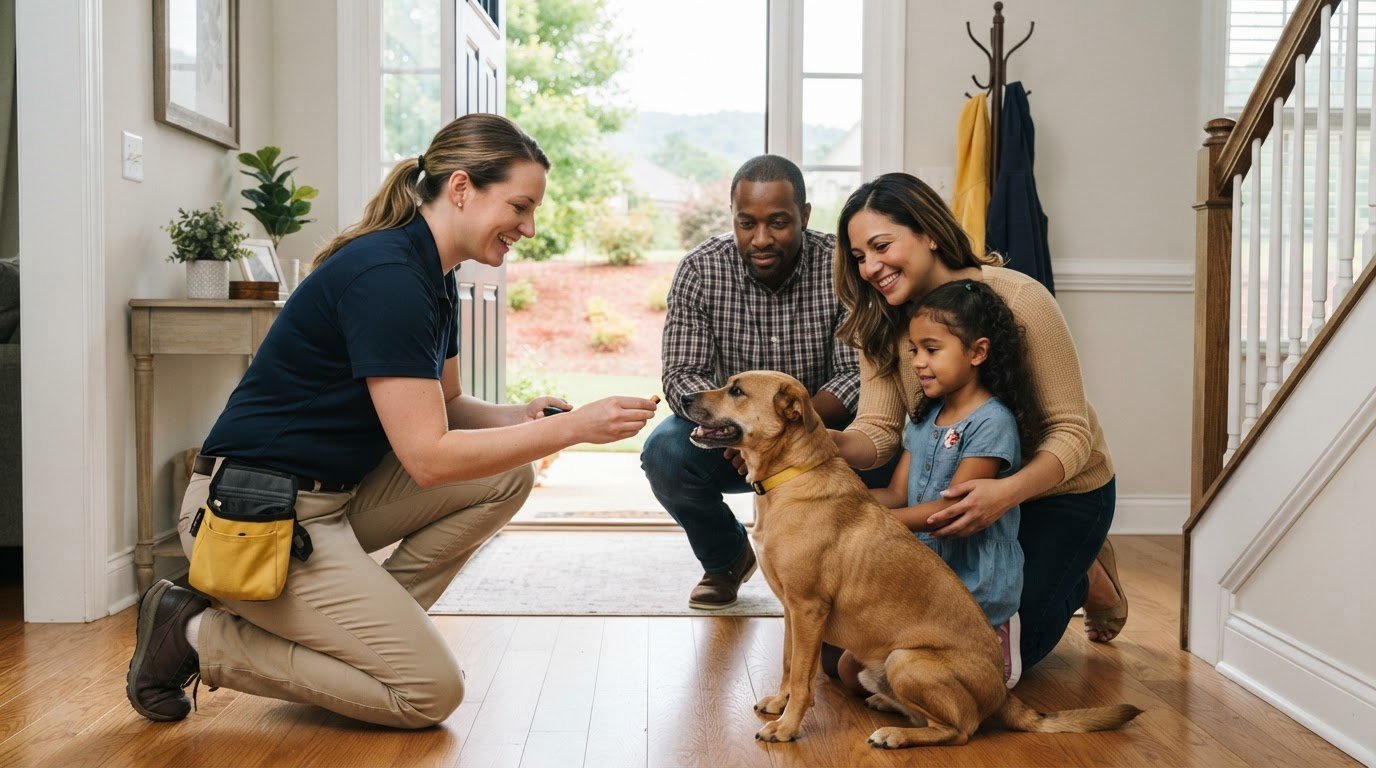
What if the key to changing your dog’s behavior isn’t another generic tip, but understanding what’s happening in the place it occurs? At-home dog behavior therapy lets a professional consider your dog’s routines, surroundings, and triggers firsthand, then tailor a plan to your household.
If barking, reactivity, fear, or other challenging behavior is disrupting family life, it’s understandable to feel frustrated, especially when advice you’ve tried hasn’t helped. You may also be unsure whether to contact a trainer or a veterinarian. Behavior-focused training can teach practical skills and support behavior change, but it doesn’t replace veterinary care or diagnose medical concerns.
This guide explains what in-home support can involve, what meaningful progress may look like, and how to prepare for a safe, useful training visit. You’ll also learn how to compare support options and when a veterinarian may be the right first step. Alan’s K9 Academy provides personalized in-home training and behavior modification for local families in Cartersville, Bartow County, and the North Atlanta Metro area. Ask about availability in your city.
Key Takeaways
• At-home dog behavior therapy can help connect behavior to household routines, spaces, and everyday triggers.
• A useful process moves from discussing your dog’s history to observing behavior, setting goals, and practising relevant skills.
• Choose between in-home training, group classes, or veterinary guidance based on the behavior and where support is needed.
• Keep notes on what happens before and after concerning behavior, and share your dog’s history, routines, and safety concerns.
• Ask prospective professionals how they assess behavior, tailor plans, involve owners, and approach safety before deciding what support fits.
At-home dog behavior therapy for everyday life
When a dog barks at every sound in the hallway, panics when a family member leaves, or reacts strongly to visitors, the stress can quickly become part of everyone’s routine. At-home dog behavior therapy is behavior-focused professional training delivered in the dog’s familiar home environment. Instead of working only on commands in an unfamiliar setting, a trainer can consider how the home, daily habits, and people around the dog may affect what happens.
That context matters. A dog’s response may differ near the front door, around another pet, or during a busy family moment. In-home coaching gives the trainer and household an opportunity to examine those patterns and practise practical responses where they’re needed. It’s collaborative: the professional guides the work, while owners learn how to reinforce skills in daily life. Progress takes observation and practice, not a one-visit cure.
Which behavior concerns may benefit from in-home support?
In-home behavior modification may be worth exploring for household manners, fear-related responses, reactivity, or other behavior that disrupts family routines. For example, a trainer may observe what happens when guests arrive or how a dog responds to activity near a window. A Dog behaviourist is one professional role associated with understanding and addressing behavior concerns, though titles and experience can vary. Ask how the professional assesses behavior and adapts support to your dog.
Suitability depends on the individual dog, behavior history, and safety needs. Share concerns before arranging support, especially if there has been biting, a risk of injury, or difficulty safely managing the dog. No single technique is right for every dog. A responsible plan should reflect the specific situation rather than promise a guaranteed outcome.
How is behavior training different from veterinary care?
A trainer teaches skills and helps owners practise consistent responses. A veterinarian assesses health concerns and can investigate whether a medical issue may be affecting behavior. Training isn’t veterinary diagnosis, medication, or emergency intervention.
If behavior changes suddenly, your dog seems to be in pain, or you suspect an underlying health concern, contact a veterinarian. Health and behavior questions can overlap, so the most useful next step may involve coordinating professional input. Once medical concerns have been considered, behavior-focused training can help you work on practical skills at home without asking a trainer to replace veterinary care.
How in-home dog behavior therapy assesses triggers and builds change
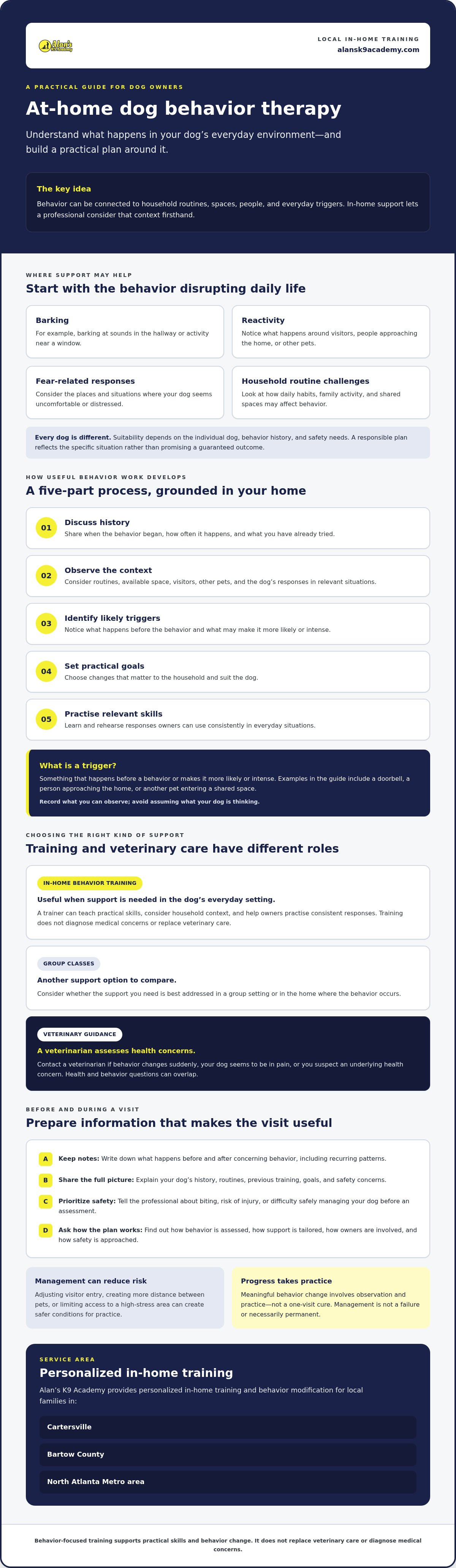
Useful behavior work starts with understanding the pattern, not simply reacting to the moment. A trainer and owner can work through the concern step by step:
Discuss history
Share when the behavior began, how often it occurs, and what you’ve already tried.
Observe
Consider the dog’s responses and household context, including daily routines, available space, visitors, and other pets.
Identify triggers
Notice what happens before the behavior and what may intensify it.
Set goals
Choose practical changes that matter to the household and suit the dog.
Practise skills
Learn and rehearse responses that can be used consistently in everyday situations.
A trigger is something that happens before a behavior or makes it more likely or intense. It might be a doorbell, a person approaching the home, or another pet entering a shared space. The same situation won’t affect every dog in the same way, so observation helps distinguish likely triggers from coincidence. When keeping notes, record what you can see rather than assuming what your dog is thinking.
Household management can also make practice safer. Adjusting how visitors enter, creating more distance between pets, or limiting access to a high-stress area may reduce risk while everyone learns new responses. Management isn’t a failure or necessarily a permanent solution. It creates safer conditions for practice.
What does a trainer observe during an in-home assessment?
An assessment may cover your dog’s behavior history, daily routines, recurring patterns, previous training, and your goals. The trainer may observe the dog in a situation connected to the concern, but safety comes first. A difficult trigger shouldn’t be brought closer just to provoke a reaction. Share known risks in advance so the trainer can plan a responsible assessment.
How do desensitization and counterconditioning fit into a plan?
Desensitization means introducing a trigger gradually, at an intensity the dog can manage. Counterconditioning aims to change the dog’s emotional association with that trigger. These approaches may be used as part of individualized behavior modification techniques, but timing and pace matter. Moving too quickly can overwhelm a dog, so a professional should tailor the plan to the dog and situation rather than prescribe a one-size-fits-all protocol.
Because owners handle day-to-day practice, look for coaching that makes the plan clear and workable for your household. If you’re exploring personalized in-home dog training, ask whether the service fits your dog’s needs and whether it’s available in your location.
At-home behavior therapy or another kind of professional support?
The right support depends on what you’re seeing, where it happens, and whether health or safety could be involved. At-home dog behavior therapy can make household patterns easier to observe, while group classes offer a different setting for practising skills. Veterinary consultation serves another purpose: assessing health concerns that may affect behavior. These options aren’t interchangeable, and one isn’t automatically best for every dog.
| Support option | Often useful for | Setting and considerations |
|---|---|---|
| In-home training | Behaviors connected to home routines, family interactions, or the household environment. | A trainer can observe patterns where they occur and coach owners as they practise skills. Work at home may not address every public setting. |
| Group classes | Learning and practising skills around other dogs and people, when the environment is suitable for the dog. | The shared setting can offer structured practice, but it may be too challenging for some dogs at a particular stage. Ask about fit before enrolling. |
| Veterinary consultation | Sudden behavior changes, suspected pain, or other possible health concerns. | A veterinarian can assess medical questions. This is distinct from training and behavior modification. |
When is in-home coaching a practical fit?
Consider in-home coaching when the concern is closely tied to your dog’s surroundings or household interactions. The trainer can consider relevant routines and help you practise responses in context. Owner participation matters because skills need to be reinforced in everyday life between sessions. For more detail on what this setting can involve, see the professional in-home dog training guide.
Keep the limits in mind. If your dog struggles mainly in parks, on walks, or in other public places, ask how the training plan will address those settings. An in-home visit can offer useful insight, but it doesn’t automatically reproduce every real-world challenge.
When should a veterinarian or other specialist be involved?
Contact a veterinarian about sudden behavior changes, possible pain, or other health concerns. Serious or escalating safety concerns also call for prompt professional assessment. Explain the risk clearly when seeking help. Training and veterinary care can complement each other, but a trainer doesn’t diagnose or treat medical conditions.
If you’re unsure which type of professional is appropriate, the ASPCA’s guidance on assistance from a qualified professional can help you understand different support roles. Share the behavior history and safety concerns so you can discuss a suitable next step.
Preparing for at-home dog behavior therapy & progress
A few clear notes can make the first session more useful. You don’t need to interpret your dog’s behavior or arrive with a perfect record. Focus on what you can observe: what happened just before the behavior, what your dog did, and what followed. For example, note whether a noise or household activity came first, how your dog responded, and how people or pets reacted afterward.
Patterns are easier to discuss when you record them over time. Keep notes brief and factual, and include the setting and how often the behavior occurs. These details can help the trainer understand the situation and discuss practical goals with your household.
What information should owners share before the first session?
Before an at-home dog behavior therapy session, gather details that can help a professional plan thoughtfully. Share how often the behavior occurs, where it happens, known triggers, relevant history, previous training, and changes in the home. Mention household members and other animals, too. Be candid about snapping, biting, escape attempts, or other safety concerns. This isn’t about blame; it helps the trainer make responsible decisions about assessment and practice.
What happened beforehand?
Note events, sounds, people, or activity nearby.
What did your dog do?
Describe visible actions rather than guessing at motives.
What followed?
Record how people, animals, or the environment responded.
What has changed?
Include routine shifts, new household members, or past training efforts.
How can families practise safely between sessions?
Follow the trainer’s individualized instructions, and don’t recreate a risky situation just to see how your dog responds. If a practice step feels unsafe or your dog’s behavior changes, pause and ask the professional how to proceed. Keep household responses as consistent as practical, so your dog receives clearer guidance from the people around them.
Use simple progress notes to track observable changes over time: how often a behavior occurs, which situations it happens in, and how your dog responds to the agreed skills. Useful progress is measured through observable behavior over time, not one standout session. Small, repeatable changes can help you and the trainer decide what to keep practising and what may need adjustment.
If you’re ready to discuss customized in-home training and behavior modification, contact Alan’s K9 Academy about in-home support. Describe your dog’s needs and ask whether the service is available in your city.
Finding at-home dog behavior therapy in Cartersville and North Atlanta
Choosing a local professional is about more than finding someone who offers at-home dog behavior therapy. Look for a clear assessment process, an approach tailored to your dog and household, and guidance you can apply between sessions. A useful initial conversation should leave you understanding what the professional can help with, what falls outside their role, and how safety will be considered.
What should you ask a local behavior trainer?
Use an initial discussion to understand how the trainer works and whether their support fits your situation. Consider asking:
• How will you assess my dog’s behavior and learn about our household routines?
• How will the plan be adapted to my dog, and how will I practise skills between sessions?
• What safety steps should we take during training and at home?
• How do you decide when a concern is outside your role or needs veterinary input?
Notice whether the answers address your concerns or rely on one solution for every dog. Share any history of bites, escalating behavior, or other safety risks openly. A responsible professional should be willing to discuss boundaries and recommend veterinary assessment when health questions may be involved.
How can Alan’s K9 Academy help local dog owners?
Alan’s K9 Academy provides personalized in-home dog training and behavior modification in Cartersville, Bartow County, and the North Atlanta Metro area. Founded by Master K9 Trainer Alan Carr, the academy draws on over 35 years of professional dog-instruction experience and uses balanced, humane methods. In-home support can help tailor training to the dog and household, with owners involved in practising skills. It’s training support, not veterinary diagnosis or medical treatment.
For additional background, read the academy’s complete guide to dog behavioral training. Before arranging support, ask whether in-home service is available in your city and how the academy would approach your dog’s needs.
Take a practical next step: describe the behavior, when and where it occurs, and any safety concerns. Then discuss whether the academy’s in-home training or behavior modification is an appropriate fit. That conversation can help you identify a thoughtful path forward for your household.
Take the next step toward a calmer home
Lasting behavior change begins with understanding what’s behind a dog’s actions and how everyday surroundings shape them. At-home dog behavior therapy can help make those patterns clearer, while practical coaching gives you skills to work on with your dog. Progress takes consistent practice and should be judged by observable changes over time, not the promise of an instant fix.
Choose support that fits your dog’s behavior and safety needs. Training can guide skills and owner responses, while sudden changes, suspected pain, or other health concerns call for veterinary input. The right professionals can help you understand which kind of support makes sense.
Alan’s K9 Academy provides personalized in-home training and behavior modification in Cartersville, Bartow County, and the North Atlanta Metro area. Founded by Master K9 Trainer Alan Carr, the academy brings over 35 years of professional dog-instruction experience. Talk with Alan’s K9 Academy about personalized behavior support, and ask whether service is available in your city. With a clear plan and thoughtful guidance, you can take a practical next step for your dog and household.
Frequently Asked Questions
What is at-home dog behavior therapy?
At-home dog behavior therapy is professional, behavior-focused training delivered in the dog’s familiar home environment. A trainer considers the dog’s surroundings and household routines while helping owners practise skills related to specific behavior concerns. Support may involve discussing the dog’s history, observing relevant patterns, setting practical goals, and following a customized plan. It isn’t a veterinary diagnosis or a promise of instant change, and progress depends on the individual dog and consistent practice.
Can a dog trainer help with anxiety or aggression at home?
A dog trainer with relevant behavior-modification experience may help owners work on anxiety-related behaviors or aggression through tailored training and guidance. The right approach depends on the dog’s history, triggers, and safety needs, so describe concerns clearly before beginning. A trainer can teach skills and guide owner responses, but can’t diagnose or treat medical conditions. For suspected pain, sudden behavior changes, or health concerns, consult a veterinarian as well.
How does an in-home dog behavior session work?
An in-home session typically begins with a discussion of your dog’s history, household routines, previous training, and your goals. The professional may observe relevant behavior and the conditions around it, then discuss triggers, safety, and practical next steps. You’ll be involved in learning and practising skills suited to your household. Don’t deliberately recreate an unsafe situation to prompt a reaction; share known risks so the trainer can plan responsibly.
Is in-home dog behavior training better than group classes?
Neither option is automatically better. In-home training lets a professional consider household patterns and coach you in the setting where home-related behavior occurs. Group classes provide a structured environment to practise skills around other dogs and people, which may suit some dogs and goals. A dog who is fearful or reactive may find a group setting difficult, so discuss your dog’s needs and safety with a professional before choosing.
How long does dog behavior modification take?
There’s no reliable timeline that applies to every dog. The pace can depend on the behavior, its history, the dog’s responses, household consistency, and how safely skills can be practised. Rather than expecting a single-session fix, track observable patterns over time, such as how often a behavior occurs and how your dog responds to agreed strategies. Ask the trainer how progress will be reviewed and when a plan might need adjustment.
Should I see a veterinarian before hiring a dog behavior trainer?
Contact a veterinarian first if the behavior changed suddenly, your dog may be in pain, or you have another health concern. A veterinarian can assess medical questions, while a trainer focuses on teaching skills and guiding owner responses. These kinds of support can complement each other, but they aren’t interchangeable. If there’s an immediate safety risk, take steps to keep people and animals apart and seek appropriate professional help promptly.
Can at-home dog behavior therapy help with behavior outside the home?
At-home dog behavior therapy can help you and your dog practise foundation skills and understand behavior patterns, but an in-home session may not cover every public setting. Ask how the professional can help you prepare for situations such as walks or visitors in unfamiliar places, and whether additional practice is appropriate. Alan’s K9 Academy serves Cartersville, Canton, Woodstock, Marietta, Rome, Acworth, Kennesaw, Sandy Springs, Roswell, Alpharetta, Powder Springs, Dallas, Hiram, Jasper, Cumming, Holly Springs, Ball Ground, and Milton. Confirm availability for your city.