%20(620%20x%20150%20px)%20(14).webp)
%20(620%20x%20150%20px)%20(15).webp)
.webp)
_page-0001.webp)
.webp)

Alpharetta Dog Obedience School: Build Skills for Real Life
What good is a “sit” your dog knows at home if it disappears when the doorbell rings or a walk gets distracting? If you’re considering an Alpharetta dog obedience school, you’re likely looking for skills that carry over into everyday life, not just familiar practice sessions. That takes more than te...
%20(5).gif)
What good is a “sit” your dog knows at home if it disappears when the doorbell rings or a walk gets distracting? If you’re considering an Alpharetta dog obedience school, you’re likely looking for skills that carry over into everyday life, not just familiar practice sessions. That takes more than teaching cues. It takes clear communication and consistent practice between you and your dog.
It’s understandable to wonder whether private instruction or a group class is the better fit, especially when your dog’s behavior is difficult to manage. Choose a format based on the goal, your dog’s comfort in that setting, and where you need the skill to work. Personalized guidance can help turn challenging behaviors into specific steps to practise.
This article explains what effective obedience training involves, how in-home training and structured group classes support different needs, and how Alan’s K9 Academy serves Alpharetta families. Founded by Master K9 Trainer Alan Carr, the academy brings over 35 years of professional dog-instruction experience to hands-on training that puts owner participation and lasting communication at the center.
Key Takeaways
• Start by identifying the everyday situations where your dog needs clearer, more consistent skills.
• Learn how balanced, humane instruction can help you build communication through clear cues and thoughtful practice.
• Compare private in-home lessons with structured group classes to find a learning format suited to your dog and household.
• Use a simple plan to track behavior patterns, choose goals, practise skills, and review progress.
• See how an Alpharetta dog obedience school like Alan’s K9 Academy can provide personalized guidance for real-life training goals.
Looking for an Alpharetta Dog Obedience School? Start With Your Dog’s Everyday Needs
Does your dog pull toward every interesting smell, jump up to greet guests, or ignore a familiar cue when the setting changes? Maybe settling at home is difficult, or you’re unsure what to work on first. These challenges can make ordinary routines feel like a training test. Start by noting when the behavior happens, what is going on around your dog, and what you’d like to happen instead. For instance, “walk more calmly” becomes more useful when you identify the route or moment where pulling is most difficult.
An obedience school is structured instruction where dogs and their owners learn practical skills together. Put simply, dog obedience training teaches people and dogs to communicate clearly so everyday routines become easier to manage. The “school” is the learning process, not necessarily a building. An Alpharetta dog obedience school should help turn broad hopes, such as “listen better,” into useful goals connected to your daily life.
Which everyday challenges can obedience training address?
For many households, a starting point is basic manners: walking with a manageable leash, responding to familiar cues, greeting people politely, or settling when family life gets busy. The best goals depend on your dog’s current behavior and your routines. A household with frequent visitors may prioritize calmer greetings; another may focus on more attentive walks or consistent responses at home. Choose goals you can observe, such as keeping four paws on the floor during a greeting, rather than a general aim like “be better behaved.”
Aggression, anxiety, and other complex behavior concerns are different from everyday manners goals. They shouldn’t be reduced to a single obedience cue or treated as a diagnosis based on a description. They may call for individualized behavior modification and professional guidance suited to the situation. Notes about what happens before and after a behavior, where it occurs, and who is present can help make a discussion about support more specific.
What should owners expect from professional instruction?
Professional coaching involves both ends of the leash. The instructor works with your dog while also helping you recognize useful moments, give cues clearly, and respond consistently. Alan’s K9 Academy serves Alpharetta and nearby North Atlanta communities with personalized in-home training, behavior modification, and structured group classes. Its balanced, humane approach centers on building communication between dogs and the people who handle them.
Progress isn’t confined to a session. Skills need thoughtful practice in the situations where you want to use them, and consistency from the household helps your dog understand what’s expected. The broader overview of Dog training offers useful context on methods and purposes, while the North Atlanta dog obedience training guide explores how owners can work toward real-world reliability. To make professional guidance more focused, choose one routine that feels difficult and describe what you’d like to see instead.
How Effective Dog Obedience Training Builds Reliable Communication
A dog may respond to a cue in one moment and miss it in another. That doesn’t automatically mean the dog is being stubborn. The setting, the handler’s timing, and whether the cue has been practised in that situation can all affect communication. Effective instruction helps you notice those details and gives you a clearer, more consistent way to guide your dog.
Alan’s K9 Academy uses balanced, humane methods. In practice, instruction is tailored to the dog and owner, with an emphasis on clear communication and appropriate guidance rather than a one-size-fits-all formula. A cue should have a consistent meaning, and your response should be clear to your dog. The American Kennel Club dog training advice also offers general training guidance for owners who want to understand the learning process.
Why owner participation matters in obedience lessons
Your dog spends far more time with you than with an instructor, so lessons should help you practise the skills you’ll use together. Coaching can help you deliver cues clearly, recognize your dog’s response, and choose a consistent next step. At home, familiar routines offer natural chances to practise: before meals, while preparing for a walk, or as the household settles for the evening. Agreeing on the same cue and response with everyone who handles the dog also avoids sending mixed messages.
Consistency gives your dog a clearer message, making it easier to understand what you’re asking across everyday situations. A lesson provides guidance, but continued practice matters; attending lessons alone can’t guarantee a particular result.
How training practice transfers to everyday settings
Skills learned in a calm setting may need gradual practice as ordinary distractions arise. Begin where your dog can pay attention, then work toward busier or less familiar situations at a pace suited to that dog. For example, practise a cue in a quiet part of the home before trying it near a normal household activity. If your dog struggles, make the situation easier and revisit the skill without turning practice into a standoff.
Daily routines also help you assess what’s becoming more reliable and what still needs attention. Notice whether your dog responds more readily in one room than another, or whether a familiar cue becomes harder when the household is active. These observations give you useful details to discuss during professional coaching. For a closer look at individualized sessions in the home, explore this professional in-home dog training guide.
Keep cues clear
Use the same word and a calm, consistent delivery for a given request.
Practise in manageable steps
Change one part of the setting at a time, such as location or background activity.
Notice patterns
Record where your dog responds well and where more support may help.
This is the practical value of working with an Alpharetta dog obedience school: instruction can connect the lesson to the choices you make with your dog between sessions. Alan’s K9 Academy’s in-home dog training focuses on hands-on coaching at home.
Private Dog Lessons or Group Classes: Choosing a Training Format Near Alpharetta
Choosing a format isn’t about finding one approach that suits every dog. Match the learning setting to your goals, your dog’s needs, and where you want to use new skills. Private in-home sessions focus on your household and individual priorities. Structured group classes let owners and dogs learn in a shared class environment. Both require active owner participation and practice beyond instruction.
Use this comparison as a starting point, not a strict rule. Your dog’s comfort, the behavior you want to work on, and your own learning preferences all matter.
| Format | Setting | Potential fit |
|---|---|---|
| Private in-home training | Your home and familiar routines | Owners seeking individualized coaching connected to household goals |
| Structured group classes | A class setting with other owners and dogs | Owners who want to practise skills in a shared learning environment |
When personalized in-home dog training may fit
Home-based coaching can be useful when your goals are closely tied to routines in your own space, such as how your dog responds to household activity or moves through daily routines. An instructor can focus on your dog’s individual needs and help you work on relevant skills where those routines happen. Before a session, note when the challenge occurs and what you have already tried. Those details help keep the discussion anchored in your household’s priorities.
Alan’s K9 Academy provides personalized in-home training for Alpharetta families. The in-home dog training overview explains more about this approach.
What structured group classes can help owners practise
In a structured class, you and your dog learn alongside other owner-dog teams. The shared setting offers a chance to practise obedience skills while other people and dogs are present, as appropriate for your dog. It can also help owners focus on giving clear cues and responding consistently outside the home. A group environment isn’t automatically the right fit for every dog or behavior concern.
Alan’s K9 Academy offers structured group classes as another way for owners and dogs to learn together. Think about your dog’s comfort around other dogs and people, the skills you want to build, and whether an individualized home setting or shared class better supports those goals. For a complex behavior concern, individual guidance may be a more appropriate starting point than expecting a group class to address every need.
Before choosing, write down one or two specific goals and the situations where they matter. An Alpharetta dog obedience school can help connect those priorities to a suitable format. The best fit is the one that gives you practical guidance to carry into everyday life, with expectations tailored to your dog rather than a promise of instant change.
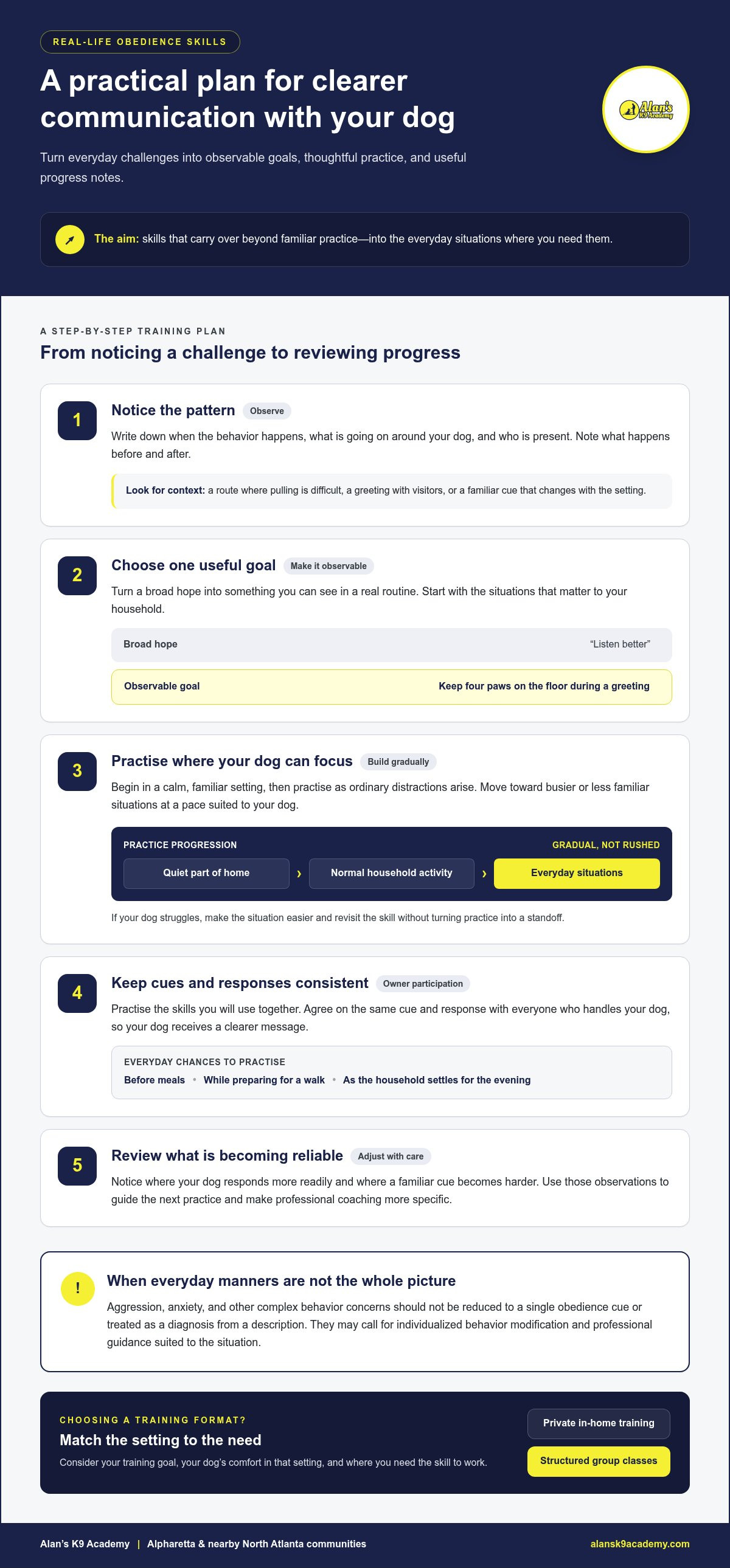
A Practical Training Plan for Alpharetta Dog Owners
A workable plan turns a general hope into a skill you can observe and practise. Rather than trying to change everything at once, pick a priority and gather useful details about the moments that are difficult. This gives you a clearer starting point for home practice or professional guidance and helps keep expectations realistic.
Identify a specific goal.
Replace “better manners” with an observable aim, such as walking with a looser leash for part of a familiar route or greeting visitors with all four paws on the floor.
Describe the situation.
Note when the behavior happens, what occurs just before it, and what follows. Include details such as location, people nearby, time of day, and what you were doing.
Choose a suitable format.
Consider whether your goal is tied to home routines or would benefit from practising in a structured class setting. For complex concerns, seek individualized professional guidance.
Practise in manageable moments.
Choose brief opportunities that fit your dog’s needs and the skill you’re building. If the situation becomes too difficult, simplify it rather than pushing through.
Review and adjust.
Keep notes on what’s changing in the target situation and where your dog still needs support. Use those observations to refine the goal or discuss next steps with a trainer.
Set goals based on your dog’s real-life routines
Useful goals connect directly to daily life. At home, you might focus on settling during a familiar routine; on walks, you could work toward more attentive leash handling; when visitors arrive, you may want a calmer greeting. Focus on one or two priorities first, so practice stays clear and achievable for the household.
Aggression, anxiety, or other complex behavior concerns call for care and individualized support, not assumptions based on a label. Alan’s K9 Academy offers behavior modification, with professional guidance shaped around the dog and situation.
Keep practice consistent and recognize meaningful progress
Build practice into ordinary routines rather than relying on occasional long sessions. Agree on shared cues and responses with everyone who handles the dog, then look for suitable chances to practise the same skill throughout the day. The goal isn’t to demand perfection; it’s to notice useful changes, such as a response becoming easier in a particular context, while recording situations that remain challenging.
There’s no universal timeline for change. Review your notes and adjust the difficulty to suit your dog. Owners working through more involved behavior concerns can explore this dog behavioral training guide for additional context.
A practical owner-led training plan sets a clear goal, tracks real-life patterns, and builds skills through consistent practice and thoughtful review. Alan’s K9 Academy provides professional guidance to help owners put a plan into practice, serving Alpharetta and North Atlanta communities.
Start Dog Obedience Training With Alan’s K9 Academy Near Alpharetta
Choosing a training path is easier when it connects to your dog’s actual needs and your family’s daily life. Alan’s K9 Academy serves Alpharetta and the North Atlanta Metro area with personalized dog training rooted in communication between owners and their dogs. Founded by Master K9 Trainer Alan Carr, the academy draws on his more than 35 years of professional dog-instruction experience.
Training is a partnership. Alan’s K9 Academy uses balanced, humane methods and emphasizes hands-on guidance that owners can carry into everyday routines. Whether you want to build foundational obedience or need support with a more involved behavior concern, the focus is on meaningful work tailored to the dog and household, not a promise of instant change.
How Alan’s K9 Academy supports different training goals
Personalized in-home training connects instruction to your dog’s familiar surroundings and your household’s priorities. Goals might include puppy obedience, smoother routines at home, or practising responses amid appropriate distractions. If your longer-term aim is more reliable responses in situations where greater freedom is involved, professional guidance can help you understand the skills and practice that goal requires without assuming a particular timeline or outcome.
For aggression, anxiety, or other complex behavior concerns, Alan’s K9 Academy offers behavior modification. Each situation deserves thoughtful, individualized guidance rather than a quick label or one-size-fits-all answer. The academy also provides therapy and service dog foundation training. Foundation work can support a training path, but it should not be confused with a promise of certification or that a dog will ultimately work in a particular role.
Structured group classes offer another learning format, giving owners and dogs the opportunity to work together in a class environment. A group setting and private in-home instruction serve different purposes. Your priorities, your dog’s needs, and the context where you want to use new skills can help guide the choice.
Take the next step toward clearer communication
Before starting, consider the situations you want to improve and the kind of guidance that would fit your home. Goals tied to household routines may point toward personalized sessions, while owners seeking shared class learning may prefer a structured group setting. For complex behavior issues, individualized behavior modification provides a way to focus on the concerns specific to your dog. Your participation helps connect instruction to life beyond a session.
If you’re searching for an Alpharetta dog obedience school, Alan’s K9 Academy offers professional guidance for building practical skills and stronger communication with your dog. Explore dog training with Alan’s K9 Academy and find a path that makes sense for your goals.
Take the Next Step Toward Everyday Progress
Pick one moment in your routine where a little more understanding between you and your dog would make a difference. That’s a practical place to begin: a clear goal gives you something specific to discuss and work toward, without expecting everything to change at once.
If you’re looking for an Alpharetta dog obedience school, Alan’s K9 Academy is an award-winning academy serving Alpharetta and the North Atlanta Metro area. Its focus on owner-dog communication helps turn concerns into a thoughtful training direction that fits your family’s routines. Progress grows through partnership, patience, and practice, one meaningful step at a time.
Explore dog training with Alan’s K9 Academy and take a positive next step for you and your dog. Clearer communication starts with a goal you can build on together.
Frequently Asked Questions
Does Alan’s K9 Academy serve dog owners in Alpharetta, Georgia?
Yes. Alan’s K9 Academy serves Alpharetta, along with Cartersville, Canton, Woodstock, Marietta, Rome, Acworth, Kennesaw, Sandy Springs, Roswell, Powder Springs, Dallas, Hiram, Jasper, Cumming, Holly Springs, Ball Ground, and Milton. For families searching for an Alpharetta dog obedience school, the academy offers in-home training and group classes across its North Atlanta Metro service area. Start by noting your priority, such as a puppy’s first cues or a routine that needs work.
What does a dog obedience school teach?
A dog obedience school teaches practical skills that help dogs and handlers work together, such as responding to cues, walking with more control, and following household expectations. Instruction can also help owners learn how to give a cue and respond to their dog’s behavior. The exact skills depend on the dog and family’s goals. For example, a new puppy may need foundational cues, while another dog may need more practice responding around everyday distractions.
Are private dog lessons or group classes better for obedience training?
Neither format is best for every dog. Private lessons offer focused instruction around an individual dog and household, while group classes provide a shared setting for practising skills with other owners and dogs present. Think about your main goal and your dog’s comfort in each environment. If you’re working on a situation that happens at home, individual coaching can make practice relevant; a class can suit owners seeking structured group learning.
Can an older dog learn obedience skills?
Yes, older dogs can learn new skills. Training goals can be adapted to the dog’s experience, pace, and current abilities, so starting later doesn’t mean you can’t build clearer communication. Choose a practical first skill and practise it in a familiar, manageable setting. If your older dog finds a situation difficult or shows a complex behavior concern, personalized professional guidance can help shape an approach around that dog’s needs.
How long does dog obedience training take?
There isn’t one fixed timeline for every dog. The time involved depends on the skills you’re working on, the dog’s individual needs, and how regularly the household can practise between lessons. Instead of measuring progress by a deadline, look for changes in the specific situation you’re addressing, such as responding more consistently in a familiar context. Your trainer can help review what’s working and adjust the practice as needed.
Can obedience training help with aggression or anxiety?
Obedience cues can be one part of a broader training plan, but aggression, anxiety, and other complex concerns may need behavior modification rather than basic manners instruction alone. A professional can help you understand the situation and guide training around your dog’s behavior and circumstances. Note what happens before and after the behavior, and share those observations during instruction. Training should be individualized, and outcomes vary by dog and situation.
What should I practise with my dog between training sessions?
Practise the skills your instructor has covered, using the same cues and responses so your dog receives a consistent message. Choose ordinary moments that suit the skill, such as asking for a pause before opening a door or practising a familiar cue during a quiet part of the day. Keep brief notes about what went smoothly and what distracted your dog. Bring those observations to your next session to guide further practice.