%20(620%20x%20150%20px)%20(14).webp)
%20(620%20x%20150%20px)%20(15).webp)
.webp)
_page-0001.webp)
.webp)
Aggressive Dog Rehabilitation in Georgia: A Safer Path Forward
Could your dog become safer and more manageable without treating aggression as a character flaw? If you’re searching for aggressive dog rehabilitation GA, you may be worried someone will get hurt and unsure what’s behind your dog’s reactions. Those concerns deserve attention, but they don’t mean you...
%20(5).gif)
Could your dog become safer and more manageable without treating aggression as a character flaw? If you’re searching for aggressive dog rehabilitation GA, you may be worried someone will get hurt and unsure what’s behind your dog’s reactions. Those concerns deserve attention, but they don’t mean you’ve failed your dog. Aggression can have different triggers, so a useful plan starts with the individual dog and the situations around them.
Rehabilitation isn’t a quick obedience fix. It’s a staged process that can include behavior modification, practical safety steps, and guidance for the people who live with the dog. This guide explains how to record useful observations, reduce avoidable risk at home, and work with a professional to shape a plan for everyday life.
For families in Cartersville, Bartow County, and the North Atlanta Metro area, Alan's K9 Academy provides in-home behavior modification and group classes. Master K9 Trainer Alan Carr brings over 35 years of professional dog instruction experience and uses balanced, humane methods tailored to the dog and household. With consistent practice and hands-on guidance, you can begin building a realistic path forward, one careful step at a time.
Key Takeaways
• Growling, snapping, or lunging are signals to take seriously, not a complete picture of your dog or what’s motivating the behavior.
• Aggressive dog rehabilitation GA is individualized behavior-modification work that considers triggers, household routines, and the dog’s responses.
• Obedience skills can support communication, but they may not address the behavior concern on their own.
• While seeking professional guidance, reduce avoidable exposure, create separation, and record incidents. Don’t test your dog by deliberately provoking a reaction.
• Personalized guidance can help you set practical priorities and build a plan around your dog and household.
Aggressive Dog Behavior in Georgia: Recognize the Signs and Take Concerns Seriously
A growl during a family visit, a lunge at another dog on a walk, or a bite can leave you shaken and unsure what to do next. Take the behavior seriously, but don’t assume one incident tells you everything about your dog. An observed action is a reason to look closer, not a reason to shame yourself or label your companion as bad.
Aggression is behavior that needs context, not a personality label. The same outward response can happen for different reasons, and a single sign doesn’t establish a cause. Consider what happened just before the behavior, who or what was nearby, how your dog’s body changed, and what happened afterward. For a broader overview of possible influences and types, see Understanding Dog Aggression.
What behaviors may signal a need for professional guidance?
Growling, stiffening, snapping, lunging, and biting are worth documenting and discussing with a qualified professional, especially if they recur, intensify, or make daily routines difficult. They may occur around unfamiliar people, other dogs, handling, food, resting places, or particular situations. None of these actions alone explains the dog’s motivation. A growl can warn that a dog is uncomfortable, so treat it as useful information rather than punishing or dismissing it.
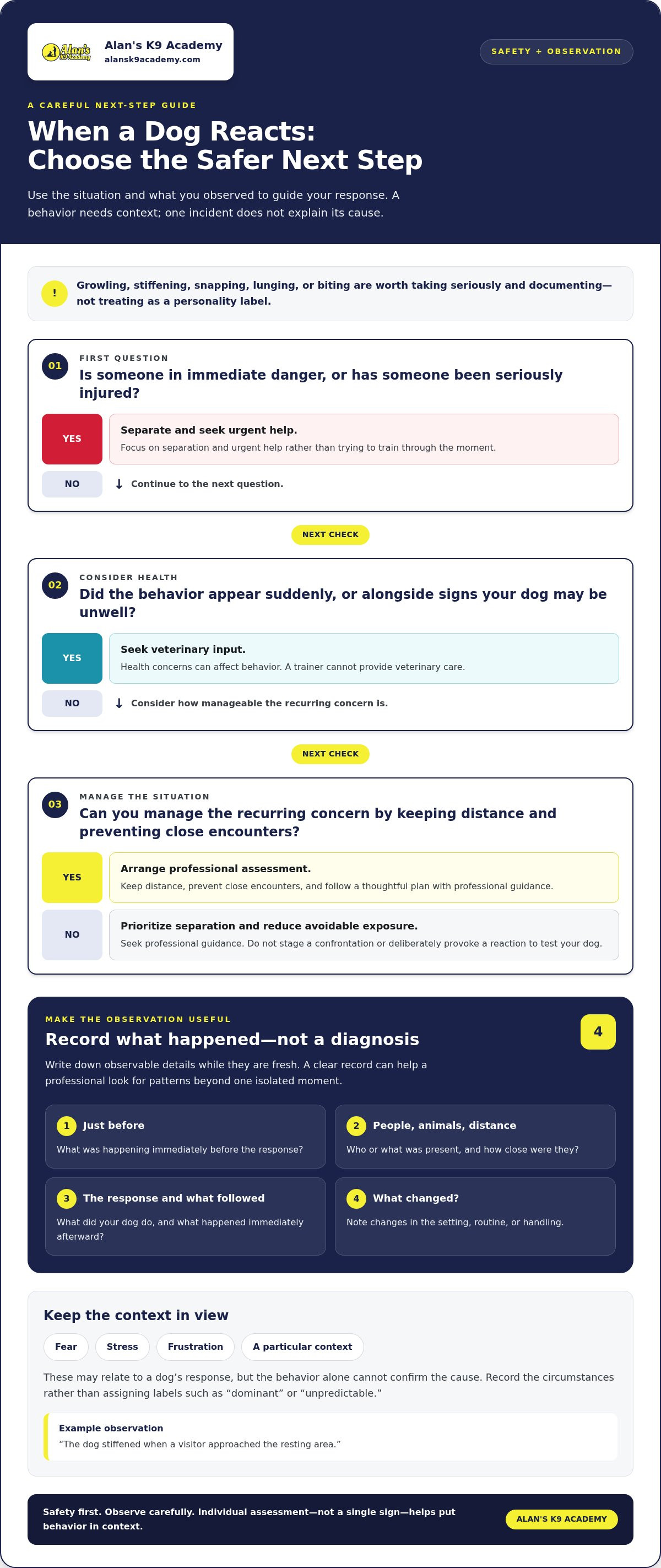
After an incident, write down what you observed while the details are fresh:
• What was happening immediately before the response?
• Who or what was present, and how close were they?
• What did the dog do, and what happened immediately afterward?
• Did anything change in the setting, routine, or handling?
Record observable details rather than conclusions such as “dominant” or “unpredictable.” For example, note that your dog stiffened when a visitor approached the resting area. A clear record helps a professional look for patterns without relying on one isolated moment.
Why the same behavior can have different triggers
A dog’s response may relate to fear, stress, frustration, or a particular context, but the behavior alone can’t confirm which factor is involved. A dog might lunge at another dog in one setting but not another. Record that difference rather than treating it as a diagnosis. Body language and surrounding events add clues, but an individual assessment is needed to understand how they fit together.
Consider urgency as well. If you can manage a recurring concern by keeping distance and preventing close encounters, arrange professional assessment and follow a thoughtful plan. If someone is in immediate danger or has been seriously injured, focus on separation and urgent help rather than trying to train through the moment. Don’t stage a confrontation to see what your dog will do.
If the behavior appears suddenly or alongside signs that your dog may be unwell, seek veterinary input. Health concerns can affect behavior, and a trainer can’t provide veterinary care. For families exploring aggressive dog rehabilitation GA, clear observations about what happened and when can make professional behavior-modification guidance more relevant to daily life.
How Aggressive Dog Rehabilitation Builds a More Manageable Response
Rehabilitation is individualized behavior-modification work that helps a dog and household handle challenging situations more effectively. It isn’t an instant obedience result or a guaranteed cure. The work starts by understanding what’s happening, then shapes a practical plan and responses that are more manageable in everyday life. The ASPCA Guide to Canine Aggression also emphasizes considering the factors behind a dog’s behavior rather than treating every case alike.
Owner participation matters because the dog’s daily environment and interactions are part of the work. Professional guidance can help you decide what to practice, how to communicate with your dog, and how to fit the plan into household routines. The aim is not to judge you or your dog. It’s to give you a clearer, consistent way forward.
Assessment begins with the dog’s real-life context
A useful assessment looks beyond a single incident. It considers the dog’s behavior history, the situations in which concerns arise, household routines, and what the people involved need to manage more confidently. Your observations and goals matter. A dog who struggles during handling may need a different approach from one who reacts in a particular home or social setting. Tailoring the work to the dog and household is more useful than applying the same exercise to every case.
• Describe the situations that tend to bring on the behavior, including what happened just before it.
• Explain your household routines and which situations feel hardest to manage.
• Set realistic goals for communication and daily life.
What personalized behavior modification can focus on
Based on the dog’s needs, professional guidance can focus on clearer communication, practical management, and tailored exercises for the dog and household. Consistent practice in everyday situations helps connect the guidance to real routines. The focus should follow the individual assessment, not a preset promise or one-size-fits-all formula.
Track practical changes you can observe. You may become better at noticing when your dog needs more space, feel more prepared to manage a routine, or see a more manageable response in a situation addressed by the plan. That doesn’t mean there will never be another reaction. It gives you and your professional a basis for reviewing what is changing and adjusting the work thoughtfully.
For families considering aggressive dog rehabilitation GA, in-home behavior modification connects professional guidance with the environment where daily routines happen. Alan's K9 Academy provides personalized behavior modification using balanced, humane methods. Explore personalized behavior modification guidance to learn how a tailored approach can support your dog and household.
Aggression Rehabilitation vs. Obedience Training: Choose the Right Goal
It’s understandable to think a dog who growls, snaps, or lunges needs firmer commands. But adding cues or discipline may not address what’s behind the response. Obedience training and behavior modification have different primary goals, although some practical skills can support both. Texas A&M University’s Research on Canine Problem Behaviors underscores why behavior concerns deserve thoughtful attention rather than a one-size-fits-all assumption.
| Area | Obedience training | Aggression rehabilitation |
|---|---|---|
| Primary goal | Build useful cues and everyday reliability. | Understand and address a specific behavior concern while building more manageable responses. |
| Typical concern | A dog needs support with skills such as responding to cues in daily routines. | Repeated growling, snapping, or lunging calls for attention to triggers and context. |
| Role of professional guidance | Help teach and practice relevant skills. | Assess the dog and household, then tailor behavior-modification guidance to their needs. |
One kind of training doesn’t make the other irrelevant. A dog may benefit from both, but the starting point should match the concern. A reliable “come” or “stay” cue can be useful, yet it doesn’t automatically explain why a dog reacts in a particular situation or resolve the factors involved. Discipline alone can also miss useful information in the dog’s response. The goal is to understand what’s happening and choose appropriate work, not to assume the dog simply needs more commands.
When behavior modification is the more relevant starting point
If growling, snapping, or lunging happens repeatedly, seek professional behavior guidance that explores when and where it occurs. A response near another dog, during handling, or in a specific household routine can have different influences. An individualized assessment helps shape the work around the dog and the people who live with them. It avoids assuming that every reactive behavior has the same cause or needs the same exercise.
Where obedience skills fit into rehabilitation
Everyday skills can support communication during behavior work, but they’re one part of a broader plan, not a substitute for understanding the concern. The owner’s role matters: notice the situation, respond consistently, and practice the guidance in ordinary routines. If your goal is general reliability rather than addressing aggression, an dog obedience training guide can help you focus on foundational skills. For families seeking aggressive dog rehabilitation GA, behavior modification is the more relevant starting point when aggression is the central concern.
A Georgia Owner’s Safety and Observation Plan While Seeking Help
While you arrange professional guidance, focus on what you can safely manage today. A predictable routine and useful observations can reduce avoidable risk and give a professional a clearer picture. Don’t test your dog by staging a confrontation or deliberately exposing them to a trigger. A reaction can put people and animals at risk, and it isn’t a safe substitute for assessment.
Reduce avoidable exposure.
For now, avoid situations you already know may bring on a reaction. Adjust household routines to limit unexpected close encounters rather than relying on your dog to cope with a difficult situation.
Create separation.
When you can do so safely, keep your dog apart from people or animals involved in a known concern. Keep children and other household members away from interactions they can’t safely manage. If separation isn’t possible without putting someone at risk, move people away and seek help.
Document what happened.
Record the setting, who or what was present, approximate distance, what occurred just before the response, and what happened afterward.
Seek qualified support.
Share your notes and relevant incident history with a behavior professional. If you have health concerns or the behavior changed suddenly, share the history with your veterinarian as well.
Record useful details without provoking another incident
Use factual descriptions. “Dog stiffened when a visitor approached the resting area” is more useful than “dog is mean” or “dog wanted to attack.” Include changes in routine or handling that may help explain the setting. You don’t need to recreate the event or get closer to gather evidence. Your safety comes first. Written observations can help a professional understand patterns and tailor guidance to your household.
Reduce avoidable risk in everyday routines
Think through moments that could lead to an accidental encounter, such as arrivals at the door, shared spaces, or routine care. Adjust the routine to keep people and animals apart where needed. If children are in the home, an adult should manage any necessary separation. Children shouldn’t be asked to supervise or handle a situation involving a known trigger.
If someone is in immediate danger, contact local emergency services. If anyone is bitten or injured, seek appropriate medical care promptly. Training guidance is not a replacement for emergency response or medical treatment.
For families in Cartersville, Bartow County, and the North Atlanta Metro area, personalized in-home behavior modification brings professional guidance into the environment where daily routines happen. If you’re considering aggressive dog rehabilitation GA, explore personalized behavior-modification support and take a considered next step with your dog and household.
Personalized Aggressive Dog Rehabilitation with Alan's K9 Academy
When aggression or another complex behavior concern affects home life, support should account for the dog and the people who care for them. Alan's K9 Academy provides personalized behavior modification and in-home dog training, helping families address concerns in the context of everyday routines. The goal is practical guidance tailored to the situation, not a one-size-fits-all formula or a promise of a particular outcome.
Founded by Master K9 Trainer Alan Carr, the academy brings more than 35 years of professional dog instruction experience to its work. For families looking into aggressive dog rehabilitation GA, local guidance is available in Cartersville, Bartow County, and the North Atlanta Metro area.
How professional support can fit the dog and household
Personalized behavior modification starts with the dog’s needs and the household’s real-life concerns. The work can account for behavior history, known triggers, routines, and what family members need help managing. In-home training makes the home environment part of the picture, while owner participation helps carry guidance into daily interactions. Goals and exercises are tailored to the individual dog, without a fixed promise about results or timing.
Your knowledge of daily routines and situations is valuable. Professional guidance can help you interpret your dog’s responses and communicate more consistently. Together, you can focus on realistic priorities, such as managing a difficult routine more thoughtfully or responding with a clearer plan when a concern arises. The approach is balanced and humane, with the dog and household considered as a whole.
Taking the next step with a local trainer
To make an initial conversation useful, gather the details you’ve observed. Share your dog’s behavior history, situations that seem to trigger a response, what you’ve already tried, and which household routines feel most challenging. Be candid, even if an incident feels upsetting. Clear information helps shape guidance around your circumstances rather than assumptions.
Alan's K9 Academy serves families in Cartersville and Bartow County, as well as the broader North Atlanta Metro area. Its behavior-modification and in-home training support includes the dog’s people and everyday environment. Keep your dog’s individual needs at the center: general information can help you prepare, while personalized support helps you consider practical next steps for your household.
You don’t have to sort through the concern alone. Share what you’ve noticed and discuss a path that fits your dog and household. Talk with Alan’s K9 Academy about behavior-modification support.
Take the Next Step Toward a More Confident Routine
You don’t have to map out every part of the journey before asking for guidance. Start with one realistic priority: a daily situation you’d like to understand or manage with greater confidence. Bring your questions and observations, even if the pattern still feels unclear. A thoughtful conversation can help turn uncertainty into a practical next step for you and your dog.
Choosing aggressive dog rehabilitation GA means looking for support that respects your dog’s individual needs and includes you in the work. There’s no need for shame or blame. What matters now is moving forward with care, clear communication, and a plan shaped around real life.
Talk with Alan’s K9 Academy about personalized behavior support. A steadier path can begin with one conversation, and you and your dog deserve the chance to take that step with support.
Frequently Asked Questions
Can an aggressive dog be rehabilitated?
Behavior modification can help some dogs develop more manageable responses, but no plan can promise a particular result. Progress depends on the dog, the situations involved, and consistent practice. Alan’s K9 Academy provides behavior modification for aggression and complex concerns. Its service area includes Cartersville, Canton, Woodstock, Marietta, Rome, Acworth, Kennesaw, Sandy Springs, Roswell, Alpharetta, Powder Springs, Dallas, Hiram, Jasper, Cumming, Holly Springs, Ball Ground, and Milton.
What causes a dog to become aggressive?
There isn’t one universal cause. A dog’s response may be influenced by fear, stress, frustration, past experiences, health, or the immediate situation, and more than one factor may be involved. For example, a dog who reacts during nail trimming may respond differently during other forms of handling. That detail can guide an assessment, but it doesn’t establish a diagnosis. A professional can help consider the individual dog’s history and circumstances.
How long does aggressive dog rehabilitation take?
There’s no reliable timeline that applies to every dog. The work may depend on how often concerning situations occur, how many routines are affected, and how consistently the household can follow tailored guidance. A dog who encounters a trigger daily may need a different plan from one whose difficulty occurs rarely. Rather than judge progress by a deadline, track practical changes, such as whether daily routines are easier to manage.
Should I take my aggressive dog to group training?
Not automatically. Group classes can support learning in a shared setting, but whether that environment suits your dog depends on the behavior concern and what can be managed safely. If your dog has reacted around other dogs or people, share that history with a professional before choosing a class. Individualized guidance can help determine whether group learning fits your dog’s current needs or whether another starting point is more appropriate.
Can a dog with a bite history still receive professional training?
Yes. A bite history is important information for a professional to consider, not a reason to conceal the incident or assume help is impossible. Share what happened, including the setting, who was involved, and what you know about the injury and events beforehand. Accurate details help guide safer, individualized behavior-modification work. If someone was injured, prioritize appropriate medical care; training is not a substitute for treatment.
Is growling always a sign that a dog will bite?
No. Growling doesn’t mean a bite will definitely follow, but it is a signal to take seriously. Give the dog space rather than reaching closer, cornering them, or forcing an interaction. Notice what was happening when the growl occurred and share that information during an assessment. Avoid punishing the sound itself, since suppressing a warning doesn’t resolve the situation that made the dog uncomfortable.
Can a medical problem cause a sudden change in a dog’s behavior?
A health concern can be associated with a sudden behavior change, so contact your veterinarian when a dog begins reacting differently without an obvious explanation. Note when the change started and whether you’ve also noticed shifts in movement, appetite, rest, or tolerance for touch. These observations can help your veterinarian assess the concern. A trainer can support behavior work, but doesn’t diagnose or treat medical conditions.
Does aggressive dog training guarantee a dog will never bite?
No. Training can’t guarantee that a dog will never bite, and responsible behavior work doesn’t promise perfect behavior in every situation. A practical plan focuses on the dog’s needs, appropriate management, and helping the household respond thoughtfully. Keep using precautions that fit your dog’s history, even as you work on new skills. If circumstances change or a new incident occurs, share the update with your professional for guidance.