%20(620%20x%20150%20px)%20(14).webp)
%20(620%20x%20150%20px)%20(15).webp)
.webp)
_page-0001.webp)
.webp)
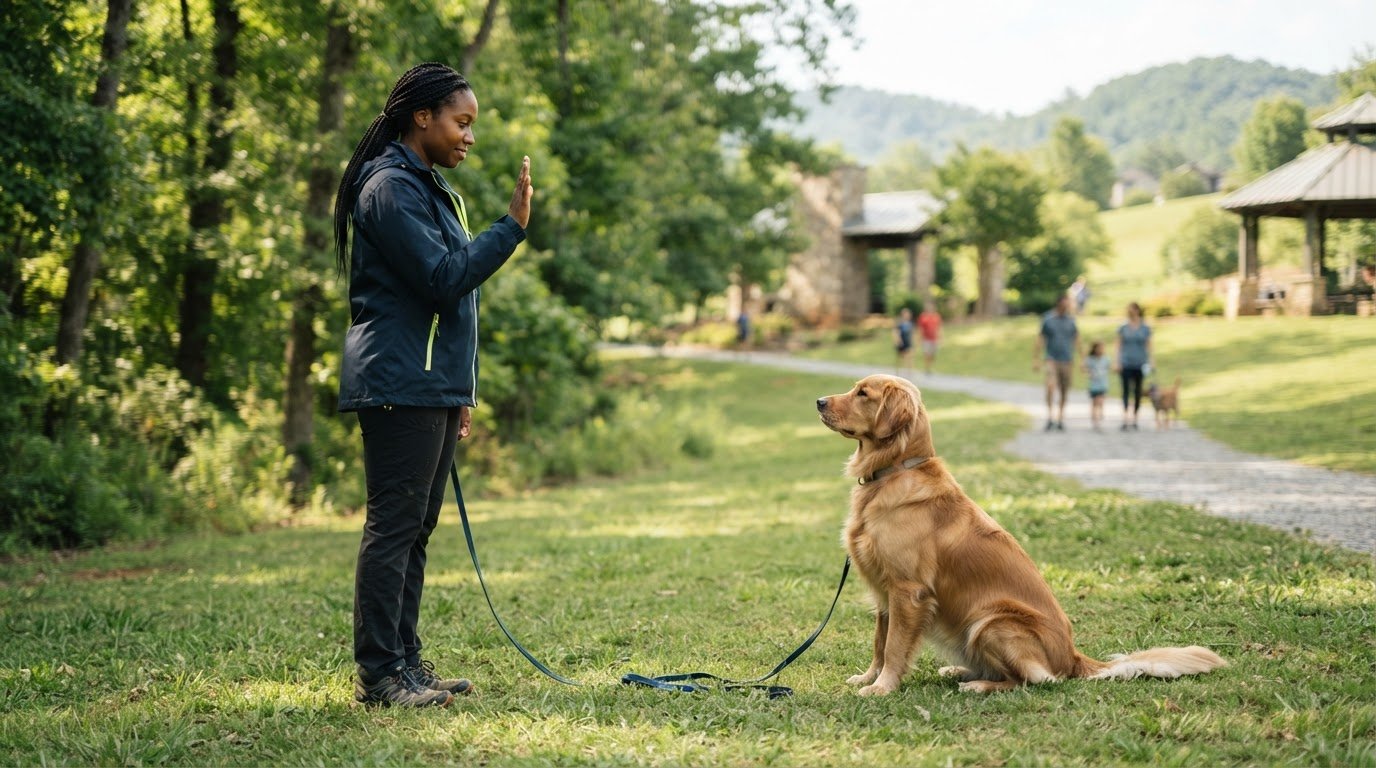
Advanced Dog Obedience Commands: How to Teach Reliable Real-World Skills
The real test of advanced dog obedience commands isn’t whether your dog responds in the living room. It’s whether the cue still works when a squirrel darts by or another dog appears. If practice seems solid at home but falls apart around distractions, the next step is not to repeat the cue louder. I...
%20(5).gif)
The real test of advanced dog obedience commands isn’t whether your dog responds in the living room. It’s whether the cue still works when a squirrel darts by or another dog appears. If practice seems solid at home but falls apart around distractions, the next step is not to repeat the cue louder. It’s to adjust the training setup and build the skill gradually. And if recall isn’t dependable yet, hesitation about off-leash practice makes sense.
Reliable skills grow over time. Your dog needs to understand each cue, then practice it across different distances, places, and distractions without being pushed too far too fast. This guide covers useful commands for everyday life and a repeatable plan for building consistency while keeping practice safe.
You’ll learn how to develop recall, a stay, and a distance cue, and how to increase the challenge one step at a time. You’ll also find guidance on when hands-on coaching can help you and your dog communicate more clearly. Alan’s K9 Academy offers personalized in-home training and group classes for families in Cartersville and the North Atlanta area, with training led by Master K9 Trainer Alan Carr, who has over 35 years of professional dog instruction experience.
Key Takeaways
• Reliability means your dog can respond as distance, duration, and distractions change, not just in one familiar setting.
• Teach advanced dog obedience commands with a clear cue, reward successful responses, and add difficulty gradually.
• Adjust distance, duration, and distractions one at a time to build skills while keeping practice manageable and safe.
• Use brief training notes to track where you practiced, what challenged your dog, and what to work on next.
• Choose commands that support your daily routines, and consider personalized coaching when you need help adapting practice to real-life situations.
What Makes an Advanced Dog Obedience Command Reliable?
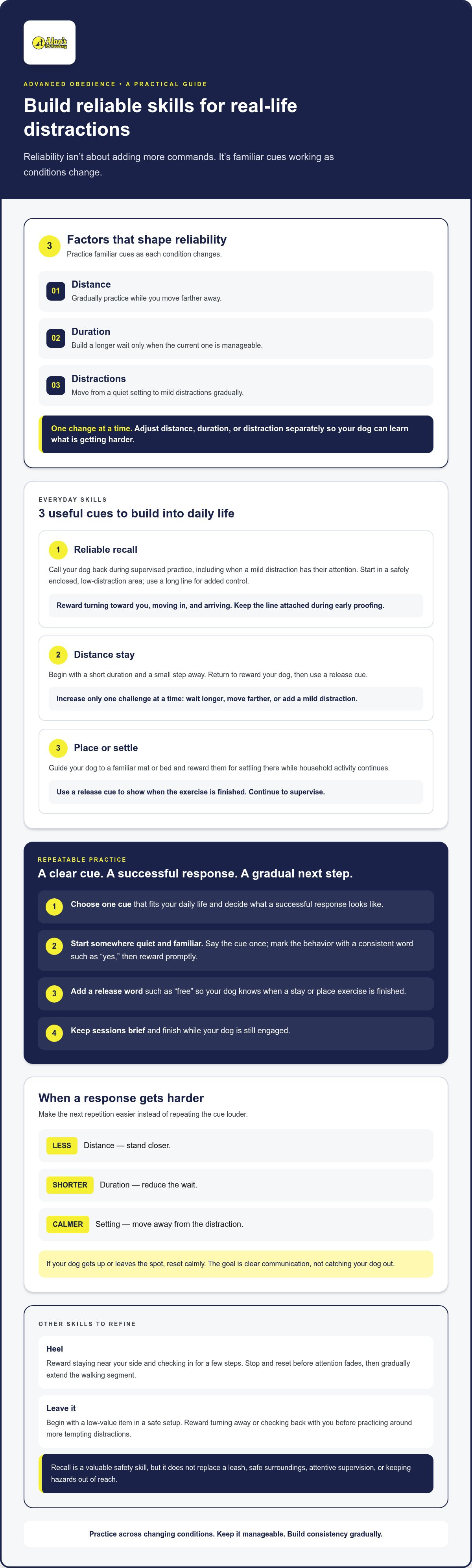
A dog who sits promptly in the kitchen has learned a useful cue. The next challenge is responding when you’re farther away, the dog has waited longer, or something interesting competes for attention. Advanced dog obedience commands aren’t defined by how many cues a dog knows. They’re defined by how consistently familiar skills work as distance, duration, and distractions change.
Advanced obedience is the reliable use of familiar cues across changing distances, durations, and distractions, not simply adding more commands. The command is the signal you give; reliability is the response your dog has practiced in different contexts. A polished performance at home may not transfer automatically to a park or sidewalk. Your dog may understand the cue in one setting but still need gradual practice to respond elsewhere. For a broader overview of dog training, including obedience and specialist training, see the general reference.
How are advanced commands different from basic cues?
The cue itself may be familiar. The challenge comes from asking for it under new conditions. For example, a dog who waits at a doorway while you stand beside them can gradually practice waiting as you take a step away. A recall that works in the yard can be practiced at a safe distance when your dog is mildly absorbed in sniffing. Success in one setting is a foundation, not proof that the behavior is ready for every situation.
Progress doesn’t require flawless responses everywhere. If your dog struggles, make the exercise easier by reducing distance, shortening the wait, or moving away from the distraction. This keeps practice achievable and helps you identify which part of the situation needs more work.
Which skills are useful in everyday life?
Choose skills that support your routines and safety needs. Three useful options are:
Reliable recall
Call your dog back to you during supervised practice, including when a mild distraction has caught their attention. Recall is a valuable safety skill, but it doesn’t replace a leash or attentive supervision.
Distance stay
Ask your dog to remain in position while you move a short distance away. This can help during everyday pauses, such as waiting while you open a gate.
Place or settle
Guide your dog to a familiar spot and encourage them to relax while household activity continues. This can support calmer routines, but you’ll still need to supervise and respond to what’s happening around your dog.
Your dog’s temperament, existing foundations, and daily life should shape which skill comes first. Personalized in-home training can connect practice to your actual environment and help strengthen communication between you and your dog.
How to Teach Advanced Dog Obedience Commands Step by Step
Build one skill at a time. Pick a cue that fits your daily life, decide what a successful response looks like, and practice first in a quiet, familiar place. Say the cue once, mark the behavior you want with a consistent word such as “yes,” then reward promptly. Add a clear release word, such as “free,” so your dog knows when a stay or place exercise is finished.
Progress by changing distance, duration, and distraction separately, so your dog can learn which part of the exercise is getting harder. Keep sessions brief and finish while your dog is still engaged. If responses become slower or your dog seems uncertain, make the next repetition easier rather than repeating the cue louder. Practical training grounded in learning principles is also explored by the IAABC Foundation Professional Dog Training course.
Teach a dependable recall and emergency stop
Start recall practice in a safely enclosed, low-distraction area, using a long line for added control. Say your chosen cue once, then reward your dog for turning toward you, moving in, and arriving. Make coming back worthwhile. Add mild distractions only after the response is developing. Keep the line attached during early proofing, and don’t use recall to end every enjoyable activity.
An emergency stop is a separate, more demanding skill. Introduce it only after your dog is developing solid foundation responses, starting close by in a quiet space. Reward stopping promptly, then build difficulty gradually. It’s a trained behavior, not a substitute for a leash, safe surroundings, or supervision.
Build a distance stay and place cue
For a stay, begin with a short duration and a small step away. Return to reward your dog, then use the release cue. Increase only one challenge at a time: hold the stay longer, move farther away, or add a mild distraction. Teach “place” similarly. Reward your dog for going to a defined mat or bed and settling there until released.
If your dog gets up or leaves the spot, reset calmly. Make the next repetition easier by standing closer, shortening the wait, or reducing activity nearby. The goal is clear communication, not catching your dog out.
Add precision with heel and leave it
For heel, reward your dog for staying near your side and checking in during a few steps. Stop and reset before attention fades, then gradually extend the walking segment. Teach “leave it” with a low-value item in a safe setup. Reward your dog for turning away or checking back with you before practicing around more tempting distractions.
Keep hazards out of reach rather than using them to test your dog’s limits. For help adapting practice to your home and routine, in-home dog training support can help you build a practical plan with your dog.
How to Proof Advanced Commands Without Sacrificing Safety
A cue that works in a quiet room may be harder to follow outside. Proofing means practicing a learned behavior in varied, controlled settings so your dog can respond as the context changes. With advanced dog obedience commands, make one part harder at a time. If your dog hesitates or stops responding, return to an easier setup and rebuild success rather than pushing through.
| Practice setting | What it may look like | How to adjust |
|---|---|---|
| Low distraction | A familiar room or securely enclosed area with little activity | Practice the cue nearby with a short wait or simple response. |
| Moderate distraction | A quiet yard or calm outdoor space with mild sights and sounds | Keep the same distance and duration while introducing one new distraction. |
| Busy environment | A supervised setting with more movement, sounds, or activity at a safe distance | Use an easier version of the cue, increase space from distractions, and keep your dog leashed. |
These are practice levels, not a schedule you have to follow. A setting that feels easy to one dog may be difficult for another.
What does proofing a command actually involve?
Think of distance, duration, and distraction as separate dials. For a stay, you might first step farther away while keeping the wait brief and the surroundings quiet. Later, return closer and extend the wait. Add a mild distraction only when that step feels manageable. Changing one variable at a time helps you identify what your dog understands and where the skill needs more practice.
Track what happens instead of relying on memory. Note the setting, the challenge you changed, whether your dog responded promptly or hesitated, and how quickly they recovered after a mistake. If responses weaken, calmly reset and make the next repetition easier. That’s useful information, not failure.
When is off-leash practice appropriate?
Use a leash or long line for recall practice while your dog is learning, and choose a secure area. A long line gives your dog room to move while helping you manage risk if they don’t return. Use an enclosed space for early practice, and avoid off-leash tests near traffic, wildlife, unfamiliar dogs, or other hazards.
Reliable cues never remove the need for supervision. Roads and unsafe surroundings remain dangerous, even for a dog with a strong recall. No command makes an unsuitable location safe. Build skill in controlled settings, and keep your dog leashed wherever the environment calls for it.
A Practical Training Plan for Advanced Dog Obedience
A simple plan helps you see what’s working and what needs adjustment. Start by checking that your dog understands the foundation cue in a familiar setting. Then choose one goal, such as holding a stay while you take a few steps away. Practice at an achievable level, review your dog’s response, and increase the challenge only when the current step is going well.
How should owners structure practice sessions?
Keep practice brief and focused. Work on one primary skill at a time, and stop before your dog becomes overwhelmed or disengaged. End with an easy cue your dog already knows, then finish on a positive response. As the behavior develops, revisit it in varied, controlled locations so your dog can learn to respond beyond one familiar room.
Keep a few notes after each session. Record the setting, the main distraction, what you changed, and how your dog responded. Include whether they answered promptly, hesitated, or needed the exercise made easier. This gives you a clearer picture than relying on a general impression that practice “went well.”
Assess
Can your dog respond to the foundation cue in an easy setting?
Choose
Pick one practical goal and define what success looks like.
Practice and review
Keep the setup manageable, then note the response.
Progress
Increase one challenge when your dog is ready, or simplify if the response weakens.
When should you simplify or seek hands-on guidance?
Repeated missed cues are a reason to adjust, not to keep asking. Check that you’re using the same cue each time, then reduce the distraction, shorten the wait, or move closer. If your dog loses focus, pause and reset in an easier spot. If the setup itself seems to be the problem, changing the location can make practice clearer.
| What you notice | Next step |
|---|---|
| Your dog responds comfortably and consistently | Continue at this level, then increase one challenge gradually. |
| Your dog hesitates or misses the cue repeatedly | Simplify the exercise and reward an achievable response. |
| Your dog disengages or the setting becomes difficult | Pause, reduce distractions, or move to a calmer practice area. |
| Safety concerns, complex behavior, or stalled progress | Consider personalized, hands-on guidance. |
For families in Cartersville and North Atlanta, explore personalized in-home dog training with Alan’s K9 Academy. Customized coaching helps adapt practice to your everyday environment and build clearer communication with your dog.
Make Advanced Obedience Work in Your Dog’s Everyday Life
The most useful next cue is the one that solves a real need in your routine. If your dog rushes toward the front door, practice a wait in a safe setup. If walks are difficult, focus on a calm response to your chosen cue while distractions are still manageable. A skill matters because it helps you and your dog communicate in situations you actually encounter, not because it sounds advanced.
Keep the cue consistent, practice in realistic but controlled settings, and notice how your dog responds. If a behavior falls apart in a new environment, adjust the practice rather than abandoning the goal. Advanced dog obedience commands become more useful as owners learn when to cue, how to support success, and when to make an exercise easier.
How can coaching adapt to a dog’s real environment?
Personalized in-home training can shape practice around household routines, space, and practical obedience goals. A trainer can help you decide where to practice and how to make a cue meaningful in your dog’s everyday environment. Group classes provide a structured setting to practice skills around other dogs, with owners actively participating and learning how to guide their dogs.
For challenges involving behavior as well as obedience, behavior modification can address the needs behind the difficulty and help tailor the training approach. The right focus depends on the dog, the household, and the owner’s priorities. Coaching supports communication and practical practice, while progress depends on the dog, the goal, and continued work together.
What should owners do next?
Choose one priority cue and name the situation where you need it most. Decide what a manageable first step looks like, then practice in a safe setting with limited distractions. Note what helps your dog respond and what makes the exercise harder. Build from there at a pace that keeps both of you engaged.
If you’re in Cartersville, Bartow County, or the North Atlanta Metro area and would value hands-on guidance, Alan’s K9 Academy offers personalized in-home training, behavior modification, and group classes. Discuss your dog’s training needs and explore a customized way to make practice fit your everyday life.
Build Skills That Travel Beyond the Living Room
Advanced dog obedience commands become meaningful when your dog can respond in everyday situations, not just during familiar practice. Choose cues that fit your routine, keep signals consistent, and build reliability gradually by adjusting distance, duration, or distractions one step at a time. Track your dog’s response, simplify when needed, and keep safety and supervision at the center of every session.
Progress is a partnership. Your understanding of when to practice, reward, or make an exercise easier matters just as much as the cue itself. Alan’s K9 Academy offers personalized in-home training and structured group classes for families in Cartersville and the North Atlanta Metro area. Master K9 Trainer Alan Carr brings over 35 years of professional dog instruction experience to helping owners build clearer communication and practical obedience.
Explore personalized dog training with Alan’s K9 Academy to get hands-on guidance tailored to your dog and home. With a thoughtful plan and steady practice, you and your dog can keep building skills that support a more confident life together.
Frequently Asked Questions
What are advanced dog obedience commands?
Advanced dog obedience commands are familiar cues practiced with greater distance, duration, or distraction. Examples include recall, a distance stay, heel, place, and “leave it.” A cue isn’t advanced just because it sounds impressive. What matters is whether your dog can respond appropriately in situations that matter to you. Build each skill gradually, adjust the challenge when your dog struggles, and keep safety central during practice.
How do I teach my dog to come when called around distractions?
Start in a secure, low-distraction area and reward your dog for turning toward you, moving to you, and arriving close. When you add mild distractions, use a long line to help manage risk. If your dog repeatedly disengages, make the setup easier before trying again. Gradually vary distance and surroundings as your dog progresses. Don’t test recall off leash near roads or other hazards, even if earlier practice has gone well.
Can older dogs learn advanced obedience commands?
Yes, adult and senior dogs can learn new cues, though the pace and practice setup should suit the individual dog. Use clear, manageable steps and consider your dog’s comfort, attention, and previous learning. Reward progress rather than expecting immediate performance. If your dog’s behavior changes suddenly or movement appears uncomfortable, consult a veterinarian before increasing training demands. Training can then be adapted to your dog’s needs and abilities.
How long does it take to teach advanced commands to a dog?
There’s no single timeline for teaching advanced commands. Progress depends on your dog’s foundation, the difficulty of the setting, your consistency, and how gradually you increase the challenge. Look for growing understanding across different practice situations rather than aiming for a fixed deadline. If your dog’s responses weaken, simplify the exercise and rebuild success before adding another challenge. Steady, repeatable practice is more useful than rushing to the next step.
Is it safe to practice advanced commands off leash?
Knowing advanced cues doesn’t automatically make off-leash practice safe. Begin in a secure area and build skills gradually. A long line can help you manage recall practice while maintaining control. Avoid off-leash tests near roads, unfamiliar animals, or other hazards. Continue supervising your dog, and follow applicable local leash rules. Even a well-practiced cue can’t remove environmental risks or make an unsafe location safe.
What should I do if my dog ignores a familiar command?
Don’t repeat the cue more loudly or increase the difficulty right away. Consider whether the setting is too distracting, the cue has become inconsistent, or your dog hasn’t practiced at that level yet. Return to an easier setup, give the cue clearly, and reward a correct response. Then build difficulty gradually. If the issue involves safety, complex behavior, or stalled progress, personalized guidance can help you plan the next steps.
Can professional dog training help with advanced commands?
Professional coaching can help you refine timing, choose manageable practice steps, and apply cues to your everyday routine. Alan’s K9 Academy offers personalized in-home training and structured group classes in Cartersville, Canton, Woodstock, Marietta, Rome, Acworth, Kennesaw, Sandy Springs, Roswell, Alpharetta, Powder Springs, Dallas, Hiram, Jasper, Cumming, Holly Springs, Ball Ground, and Milton. Training emphasizes owner-dog communication and practical practice, with progress shaped by the dog, the goal, and continued work together.